Recognition: unknown
Charging Quantum Batteries via Dissipative Quenches
Pith reviewed 2026-05-10 16:54 UTC · model grok-4.3
The pith
Purely dissipative dynamics generate finite ergotropy from passive thermal states in XX spin-chain batteries.
A machine-rendered reading of the paper's core claim, the machinery that carries it, and where it could break.
Core claim
Purely dissipative dynamics activate finite ergotropy from completely passive thermal states, giving rise to temperature-dependent transient regimes where hotter initial states temporarily outperform colder ones in an ergotropic Mpemba-like fashion; collective dissipation produces steady states whose passivity depends on initial temperature and system size due to non-trivial dark subspaces.
What carries the argument
Continuous interpolation between parallel (local) and collective dissipative channels weakly coupled to the XX Hamiltonian.
If this is right
- Finite ergotropy appears during transients even when the initial thermal state has zero ergotropy.
- Hotter initial temperatures produce higher transient ergotropy under intermediate noise interpolation.
- Collective dissipation yields non-passive steady states whose ergotropy grows with system size.
- Dephasing channels remove both the transient advantage and any steady-state work extraction.
Where Pith is reading between the lines
- Engineered baths could charge quantum batteries without coherent control pulses.
- The dark subspaces identified here may protect steady-state coherence for quantum information tasks.
- Similar Mpemba-like transients might appear in larger spin networks or different interaction Hamiltonians.
- The interpolation parameter offers a tunable knob for experimental tests in superconducting circuits.
Load-bearing premise
The spin chains remain weakly coupled to environments whose noise can be tuned continuously between local and collective forms, and the initial states are thermal Gibbs states.
What would settle it
Observation that the steady-state ergotropy under collective dissipation is independent of initial temperature or system size, or that hotter thermal states never transiently exceed colder ones in ergotropy.
Figures




read the original abstract
We investigate work extraction in open quantum batteries composed of interacting spin chains weakly coupled to engineered environments. Focusing on two- and four-qubit XX models initially prepared in thermal Gibbs states, we analyze how dissipation and dephasing, acting either locally or collectively, can generate and shape ergotropy during both transient and steady-state dynamics. By introducing a continuous interpolation between parallel and collective noise channels, we systematically characterize the impact of environmental structure on work extractability. We show that purely dissipative dynamics can activate finite ergotropy from completely passive thermal states, giving rise to temperature-dependent transient regimes where hotter initial states temporarily outperform colder ones in an ergotropic Mpemba-like fashion. In contrast, collective dissipation leads to steady states whose passivity crucially depends on the initial temperature and system size, a behavior we trace back to the emergence of non-trivial dark subspaces. Finally, we demonstrate that dephasing channels suppress both transient advantages and steady-state work extraction, highlighting the qualitative difference between dissipative and dephasing environments.
Editorial analysis
A structured set of objections, weighed in public.
Referee Report
Summary. The paper investigates work extraction from open quantum batteries consisting of two- and four-qubit XX spin chains prepared in thermal Gibbs states and weakly coupled to engineered environments. It shows that purely dissipative dynamics, via a continuous interpolation between parallel and collective noise channels, can generate finite ergotropy from initially passive states. This includes transient temperature-dependent regimes exhibiting an ergotropic Mpemba-like effect (hotter initial states temporarily outperforming colder ones) and, under collective dissipation, steady states whose passivity depends on initial temperature and system size due to non-trivial dark subspaces. Dephasing channels are shown to suppress both transient and steady-state advantages.
Significance. If the results hold, the work demonstrates a mechanism for charging quantum batteries using only dissipation without coherent driving, while identifying an ergotropic analog of the Mpemba effect and clarifying the role of dark subspaces in collective environments. The systematic channel interpolation and focus on small spin chains provide concrete, testable predictions for quantum thermodynamics and could guide experimental implementations in platforms such as trapped ions or superconducting qubits.
major comments (2)
- [§3] §3 (transient dynamics): The Mpemba-like inversion is reported for specific temperature pairs, but the manuscript does not quantify the sensitivity of the crossover time to the interpolation parameter λ between parallel and collective channels; a small variation in λ could shift or eliminate the effect, which is central to the claim of environmental-structure control.
- [§4] §4 (steady-state analysis): The dependence of steady-state passivity on initial temperature for the four-qubit case is attributed to dark subspaces, yet no explicit projector or eigenvalue spectrum of the steady-state density matrix is provided; without this, it is difficult to confirm that the passivity is not an artifact of the weak-coupling or secular approximations used in the Lindblad derivation.
minor comments (3)
- The abstract and introduction use the term 'ergotropic Mpemba-like fashion' without a brief definition or reference to the standard Mpemba effect in the first paragraph; adding one sentence would improve accessibility.
- Figure captions for the ergotropy-vs-time plots should explicitly state the values of the interpolation parameter λ, the coupling strength γ, and the temperature range T used in each panel.
- [§2] The Lindblad operators for the interpolated channels are defined in §2, but the normalization condition ensuring trace preservation for all λ is not written explicitly; including it would remove ambiguity.
Simulated Author's Rebuttal
We thank the referee for the positive evaluation and the recommendation for minor revision. The comments are constructive and help strengthen the presentation of our results on dissipative charging of quantum batteries. We address each major comment below.
read point-by-point responses
-
Referee: [§3] §3 (transient dynamics): The Mpemba-like inversion is reported for specific temperature pairs, but the manuscript does not quantify the sensitivity of the crossover time to the interpolation parameter λ between parallel and collective channels; a small variation in λ could shift or eliminate the effect, which is central to the claim of environmental-structure control.
Authors: We agree that quantifying the dependence of the crossover time on λ would better support the claim of environmental-structure control. In the revised manuscript we will add a new panel (or supplementary figure) in Section 3 that plots the crossover time versus λ for the temperature pairs already considered. This will explicitly show the range of λ over which the ergotropic Mpemba-like inversion persists, thereby addressing the sensitivity concern without altering the main conclusions. revision: yes
-
Referee: [§4] §4 (steady-state analysis): The dependence of steady-state passivity on initial temperature for the four-qubit case is attributed to dark subspaces, yet no explicit projector or eigenvalue spectrum of the steady-state density matrix is provided; without this, it is difficult to confirm that the passivity is not an artifact of the weak-coupling or secular approximations used in the Lindblad derivation.
Authors: We thank the referee for this observation. To remove any ambiguity regarding the origin of the temperature-dependent passivity, the revised manuscript will include the explicit projector onto the dark subspace for the four-qubit collective channel, together with the eigenvalue spectrum of the steady-state density matrix for representative initial temperatures. These additions (placed in Section 4 and an appendix) will demonstrate that the non-trivial steady-state populations arise directly from the dark-subspace structure and are robust under the employed approximations. revision: yes
Circularity Check
No significant circularity; derivation self-contained in standard Lindblad dynamics
full rationale
The paper's claims rest on direct application of the Lindblad master equation to small XX spin chains initialized in thermal Gibbs states, with an interpolation between parallel and collective dissipators. No equations, parameters, or results are defined in terms of themselves or prior self-citations in a load-bearing way; ergotropy emergence and transient temperature inversion follow from the non-commuting structure of the jump operators and dark subspaces without any reduction to fitted inputs or renamed ansatze. The modeling uses standard open-quantum-system tools that are externally verifiable and independent of the target phenomena.
Axiom & Free-Parameter Ledger
axioms (2)
- domain assumption Weak-coupling limit allowing a Markovian master equation description
- domain assumption Initial states are thermal Gibbs states of the closed XX Hamiltonian
Reference graph
Works this paper leans on
-
[1]
10 we fix α = 0 in Eq
Dissipative case In Fig. 10 we fix α = 0 in Eq. (15) and we plot the ergotropy of the steady state varying α(−), which repre- sents the degree of collectivity of the channels, and the inverse temperature β. For α(−) = 0 and α(−) = 1 we recover the results already discussed in Sec. III A of the main text. For intermediate values of α(−) we observe two diff...
-
[2]
(15) and we plot in Fig
Dephasing case We now fix α = 1 in Eq. (15) and we plot in Fig. 11 the ergotropy of the steady state varying α(z) and β. Confirming what already observed in Sec. IV, for the full dephasing scenario the differences between the two- qubit, panel (a), and four-qubit chain, panel (b), are less pronounced. (a) (b) Figure 11: Ergotropy E of the system’s steady ...
-
[3]
For each sce- nario we report the behavior of the lowest and highest values of β we fixed in the main text
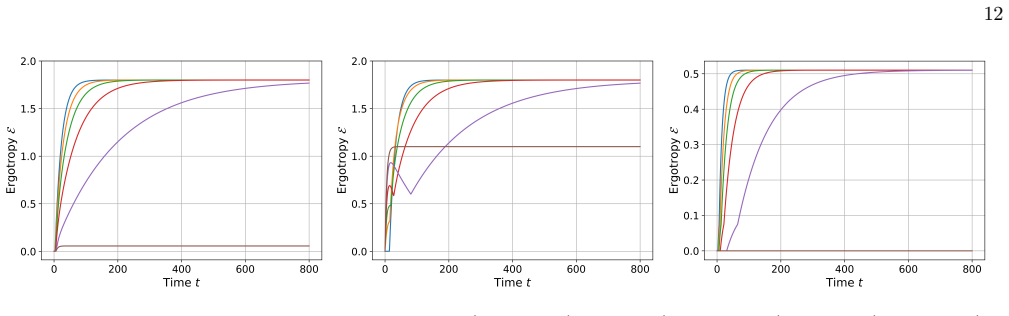
Channels interpolation We finally fix both α(−) and α(z) to either 0 (fully parallel) or 1 (fully collective) and we interpolate α as- signing a different weight on each channel. For each sce- nario we report the behavior of the lowest and highest values of β we fixed in the main text. The results are shown in the three panels of Fig. 12 (note that the fu...
-
[4]
Alicki and M
R. Alicki and M. Fannes, Phys. Rev. E 87, 042123 (2013), URL https://link.aps.org/doi/10. 1103/PhysRevE.87.042123
2013
-
[5]
S. Bhattacharjee and A. Dutta, The European Physical Journal B 94, 239 (2021), ISSN 1434-6036, URL https: //doi.org/10.1140/epjb/s10051-021-00235-3
-
[6]
Quach, G
J. Quach, G. Cerullo, and T. Virgili, Joule 7, 2195 (2023), ISSN 2542-4351, URL https://www.sciencedirect. com/science/article/pii/S2542435123003641
2023
-
[7]
Campaioli, S
F. Campaioli, S. Gherardini, J. Q. Quach, M. Polini, and G. M. Andolina, Rev. Mod. Phys. 96, 031001 (2024), URL https://link.aps.org/doi/10.1103/ RevModPhys.96.031001
2024
-
[8]
A. Camposeo, T. Virgili, F. Lombardi, G. Cerullo, D. Pisignano, and M. Polini, Advanced Materi- als 37, 2415073 (2025), URL https://advanced. onlinelibrary.wiley.com/doi/abs/10.1002/adma. 202415073
-
[9]
Ferraro, F
D. Ferraro, F. Cavaliere, M. G. Genoni, G. Be- nenti, and M. Sassetti, Nature Reviews Physics 8, 115 (2026), ISSN 2522-5820, URL https://doi.org/10. 1038/s42254-025-00906-5
2026
-
[10]
G. Chiribella, Y. Yang, and R. Renner, Phys. Rev. X 11, 021014 (2021), URL https://link.aps.org/doi/ 10.1103/PhysRevX.11.021014
-
[11]
Y. Kurman, K. Hymas, A. Fedorov, W. J. Munro, and J. Quach, Phys. Rev. X 16, 011016 (2026), URL https: //link.aps.org/doi/10.1103/l39v-jwwz
-
[12]
F. Cioni, R. Menta, R. Aiudi, M. Polini, and V. Gio- vannetti, Phys. Rev. A 113, 012439 (2026), URL https: //link.aps.org/doi/10.1103/6zzp-ctyx
-
[13]
T. P. Le, J. Levinsen, K. Modi, M. M. Parish, and F. A. Pollock, Phys. Rev. A 97, 022106 (2018), URL https: //link.aps.org/doi/10.1103/PhysRevA.97.022106
-
[14]
D. Rossini, G. M. Andolina, and M. Polini, Phys. Rev. B 100, 115142 (2019), URL https://link.aps.org/doi/ 10.1103/PhysRevB.100.115142
-
[15]
Catalano, S
A. Catalano, S. Giampaolo, O. Morsch, V. Gio- vannetti, and F. Franchini, PRX Quantum 5, 030319 (2024), URL https://link.aps.org/doi/10. 1103/PRXQuantum.5.030319
2024
-
[16]
Grazi, D
R. Grazi, D. Sacco Shaikh, M. Sassetti, N. Traverso Ziani, and D. Ferraro, Phys. Rev. Lett. 133, 197001 (2024)
2024
-
[17]
Grazi, F
R. Grazi, F. Cavaliere, M. Sassetti, D. Ferraro, and N. Traverso Ziani, Chaos, Solitons & Frac- tals 196, 116383 (2025), ISSN 0960-0779, URL https://www.sciencedirect.com/science/article/ pii/S0960077925003960
2025
-
[18]
D. Farina, M. Sassetti, V. Cataudella, D. Ferraro, and N. T. Ziani, arXiv preprint arXiv:2603.02819 (2026), URL https://doi.org/10.48550/arXiv.2603.02819
-
[19]
G. M. Andolina, D. Farina, A. Mari, V. Pellegrini, V. Giovannetti, and M. Polini, Phys. Rev. B 98, 205423 (2018)
2018
-
[20]
K. V. Hovhannisyan, F. Barra, and A. Imparato, Phys. Rev. Res. 2, 033413 (2020), URL https://link.aps. org/doi/10.1103/PhysRevResearch.2.033413
-
[21]
Cavaliere, G
F. Cavaliere, G. Gemme, G. Benenti, D. Ferraro, and M. Sassetti, Commun. Phys. 8, 76 (2025)
2025
-
[22]
G. M. Andolina, V. Stanzione, V. Giovannetti, and M. Polini, Phys. Rev. Lett. 134, 240403 (2025), URL https://link.aps.org/doi/10.1103/kzvn-dj7v
-
[23]
F. Cavaliere, D. Ferraro, M. Carrega, G. Benenti, and M. Sassetti, Quantum advantage bounds for a multipar- tite gaussian battery (2025), 2510.24162, URL https: //arxiv.org/abs/2510.24162
-
[24]
Ferraro, M
D. Ferraro, M. Campisi, G. M. Andolina, V. Pellegrini, and M. Polini, Phys. Rev. Lett. 120, 117702 (2018)
2018
-
[25]
A. Crescente, M. Carrega, M. Sassetti, and D. Ferraro, Phys. Rev. B 102, 245407 (2020), URL https://link. aps.org/doi/10.1103/PhysRevB.102.245407
-
[26]
J. Carrasco, J. R. Maze, C. Hermann-Avigliano, and F. Barra, Phys. Rev. E 105, 064119 (2022), URL https: //link.aps.org/doi/10.1103/PhysRevE.105.064119
-
[27]
Gemme, G
G. Gemme, G. M. Andolina, F. M. D. Pellegrino, M. Sas- setti, and D. Ferraro, Batteries9 (2023), ISSN 2313-0105, URL https://www.mdpi.com/2313-0105/9/4/197
2023
-
[28]
Dou and F.-M
F.-Q. Dou and F.-M. Yang, Phys. Rev. A 107, 023725 (2023), URL https://link.aps.org/doi/10. 1103/PhysRevA.107.023725
2023
-
[29]
D. Rinaldi, R. Filip, D. Gerace, and G. Guarnieri, Phys. Rev. A 112, 012205 (2025), URL https://link.aps. org/doi/10.1103/6kwv-z6fx
-
[30]
C. Rodr´ ıguez, D. Rosa, and J. Olle, Phys. Rev. A 108, 042618 (2023), URL https://link.aps.org/doi/ 10.1103/PhysRevA.108.042618
-
[32]
A. Canzio, V. Cavina, M. Polini, and V. Giovannetti, Phys. Rev. A 111, 022222 (2025), URL https://link. aps.org/doi/10.1103/PhysRevA.111.022222
-
[33]
Massa, F
N. Massa, F. Cavaliere, and D. Ferraro, Batteries 11, 240 (2025)
2025
-
[34]
Quach, K
J. Quach, K. E. McGhee, L. Ganzer, D. M. Rouse, B. W. Lovett, E. M. Gauger, J. Keeling, G. Cerullo, D. Lidzey, and T. Virgili, Sci. Adv. 8, eabk3160 (2022)
2022
-
[35]
C. Hu, J. Qiu, P. J. P. Souza, J. Yuan, Y. Zhou, L. Zhang, J. Chu, X. Pan, L. Hu, J. Li, et al., Quantum Sci. Tech- nol. 7, 045018 (2022)
2022
-
[36]
Gemme, M
G. Gemme, M. Grossi, S. Vallecorsa, M. Sas- setti, and D. Ferraro, Phys. Rev. Res. 6, 023091 (2024), URL https://link.aps.org/doi/10.1103/ PhysRevResearch.6.023091
2024
-
[37]
Joshi and T
J. Joshi and T. S. Mahesh, Phys. Rev. A 106, 042601 (2022), URL https://link.aps.org/doi/10. 1103/PhysRevA.106.042601
2022
-
[38]
C. Cruz, M. F. Anka, M. S. Reis, R. Bachelard, and A. C. Santos, Quantum Science and Technol- ogy 7, 025020 (2022), URL https://doi.org/10.1088/ 2058-9565/ac57f3
2022
-
[39]
D. J. Tibben, E. Della Gaspera, J. van Embden, P. Rei- neck, J. Q. Quach, F. Campaioli, and D. E. G´ omez, PRX Energy 4, 023012 (2025), URL https://link.aps.org/ doi/10.1103/bhyh-53np
-
[40]
K. Hymas, J. B. Muir, D. Tibben, J. van Embden, T. Hirai, C. J. Dunn, D. E. G´ omez, J. A. Hutchison, T. A. Smith, and J. Q. Quach, Light: Science & Ap- plications 15, 168 (2026), ISSN 2047-7538, URL https: //doi.org/10.1038/s41377-026-02240-6
-
[41]
F. C. Binder, S. Vinjanampathy, K. Modi, and J. Goold, 14 New Journal of Physics 17, 075015 (2015), URL https: //doi.org/10.1088/1367-2630/17/7/075015
-
[42]
F. Campaioli, F. A. Pollock, F. C. Binder, L. C´ eleri, J. Goold, S. Vinjanampathy, and K. Modi, Phys. Rev. Lett. 118, 150601 (2017), URL https://link.aps.org/ doi/10.1103/PhysRevLett.118.150601
-
[43]
D. Farina, G. M. Andolina, A. Mari, M. Polini, and V. Giovannetti, Phys. Rev. B 99, 035421 (2019), URL https://link.aps.org/doi/10.1103/PhysRevB. 99.035421
-
[44]
Pirmoradian and K
F. Pirmoradian and K. Mølmer, Phys. Rev. A 100, 043833 (2019), URL https://link.aps.org/doi/10. 1103/PhysRevA.100.043833
2019
-
[45]
S. Zakavati, F. T. Tabesh, and S. Salimi, Phys. Rev. E 104, 054117 (2021), URL https://link.aps.org/doi/ 10.1103/PhysRevE.104.054117
-
[46]
D. Morrone, M. A. C. Rossi, A. Smirne, and M. G. Genoni, Quantum Science and Technology 8, 035007 (2023), URL https://doi.org/10.1088/2058-9565/ accca4
- [47]
-
[48]
doi: 10.1093/acprof:oso/9780199563029
H.-P. Breuer and F. Petruccione, The Theory of Open Quantum Systems (Oxford University Press, 2007), ISBN 9780199213900, URL https://doi.org/10.1093/ acprof:oso/9780199213900.001.0001
-
[49]
New Journal of Physics , abstract =
˜A. Rivas, A. D. K Plato, S. F. Huelga, and M. B Plenio, New Journal of Physics 12, 113032 (2010), URL https: //doi.org/10.1088/1367-2630/12/11/113032
-
[50]
P. P. Hofer, M. Perarnau-Llobet, L. D. M. Miranda, G. Haack, R. Silva, J. B. Brask, and N. Brunner, New Journal of Physics 19, 123037 (2017), URL https:// doi.org/10.1088/1367-2630/aa964f
-
[51]
M. Cattaneo, G. L. Giorgi, S. Maniscalco, and R. Zam- brini, New Journal of Physics 21, 113045 (2019), URL https://doi.org/10.1088/1367-2630/ab54ac
-
[52]
D. Farina, G. De Filippis, V. Cataudella, M. Polini, and V. Giovannetti, Phys. Rev. A 102, 052208 (2020), URL https://link.aps.org/doi/10.1103/PhysRevA. 102.052208
-
[54]
F. T. Tabesh, F. H. Kamin, and S. Salimi, Phys. Rev. A 102, 052223 (2020), URL https://link.aps.org/doi/ 10.1103/PhysRevA.102.052223
-
[55]
B. i. e. i. f. m. c. C ¸ akmak, Phys. Rev. E 102, 042111 (2020), URL https://link.aps.org/doi/10. 1103/PhysRevE.102.042111
2020
-
[56]
S. Ghosh, T. Chanda, S. Mal, and A. Sen(De), Phys. Rev. A 104, 032207 (2021), URL https://link.aps. org/doi/10.1103/PhysRevA.104.032207
-
[57]
Feliu and F
D. Feliu and F. Barra, Quantum Science and Technol- ogy 9, 035043 (2024), URL https://doi.org/10.1088/ 2058-9565/ad4d1a
2024
-
[58]
G. Bhanja, D. Tiwari, and S. Banerjee, Phys. Rev. A 109, 012224 (2024), URL https://link.aps.org/doi/ 10.1103/PhysRevA.109.012224
-
[59]
B. Ahmadi, P. Mazurek, P. Horodecki, and S. Barzan- jeh, Phys. Rev. Lett. 132, 210402 (2024), URL https:// link.aps.org/doi/10.1103/PhysRevLett.132.210402
-
[60]
J. M. Z. Choquehuanca, P. A. C. Obando, F. M. de Paula, and M. S. Sarandy, Phys. Rev. A 109, 052219 (2024), URL https://link.aps.org/doi/10. 1103/PhysRevA.109.052219
2024
-
[61]
Ahmadi, P
B. Ahmadi, P. Mazurek, S. Barzanjeh, and P. Horodecki, Phys. Rev. Appl. 23, 024010 (2025)
2025
-
[62]
Oularabi, A
A. Oularabi, A. El Allati, and K. El Anouz, Physica A: Statistical Mechanics and its Applica- tions 679, 131003 (2025), ISSN 0378-4371, URL https://www.sciencedirect.com/science/article/ pii/S0378437125006557
2025
-
[63]
A. E. Allahverdyan, R. Balian, and T. M. Nieuwenhuizen, Europhysics Letters 67, 565 (2004), URL https://doi. org/10.1209/epl/i2004-10101-2
-
[64]
Hadipour and S
M. Hadipour and S. Haseli, Scientific Reports 15, 31740 (2025), ISSN 2045-2322, URL https://doi.org/10. 1038/s41598-025-17601-1
2025
-
[65]
W. Pusz and S. L. Woronowicz, Communications in Mathematical Physics 58, 273 (1978), ISSN 1432-0916, URL https://doi.org/10.1007/BF01614224
-
[66]
I. Medina, O. Culhane, F. C. Binder, G. T. Landi, and J. Goold, Phys. Rev. Lett. 134, 220402 (2025), URL https://link.aps.org/doi/10.1103/PhysRevLett. 134.220402
-
[67]
Ergotropic mpemba crossings in finite-dimensional quantum batter- ies,
T. Sapui, T. K. Konar, and A. S. De, arXiv preprint arXiv:2602.11056 (2026), URL https://doi.org/10. 48550/arXiv.2602.11056
-
[68]
J. Guo, O. Hart, C.-F. Chen, A. J. Friedman, and A. Lu- cas, Quantum 9, 1612 (2025), ISSN 2521-327X, URL https://doi.org/10.22331/q-2025-01-28-1612
-
[69]
L. Razzoli, G. Gemme, I. Khomchenko, M. Sassetti, H. Ouerdane, D. Ferraro, and G. Benenti, Quantum Sci- ence and Technology 10, 015064 (2025), URL https: //doi.org/10.1088/2058-9565/ad9ed4
-
[70]
W. P. Schleich, Quantum optics in phase space (John Wiley & Sons, 2015), URL https://onlinelibrary. wiley.com/doi/book/10.1002/3527602976?msockid= 2643d0851f7668cf08adc4fb1b766af1
-
[71]
P. Kirton, M. M. Roses, J. Keeling, and E. G. Dalla Torre, Advanced Quan- tum Technologies 2, 1800043 (2019), https://advanced.onlinelibrary.wiley.com/doi/pdf/10.1002/qute.201800043, URL https://advanced.onlinelibrary.wiley.com/ doi/abs/10.1002/qute.201800043
-
[72]
Y. Li, W. Li, and X. Li, Phys. Rev. A112, 032209 (2025), URL https://link.aps.org/doi/10.1103/5xrr-x2rm
-
[73]
G. Teza, J. Bechhoefer, A. Lasanta, O. Raz, and M. Vucelja, Physics Reports1164, 1 (2026), URL https: //doi.org/10.1016/j.physrep.2025.10.009
-
[74]
J. Q. Quach and W. J. Munro, Phys. Rev. Appl. 14, 024092 (2020), URL https://link.aps.org/doi/10. 1103/PhysRevApplied.14.024092
2020
-
[75]
M. Scala, B. Militello, A. Messina, J. Piilo, and S. Man- iscalco, Phys. Rev. A 75, 013811 (2007), URL https: //link.aps.org/doi/10.1103/PhysRevA.75.013811
discussion (0)
Sign in with ORCID, Apple, or X to comment. Anyone can read and Pith papers without signing in.