Recognition: unknown
Thermodynamics and orbital structure of anti-de Sitter black holes in Palatini-inspired nonlinear electrodynamics
Pith reviewed 2026-05-10 17:13 UTC · model grok-4.3
The pith
A Palatini-inspired nonlinear electrodynamics model yields a consistent anti-de Sitter black hole whose electromagnetic solution keeps its original parametric form while the metric gains the standard cosmological term.
A machine-rendered reading of the paper's core claim, the machinery that carries it, and where it could break.
Core claim
Starting from the Einstein-Hilbert action with a negative cosmological constant and the first-order PINLED sector, the nonlinear electromagnetic solution preserves its original parametric structure, while the lapse function acquires the standard AdS contribution. This furnishes the exact AdS extension of the asymptotically flat PINLED black hole.
What carries the argument
The first-order Palatini-inspired nonlinear electrodynamics Y^n sector, solved independently of the metric and then inserted into the Einstein equations with negative cosmological constant.
If this is right
- The lapse function is the flat-space PINLED lapse plus the standard -r^2/L^2 AdS term, so horizon radii are shifted but retain the same qualitative structure.
- Hawking temperature and extended phase-space thermodynamics produce an equation of state whose critical points can be compared with the flat-space case.
- Null geodesics admit a photon sphere whose radius and the associated shadow radius for a static observer at finite distance are computable from the effective potential.
- Timelike geodesics yield an innermost stable circular orbit whose location follows from the second derivative of the effective potential.
- The resulting geometry supplies an exact background for numerical studies of thermodynamic stability and optical properties.
Where Pith is reading between the lines
- Because the electromagnetic parameters remain fixed, thermodynamic quantities such as heat capacity may display the same functional dependence on mass and charge as in the asymptotically flat case, only shifted by AdS corrections.
- The photon-sphere and shadow calculations provide a clean benchmark for comparing nonlinear-electrodynamics effects against the Reissner-Nordström-AdS case in the same coordinate system.
- The preserved parametric structure suggests that any holographic dual interpretation, if pursued, would involve the same boundary gauge theory data as the flat-space model but with a different bulk geometry.
Load-bearing premise
The nonlinear electromagnetic sector can be solved on its own and then placed into the metric ansatz without the cosmological constant term altering the electromagnetic field's parametric structure.
What would settle it
An explicit integration of the electromagnetic field equations in the presence of the negative cosmological constant that yields a different radial dependence for the field strength or potential than the flat-space PINLED solution.
Figures






read the original abstract
We construct a consistent anti-de Sitter completion of the static and spherically symmetric black-hole solution sourced by the Palatini-inspired nonlinear electrodynamics \(Y^n\) model. Starting from the Einstein--Hilbert action with a negative cosmological constant and the first-order PINLED sector, we derive the full set of field equations and show that the nonlinear electromagnetic solution preserves its original parametric structure, while the lapse function acquires the standard AdS contribution. We then analyze the horizon structure, Hawking temperature, extended phase-space thermodynamics, and the associated equation of state. In addition, we investigate null and timelike geodesics, with emphasis on the effective potentials, photon sphere, shadow radius for a static observer at finite distance, and innermost stable circular orbit. The resulting framework furnishes the exact AdS extension of the asymptotically flat PINLED black hole and provides a coherent basis for numerical and phenomenological studies of its thermodynamic, optical, and orbital properties.
Editorial analysis
A structured set of objections, weighed in public.
Referee Report
Summary. The manuscript constructs a consistent anti-de Sitter completion of the static spherically symmetric black-hole solution sourced by the Palatini-inspired nonlinear electrodynamics Y^n model. Starting from the Einstein-Hilbert action with negative cosmological constant and the first-order PINLED sector, the authors derive the full set of field equations and claim that the nonlinear electromagnetic solution preserves its original parametric structure (with the same dependence on charge and the parameter n), while the lapse function acquires the standard AdS contribution. The paper then analyzes the horizon structure, Hawking temperature, extended phase-space thermodynamics and equation of state, followed by null and timelike geodesics with emphasis on effective potentials, photon sphere, shadow radius for a static observer at finite distance, and the innermost stable circular orbit.
Significance. If the central claim of parametric preservation holds under the coupled first-order system, the work supplies an exact AdS extension of the known asymptotically flat PINLED black holes. This furnishes a coherent framework for thermodynamic studies in extended phase space and for orbital/optical properties (photon spheres, shadows, ISCOs) that are directly relevant to AdS/CFT applications and black-hole phenomenology. The explicit treatment of both thermodynamic and geodesic sectors strengthens the utility for numerical follow-up work.
major comments (1)
- [Abstract / field-equation derivation] Abstract and the derivation of the field equations: the load-bearing claim that 'the nonlinear electromagnetic solution preserves its original parametric structure' after inclusion of the negative cosmological constant requires explicit demonstration that the first-order Palatini variations of the PINLED sector (with respect to the independent connection and auxiliary fields) receive no metric-dependent corrections from the Einstein equations with Lambda. The stress-energy tensor of the NED sector enters the metric equations, so any implicit dependence of the constitutive relations or connection on the metric functions could alter the integrated form of the electric field or auxiliary variable before the AdS term is added to the lapse; this decoupling must be shown by direct solution of the coupled system rather than by superposition from the flat-space case.
Simulated Author's Rebuttal
We thank the referee for the thorough review and valuable suggestions. We address the major comment as follows.
read point-by-point responses
-
Referee: Abstract and the derivation of the field equations: the load-bearing claim that 'the nonlinear electromagnetic solution preserves its original parametric structure' after inclusion of the negative cosmological constant requires explicit demonstration that the first-order Palatini variations of the PINLED sector (with respect to the independent connection and auxiliary fields) receive no metric-dependent corrections from the Einstein equations with Lambda. The stress-energy tensor of the NED sector enters the metric equations, so any implicit dependence of the constitutive relations or connection on the metric functions could alter the integrated form of the electric field or auxiliary variable before the AdS term is added to the lapse; this decoupling must be shown by direct solution of the coupled system rather than by superposition from the flat-space case.
Authors: We agree with the referee that an explicit demonstration of the decoupling is necessary to substantiate the claim. In the revised version of the manuscript, we have expanded the derivation section to include a direct solution of the full coupled system. Specifically, we vary the action with respect to the independent connection and auxiliary fields, obtaining relations that fix the auxiliary variable Y and the connection in terms of the metric and the electromagnetic invariant without influence from the cosmological constant term. The resulting stress-energy tensor is then used in the metric field equations, which integrate straightforwardly to yield the AdS-modified lapse function while preserving the parametric form of the electromagnetic solution. This step-by-step solution confirms that no metric-dependent corrections arise in the NED sector due to the inclusion of Lambda. We believe this addresses the concern and strengthens the presentation of the field equations. revision: yes
Circularity Check
No significant circularity; derivation proceeds from the coupled action
full rationale
The paper explicitly states that it begins from the Einstein-Hilbert action with negative cosmological constant plus the first-order PINLED sector, derives the full set of field equations, and then shows that the nonlinear electromagnetic solution preserves its parametric structure while the lapse acquires the AdS term. This constitutes an independent derivation from the action rather than a superposition of a pre-existing flat-space solution or a self-definitional fit. No load-bearing self-citation, ansatz smuggling, or renaming of known results is required for the central claim in the abstract; the preservation result is presented as emerging from the derived equations. The framework is therefore self-contained against external benchmarks.
Axiom & Free-Parameter Ledger
free parameters (1)
- n
axioms (3)
- standard math Einstein-Hilbert action supplemented by negative cosmological constant
- domain assumption First-order Palatini formulation of the nonlinear EM sector
- domain assumption Static spherically symmetric metric ansatz
Reference graph
Works this paper leans on
-
[1]
The SBH is locally unsta- ble (CP <0) and thermodynamically subdominant at all temperatures
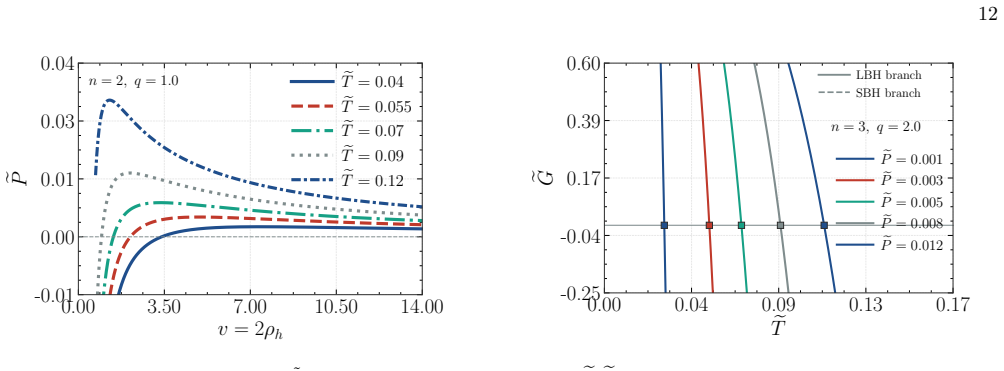
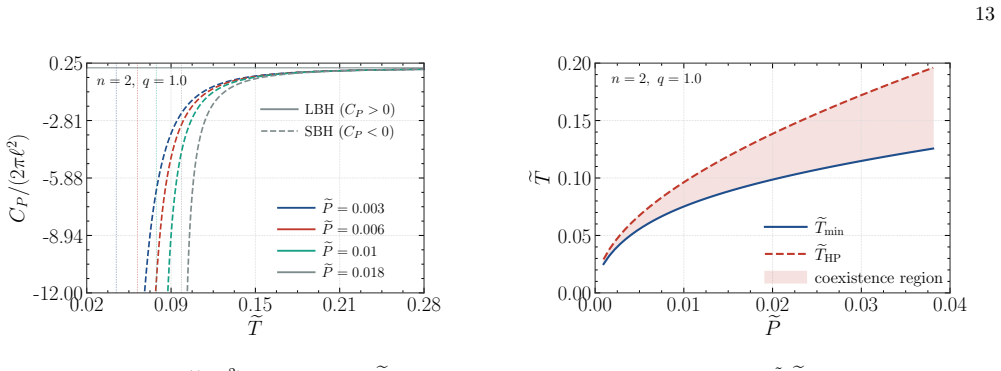
Forn= 2, the electromagnetic correctionK(y)∼ y/4produces a softer ˜P-visotherm than RN-AdS, and the system undergoes only a Hawking-Page first-order transition between thermal AdS and a stable large black hole. The SBH is locally unsta- ble (CP <0) and thermodynamically subdominant at all temperatures
-
[2]
This can produce a swallowtail in the˜G- ˜Tdiagram and a genuine VdW-like SBH-LBH first-order phase transition, qualitatively analogous to the RN-AdS case [25, 30]
Forn≥3at sufficiently large chargeq, the energy densityK(y)∼[(3n−2)/(4n)]yn grows faster withy, generating a stronger electromag- netic contribution at small horizon radii. This can produce a swallowtail in the˜G- ˜Tdiagram and a genuine VdW-like SBH-LBH first-order phase transition, qualitatively analogous to the RN-AdS case [25, 30]. Thus, the nonlinear...
-
[3]
Figure 11 showsVnull eff /L2 forn= 2, ˜M= 0.75, ˜P= 0.01, and four values of the chargeq
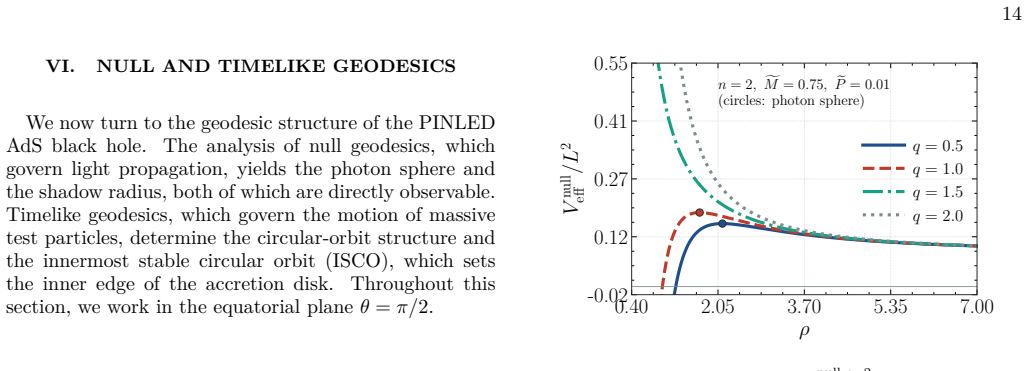
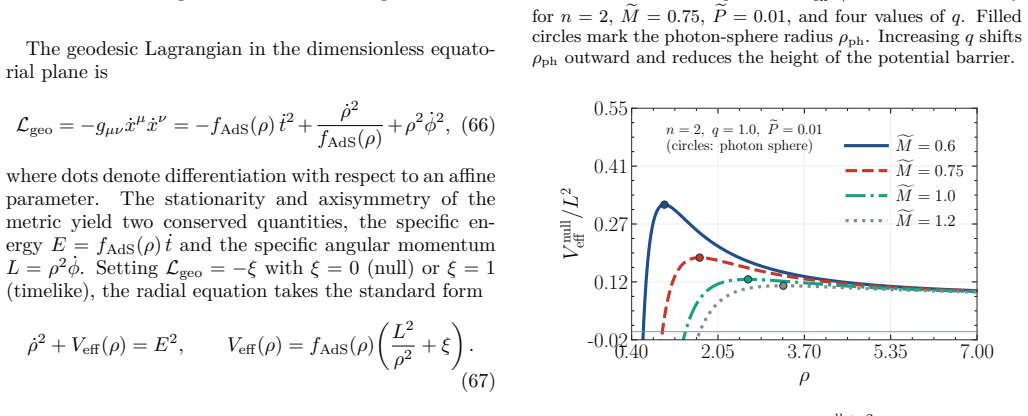
Null effective potential Forξ= 0, V null eff (ρ) =fAdS(ρ)L2 ρ2.(68) The maximum ofV null eff defines the photon sphere, which separates captured from scattered photon trajectories. Figure 11 showsVnull eff /L2 forn= 2, ˜M= 0.75, ˜P= 0.01, and four values of the chargeq. Each potential exhibits a single maximum whose height, the capture cross-section, decr...
-
[4]
For smallL(e.g.L= 2), thepotentialismonotonicallyincreasingbeyondthehori- zon; no local minimum exists, and no stable circular or- bit is available
Timelike effective potential Forξ= 1, V timelike eff (ρ) =fAdS(ρ) (L2 ρ2 + 1 ) .(69) Figure 13 showsV timelike eff forn= 2,q= 1, ˜M= 0.75, ˜P= 0.01, and five values ofL. For smallL(e.g.L= 2), thepotentialismonotonicallyincreasingbeyondthehori- zon; no local minimum exists, and no stable circular or- bit is available. AsLincreases, a local minimum de- velo...
2022
-
[5]
acknowledges the Inter University Center for Astronomy and Astrophysics (IUCAA), Pune, In- dia, for granting visiting associateship
F.A. acknowledges the Inter University Center for Astronomy and Astrophysics (IUCAA), Pune, In- dia, for granting visiting associateship. J.A.A.S.R ac- knowledges partial financial support from UESB through Grant AuxPPI (Edital No. 267/2024), as well as from FAPESB–CNPq/Produtividade under Grant No. 12243/2025 (TOB-BOL2798/2025). DATA AVAILABILITY STATEME...
2024
-
[6]
Born and L
M. Born and L. Infeld, Proc. R. Soc. Lond. A144, 425 (1934)
1934
-
[7]
Euler and B
H. Euler and B. Kockel, Naturwissenschaften23, 246 (1935)
1935
-
[8]
Demiánski, Found
M. Demiánski, Found. Phys.16, 187 (1986)
1986
-
[9]
Regular Black Hole in General Relativity Coupled to Nonlinear Electrodynamics
E. Ayón-Beato and A. García, Phys. Rev. Lett.80, 5056 (1998), arXiv:gr-qc/9911046
work page Pith review arXiv 1998
-
[10]
E. Ayón-Beato and A. García, Phys. Lett. B464, 25 (1999), arXiv:hep-th/9911174
-
[11]
The Bardeen Model as a Nonlinear Magnetic Monopole
E. Ayón-Beato and A. García, Phys. Lett. B493, 149 (2000), arXiv:gr-qc/0009077
work page Pith review arXiv 2000
-
[12]
K. A. Bronnikov, Phys. Rev. D63, 044005 (2001), arXiv:gr-qc/0006014
work page Pith review arXiv 2001
- [13]
- [14]
-
[15]
S. I. Kruglov, Annalen der Physik529, 1700073 (2017)
2017
-
[16]
Bardeen, inProceedings of the 5th International Con- ference on Gravitation and the Theory of Relativity, edited by H.-J
J. Bardeen, inProceedings of the 5th International Con- ference on Gravitation and the Theory of Relativity, edited by H.-J. Treder (Tbilisi University Press, Tbilisi,
-
[17]
Regular black holes with a nonlinear electrodynamics source
L. Balart and E. C. Vagenas, Phys. Rev. D90, 124045 (2014), arXiv:1408.0306
work page Pith review arXiv 2014
-
[18]
Construction of Regular Black Holes in General Relativity
Z.-Y. Fan and X. Wang, Phys. Rev. D94, 124027 (2016), arXiv:1610.02636
work page Pith review arXiv 2016
-
[19]
Verbin, B
Y. Verbin, B. Puliçe, A. Övgün, and H. Huang, Phys. Rev. D111, 084061 (2025)
2025
- [20]
-
[21]
J. M. Maldacena, Adv. Theor. Math. Phys.2, 231 (1998), arXiv:hep-th/9711200
work page internal anchor Pith review Pith/arXiv arXiv 1998
-
[22]
Anti De Sitter Space And Holography
E. Witten, Adv. Theor. Math. Phys.2, 253 (1998), arXiv:hep-th/9802150
work page internal anchor Pith review arXiv 1998
-
[23]
S. S. Gubser, I. R. Klebanov, and A. M. Polyakov, Phys. Lett. B428, 105 (1998), arXiv:hep-th/9802109. 21
work page internal anchor Pith review arXiv 1998
-
[24]
S. W. Hawking and D. N. Page, Commun. Math. Phys. 87, 577 (1983)
1983
-
[25]
Anti-de Sitter Space, Thermal Phase Transition, And Confinement In Gauge Theories
E. Witten, Adv. Theor. Math. Phys.2, 505 (1998), arXiv:hep-th/9803131
work page Pith review arXiv 1998
-
[26]
Charged AdS Black Holes and Catastrophic Holography
A. Chamblin, R. Emparan, H. S. Reall, and R. C. Myers, Phys. Rev. D60, 064018 (1999), arXiv:hep-th/9902170
work page Pith review arXiv 1999
-
[27]
Enthalpy and the Mechanics of AdS Black Holes
D. Kastor, S. Ray, and J. Traschen, Class. Quant. Grav. 26, 195011 (2009), arXiv:0904.2765
work page Pith review arXiv 2009
- [28]
- [29]
-
[30]
P-V criticality of charged AdS black holes
D. Kubiznák and R. B. Mann, JHEP2012(07), 033, arXiv:1205.0559
-
[31]
D. Kubiznák, R. B. Mann, and M. Teo, Class. Quant. Grav.34, 063001 (2017), arXiv:1608.06147
-
[32]
N. Altamirano, D. Kubiznák, and R. B. Mann, Phys. Rev. D88, 101502 (2013), arXiv:1306.5756
-
[33]
Kerr-AdS analogue of triple point and solid/liquid/gas phase transition,
N. Altamirano, D. Kubiznák, R. B. Mann, and Z. Sherkatghanad, Class. Quant. Grav.31, 042001 (2014), arXiv:1308.2672
- [34]
-
[35]
S. Gunasekaran, D. Kubiznák, and R. B. Mann, JHEP 2012(11), 110, arXiv:1208.6251
- [36]
- [37]
-
[38]
J. L. Synge, Mon. Not. R. Astron. Soc.131, 463 (1966)
1966
-
[39]
Luminet, Astron
J.-P. Luminet, Astron. Astrophys.75, 228 (1979)
1979
-
[40]
J. M. Bardeen, inBlack Holes (Les Houches 1972),edited by C. DeWitt and B. S. DeWitt (Gordon and Breach, New York, 1973) pp. 215–239
1972
-
[41]
Ferrari and B
V. Ferrari and B. Mashhoon, Phys. Rev. D30, 295 (1984)
1984
-
[42]
Geodesic stability, Lyapunov exponents and quasinormal modes,
V. Cardoso, A. S. Miranda, E. Berti, H. Witek, and V. T. Zanchin, Phys. Rev. D79, 064016 (2009), arXiv:0812.1806
-
[43]
Event Horizon Telescope Collaboration, Astrophys. J. Lett.875, L1 (2019), arXiv:1906.11238
work page internal anchor Pith review arXiv 2019
-
[44]
Event Horizon Telescope Collaboration, Astrophys. J. Lett.875, L4 (2019), arXiv:1906.11241
work page Pith review arXiv 2019
-
[45]
Event Horizon Telescope Collaboration, Astrophys. J. Lett.930, L12 (2022), arXiv:2311.08680
work page internal anchor Pith review arXiv 2022
-
[46]
V. Perlick, O. Y. Tsupko, and G. S. Bisnovatyi-Kogan, Phys. Rev. D92, 104031 (2015), arXiv:1507.04217
- [47]
-
[48]
Plebański,Lectures on Nonlinear Electrodynamics (Nordita, Copenhagen, 1970)
J. Plebański,Lectures on Nonlinear Electrodynamics (Nordita, Copenhagen, 1970)
1970
-
[49]
Holography, Thermodynamics and Fluctuations of Charged AdS Black Holes
A. Chamblin, R. Emparan, H. S. Reall, and R. C. Myers, Phys. Rev. D60, 104026 (1999), arXiv:hep-th/9904197
work page Pith review arXiv 1999
discussion (0)
Sign in with ORCID, Apple, or X to comment. Anyone can read and Pith papers without signing in.