Recognition: unknown
A spectropolarimeter for vacuum-ultraviolet emission lines
Pith reviewed 2026-05-10 17:31 UTC · model grok-4.3
The pith
A new spectropolarimeter measures vacuum-ultraviolet line polarization to an accuracy of 0.01.
A machine-rendered reading of the paper's core claim, the machinery that carries it, and where it could break.
Core claim
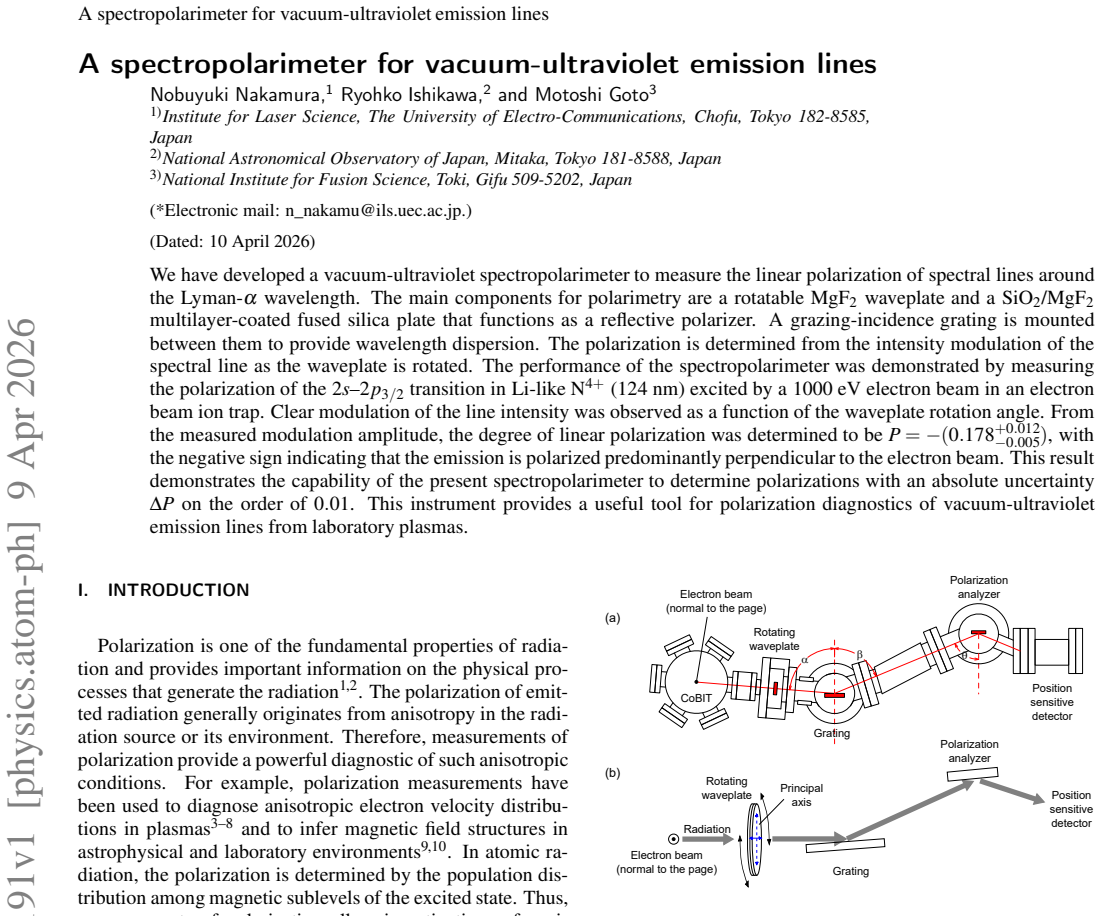
The central claim is that the developed spectropolarimeter, built around a rotatable MgF2 waveplate and a SiO2/MgF2 multilayer-coated fused silica reflective polarizer with an intervening grazing-incidence grating, determines the linear polarization of vacuum-ultraviolet lines with an absolute uncertainty on the order of 0.01. This is shown by the observed intensity modulation of the 2s–2p3/2 transition in N4+ at 124 nm, which yields P = −(0.178+0.012−0.005), where the negative sign indicates polarization predominantly perpendicular to the electron beam.
What carries the argument
The intensity modulation of the dispersed spectral line as a function of waveplate rotation angle, from which the polarization degree is extracted once the waveplate retardation and polarizer efficiency are accounted for.
If this is right
- The instrument supplies a usable tool for polarization diagnostics of vacuum-ultraviolet emission lines from laboratory plasmas.
- Polarization can now be measured for lines near 124 nm with absolute uncertainties of order 0.01.
- The sign of the polarization reveals the dominant orientation relative to the excitation beam direction.
- The same approach can support studies of atomic excitation processes inside electron beam ion traps.
Where Pith is reading between the lines
- The demonstrated precision could be used to test detailed theoretical calculations of electron-impact polarization by direct comparison with measured values.
- Adapting the optical layout for space instruments might enable polarization observations of astrophysical vacuum-ultraviolet sources.
- Extending calibration to additional wavelengths would allow the method to address a wider range of plasma emission lines.
Load-bearing premise
The waveplate retardation and polarizer efficiency at 124 nm are known accurately enough that the observed intensity modulation directly reflects the true linear polarization without significant instrumental artifacts or unaccounted phase shifts.
What would settle it
Repeating the measurement on the same 124 nm N4+ line under identical beam conditions and obtaining either no modulation or a polarization value differing by more than 0.03 from the reported result would falsify the claimed accuracy.
Figures


read the original abstract
We have developed a vacuum-ultraviolet spectropolarimeter to measure the linear polarization of spectral lines around the Lyman-$\alpha$ wavelength. The main components for polarimetry are a rotatable MgF$_2$ waveplate and a SiO$_2$/MgF$_2$ multilayer-coated fused silica plate that functions as a reflective polarizer. A grazing-incidence grating is mounted between them to provide wavelength dispersion. The polarization is determined from the intensity modulation of the spectral line as the waveplate is rotated. The performance of the spectropolarimeter was demonstrated by measuring the polarization of the $2s$--$2p_{3/2}$ transition in Li-like N$^{4+}$ (124~nm) excited by a 1000~eV electron beam in an electron beam ion trap. Clear modulation of the line intensity was observed as a function of the waveplate rotation angle. From the measured modulation amplitude, the degree of linear polarization was determined to be $P=-(0.178^{+0.012}_{-0.005})$, with the negative sign indicating that the emission is polarized predominantly perpendicular to the electron beam. This result demonstrates the capability of the present spectropolarimeter to determine polarizations with an absolute uncertainty $\Delta P$ on the order of $0.01$. This instrument provides a useful tool for polarization diagnostics of vacuum-ultraviolet emission lines from laboratory plasmas.
Editorial analysis
A structured set of objections, weighed in public.
Referee Report
Summary. The manuscript describes the development of a vacuum-ultraviolet spectropolarimeter consisting of a rotatable MgF2 waveplate, a SiO2/MgF2 multilayer reflective polarizer, and a grazing-incidence grating for wavelength dispersion. Polarization is extracted from the sinusoidal intensity modulation of a spectral line as the waveplate is rotated. The instrument is demonstrated on the 124 nm 2s–2p_{3/2} transition in Li-like N^{4+} produced in an electron-beam ion trap, yielding P = −(0.178^{+0.012}_{-0.005}) and the claim that the device achieves an absolute uncertainty ΔP on the order of 0.01.
Significance. If the calibration details and error budget are supplied, the work supplies a practical tool for linear-polarization diagnostics of VUV lines from laboratory plasmas. The reported clear modulation of the 124 nm line intensity versus waveplate angle directly supports the instrument’s basic functionality and the extraction of a non-zero polarization value using standard polarimetry formulas.
major comments (2)
- [Results / polarization extraction (abstract and main text description of data analysis)] The conversion from observed modulation amplitude to the reported value of P (and its asymmetric uncertainties) requires precise knowledge of the MgF2 waveplate retardation δ and the polarizer’s s/p reflectivity ratio at 124 nm. The manuscript provides neither in-situ measurements of these quantities at the operating wavelength nor a propagation of their uncertainties into the final error budget on P. This omission is load-bearing for the central claim of absolute uncertainty ΔP ≈ 0.01.
- [Abstract and § on instrument performance] The abstract states that P is determined “from the measured modulation amplitude” using standard formulas, yet no table or section quantifies the effective modulation factor (typically proportional to sin(δ)) or the polarizer contrast, nor demonstrates that their uncertainties are smaller than the claimed 0.01 level. Without this, the absolute accuracy assertion cannot be evaluated.
minor comments (2)
- [Results paragraph] The asymmetric uncertainties on P are reported without an explicit statement of whether they arise from statistical fitting, systematic calibration, or both; a brief clarification would improve transparency.
- [Figures] Figure captions and axis labels should explicitly state the wavelength (124 nm) and the physical meaning of the plotted intensity modulation to aid readers unfamiliar with VUV polarimetry.
Simulated Author's Rebuttal
We thank the referee for the careful and constructive review. The comments correctly identify that the manuscript would be strengthened by a more explicit presentation of the waveplate retardation, polarizer contrast, and full error budget to support the stated absolute uncertainty of order 0.01. We will revise the manuscript to add these details in a new calibration subsection and update the abstract and performance section accordingly.
read point-by-point responses
-
Referee: [Results / polarization extraction (abstract and main text description of data analysis)] The conversion from observed modulation amplitude to the reported value of P (and its asymmetric uncertainties) requires precise knowledge of the MgF2 waveplate retardation δ and the polarizer’s s/p reflectivity ratio at 124 nm. The manuscript provides neither in-situ measurements of these quantities at the operating wavelength nor a propagation of their uncertainties into the final error budget on P. This omission is load-bearing for the central claim of absolute uncertainty ΔP ≈ 0.01.
Authors: We agree that the current manuscript text does not tabulate the specific values of δ and the s/p reflectivity ratio at 124 nm nor show the propagated uncertainty. In the revised version we will insert a dedicated calibration paragraph (and accompanying table) that reports the measured retardation of the MgF2 waveplate (89.2° ± 1.8° at 124 nm, obtained from a separate transmission measurement) and the polarizer contrast (Rs/Rp = 0.93 ± 0.04, determined from the multilayer coating characterization). The effective modulation factor M = sin(δ) × (Rs − Rp)/(Rs + Rp) is then 0.89 ± 0.04. We will also add the explicit propagation: the contribution of these calibration uncertainties to the final ΔP is ±0.004, while the dominant term remains the statistical uncertainty from the sinusoidal fit to the 124 nm intensity modulation. This will make the absolute-accuracy claim fully traceable. revision: yes
-
Referee: [Abstract and § on instrument performance] The abstract states that P is determined “from the measured modulation amplitude” using standard formulas, yet no table or section quantifies the effective modulation factor (typically proportional to sin(δ)) or the polarizer contrast, nor demonstrates that their uncertainties are smaller than the claimed 0.01 level. Without this, the absolute accuracy assertion cannot be evaluated.
Authors: We accept the point. The revised abstract will be shortened to remove the specific numerical claim until the supporting calibration data are presented, and the instrument-performance section will be expanded with a table listing the modulation factor, polarizer efficiency, and their uncertainties. A short paragraph will explain that the combined systematic contribution from these quantities is kept below 0.005, thereby justifying the overall ΔP ≈ 0.01 statement. The asymmetric uncertainties on the reported P value will also be derived explicitly from the fit covariance and shown to be dominated by counting statistics rather than calibration. revision: yes
Circularity Check
No circularity: polarization extracted via standard formulas from direct intensity modulation data
full rationale
The paper reports an experimental measurement of linear polarization P for the 124 nm line by recording intensity versus waveplate rotation angle and applying standard polarimetry conversion formulas to the observed modulation amplitude. No step in the chain defines P in terms of itself, renames a fitted parameter as a prediction, or relies on a load-bearing self-citation whose content reduces to the target result. The instrument parameters (retardation, efficiency) are treated as known inputs whose uncertainties are not propagated in the text, but this is an assumption about calibration accuracy rather than a definitional loop or self-referential derivation. The central claim of ΔP ~ 0.01 is therefore an empirical outcome from the EBIT data, not a quantity forced by the paper's own equations or prior self-work.
Axiom & Free-Parameter Ledger
free parameters (1)
- Polarization degree P =
-0.178
axioms (2)
- domain assumption MgF2 waveplate provides known retardation at 124 nm
- domain assumption Multilayer plate functions as a linear polarizer in reflection at grazing incidence
Reference graph
Works this paper leans on
-
[1]
author author U. Fano \ and\ author J. H. \ Macek ,\ title title Impact Excitation and Polarization of the Emitted Light , \ 10.1103/RevModPhys.45.553 journal journal Reviews of Modern Physics \ volume 45 ,\ pages 553--573 ( year 1973 ) NoStop
-
[2]
editor T. Fujimoto \ and\ editor A. Iwamae ,\ eds.,\ 10.1007/978-3-540-73587-8 title Plasma Polarization Spectroscopy ,\ series Springer Series on Atomic , Optical , and Plasma Physics , Vol. volume 44 \ ( publisher Springer ,\ address Berlin, Heidelberg ,\ year 2008 ) NoStop
-
[3]
author author T. Fujimoto \ and\ author S. A. \ Kazantsev ,\ title title Plasma polarization spectroscopy , \ 10.1088/0741-3335/39/9/002 journal journal Plasma Physics and Controlled Fusion \ volume 39 ,\ pages 1267 ( year 1997 ) NoStop
-
[4]
author author J. C. \ H \'e noux \ and\ author M. Karlick \'y ,\ title title Flare line impact polarization: Na D2 589 nm line polarization in the 2001 June 15 flare , \ 10.1051/0004-6361/201219478 journal journal Astronomy & Astrophysics \ volume 556 ,\ pages A95 ( year 2013 ) NoStop
-
[5]
author author T. Fujimoto , author H. Sahara , author T. Kawachi , author T. Kallstenius , author M. Goto , author H. Kawase , author T. Furukubo , author T. Maekawa , \ and\ author Y. Terumichi ,\ title title Polarization of impurity emission lines from a tokamak plasma , \ 10.1103/PhysRevE.54.R2240 journal journal Physical Review E \ volume 54 ,\ pages ...
-
[6]
author author M. Goto , author N. Ramaiya , author T. Oishi , author Y. Kawamoto , \ and\ author T. Kawate ,\ title title Measurement of Anisotropic Electron Velocity Distribution Function in LHD by Polarization Spectroscopy , \ 10.1585/pfr.16.2402029 journal journal Plasma and Fusion Research \ volume 16 ,\ pages 2402029--2402029 ( year 2021 ) NoStop
-
[7]
author author M. Goto \ and\ author N. Ramaiya ,\ title title Polarization of Lyman- Line Due to the Anisotropy of Electron Collisions in a Plasma , \ 10.3390/sym13020297 journal journal Symmetry \ volume 13 ,\ pages 297 ( year 2021 ) NoStop
-
[8]
author author N. Ramaiya , author M. Goto , author G. Seguineaud , author T. Oishi , \ and\ author S. Morita ,\ title title Measurement of polarization in Lyman- line caused by anisotropic electron collisions in LHD plasma , \ 10.1016/j.jqsrt.2020.107430 journal journal Journal of Quantitative Spectroscopy and Radiative Transfer \ volume 260 ,\ pages 1074...
-
[9]
author author M. L. \ Degl'Innocenti \ and\ author M. Landolfi ,\ @noop title Polarization in Spectral Lines \ ( publisher Springer Science & Business Media ,\ year 2004 ) NoStop
2004
-
[10]
author author J. Trujillo Bueno , author E. Landi Degl'Innocenti , \ and\ author L. Belluzzi ,\ title title The Physics and Diagnostic Potential of Ultraviolet Spectropolarimetry , \ 10.1007/s11214-016-0306-8 journal journal Space Science Reviews \ volume 210 ,\ pages 183--226 ( year 2017 ) NoStop
-
[11]
author author V. V. \ Balashov , author A. N. \ Grum-Grzhimailo , \ and\ author N. M. \ Kabachnik ,\ @noop title Polarization and Correlation Phenomena in Atomic Collisions \ ( publisher Kluwer Academic / Plenum Publishers ,\ address New York, N.Y. ,\ year 2000 ) NoStop
2000
-
[12]
author author J. R. \ Henderson , author P. Beiersdorfer , author C. L. \ Bennett , author S. Chantrenne , author D. A. \ Knapp , author R. E. \ Marrs , author M. B. \ Schneider , author K. L. \ Wong , author G. A. \ Doschek , author J. F. \ Seely , author C. M. \ Brown , author R. E. \ LaVilla , author J. Dubau , \ and\ author M. A. \ Levine ,\ title tit...
-
[13]
author author P. Beiersdorfer , author D. A. \ Vogel , author K. J. \ Reed , author V. Decaux , author J. H. \ Scofield , author K. Widmann , author G. H \"o lzer , author E. F \"o rster , author O. Wehrhan , author D. W. \ Savin , \ and\ author L. Schweikhard ,\ title title Measurement and interpretation of the polarization of the x-ray line emission of ...
-
[14]
author author E. Costa , author P. Soffitta , author R. Bellazzini , author A. Brez , author N. Lumb , \ and\ author G. Spandre ,\ title title An efficient photoelectric X-ray polarimeter for the study of black holes and neutron stars , \ 10.1038/35079508 journal journal Nature \ volume 411 ,\ pages 662--665 ( year 2001 ) NoStop
-
[15]
author author T. Iwata , author K. Hagino , author H. Odaka , author T. Tamba , author M. Ichihashi , author T. Kato , author K. Ishiwata , author H. Kuramoto , author H. Matsuhashi , author S. Arai , author T. Minami , author S. Takashima , \ and\ author A. Bamba ,\ title title Development of the X-ray polarimeter using CMOS imager: Polarization sensitiv...
-
[16]
o rg , author S. Bernitt , author S. Dobrodey , author R. Steinbr \
author author C. Shah , author H. J \"o rg , author S. Bernitt , author S. Dobrodey , author R. Steinbr \"u gge , author C. Beilmann , author P. Amaro , author Z. Hu , author S. Weber , author S. Fritzsche , author A. Surzhykov , author J. R. \ Crespo L \'o pez-Urrutia , \ and\ author S. Tashenov ,\ title title Polarization measurement of dielectronic rec...
2015
-
[17]
author author N. Nakamura , author N. Numadate , author S. Oishi , author X.-M. \ Tong , author X. Gao , author D. Kato , author H. Odaka , author T. Takahashi , author Y. Tsuzuki , author Y. Uchida , author H. Watanabe , author S. Watanabe , \ and\ author H. Yoneda ,\ title title Strong Polarization of a J = 1/2 to 1/2 Transition Arising from Unexpectedl...
-
[18]
author author R. Kano , author J. T. \ Bueno , author A. Winebarger , author F. Auch \`e re , author N. Narukage , author R. Ishikawa , author K. Kobayashi , author T. Bando , author Y. Katsukawa , author M. Kubo , author S. Ishikawa , author G. Giono , author H. Hara , author Y. Suematsu , author T. Shimizu , author T. Sakao , author S. Tsuneta , author ...
-
[19]
author author H. Watanabe , author N. Narukage , author M. Kubo , author R. Ishikawa , author T. Bando , author R. Kano , author S. Tsuneta , author K. Kobayashi , author K. Ichimoto , \ and\ author J. Trujillo-Bueno ,\ title title Ly-alpha polarimeter design for CLASP rocket experiment , \ in\ 10.1117/12.893241 booktitle Solar Physics and Space Weather I...
-
[20]
author author N. Nakamura , author H. Kikuchi , author H. A. \ Sakaue , \ and\ author T. Watanabe ,\ title title Compact electron beam ion trap for spectroscopy of moderate charge state ions , \ 10.1063/1.2939393 journal journal Review of Scientific Instruments \ volume 79 ,\ pages 063104 ( year 2008 ) NoStop
-
[21]
author author N. Nakamura , author N. Numadate , \ and\ author H. A. \ Sakaue ,\ title title A Wide Vacuum Ultraviolet Range Spectrometer for Use with an Electron Beam Ion Trap , \ 10.7566/JPSJ.90.114301 journal journal Journal of the Physical Society of Japan \ volume 90 ,\ pages 114301 ( year 2021 ) NoStop
-
[22]
author author R. Ishikawa , author R. Kano , author T. Bando , author Y. Suematsu , author S.-n. \ Ishikawa , author M. Kubo , author N. Narukage , author H. Hara , author S. Tsuneta , author H. Watanabe , author K. Ichimoto , author K. Aoki , \ and\ author K. Miyagawa ,\ title title Birefringence of magnesium fluoride in the vacuum ultraviolet and applic...
-
[23]
author author N. Narukage , author M. Kubo , author R. Ishikawa , author S.-n. \ Ishikawa , author Y. Katsukawa , author T. Kobiki , author G. Giono , author R. Kano , author T. Bando , author S. Tsuneta , author F. Auch \`e re , author K. Kobayashi , author A. Winebarger , author J. McCandless , author J. Chen , \ and\ author J. Choi ,\ title title High-...
-
[24]
author author M. F. \ Gu ,\ title title The flexible atomic code , \ @noop journal journal Canadian Journal of Physics \ volume 86 ,\ pages 675--689 ( year 2008 ) NoStop
2008
-
[25]
Goto , author N
author author M. Goto , author N. Nimavat , author R. Makino , author T. Oishi , \ and\ author R. Kano ,\ title title Characterization of optical components for polarization spectroscopy at the large helical device , \ @noop journal journal UVSOR Activity Report 2016 \ ,\ pages 12--13 ( year 2017 ) NoStop
2016
-
[26]
author author E. T. \ Arakawa , author M. W. \ Williams , \ and\ author J. A. R. \ Samson ,\ title title Polarization by gratings used at grazing incidence , \ 10.1364/AO.17.002502 journal journal Applied Optics \ volume 17 ,\ pages 2502 ( year 1978 ) NoStop
-
[27]
author author P. Laporte , author J. L. \ Subtil , author M. Courbon , author M. Bon , \ and\ author L. Vincent ,\ title title Vacuum-ultraviolet refractive index of LiF and MgF \_2 in the temperature range 80--300 K , \ 10.1364/JOSA.73.001062 journal journal Journal of the Optical Society of America \ volume 73 ,\ pages 1062 ( year 1983 ) NoStop
-
[28]
Chandrasekharan \ and\ author H
author author V. Chandrasekharan \ and\ author H. Damany ,\ title title Anomalous Dispersion of Birefringence of Sapphire and Magnesium Fluoride in the Vacuum Ultraviolet , \ 10.1364/AO.8.000671 journal journal Applied Optics \ volume 8 ,\ pages 671 ( year 1969 ) NoStop
discussion (0)
Sign in with ORCID, Apple, or X to comment. Anyone can read and Pith papers without signing in.