Recognition: unknown
Ground State Decay of the Three-Proton Emitter ¹⁷Na Reveals Isospin Symmetry Breaking
Pith reviewed 2026-05-10 17:31 UTC · model grok-4.3
The pith
The ground state of three-proton emitter 17Na decays at 2.24 MeV, showing a systematic drop in mirror energy differences that signals isospin symmetry breaking.
A machine-rendered reading of the paper's core claim, the machinery that carries it, and where it could break.
Core claim
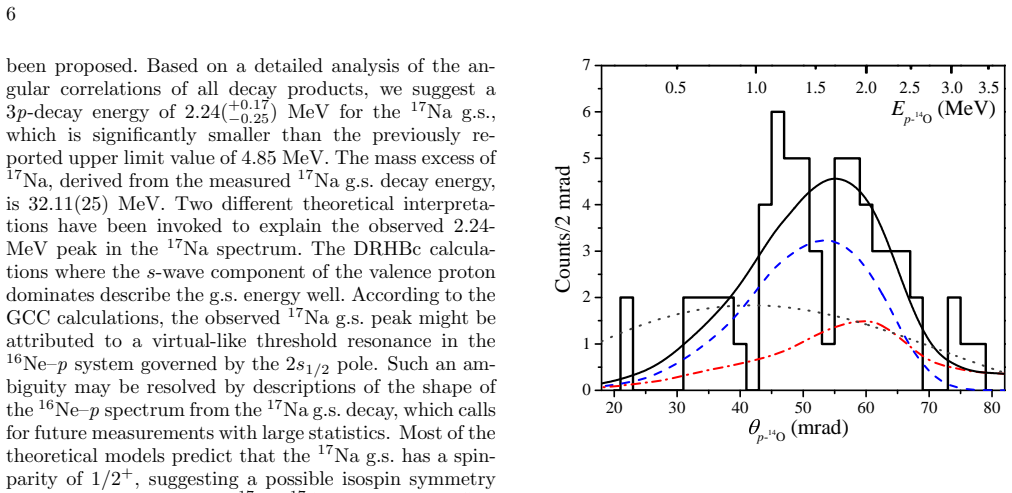
The spectrum of the exotic three-proton emitter 17Na has been studied by detecting all in-flight decay products. Derived from the measured angular correlations 14O+p+p+p, a resonant peak has been discovered at the 3p-decay energy of 2.24(+0.17-0.25) MeV, which likely corresponds to the 17Na ground state. This decay energy value is significantly smaller than the previous experimental upper limit. Our measured 14O-p correlations stemming from the ground state decay have been quantitatively described by a sequential 1p-2p emission from a 17Na resonance via the intermediate 16Ne ground state, which allowed to derive the upper limit of 17Na ground-state width of 0.6 MeV. A dramatic systematic dec
What carries the argument
Angular correlations of the 14O+p+p+p decay products that identify the resonance energy and confirm sequential 1p-2p emission through the 16Ne ground state.
If this is right
- The ground-state decay width of 17Na is bounded above by 0.6 MeV.
- Mirror energy differences decrease systematically across nearly all known three-proton emitters.
- Nuclear structure evolves differently for light-to-medium-mass nuclei beyond the proton drip line.
- The observed lowering is linked to strong isospin symmetry breaking in these exotic systems.
Where Pith is reading between the lines
- Nuclear models that assume near-perfect isospin symmetry may need larger explicit breaking terms when applied to proton-rich drip-line nuclei.
- The revised 17Na energy changes input to reaction-rate calculations that involve this nucleus in astrophysical environments.
- The same mirror-difference trend can be tested directly by measuring additional proton-rich nuclei with multi-proton decay channels.
Load-bearing premise
The resonant peak at 2.24 MeV is the ground state of 17Na and the decay proceeds sequentially through the 16Ne ground state with negligible direct three-proton emission.
What would settle it
A measurement of the 14O+p+p+p angular correlations with better energy resolution that either assigns the resonance to an excited state or requires a large direct three-proton decay branch would falsify the ground-state assignment and sequential-decay description.
Figures



read the original abstract
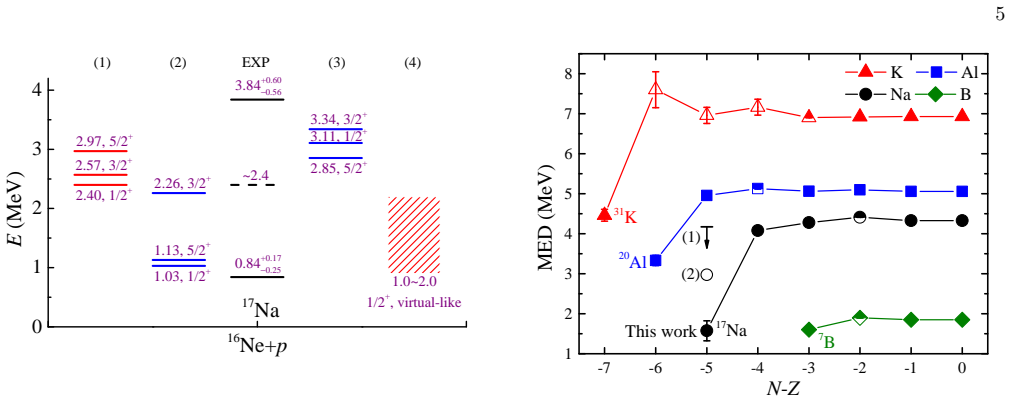
The spectrum of the exotic three-proton (3p) emitter $^{17}$Na has been studied by detecting all in-flight decay products. Derived from the measured angular correlations $^{14}$O+p+p+p, a resonant peak has been discovered at the 3p-decay energy of 2.24($^{+0.17}_{-0.25}$) MeV, which likely corresponds to the $^{17}$Na ground state. This decay energy value is significantly smaller than the previous experimental upper limit. Our measured $^{14}$O-p correlations stemming from the ground state decay have been quantitatively described by a sequential 1p-2p emission from a $^{17}$Na resonance via the intermediate $^{16}$Ne ground state, which allowed to derive the upper limit of $^{17}$Na ground-state width of 0.6 MeV. A dramatic systematic decrease in the mirror energy differences of mirror nuclei pairs has been observed at almost all 3p emitters with known proton separation energy (such as $^{31}$K, $^{20}$Al, and $^{17}$Na), in sharp contrast to the behavior in less exotic nuclei. Such a lowering effect indicates a general trend in evolution of nuclear structure for light to medium mass nuclei beyond the proton drip line, which is often associated with strong isospin symmetry breaking.
Editorial analysis
A structured set of objections, weighed in public.
Referee Report
Summary. The manuscript reports an experimental measurement of the three-proton decay of 17Na via detection of all in-flight decay products. From angular correlations of 14O+p+p+p, a resonant peak is identified at a 3p-decay energy of 2.24(+0.17-0.25) MeV, interpreted as the 17Na ground state. The decay is described as sequential via the 16Ne ground state, yielding an upper limit of 0.6 MeV on the ground-state width. The work also reports a systematic decrease in mirror energy differences for 3p emitters (including 31K, 20Al, and 17Na) relative to less exotic nuclei, interpreted as evidence for isospin symmetry breaking.
Significance. If the ground-state assignment and sequential-decay interpretation hold, the result supplies new data on the structure and decay of a proton-rich nucleus beyond the drip line. The reported systematic trend in mirror energy differences could point to broader evolution of nuclear structure in isospin-asymmetric systems, providing a contrast to behavior in stable nuclei and motivating further theoretical work on isospin symmetry breaking.
major comments (2)
- [Abstract] Abstract: The identification of the 2.24(+0.17-0.25) MeV resonance as the 17Na ground state (rather than a low-lying excited state) is load-bearing for both the quoted 3p separation energy and the claimed dramatic systematic decrease in mirror energy differences across 3p emitters. The supporting evidence consists of the peak being the lowest-energy structure observed and the angular correlations fitting a sequential model, but no independent confirmation (gamma-ray tagging or theoretical anchor) is described that would exclude an excited-state interpretation; if the resonance is excited, the true ground-state separation energy is lower and the reported trend is weakened.
- [Abstract] Abstract and results discussion: The quantitative description of the 14O-p correlations by the sequential 1p-2p emission model is used to set the 0.6 MeV width upper limit, yet the abstract and main text supply no statistics on the peak significance, background subtraction procedure, or full error analysis on the angular-correlation data, leaving the central experimental claims only moderately supported.
minor comments (1)
- [Abstract] Abstract: The abstract does not report the number of events, fit details, or goodness-of-fit metrics for the angular-correlation analysis that underpins both the resonance energy and the sequential-decay interpretation.
Simulated Author's Rebuttal
We thank the referee for the careful and constructive review of our manuscript. We address each major comment point by point below, providing the strongest honest defense of our work while acknowledging where revisions are warranted to improve clarity and support for the claims.
read point-by-point responses
-
Referee: [Abstract] Abstract: The identification of the 2.24(+0.17-0.25) MeV resonance as the 17Na ground state (rather than a low-lying excited state) is load-bearing for both the quoted 3p separation energy and the claimed dramatic systematic decrease in mirror energy differences across 3p emitters. The supporting evidence consists of the peak being the lowest-energy structure observed and the angular correlations fitting a sequential model, but no independent confirmation (gamma-ray tagging or theoretical anchor) is described that would exclude an excited-state interpretation; if the resonance is excited, the true ground-state separation energy is lower and the reported trend is weakened.
Authors: We agree that the ground-state assignment is central to the reported separation energy and the observed systematic trend in mirror energy differences. The supporting evidence in the manuscript is that this resonance is the lowest-energy structure observed and that the measured 14O-p angular correlations are quantitatively reproduced by a sequential 1p-2p emission model proceeding through the 16Ne ground state. No gamma-ray tagging or independent theoretical calculation is available from this experiment to rule out an excited-state interpretation. However, the lack of any lower-lying structure in the data, combined with the decay pattern matching expectations for the ground state of a three-proton emitter, provides reasonable support for the assignment. We will revise the text to include a more explicit discussion of the basis for this interpretation and the consequences if the resonance were instead an excited state. revision: partial
-
Referee: [Abstract] Abstract and results discussion: The quantitative description of the 14O-p correlations by the sequential 1p-2p emission model is used to set the 0.6 MeV width upper limit, yet the abstract and main text supply no statistics on the peak significance, background subtraction procedure, or full error analysis on the angular-correlation data, leaving the central experimental claims only moderately supported.
Authors: The referee is correct that the abstract and main text do not include quantitative details on peak significance, the background subtraction procedure, or the full error analysis associated with the angular-correlation fits and the derived width limit. These details are necessary to fully substantiate the experimental results. In the revised manuscript we will add the peak significance (in standard deviations above background), a description of the background model and subtraction, and the uncertainties on the angular-correlation data and model parameters. This will provide stronger support for the central claims. revision: yes
Circularity Check
No significant circularity: experimental measurement and empirical observation
full rationale
The paper reports direct measurements of in-flight decay products and angular correlations for 17Na. The resonant peak position, sequential decay description via 16Ne, and width upper limit are extracted from data fits to observed correlations; the systematic trend in mirror energy differences is an empirical compilation across nuclei including this new datum. No derivation step reduces a claimed prediction to a fitted input by construction, invokes self-citation for uniqueness, or renames a known result as new unification. The ground-state assignment is interpretive but does not create circularity in the reported quantities.
Axiom & Free-Parameter Ledger
free parameters (1)
- resonance energy and width parameters
axioms (1)
- standard math Standard conservation of energy, momentum, and angular momentum in nuclear decays
Reference graph
Works this paper leans on
-
[1]
stabilization
(2) EXP (3) (4)0 .84+ 0.17−0 .252 .26, 3/2+ 1 .13, 5/2+ 1.03, 1/2+ ~ 2.42.57, 3/2+ 2.97, 5/2+ 2 .40, 1/2+ 2 .85, 5/2+ 3.34, 3/2+ 3.11, 1/2+ FIG. 4. The experimental energies of the lowest states in 17Na observed in the present work compared to various model predictions. Predictions (1) and (2) are taken from Ref. [17] and Ref. [16], respectively. Result (...
2019
-
[2]
Wigner, Phys
E. Wigner, Phys. Rev.51, 106 (1937)
1937
-
[3]
Stefan, F
I. Stefan, F. de Oliveira Santos, O. Sorlin, T. Davin- son, M. Lewitowicz, G. Dumitru, J. C. Ang´ elique, M. Ang´ elique, E. Berthoumieux, C. Borcea, R. Borcea, A. Buta, J. M. Daugas, F. de Grancey, M. Fadil, S. Gr´ evy, J. Kiener, A. Lefebvre-Schuhl, M. Lenhardt, J. Mrazek, F. Negoita, D. Pantelica, M. G. Pellegriti, L. Perrot, M. Ploszajczak, O. Roig, M...
2014
-
[4]
Pf¨ utzner, I
M. Pf¨ utzner, I. Mukha, and S. M. Wang, Prog. Part. Nucl. Phys.132, 104050 (2023)
2023
-
[5]
R. J. Charity, J. M. Elson, J. Manfredi, R. Shane, L. G. Sobotka, B. A. Brown, Z. Chajecki, D. Coupland, H. Iwasaki, M. Kilburn, J. Lee, W. G. Lynch, A. Sane- tullaev, M. B. Tsang, J. Winkelbauer, M. Youngs, S. T. Marley, D. V. Shetty, A. H. Wuosmaa, T. K. Ghosh, and M. E. Howard, Phys. Rev. C84, 014320 (2011)
2011
-
[6]
R. J. Charity, T. B. Webb, J. M. Elson, D. E. M. Hoff, C. D. Pruitt, L. G. Sobotka, K. W. Brown, G. Cer- izza, J. Estee, W. G. Lynch, J. Manfredi, P. Morfouace, C. Santamaria, S. Sweany, C. Y. Tsang, M. B. Tsang, Y. Zhang, K. Zhu, S. A. Kuvin, D. McNeel, J. Smith, A. H. Wuosmaa, and Z. Chajecki, Phys. Rev. Lett.126, 132501 (2021)
2021
-
[7]
K. W. Brown, R. J. Charity, J. M. Elson, W. Reviol, L. G. Sobotka, W. W. Buhro, Z. Chajecki, W. G. Lynch, J. Manfredi, R. Shane, R. H. Showalter, M. B. Tsang, D. Weisshaar, J. R. Winkelbauer, S. Bedoor, and A. H. Wuosmaa, Phys. Rev. C95, 044326 (2017)
2017
-
[8]
X.-D. Xu, I. Mukha, J. G. Li, S. M. Wang, L. Acosta, M. Bajzek, E. Casarejos, D. Cortina-Gil, J. M. Espino, A. Fomichev, H. Geissel, J. G´ omez-Camacho, L. V. Grig- orenko, O. Kiselev, A. A. Korsheninnikov, D. Kostyl- eva, N. Kurz, Y. A. Litvinov, I. Martel, C. Nociforo, M. Pf¨ utzner, C. Rodr´ ıguez-Tajes, C. Scheidenberger, M. Stanoiu, K. S¨ ummerer, H....
2025
-
[9]
Kostyleva, I
D. Kostyleva, I. Mukha, L. Acosta, E. Casarejos, V. Chu- doba, A. A. Ciemny, W. Dominik, J. A. Due˜ nas, V. Dunin, J. M. Espino, A. Estrad´ e, F. Farinon, A. Fomichev, H. Geissel, A. Gorshkov, L. V. Grigorenko, Z. Janas, G. Kami´ nski, O. Kiselev, R. Kn¨ obel, S. Krupko, M. Kuich, Y. A. Litvinov, G. Marquinez-Dur´ an, I. Mar- tel, C. Mazzocchi, C. Nocifor...
2019
-
[10]
Mukha, K
I. Mukha, K. S¨ ummerer, L. Acosta, M. A. G. Al- varez, E. Casarejos, A. Chatillon, D. Cortina-Gil, I. A. Egorova, J. M. Espino, A. Fomichev, J. E. Garc´ ıa-Ramos, H. Geissel, J. G´ omez-Camacho, L. Grigorenko, J. Hof- mann, O. Kiselev, A. Korsheninnikov, N. Kurz, Y. A. Litvinov, E. Litvinova, I. Martel, C. Nociforo, W. Ott, M. Pf¨ utzner, C. Rodr´ ıguez-...
2010
-
[11]
Mukha, L
I. Mukha, L. Grigorenko, L. Acosta, M. A. G. Alvarez, E. Casarejos, A. Chatillon, D. Cortina-Gil, J. M. Espino, A. Fomichev, J. E. Garc´ ıa-Ramos, H. Geissel, J. G´ omez- Camacho, J. Hofmann, O. Kiselev, A. Korsheninnikov, N. Kurz, Y. A. Litvinov, I. Martel, C. Nociforo, W. Ott, M. Pf¨ utzner, C. Rodr´ ıguez-Tajes, E. Roeckl, C. Scheiden- berger, M. Stano...
2012
-
[12]
Mukha, K
I. Mukha, K. S¨ ummerer, L. Acosta, M. A. G. Alvarez, E. Casarejos, A. Chatillon, D. Cortina-Gil, J. Espino, A. Fomichev, J. E. Garcia-Ramos, H. Geissel, J. Gomez- Camacho, L. Grigorenko, J. Hofmann, O. Kiselev, A. Ko- rsheninnikov, N. Kurz, Y. Litvinov, I. Martel, C. Nocif- oro, W. Ott, M. Pf¨ utzner, C. Rodriguez-Tajes, E. Roeckl, M. Stanoiu, H. Weick, ...
2007
-
[13]
Stanoiu, K
M. Stanoiu, K. S¨ ummerer, I. Mukha, A. Chatillon, E. C. Gil, M. Heil, J. Hoffman, O. Kiselev, N. Kurz, and W. Ott (S271 Collaboration), Nucl. Instrum. Methods Phys. Res., Sect. B266, 4625 (2008)
2008
-
[14]
I. A. Muzalevskii, N. B. Shulgina, A. A. Bezbakh, V. Chudoba, S. A. Krupko, S. G. Belogurov, D. Biare, I. A. Egorova, A. S. Fomichev, E. M. Gazeeva, A. V. Gorshkov, L. V. Grigorenko, G. Kaminski, M. Khirk, O. Kiselev, D. A. Kostyleva, M. Y. Kozlov, B. Mauyey, I. Mukha, E. Y. Nikolskii, Y. L. Parfenova, W. Pi- atek, A. M. Quynh, A. Serikov, S. I. Sidorchuk...
2025
-
[15]
M. Wang, W. Huang, F. Kondev, G. Audi, and S. Naimi, Chinese Physics C45, 030003 (2021)
2021
-
[16]
W. T. Eadieet al.,Statistical Methods in Experimental Physics(North-Holland, Amsterdam, 1971)
1971
-
[17]
K. Amos, L. Canton, P. Fraser, S. Karataglidis, J. Svenne, and D. van der Knijff, Nucl. Phys. A879, 132 (2012)
2012
-
[18]
N. K. Timofeyuk and P. Descouvemont, Phys. Rev. C 81, 051301 (2010)
2010
-
[19]
Michel, J
N. Michel, J. G. Li, F. R. Xu, and W. Zuo, Phys. Rev. C103, 044319 (2021)
2021
-
[20]
H. T. Fortune and R. Sherr, Phys. Rev. C82, 027310 (2010)
2010
-
[21]
H. T. Fortune, Phys. Rev. C90, 067302 (2014)
2014
-
[22]
Y. Y. Zong, C. Ma, M. Q. Lin, and Y. M. Zhao, Phys. Rev. C105, 034321 (2022)
2022
-
[23]
J. Tian, N. Wang, C. Li, and J. Li, Phys. Rev. C87, 014313 (2013)
2013
-
[24]
S.-G. Zhou, J. Meng, P. Ring, and E.-G. Zhao, Phys. Rev. C82, 011301 (2010)
2010
-
[25]
L. Li, J. Meng, P. Ring, E.-G. Zhao, and S.-G. Zhou, Phys. Rev. C85, 024312 (2012)
2012
-
[26]
Maddalena, T
V. Maddalena, T. Aumann, D. Bazin, B. A. Brown, J. A. Caggiano, B. Davids, T. Glasmacher, P. G. Hansen, R. W. Ibbotson, A. Navin, B. V. Pritychenko, H. Scheit, B. M. Sherrill, M. Steiner, J. A. Tostevin, and J. Yurkon, Phys. Rev. C63, 024613 (2001)
2001
-
[27]
Michel and M
N. Michel and M. P loszajczak,The Euroschool Lectures on Physics with Exotic Beams, Vol. I(Springer Berlin Heidelberg, Berlin, Heidelberg, 2021)
2021
-
[28]
Michel, W
N. Michel, W. Nazarewicz, M. P loszajczak, and K. Ben- naceur, Phys. Rev. Lett.89, 042502 (2002)
2002
-
[29]
S. M. Wang, N. Michel, W. Nazarewicz, and F. R. Xu, Phys. Rev. C96, 044307 (2017)
2017
-
[30]
S. M. Wang, W. Nazarewicz, R. J. Charity, and L. G. Sobotka, Phys. Rev. C99, 054302 (2019)
2019
-
[31]
S. M. Wang and W. Nazarewicz, Phys. Rev. Lett.126, 142501 (2021)
2021
-
[32]
H. T. Fortune, Phys. Rev. C97, 034301 (2018)
2018
-
[33]
R. G. Thomas, Phys. Rev.88, 1109 (1952)
1952
-
[34]
J. B. Ehrman, Phys. Rev.81, 412 (1951)
1951
-
[35]
Y. M. Xing, Y. F. Luo, K. H. Li, Y. H. Zhang, J. G. Li, M. Wang, Y. A. Litvinov, K. Blaum, X. L. Yan, T. Liao, M. Zhang, and X. Zhou, Phys. Rev. C111, 024313 (2025)
2025
-
[36]
Michel and M
N. Michel and M. P loszajczak,Gamow Shell Model, The Unified Theory of Nuclear Structure and Reactions, Lec- ture Notes in Physics, Vol. 983 (Springer, Berlin, 2021)
2021
-
[37]
Berggren, Nucl
T. Berggren, Nucl. Phys. A109, 265 (1968)
1968
-
[38]
Coraggio and N
L. Coraggio and N. Itaco, Front. Phys.8, 345 (2020)
2020
-
[39]
B. S. Hu, Q. Wu, J. G. Li, Y. Z. Ma, Z. H. Sun, N. Michel, and F. R. Xu, Phys. Lett. B802, 135206 (2020)
2020
-
[40]
Z. C. Xu, S. Zhang, J. G. Li, S. L. Jin, Q. Yuan, Z. H. Cheng, N. Michel, and F. R. Xu, Phys. Rev. C108, L031301 (2023)
2023
-
[41]
Zhang, F
S. Zhang, F. R. Xu, J. G. Li, B. S. Hu, Z. H. Cheng, N. Michel, Y. Z. Ma, Q. Yuan, and Y. H. Zhang, Phys. Rev. C108, 064316 (2023)
2023
-
[42]
Z. C. Xu, S. M. Wang, T. Beck, A. Gade, and W. Nazarewicz, Phys. Rev. C112, L011302 (2025)
2025
-
[43]
Michel, W
N. Michel, W. Nazarewicz, M. P loszajczak, and J. Ro- tureau, Phys. Rev. C74, 054305 (2006)
2006
-
[44]
R. J. Charity, J. Wylie, S. M. Wang, T. B. Webb, K. W. Brown, G. Cerizza, Z. Chajecki, J. M. Elson, J. Estee, D. E. M. Hoff, S. A. Kuvin, W. G. Lynch, J. Manfredi, N. Michel, D. G. McNeel, P. Morfouace, W. Nazarewicz, C. D. Pruitt, C. Santamaria, S. Sweany, J. Smith, L. G. Sobotka, M. B. Tsang, and A. H. Wuosmaa, Phys. Rev. Lett.131, 172501 (2023)
2023
-
[45]
Y. H. Yang, Y. G. Ma, S. M. Wang, B. Zhou, and D. Q. Fang, Phys. Rev. C108, 044307 (2023)
2023
-
[46]
S.-G. Zhou, J. Meng, and P. Ring, Phys. Rev. C68, 034323 (2003)
2003
-
[47]
Zhang, M.-K
K. Zhang, M.-K. Cheoun, Y.-B. Choi, P. S. Chong, J. Dong, Z. Dong, X. Du, L. Geng, E. Ha, X.-T. He, C. Heo, M. C. Ho, E. J. In, S. Kim, Y. Kim, C.-H. Lee, J. Lee, H. Li, Z. Li, T. Luo, J. Meng, M.-H. Mun, Z. Niu, C. Pan, P. Papakonstantinou, X. Shang, C. Shen, G. Shen, W. Sun, X.-X. Sun, C. K. Tam, Thaivayongnou, C. Wang, X. Wang, S. H. Wong, J. Wu, X. Wu...
2022
-
[48]
P. Guo, X. Cao, K. Chen, Z. Chen, M.-K. Cheoun, Y.- B. Choi, P. C. Lam, W. Deng, J. Dong, P. Du, X. Du, K. Duan, X. Fan, W. Gao, L. Geng, E. Ha, X.-T. He, J. Hu, J. Huang, K. Huang, Y. Huang, Z. Huang, K. D. Hyung, H. Y. Chan, X. Jiang, S. Kim, Y. Kim, C.-H. Lee, J. Lee, J. Li, M. Li, Z. Li, Z. Li, Z. Lian, H. Liang, L. Liu, X. Lu, Z.-R. Liu, J. Meng, Z. ...
2024
-
[49]
K. Y. Zhang, C. Pan, and S. Wang, Phys. Rev. C110, 014320 (2024)
2024
-
[50]
Zhang and X
K. Zhang and X. Lu, Phys. Lett. B , 139989 (2025)
2025
-
[51]
Lu, K.-Y
Q. Lu, K.-Y. Zhang, and S.-S. Zhang, Phys. Lett. B856, 138922 (2024)
2024
-
[52]
K. Y. Zhang, C. Pan, and X. H. Wu, Phys. Rev. C112, 10 L051303 (2025)
2025
-
[53]
Kanungo, W
R. Kanungo, W. Horiuchi, G. Hagen, G. R. Jansen, P. Navratil, F. Ameil, J. Atkinson, Y. Ayyad, D. Cortina- Gil, I. Dillmann, A. Estrad´ e, A. Evdokimov, F. Fari- non, H. Geissel, G. Guastalla, R. Janik, M. Kimura, R. Kn¨ obel, J. Kurcewicz, Y. A. Litvinov, M. Marta, M. Mostazo, I. Mukha, C. Nociforo, H. J. Ong, S. Pietri, A. Prochazka, C. Scheidenberger, ...
2016
-
[54]
Dobrovolsky, G
A. Dobrovolsky, G. Korolev, S. Tang, G. Alkhazov, G. Col` o, I. Dillmann, P. Egelhof, A. Estrad´ e, F. Fari- non, H. Geissel, S. Ilieva, A. Inglessi, Y. Ke, A. Khan- zadeev, O. Kiselev, J. Kurcewicz, L. Chung, Y. Litvinov, G. Petrov, A. Prochazka, C. Scheidenberger, L. Sergeev, H. Simon, M. Takechi, V. Volkov, A. Vorobyov, H. Weick, and V. Yatsoura, Nucl....
2021
-
[55]
Y. Yu, Y. M. Xing, Y. H. Zhang, M. Wang, X. H. Zhou, J. G. Li, H. H. Li, Q. Yuan, Y. F. Niu, Y. N. Huang, J. Geng, J. Y. Guo, J. W. Chen, J. C. Pei, F. R. Xu, Y. A. Litvinov, K. Blaum, G. de Angelis, I. Tanihata, T. Yamaguchi, X. Zhou, H. S. Xu, Z. Y. Chen, R. J. Chen, H. Y. Deng, C. Y. Fu, W. W. Ge, W. J. Huang, H. Y. Jiao, Y. F. Luo, H. F. Li, T. Liao, ...
2024
discussion (0)
Sign in with ORCID, Apple, or X to comment. Anyone can read and Pith papers without signing in.