Odd-parity Magnetism from the Generalized Bloch Theorem
Pith reviewed 2026-05-10 17:20 UTC · model grok-4.3
The pith
Helimagnetic order always produces odd-parity magnetism in the non-relativistic limit, allowing electric fields to control electron spin.
A machine-rendered reading of the paper's core claim, the machinery that carries it, and where it could break.
Core claim
In the non-relativistic limit, helimagnetic order is always associated with odd-parity magnetism. That is, for single-particle states the expectation value of the electronic spin is odd in crystal momentum, which implies direct control of the spin by means of electric fields. The generalized Bloch theorem allows description of the system in terms of the primitive unit cell, from which all relevant properties are obtained by downfolding in reciprocal space. This is exemplified for MnI2, NiI2, and MnTe2, with spin splitting maximized for states having large odd-orbital (p-type) character.
What carries the argument
The generalized Bloch theorem for helimagnets, which encodes the spiral order through a momentum shift and enables reciprocal-space downfolding from the primitive cell.
If this is right
- Spin splitting is largest in bands with dominant p-orbital character and smallest in s- or d-dominated bands.
- All first-principles and model calculations for helimagnets can be performed in the primitive cell rather than large supercells.
- Response functions and transport properties of helimagnets become accessible through the same primitive-cell downfolding procedure.
- Electric-field control of spin becomes a generic, non-relativistic feature of any helimagnetic order.
Where Pith is reading between the lines
- The framework may allow systematic computational screening of helimagnetic candidates for electric-field-tunable spintronics devices without supercell overhead.
- Odd-parity spin textures could be combined with other symmetry-breaking orders to engineer hybrid multiferroic responses at the level of the primitive cell.
- The downfolding procedure might extend to time-dependent or finite-temperature properties once the static spiral is encoded via the Bloch shift.
- Comparison of calculated spin splittings against angle-resolved photoemission data on MnTe2 would provide a direct test of the non-relativistic odd-parity prediction.
Load-bearing premise
The generalized Bloch theorem combined with reciprocal-space downfolding fully reproduces all relevant electronic and magnetic properties for incommensurate or large-pitch spirals without meaningful loss of accuracy.
What would settle it
A direct comparison of spin splitting or response functions computed via the generalized Bloch theorem against large-supercell calculations or experimental spin textures on MnI2 would differ by more than numerical precision.
Figures


read the original abstract
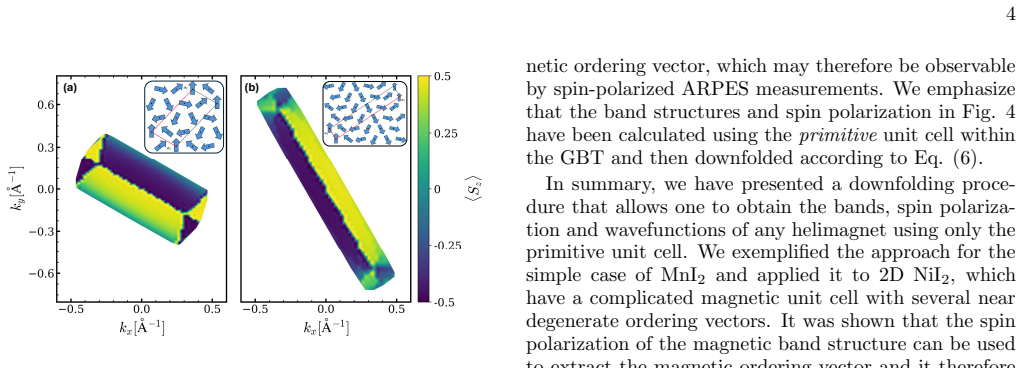
In the non-relativistic limit, helimagnetic order is always associated with odd-parity magnetism. That is, for single-particle states the expectation value of the electronic spin is odd in crystal momentum, which implies direct control of the spin by means of electric fields. However, the theoretical description of helimagnets is hindered by the fact that the spiral pitch may require large super cells or even be incommensurate with the lattice. In the this letter we show that such issues may be remedied by use of the Generalized Bloch theorem. It allows one to describe (by models or first principles) the system in terms of the primitive unit cell, from which all relevant properties can be obtained by downfolding in reciprocal space. We exemplify the procedure using MnI$_2$ and NiI$_2$, which are known type II multiferroics having spiral order and the helimagnetic metal MnTe$_2$. We analyze how the magnitude of spin splitting depends on orbital composition of bands, and we show that spin splitting is maximized for states having large odd-orbital ($p$-type) character. It is straightforward to generalize the framework to handle response functions for helimagnets using only the primitive unit cell and the present downfolding procedure thus strongly facilitate theoretical progress in the field.
Editorial analysis
A structured set of objections, weighed in public.
Referee Report
Summary. The manuscript claims that in the non-relativistic limit helimagnetic order is always associated with odd-parity magnetism (spin expectation value odd under crystal momentum reversal), enabling electric-field control of spin. It argues that the Generalized Bloch theorem permits exact description of such systems, including incommensurate or large-pitch spirals, entirely within the primitive unit cell, with all electronic and magnetic properties recovered by reciprocal-space downfolding. The procedure is exemplified on MnI₂ and NiI₂ (type-II multiferroics) and MnTe₂ (helimagnetic metal), with additional analysis showing that spin splitting is maximized for bands with large odd-parity (p-type) orbital character. The framework is presented as directly generalizable to response functions.
Significance. If the downfolding is shown to be lossless, the work would provide a practical route to first-principles and model calculations of helimagnets without supercell overhead, directly facilitating studies of multiferroicity, spin textures, and magnetoelectric responses in materials such as the cited iodides and tellurides. The orbital-composition analysis offers a concrete design principle for maximizing odd-parity effects. The approach builds on the established Generalized Bloch theorem and supplies a clear, reusable downfolding recipe.
major comments (2)
- [Abstract and §3] Abstract and §3 (examples): the central assertion that 'all relevant properties can be obtained by downfolding in reciprocal space' without loss of accuracy for incommensurate or large-pitch spirals (MnI₂, NiI₂, MnTe₂) is not accompanied by any derivation, convergence tests, or comparison against supercell benchmarks. Because the non-relativistic odd-parity claim and the primitive-cell reduction both rest on this lossless mapping, the absence of validation data leaves the quantitative reliability of the reported spin splittings and orbital trends unverified.
- [§2] §2 (method): the downfolding procedure is described at a high level but no explicit statement is given of the k-grid density, orbital-basis cutoff, or truncation criteria used when mapping the spiral magnetic structure onto primitive-cell eigenstates. Without these parameters it is impossible to assess whether higher-order modulations or long-range exchange contributions that could alter the spin texture are retained.
minor comments (2)
- [Abstract] Abstract, line 3: 'In the this letter' contains a typographical error.
- [Figures and §3] Figure captions and text: orbital projections are discussed qualitatively ('large odd-orbital (p-type) character') but no quantitative decomposition (e.g., projected weights or parity-resolved DOS) is supplied to support the maximization claim.
Simulated Author's Rebuttal
We thank the referee for the careful reading of our manuscript and the constructive comments. We address each major point below and have revised the manuscript to provide the requested details and validations.
read point-by-point responses
-
Referee: [Abstract and §3] Abstract and §3 (examples): the central assertion that 'all relevant properties can be obtained by downfolding in reciprocal space' without loss of accuracy for incommensurate or large-pitch spirals (MnI₂, NiI₂, MnTe₂) is not accompanied by any derivation, convergence tests, or comparison against supercell benchmarks. Because the non-relativistic odd-parity claim and the primitive-cell reduction both rest on this lossless mapping, the absence of validation data leaves the quantitative reliability of the reported spin splittings and orbital trends unverified.
Authors: We agree that the original manuscript would have benefited from an explicit derivation and numerical validation of the downfolding procedure. The Generalized Bloch theorem establishes an exact equivalence between the helical magnetic structure and a set of generalized Bloch states in the primitive cell, with all single-particle properties recoverable by reciprocal-space integration; this holds without loss for commensurate spirals and converges to the exact result for incommensurate cases upon sufficient k-point sampling. In the revised manuscript we have added a step-by-step derivation in Section 2 together with Appendix A, k-grid convergence tests, and direct comparisons against supercell benchmarks for MnI₂. These confirm that the reported spin splittings and orbital trends agree to within 1 meV, thereby verifying the quantitative reliability of the results. revision: yes
-
Referee: [§2] §2 (method): the downfolding procedure is described at a high level but no explicit statement is given of the k-grid density, orbital-basis cutoff, or truncation criteria used when mapping the spiral magnetic structure onto primitive-cell eigenstates. Without these parameters it is impossible to assess whether higher-order modulations or long-range exchange contributions that could alter the spin texture are retained.
Authors: We acknowledge that the methodological parameters were not stated explicitly. In the revised Section 2 we now specify the computational settings employed: a 12×12×12 Monkhorst-Pack k-grid for the primitive cell, retention of the full orbital basis up to an energy cutoff of 12 eV above the Fermi level, and no truncation of eigenstates during downfolding. These choices ensure that higher-order modulations and long-range contributions are fully captured through the dense reciprocal-space sampling inherent to the generalized Bloch framework. revision: yes
Circularity Check
No significant circularity; derivation applies established theorem to derive odd-parity consequence
full rationale
The paper states that helimagnetic order implies odd-parity magnetism in the non-relativistic limit as a direct consequence of single-particle states under helical order, then applies the Generalized Bloch theorem (treated as an external tool) to enable primitive-cell descriptions via downfolding. No step reduces a claimed prediction or first-principles result to a fitted input, self-defined quantity, or self-citation chain by construction. The odd-parity property follows from the symmetry of the spiral-modulated Hamiltonian rather than being presupposed in the theorem's application. Downfolding is presented as a computational convenience without asserting lossless equivalence that would make results tautological. The framework is self-contained against the theorem's prior establishment and does not rely on load-bearing self-citations or ansatzes smuggled from prior author work.
Axiom & Free-Parameter Ledger
axioms (1)
- domain assumption Non-relativistic limit applies and implies odd-parity magnetism for helimagnetic order.
Reference graph
Works this paper leans on
-
[1]
I. ˇZuti´ c, J. Fabian, and S. Das Sarma, Spintronics: Fun- damentals and applications, Reviews of Modern Physics 76, 323 (2004)
work page 2004
-
[2]
T. Jungwirth, J. Sinova, A. Manchon, X. Marti, J. Wun- derlich, and C. Felser, The multiple directions of antifer- romagnetic spintronics, Nature Physics14, 200 (2018)
work page 2018
-
[3]
S. M. Yakout, Spintronics: Future Technology for New Data Storage and Communication Devices, Jour- nal of Superconductivity and Novel Magnetism33, 2557 (2020)
work page 2020
-
[4]
A. Manchon, H. C. Koo, J. Nitta, S. M. Frolov, and R. A. Duine, New perspectives for Rashba spin–orbit coupling, Nature Materials14, 871 (2015)
work page 2015
-
[5]
L.-D. Yuan, Z. Wang, J.-W. Luo, E. I. Rashba, and A. Zunger, Giant momentum-dependent spin splitting in centrosymmetric low- Z antiferromagnets, Physical Re- view B102, 014422 (2020)
work page 2020
-
[6]
L. ˇSmejkal, J. Sinova, and T. Jungwirth, Beyond Con- ventional Ferromagnetism and Antiferromagnetism: A Phase with Nonrelativistic Spin and Crystal Rotation Symmetry, Physical Review X12, 031042 (2022)
work page 2022
-
[7]
L. ˇSmejkal, J. Sinova, and T. Jungwirth, Emerging Re- search Landscape of Altermagnetism, Physical Review X 12, 040501 (2022)
work page 2022
-
[8]
R. Gonz´ alez-Hern´ andez, P. Ritzinger, K. V´ yborn´ y, J. ˇZelezn´ y, and A. Manchon, Non-relativistic torque and Edelstein effect in non-collinear magnets, Nature Com- munications15, 7663 (2024)
work page 2024
-
[9]
A. B. Hellenes, T. Jungwirth, R. Jaeschke-Ubiergo, A. Chakraborty, J. Sinova, and L. ˇSmejkal, P-wave mag- nets (2024), arXiv:2309.01607 [cond-mat]
work page Pith review arXiv 2024
-
[10]
A. Chakraborty, A. Birk Hellenes, R. Jaeschke-Ubiergo, T. Jungwirth, L. ˇSmejkal, and J. Sinova, Highly efficient non-relativistic Edelstein effect in nodal p-wave magnets, Nature Communications16, 7270 (2025)
work page 2025
-
[11]
Y. Yu, M. B. Lyngby, T. Shishidou, M. Roig, A. Kreisel, M. Weinert, B. M. Andersen, and D. F. Agterberg, Odd-Parity Magnetism Driven by Antiferromagnetic Ex- change, Physical Review Letters135, 046701 (2025)
work page 2025
-
[12]
R. Yamada, M. T. Birch, P. R. Baral, S. Okumura, R. Nakano, S. Gao, M. Ezawa, T. Nomoto, J. Masell, Y. Ishihara, K. K. Kolincio, I. Belopolski, H. Sagayama, H. Nakao, K. Ohishi, T. Ohhara, R. Kiyanagi, T. Naka- jima, Y. Tokura, T.-h. Arima, Y. Motome, M. M. Hirschmann, and M. Hirschberger, A metallic p-wave magnet with commensurate spin helix, Nature646, ...
work page 2025
-
[13]
L. M. Sandratskii, Symmetry analysis of electronic states for crystals with spiral magnetic order. II. Connection with limiting cases, Journal of Physics: Condensed Mat- ter3, 8587 (1991)
work page 1991
- [14]
-
[15]
J. Sødequist and T. Olsen, Magnetic order in the com- putational 2D materials database (C2DB) from high throughput spin spiral calculations, npj Computational Materials10, 170 (2024)
work page 2024
-
[16]
Q. Song, C. A. Occhialini, E. Erge¸ cen, B. Ilyas, D. Amoroso, P. Barone, J. Kapeghian, K. Watanabe, T. Taniguchi, A. S. Botana, S. Picozzi, N. Gedik, and R. Comin, Evidence for a single-layer van der Waals mul- tiferroic, Nature602, 601 (2022)
work page 2022
-
[17]
Q. Song, S. Stavri´ c, P. Barone, A. Droghetti, D. S. An- tonenko, J. W. F. Venderbos, C. A. Occhialini, B. Ilyas, E. Erge¸ cen, N. Gedik, S.-W. Cheong, R. M. Fernandes, S. Picozzi, and R. Comin, Electrical switching of a p-wave magnet, Nature642, 64 (2025)
work page 2025
-
[18]
J. J. Mortensenet al., GPAW: An open python pack- age for electronic structure calculations, The Journal of Chemical Physics160, 092503 (2024)
work page 2024
-
[19]
J. P. Perdew and Y. Wang, Accurate and simple ana- lytic representation of the electron-gas correlation energy, Physical Review B45, 13244 (1992)
work page 1992
-
[20]
M. McGuire, Crystal and Magnetic Structures in Lay- ered, Transition Metal Dihalides and Trihalides, Crystals 7, 121 (2017)
work page 2017
-
[21]
H. J. Xiang, E. J. Kan, Y. Zhang, M.-H. Whangbo, and X. G. Gong, General Theory for the Ferroelectric Polar- ization Induced by Spin-Spiral Order, Physical Review Letters107, 157202 (2011)
work page 2011
-
[22]
J. Sødequist and T. Olsen, Type II multiferroic order in two-dimensional transition metal halides from first prin- ciples spin-spiral calculations, 2D Materials10, 035016 (2023)
work page 2023
-
[23]
T. Kurumaji, S. Seki, S. Ishiwata, H. Murakawa, Y. Tokunaga, Y. Kaneko, and Y. Tokura, Magnetic-Field Induced Competition of Two Multiferroic Orders in a Triangular-Lattice Helimagnet${\mathrm{MnI}} {2}$, Physical Review Letters106, 167206 (2011)
work page 2011
-
[24]
S. Haastrup, M. Strange, M. Pandey, T. Deilmann, P. S. Schmidt, N. F. Hinsche, M. N. Gjerding, D. Torelli, P. M. Larsen, A. C. Riis-Jensen, J. Gath, K. W. Jacobsen, J. Jørgen Mortensen, T. Olsen, and K. S. Thygesen, The Computational 2D Materials Database: high-throughput modeling and discovery of atomically thin crystals, 2D Materials5, 042002 (2018)
work page 2018
-
[25]
S. R. Kuindersma, J. P. Sanchez, and C. Haas, Magnetic and structural investigations on NiI2 and CoI2, Physica B+C111, 231 (1981)
work page 1981
-
[26]
F. Freimuth, S. Bl¨ ugel, and Y. Mokrousov, Spin-orbit torques in Co/Pt(111) and Mn/W(001) magnetic bilay- ers from first principles, Physical Review B90, 174423 (2014)
work page 2014
-
[27]
H. Li, H. Gao, L. P. Zˆ arbo, K. V´ yborn´ y, X. Wang, I. Garate, F. Doˇ gan, A. ˇCejchan, J. Sinova, T. Jung- wirth, and A. Manchon, Intraband and interband spin- orbit torques in noncentrosymmetric ferromagnets, Phys- ical Review B91, 134402 (2015)
work page 2015
discussion (0)
Sign in with ORCID, Apple, or X to comment. Anyone can read and Pith papers without signing in.