Recognition: unknown
Fermion Multiplicities at the GUT Scale: A Statistical Study of Unification and Proton Decay
Pith reviewed 2026-05-10 17:16 UTC · model grok-4.3
The pith
Multiple vector-like fermions in SU(5) grand unified theories raise the unification scale and suppress proton decay operators.
A machine-rendered reading of the paper's core claim, the machinery that carries it, and where it could break.
Core claim
By including multiple vector-like fermions, threshold corrections shift the unification scale upward while the admixture of Standard Model fermions from several GUT multiplets damps the nucleon-decay operators and loosens rigid Yukawa relations, yielding a consistent picture that reconciles gauge coupling unification, observed flavor patterns, and proton stability.
What carries the argument
Threshold corrections to gauge-coupling running from extra vector-like fermions, together with the suppression of decay operators by admixture of multiple GUT multiplets in the light fermions.
If this is right
- The three gauge couplings meet at approximately 10^15.5 GeV.
- Proton lifetimes exceed those of minimal SU(5) by a sizable factor.
- The bottom-tau mass relation is no longer forced to hold exactly at the unification scale.
- Searches must target several distinct proton-decay final states rather than a single dominant mode.
Where Pith is reading between the lines
- A statistical scan over fermion content implies that many different multiplicity choices can work, widening the range of viable models.
- The same admixture mechanism that lengthens proton life could also alter branching ratios among decay channels in ways future detectors could distinguish.
- If the extra fermions remain light enough to affect thresholds, they might leave indirect traces in precision flavor observables at lower energies.
Load-bearing premise
The added vector-like fermions must sit at masses and in numbers that produce helpful threshold corrections without creating new proton-decay channels or destroying perturbativity.
What would settle it
Observation of proton decay at a lifetime shorter than the range allowed by the raised unification scale would rule out the mechanism.
Figures




read the original abstract
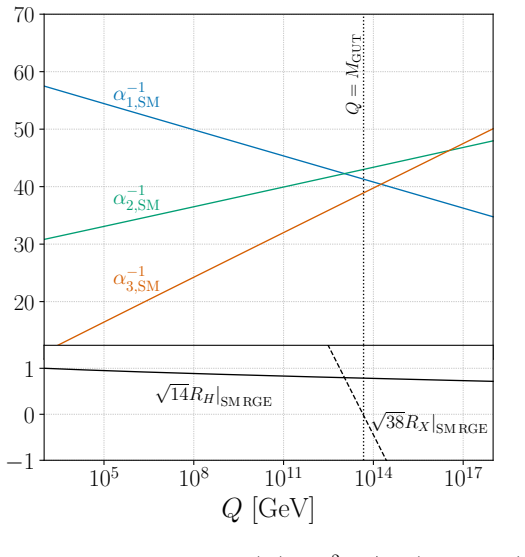
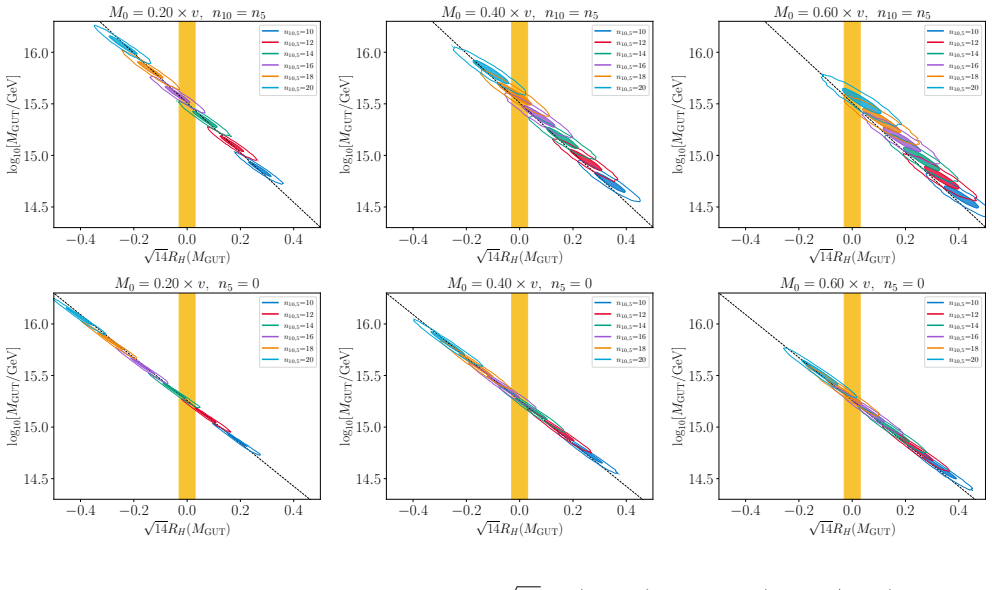
We study the impact of multiple vector-like fermions in SU(5) grand unified theory (GUT). Threshold effects from extra fermions allow the observed gauge couplings to be consistently matched to a single unified gauge coupling, and typically raise the unification scale to $M_\mathrm{GUT}\simeq 10^{15.5}\,\mathrm{GeV}$. Because the Standard Model fermions arise as admixtures of several GUT multiplets, the nucleon decay operator coefficients are further suppressed, leading to longer proton lifetimes than in conventional GUTs. We also find that the admixture of multiple GUT multiplets relaxes the rigid Yukawa relations of conventional GUTs and alleviates the bottom-tau unification problem. Overall, our analysis demonstrates that multi-fermion SU(5) GUTs provide a testable framework that simultaneously reconciles gauge coupling unification, realistic flavor structures, and proton stability. Our results highlight the importance of probing multiple proton-decay channels in next-generation experiments such as Hyper-Kamiokande to critically test this scenario.
Editorial analysis
A structured set of objections, weighed in public.
Referee Report
Summary. The manuscript performs a statistical study of SU(5) GUTs with additional vector-like fermions in various representations. Threshold corrections from these fields are shown to unify the three gauge couplings at a raised scale M_GUT ≃ 10^{15.5} GeV while remaining perturbative. Admixtures of multiple GUT multiplets for the SM fermions suppress the coefficients of dimension-6 nucleon decay operators, yielding longer proton lifetimes than in minimal SU(5). The same admixtures relax the rigid Yukawa relations, alleviating the b–τ unification tension. The authors conclude that multi-fermion SU(5) models simultaneously reconcile unification, flavor structure, and proton stability and are testable via multiple decay channels at Hyper-Kamiokande.
Significance. If the numerical scan is shown to be free of post-hoc tuning and the mass assignments are demonstrated to be consistent, the work would be significant for GUT phenomenology. It provides a concrete, statistically explored mechanism by which extra fermions can raise the unification scale and suppress proton decay without new decay channels, while improving flavor predictions. The emphasis on multiple proton-decay modes supplies falsifiable targets for next-generation experiments.
major comments (2)
- [§3] §3 (Statistical methodology): The scan over multiplicities and mass thresholds is presented as generating viable unification solutions, yet the acceptance criteria for mass values (required to lie between the electroweak and GUT scales while preserving perturbativity) are not shown to be independent of the unification condition itself. This leaves open whether the reported rise in M_GUT and the consequent proton-lifetime improvement are genuine outcomes or artifacts of the selection procedure.
- [§4.2 and §5] §4.2 and §5 (Proton decay and flavor): The claim that GUT-multiplet admixtures suppress all nucleon-decay operators without introducing new channels relies on the assumption that vector-like fermions do not generate additional dimension-6 operators via their Yukawa couplings to SM fields. No explicit operator list or suppression-factor calculation including these couplings is provided, which is load-bearing for the proton-stability assertion.
minor comments (2)
- [Abstract] The abstract states M_GUT ≃ 10^{15.5} GeV but does not quote the uncertainty or the fraction of scanned points that achieve this value; adding these numbers would strengthen the quantitative claim.
- Notation for the extra fermion representations (e.g., the precise SU(5) quantum numbers and multiplicity labels) should be collected in a single table for clarity.
Simulated Author's Rebuttal
We thank the referee for their careful reading of our manuscript and for providing constructive comments that will help improve the presentation and rigor of our work. Below we respond to each major comment in turn.
read point-by-point responses
-
Referee: [§3] §3 (Statistical methodology): The scan over multiplicities and mass thresholds is presented as generating viable unification solutions, yet the acceptance criteria for mass values (required to lie between the electroweak and GUT scales while preserving perturbativity) are not shown to be independent of the unification condition itself. This leaves open whether the reported rise in M_GUT and the consequent proton-lifetime improvement are genuine outcomes or artifacts of the selection procedure.
Authors: We appreciate the referee's concern regarding potential bias in our statistical methodology. In the manuscript, the multiplicities of vector-like fermions are scanned over a discrete set of representations, and their mass thresholds are sampled from a uniform distribution in logarithmic scale between the electroweak scale (~100 GeV) and an upper limit of 10^16 GeV, chosen to ensure perturbativity (i.e., the gauge couplings do not exceed 4π before the GUT scale). The unification condition is imposed only after the threshold corrections are computed, selecting those configurations where the three couplings meet at a single scale. To demonstrate the independence, we will revise §3 to include a detailed description of the prior sampling procedure and show histograms of accepted vs. rejected points based on mass criteria alone, before applying the unification filter. This will clarify that the rise in M_GUT is a robust outcome of the threshold effects rather than a selection artifact. revision: yes
-
Referee: [§4.2 and §5] §4.2 and §5 (Proton decay and flavor): The claim that GUT-multiplet admixtures suppress all nucleon-decay operators without introducing new channels relies on the assumption that vector-like fermions do not generate additional dimension-6 operators via their Yukawa couplings to SM fields. No explicit operator list or suppression-factor calculation including these couplings is provided, which is load-bearing for the proton-stability assertion.
Authors: The referee raises an important point about the completeness of our operator analysis. Our current treatment assumes that the vector-like fermions are integrated out at their mass scales, and any additional dimension-6 operators generated by their Yukawa interactions with the SM fields would be suppressed by the heavy mass scale, similar to the standard GUT operators. However, we acknowledge that an explicit enumeration was not provided. In the revised manuscript, we will add to §4.2 an explicit list of potential dimension-6 operators involving the vector-like fields and demonstrate that, due to the structure of the SU(5) representations and the absence of direct couplings that would mediate unsuppressed decays, no new unsuppressed channels are introduced. The suppression factors from admixtures will be recalculated including these considerations. This addition will strengthen the proton-stability claim. revision: yes
Circularity Check
No significant circularity: statistical scan produces independent structural consequences
full rationale
The paper conducts a statistical scan over vector-like fermion multiplicities and representations in SU(5), using the resulting threshold corrections to the gauge beta functions as a means to match the three low-energy couplings to a common value at a raised scale. For the same multiplicity choices that permit unification, the paper separately computes the suppression of dimension-6 nucleon decay operators arising from the admixture of SM fermions across multiple GUT multiplets. These two outputs are not identical by construction: the unification condition depends on the one-loop (and possibly two-loop) contributions to the running, while the lifetime enhancement depends on the Clebsch-Gordan coefficients and mixing angles in the effective operators. No equation or scan procedure is shown to equate the two quantities, and the low-energy gauge data serve as external input rather than a fitted output being relabeled as a prediction. The analysis therefore remains self-contained.
Axiom & Free-Parameter Ledger
free parameters (1)
- multiplicities and mass scales of vector-like fermions
axioms (2)
- domain assumption SU(5) gauge group unifies the Standard Model forces at a high scale with standard renormalization group evolution modified by thresholds
- domain assumption Vector-like fermions appear in complete GUT multiplets that mix with Standard Model fields
invented entities (1)
-
multiple copies of vector-like fermions in SU(5) representations
no independent evidence
Reference graph
Works this paper leans on
-
[1]
Georgi and S
H. Georgi and S. L. Glashow, Phys. Rev. Lett.32, 438 (1974)
1974
-
[2]
Georgi, H
H. Georgi, H. R. Quinn, and S. Weinberg, Phys. Rev. Lett.33, 451 (1974)
1974
-
[3]
A. J. Buras, J. R. Ellis, M. K. Gaillard, and D. V. Nanopoulos, Nucl. Phys.B135, 66 (1978)
1978
-
[4]
Navas et al
S. Navas et al. (Particle Data Group), Phys. Rev. D110, 030001 (2024)
2024
-
[5]
Georgi and C
H. Georgi and C. Jarlskog, Phys. Lett. B86, 297 (1979)
1979
-
[6]
Witten, Phys
E. Witten, Phys. Lett. B91, 81 (1980)
1980
-
[7]
Hempfling, Phys
R. Hempfling, Phys. Rev. D49, 6168 (1994)
1994
-
[8]
Q. Shafi and Z. Tavartkiladze, Phys. Lett. B459, 563 (1999), arXiv:hep-ph/9904249
-
[9]
B. Fornal and B. Grinstein, Phys. Rev. Lett.119, 241801 (2017), arXiv:1706.08535 [hep-ph] . 37
-
[10]
Minimal SU(5) GUTs with vectorlike fermions,
S. Antusch, K. Hinze, and S. Saad, Phys. Rev. D108, 095010 (2023), arXiv:2308.08585 [hep-ph]
-
[11]
Georgi, Nucl
H. Georgi, Nucl. Phys. B156, 126 (1979)
1979
-
[12]
Barbieri and D
R. Barbieri and D. V. Nanopoulos, Phys. Lett. B91, 369 (1980)
1980
- [13]
- [14]
-
[15]
Weinberg, Phys
S. Weinberg, Phys. Lett. B91, 51 (1980)
1980
-
[16]
L. J. Hall, Nucl. Phys. B178, 75 (1981)
1981
- [17]
-
[18]
D. R. T. Jones, Nucl. Phys. B75, 531 (1974)
1974
- [19]
- [20]
- [21]
-
[22]
A. Takenaka et al. (Super-Kamiokande), Phys. Rev. D102, 112011 (2020), arXiv:2010.16098 [hep-ex]
-
[23]
C. D. Froggatt and H. B. Nielsen, Nucl. Phys. B147, 277 (1979)
1979
-
[24]
Search for proton decay viap→νK + us- ing 260 kiloton·year data of Super-Kamiokande,
K. Abe et al. (Super-Kamiokande), Phys. Rev. D90, 072005 (2014), arXiv:1408.1195 [hep-ex]
-
[25]
S. Jung et al. (Super-Kamiokande), Phys. Rev. D113, 012015 (2026), arXiv:2510.26232 [hep-ex]
-
[26]
Hyper-Kamiokande Design Report
K. Abe et al. (Hyper-Kamiokande), (2018), arXiv:1805.04163 [physics.ins-det]
work page Pith review arXiv 2018
- [27]
-
[28]
A. Chitose, M. Ibe, and S. Shirai, JHEP02, 183 (2026), arXiv:2510.13617 [hep-ph]
-
[29]
L. F. Abbott and M. B. Wise, Phys. Rev. D22, 2208 (1980)
1980
-
[30]
N. Nagata and S. Shirai, JHEP03, 049 (2014), arXiv:1312.7854 [hep-ph] . 38
discussion (0)
Sign in with ORCID, Apple, or X to comment. Anyone can read and Pith papers without signing in.