Elastic and Viscous Effects in Viscoelastic Flows: Elucidating the Distinct Roles of the Deborah and Weissenberg Numbers
Pith reviewed 2026-05-10 17:11 UTC · model grok-4.3
The pith
The Deborah and Weissenberg numbers play distinct roles in describing elastic and viscous effects in viscoelastic flows.
A machine-rendered reading of the paper's core claim, the machinery that carries it, and where it could break.
Core claim
In the Oldroyd-B model, the Deborah number De represents the ratio of the fluid's relaxation time to the characteristic time scale of the flow, particularly important in unsteady situations, whereas the Weissenberg number Wi characterizes the ratio of relaxation time to the inverse of the shear rate, dominant in steady shear flows. Analysis of the two geometries shows these lead to different impacts on the velocity and stress fields, providing guidelines for their separate use in analytical and numerical studies of viscoelastic flows.
What carries the argument
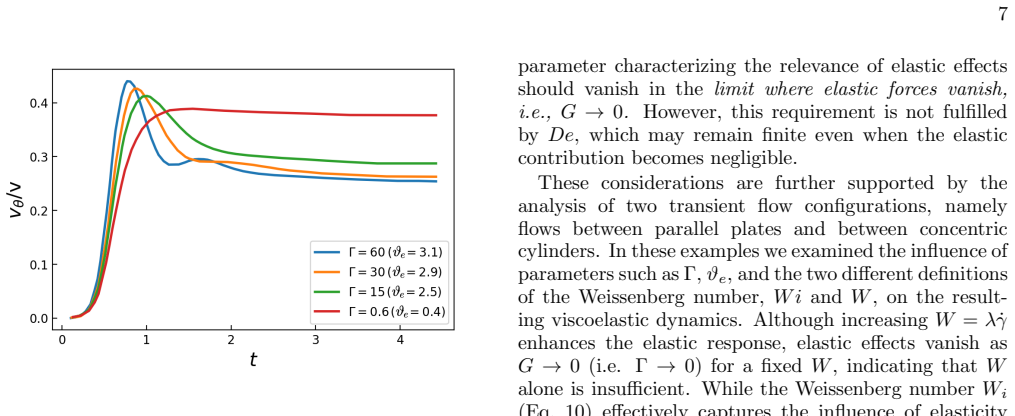
The Oldroyd-B constitutive equations applied to an unsteady planar flow with analytical solution and a coaxial rotating cylinders flow with numerical simulation, used to separate the effects of De and Wi.
If this is right
- Analytical solutions in time-dependent flows should prioritize the Deborah number to capture transient elastic responses.
- Numerical simulations of steady shear-dominated flows benefit from focusing on the Weissenberg number for viscous-elastic balance.
- Ambiguities in literature interpretations of viscoelastic phenomena can be reduced by assigning De and Wi to their specific physical roles.
- Guidelines from these cases apply to both theoretical analysis and experimental design in complex fluid dynamics.
Where Pith is reading between the lines
- Similar distinctions might apply to other constitutive models like FENE or Giesekus if tested in comparable setups.
- These insights could extend to more complex geometries such as flow past obstacles or in porous media.
- Experimental validation with real viscoelastic fluids could confirm if the numerical distinctions hold in practice.
Load-bearing premise
The Oldroyd-B constitutive model together with the two chosen flow geometries are sufficiently representative to establish general guidelines for the distinct roles of De and Wi across viscoelastic flows.
What would settle it
Observing that De and Wi produce identical effects on flow characteristics in a third independent geometry or constitutive model would falsify the claimed distinction.
Figures
read the original abstract
The interpretation of the parameters appearing in constitutive models for viscoelastic fluids is essential for analyzing theoretical predictions and understanding the origin of phenomena observed in experiments. In this work, we examine the physical significance of the Deborah ($De$) and Weissenberg ($Wi$) numbers, along with other key parameters commonly used in these models. The central objective is to clarify the extent to which these dimensionless groups effectively characterise the competition between elastic and viscous effects in complex flows. While these parameters are ubiquitous in theoretical and experimental research, their interpretation is often context-dependent and prone to ambiguity. To address this, we analyse two representative scenarios: an analytical solution for unsteady planar flow and a numerical simulation of viscoelastic flow between rotating coaxial cylinders, governed by the Oldroyd-B constitutive equations. Our findings elucidate the distinct roles of these dimensionless numbers, offering guidelines for their rigorous interpretation in both analytical and numerical studies.
Editorial analysis
A structured set of objections, weighed in public.
Referee Report
Summary. The paper analyzes the physical interpretation of the Deborah (De) and Weissenberg (Wi) numbers in viscoelastic flows governed by the Oldroyd-B constitutive model. It derives an analytical solution for unsteady planar shear flow and performs numerical simulations of flow between coaxial rotating cylinders to distinguish how De (relaxation time relative to process time) and Wi (relaxation time relative to flow time scale) separately characterize elastic versus viscous competition, and offers interpretive guidelines for analytical and numerical studies.
Significance. If the distinctions are robust, the work would help resolve frequent ambiguities in the use of De and Wi across the viscoelastic fluids literature. The combination of exact analytical results with numerical verification in a second geometry is a strength, as is the explicit focus on parameter definitions rather than fitting.
major comments (2)
- [Abstract and the sections presenting the unsteady planar flow and coaxial-cylinder results] The central claim that the observed distinctions yield general guidelines for De and Wi roles rests on the representativeness of the Oldroyd-B model and the two chosen shear-dominated geometries. No cross-validation with constitutive models that include shear-thinning or finite extensibility (e.g., Giesekus or FENE-P) or with flows containing significant extensional kinematics is provided; if the relative weighting of De versus Wi changes under those conditions, the proposed guidelines would not hold broadly.
- [Numerical simulation section (coaxial cylinders)] In the coaxial-cylinder numerical case, the flow remains simple shear with no strong extensional components. The manuscript does not demonstrate that the De/Wi separation identified in these kinematics persists when the velocity field includes regions of extension or complex streamlines, which are common in applications where the distinction is most needed.
minor comments (2)
- [Analytical solution section] Clarify the exact definitions of the process time and flow time scale used to form De and Wi in each example; small differences in these choices can alter the reported separation between the two numbers.
- [Introduction and parameter discussion] The abstract states that 'other key parameters' are examined, but the manuscript should explicitly list which additional dimensionless groups (e.g., viscosity ratio) are varied and how they interact with De and Wi.
Simulated Author's Rebuttal
We thank the referee for the constructive and detailed comments, which help us better delineate the scope of our findings. We address each major comment below, acknowledging the limitations of the chosen model and flows while defending the value of the analysis within its intended context. We will make partial revisions to clarify these points without overclaiming generality.
read point-by-point responses
-
Referee: [Abstract and the sections presenting the unsteady planar flow and coaxial-cylinder results] The central claim that the observed distinctions yield general guidelines for De and Wi roles rests on the representativeness of the Oldroyd-B model and the two chosen shear-dominated geometries. No cross-validation with constitutive models that include shear-thinning or finite extensibility (e.g., Giesekus or FENE-P) or with flows containing significant extensional kinematics is provided; if the relative weighting of De versus Wi changes under those conditions, the proposed guidelines would not hold broadly.
Authors: We appreciate this observation on the scope of our claims. The Oldroyd-B model was selected precisely because it is the minimal constitutive model that retains distinct viscous and elastic contributions without additional nonlinear effects such as shear-thinning or finite extensibility, thereby allowing a clean isolation of the De and Wi roles. The unsteady planar shear flow and coaxial-cylinder geometry are canonical, analytically tractable cases that permit independent variation of the two numbers. We do not assert that the resulting guidelines are universal; rather, they illustrate how the definitions of De (process time) and Wi (flow time scale) lead to distinct physical interpretations within this framework. To address the concern, we will revise the abstract, introduction, and concluding section to explicitly qualify the guidelines as applicable to Oldroyd-B fluids in shear-dominated kinematics and to note that extension to models with shear-thinning or extensional effects remains an open question for future work. revision: partial
-
Referee: [Numerical simulation section (coaxial cylinders)] In the coaxial-cylinder numerical case, the flow remains simple shear with no strong extensional components. The manuscript does not demonstrate that the De/Wi separation identified in these kinematics persists when the velocity field includes regions of extension or complex streamlines, which are common in applications where the distinction is most needed.
Authors: We agree that both geometries examined are shear-dominated and lack significant extensional kinematics. The coaxial-cylinder configuration was chosen because it permits a steady, spatially uniform shear rate while still allowing independent control of De and Wi through the relaxation time and cylinder speed; this complements the time-dependent planar flow. The separation we report follows directly from the structure of the Oldroyd-B equations and the definitions of the dimensionless groups, independent of the specific shear rate distribution. Nevertheless, we recognize that in flows with strong extension (e.g., contraction or stagnation-point flows) the relative importance may shift due to extensional viscosity. We will add a dedicated paragraph in the discussion section that acknowledges this limitation, explains why the shear cases provide a necessary first step for isolating the effects, and outlines how the same definitional distinction could be tested in extensional flows. Additional simulations with complex kinematics are beyond the present study but will be flagged as important future work. revision: partial
- Cross-validation of the De/Wi distinction with constitutive models that incorporate shear-thinning or finite extensibility (Giesekus, FENE-P) and with flows containing significant extensional components would require new analytical derivations and numerical campaigns that exceed the scope and resources of the current manuscript.
Circularity Check
No circularity; distinctions derived from direct Oldroyd-B solutions in explicit geometries
full rationale
The paper computes analytical solutions to the unsteady planar flow and performs numerical simulations of coaxial-cylinder flow under the standard Oldroyd-B constitutive model. The claimed guidelines for interpreting De versus Wi emerge from these explicit calculations of elastic and viscous contributions rather than from any fitted parameter, self-referential definition, or load-bearing self-citation. No step reduces the target distinction to an input by construction; the analysis remains self-contained against the chosen model and flows.
Axiom & Free-Parameter Ledger
axioms (1)
- domain assumption The Oldroyd-B constitutive equations accurately represent the viscoelastic behavior for the unsteady planar flow and coaxial cylinder flow examined.
Reference graph
Works this paper leans on
-
[1]
R.R. Huilgol and N. Phan-Thien, Fluid Mechanics of Viscoelasticity , Elsevier, Amsterdam, 1997
work page 1997
-
[2]
Dealy, Weissenberg and Deborah numbers – their definition and use , Rheol
J.M. Dealy, Weissenberg and Deborah numbers – their definition and use , Rheol. Bull.- Soc. Rheol. 79 (2010) 14–18
work page 2010
-
[3]
Larson, The Structure and Rheology of Complex Fluids , Oxford University Press, Oxford, 1999
R.G. Larson, The Structure and Rheology of Complex Fluids , Oxford University Press, Oxford, 1999
work page 1999
-
[4]
R.G. Larson, Constitutive equations for polymer melts and solutions: Butterworths series in chemical engineering. Butterworth-Heinemann, 2013
work page 2013
-
[5]
Poole, The Deborah and Weissenberg numbers , Rheol
R.J. Poole, The Deborah and Weissenberg numbers , Rheol. Bull. Br. Soc. Rheol. 53 (2012) 32–39
work page 2012
-
[6]
Huilgol, On the Concept of the Deborah Number , Trans
R.R. Huilgol, On the Concept of the Deborah Number , Trans. Soc. Rheol. 19 (1975) 297–306
work page 1975
-
[7]
de Souza Mendes, Dimensionless non-Newtonian fluid mechanics , J
P.R. de Souza Mendes, Dimensionless non-Newtonian fluid mechanics , J. Non-Newton. Fluid Mech. 147 (2007) 109–116
work page 2007
-
[8]
R.L. Thompson and C.M. Oishi, J. Non-Newtonian Fluid Mech. 292 (2021) 104550
work page 2021
- [9]
-
[10]
E.S.G. Shaqfeh and B. Khomami, The Oldroyd-B Fluid in Elastic Instabilities, Turbulence and Particle Suspensions , J. Non-Newtonian Fluid Mech. 0 (2021) 1–39
work page 2021
-
[11]
Kundu, Fluid Mechanics , 2nd ed., Academic Press, London, 2002
P.K. Kundu, Fluid Mechanics , 2nd ed., Academic Press, London, 2002
work page 2002
-
[12]
R. Guido et al., Development and decay of vortex flows in viscoelastic fluids between concentric cylinders , J. Phys.: Condens. Matter 34 (2022) 154003
work page 2022
-
[13]
Tanner, Note on the Rayleigh problem for a visco-elastic fluid , Z
R.I. Tanner, Note on the Rayleigh problem for a visco-elastic fluid , Z. Angew. Math. Phys. 13 (1962) 573–580
work page 1962
-
[14]
K.R. Rajagopal and R.K. Bhatnagar, Exact solutions for some simple flows of an Oldroyd-B fluid , Acta Mechanica 113 (1995) 233–238
work page 1995
-
[15]
T. Hayat, A.M. Siddiqui, S. Asghar, Some simple flows of an Oldroyd-B fluid , Int. J. Eng. Sci. 39 (2001) 135–147
work page 2001
-
[16]
T. Hayat , Masood Khan, M. Ayub, Exact solutions of flows problems of an Oldroyd-B fluid , App. Math. Comput. 151 (2004) 105-119
work page 2004
-
[17]
J.M. Martel and M. Toner, Inertial focusing dynamics in spiral microchannels , Phys. Fluids 24 , 032001 (2012)
work page 2012
- [18]
-
[19]
S.A. Obembe and F.T. Tepe, A fast scheme for incompressible viscoelastic fluids , Comput. Math. Appl. 59 (2010) 1327–1337
work page 2010
-
[20]
L. Zhu, E. Lauga, and L. Brandt, Self-propulsion in viscoelastic fluids , Phys. Rev. Lett. 117 (2016) 028102
work page 2016
-
[21]
N. Phan-Thien and Y.T. Chew, On the Rayleigh problem for a viscoelastic fluid , J. Non-Newtonian Fluid Mech. 28 (1988) 117–129
work page 1988
- [22]
discussion (0)
Sign in with ORCID, Apple, or X to comment. Anyone can read and Pith papers without signing in.