Recognition: 2 theorem links
· Lean TheoremMultivariate quantum reservoir computing with discrete and continuous variable systems
Pith reviewed 2026-05-10 17:51 UTC · model grok-4.3
The pith
Optimal encoding for quantum reservoirs depends on the system and task, with peak performance tied to non-classical effects.
A machine-rendered reading of the paper's core claim, the machinery that carries it, and where it could break.
Core claim
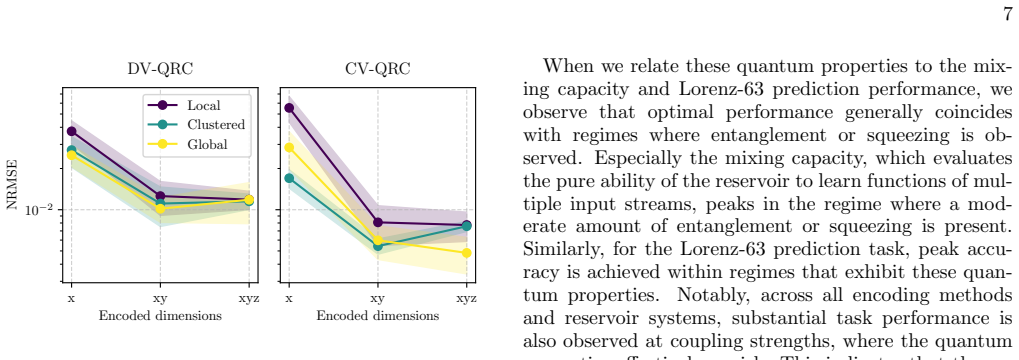
We establish an extensive framework for multivariate data processing in quantum reservoir computing. We propose and evaluate three multivariate encoding schemes and introduce the mixing capacity as a novel metric to evaluate the effectiveness with which a reservoir combines independent data streams. The computational performance of these proposed schemes is systematically assessed using this metric, as well as on the chaotic Lorenz-63 system prediction task, for two quantum reservoirs based on discrete and continuous-variable quantum systems. Our findings reveal that the optimal encoding method is highly dependent on the reservoir system and the specific task. Moreover, we observe that peak
What carries the argument
The mixing capacity metric for evaluating how effectively quantum reservoirs combine independent input streams, along with task-specific multivariate encoding schemes for discrete and continuous variable systems.
Load-bearing premise
That the coincidence of peak performance with non-classical effects means quantum resources are actively contributing to the computation rather than merely correlating with good performance by chance.
What would settle it
Demonstrating equivalent or better performance on the Lorenz-63 task using a classical reservoir that lacks non-classical features but matches the mixing capacity would challenge the claim that quantum resources play a causal role.
Figures



read the original abstract
Quantum reservoir computing is a promising paradigm for processing temporal data. So far, the primary focus has been on univariate time series. However, the most relevant and complex real-world data is multidimensional. In this paper, we establish an extensive framework for multivariate data processing in quantum reservoir computing. We propose and evaluate three multivariate encoding schemes and introduce the mixing capacity as a novel metric to evaluate the effectiveness with which a reservoir combines independent data streams. The computational performance of these proposed schemes is systematically assessed using this metric, as well as on the chaotic Lorenz-63 system prediction task, for two quantum reservoirs based on discrete and continuous-variable quantum systems. Furthermore, we relate the computational performance on these tasks to the underlying quantum properties of the reservoir. Our findings reveal that the optimal encoding method is highly dependent on the reservoir system and the specific task, underlining the importance of a task-specific input design. Moreover, we observe that peak computational performance coincides with the presence of non-classical effects, which indicates that quantum resources play a role in processing multivariate data.
Editorial analysis
A structured set of objections, weighed in public.
Referee Report
Summary. The paper establishes a framework for multivariate quantum reservoir computing using discrete-variable and continuous-variable systems. It proposes three encoding schemes for multivariate inputs, defines a mixing capacity metric to quantify how reservoirs combine independent data streams, and evaluates performance via this metric and the Lorenz-63 chaotic prediction task. Computational results are related to quantum properties such as non-classicality (negative Wigner functions, entanglement), leading to the claims that optimal encoding is task- and system-dependent and that peak performance coincides with non-classical effects, indicating a role for quantum resources.
Significance. If the link between non-classical effects and performance advantage is substantiated, the work would meaningfully advance quantum reservoir computing by moving beyond univariate time series to realistic multivariate data, introducing a useful new metric, and providing a comparative study of DV and CV reservoirs. The systematic parameter sweeps and task-specific findings are strengths. However, the absence of classical controls means the quantum-resource claim remains correlational rather than causal, limiting immediate impact on the broader quantum machine learning literature.
major comments (2)
- Results/Discussion section on quantum properties: The central claim that 'quantum resources play a role in processing multivariate data' rests on the observed coincidence between peak performance (on mixing capacity and Lorenz-63) and non-classical signatures. No classical reservoir baseline is presented whose dynamics are engineered to reproduce the same mixing capacity and input-output map without quantum features; because mixing capacity is defined in a manner accessible to classical systems, this leaves open the possibility that the advantage is dynamical rather than quantum-specific.
- Section introducing the mixing capacity metric: The metric is used to assess encoding effectiveness and to link performance to quantumness, yet its precise mathematical definition and normalization (including how independence of streams is quantified) are not shown to be robust against classical approximations; a short derivation or explicit formula would strengthen the claim that it isolates quantum contributions.
minor comments (2)
- Figure captions (e.g., those showing Wigner functions or performance vs. parameter sweeps): Axis labels and color legends for the three encoding schemes are occasionally ambiguous; explicit mapping of colors/linestyles to schemes would improve readability.
- Notation section: The symbols for the three proposed encoding schemes are introduced without a consolidated table; adding one would aid cross-referencing between methods and results.
Simulated Author's Rebuttal
We thank the referee for the constructive and detailed report. We address each major comment below and will revise the manuscript to improve clarity on the interpretation of our results and the presentation of the mixing capacity metric.
read point-by-point responses
-
Referee: Results/Discussion section on quantum properties: The central claim that 'quantum resources play a role in processing multivariate data' rests on the observed coincidence between peak performance (on mixing capacity and Lorenz-63) and non-classical signatures. No classical reservoir baseline is presented whose dynamics are engineered to reproduce the same mixing capacity and input-output map without quantum features; because mixing capacity is defined in a manner accessible to classical systems, this leaves open the possibility that the advantage is dynamical rather than quantum-specific.
Authors: We agree that our evidence linking non-classical effects to performance is correlational, as the manuscript does not include a classical reservoir baseline engineered to match the observed mixing capacity and input-output behavior. The mixing capacity metric is indeed formulated in a manner that classical systems could in principle satisfy. In the revised manuscript, we will update the Results/Discussion section to explicitly characterize the observed coincidence as correlational evidence rather than a demonstration of quantum-specific advantage. We will temper the language regarding the role of quantum resources and note that distinguishing dynamical from quantum contributions would require classical controls, which we suggest as a direction for future work. revision: yes
-
Referee: Section introducing the mixing capacity metric: The metric is used to assess encoding effectiveness and to link performance to quantumness, yet its precise mathematical definition and normalization (including how independence of streams is quantified) are not shown to be robust against classical approximations; a short derivation or explicit formula would strengthen the claim that it isolates quantum contributions.
Authors: We appreciate the suggestion to strengthen the presentation of the mixing capacity. While the metric is defined and used in the manuscript, we acknowledge that an explicit formula, normalization details, and a short derivation would improve transparency and allow readers to assess its behavior under classical approximations. In the revised manuscript, we will insert a dedicated subsection or appendix providing the precise mathematical definition of mixing capacity, the normalization procedure, the quantification of stream independence, and a brief derivation of its computation. We will also add a short discussion of its applicability to classical systems. revision: yes
Circularity Check
No circularity: empirical observations and task-specific evaluations stand independently of inputs.
full rationale
The paper introduces three encoding schemes and the mixing capacity metric, then reports their performance on the Lorenz-63 task for discrete- and continuous-variable reservoirs while correlating results with non-classical signatures. These steps consist of proposal, numerical evaluation, and observational interpretation rather than any derivation that reduces by construction to fitted parameters, self-definitions, or self-citation chains. No equations are presented that equate a claimed prediction to its own input; the coincidence between peak performance and non-classical effects is stated as an observation, not derived from prior results by the same authors. The analysis remains self-contained against external benchmarks.
Axiom & Free-Parameter Ledger
Lean theorems connected to this paper
-
IndisputableMonolith/Cost/FunctionalEquation.leanwashburn_uniqueness_aczel unclear?
unclearRelation between the paper passage and the cited Recognition theorem.
We propose and evaluate three multivariate encoding schemes and introduce the mixing capacity as a novel metric...
-
IndisputableMonolith/Foundation/RealityFromDistinction.leanreality_from_one_distinction unclear?
unclearRelation between the paper passage and the cited Recognition theorem.
peak computational performance coincides with the presence of non-classical effects
What do these tags mean?
- matches
- The paper's claim is directly supported by a theorem in the formal canon.
- supports
- The theorem supports part of the paper's argument, but the paper may add assumptions or extra steps.
- extends
- The paper goes beyond the formal theorem; the theorem is a base layer rather than the whole result.
- uses
- The paper appears to rely on the theorem as machinery.
- contradicts
- The paper's claim conflicts with a theorem or certificate in the canon.
- unclear
- Pith found a possible connection, but the passage is too broad, indirect, or ambiguous to say the theorem truly supports the claim.
Reference graph
Works this paper leans on
-
[1]
This DV-QRC model has been widely studied in the context of QRC [12]
Discrete variable QRC The first system we consider is based on the transverse field Ising model. This DV-QRC model has been widely studied in the context of QRC [12]. Specifically, we study a model of a tilted transverse field Ising model ofnspins, similar to the model in [28] H(t) = X i<j Jijσx i σx j + nX i=1 (hzσz i +h x i (t)σx i ) (1) with Pauli oper...
-
[2]
Continuous variable QRC An alternative approach to QRC is based on CV quan- tum systems with Gaussian states [18, 20]. We consider a system ofncoupled quantum harmonic oscillators H(t) = nX i=1 1 2 ˆp2 i +ω i(t)2ˆq2 i + X i<j Jij 2 (ˆqi −ˆqj)2 (3) with the position and momentum operators ˆq i and ˆpi of thei-th oscillator, time-dependent frequenciesω i(t)...
2075
-
[3]
Jaeger and H
H. Jaeger and H. Haas, Harnessing Nonlinearity: Pre- dicting Chaotic Systems and Saving Energy in Wireless Communication, Science304, 78 (2004)
2004
-
[4]
Maass, T
W. Maass, T. Natschl¨ ager, and H. Markram, Real-Time Computing Without Stable States: A New Framework for Neural Computation Based on Perturbations, Neural Computation14, 2531 (2002)
2002
-
[5]
Vandoorne, P
K. Vandoorne, P. Mechet, T. Van Vaerenbergh, M. Fiers, G. Morthier, D. Verstraeten, B. Schrauwen, J. Dambre, and P. Bienstman, Experimental demonstration of reser- voir computing on a silicon photonics chip, Nature Com- munications5, 3541 (2014)
2014
-
[6]
Nakajima, K
M. Nakajima, K. Tanaka, and T. Hashimoto, Scalable reservoir computing on coherent linear photonic proces- sor, Communications Physics4, 1 (2021)
2021
-
[7]
Brunner, M
D. Brunner, M. C. Soriano, C. R. Mirasso, and I. Fischer, Parallel photonic information processing at gigabyte per second data rates using transient states, Nature Commu- nications4, 1364 (2013)
2013
-
[8]
Duport, B
F. Duport, B. Schneider, A. Smerieri, M. Haelterman, and S. Massar, All-optical reservoir computing, Optics Express20, 22783 (2012)
2012
-
[9]
C. Du, F. Cai, M. A. Zidan, W. Ma, S. H. Lee, and W. D. Lu, Reservoir computing using dynamic memris- tors for temporal information processing, Nature Com- munications8, 2204 (2017)
2017
-
[10]
Zhong, J
Y. Zhong, J. Tang, X. Li, B. Gao, H. Qian, and H. Wu, Dynamic memristor-based reservoir computing for high- 11 efficiency temporal signal processing, Nature Communi- cations12, 408 (2021)
2021
-
[11]
Lymburn, S
T. Lymburn, S. D. Algar, M. Small, and T. J¨ ungling, Reservoir computing with swarms, Chaos: An Interdisci- plinary Journal of Nonlinear Science31, 033121 (2021)
2021
- [12]
- [13]
-
[14]
Fujii and K
K. Fujii and K. Nakajima, Harnessing Disordered- Ensemble Quantum Dynamics for Machine Learning, Physical Review Applied8, 024030 (2017)
2017
-
[15]
Nakajima, K
K. Nakajima, K. Fujii, M. Negoro, K. Mitarai, and M. Kitagawa, Boosting Computational Power through Spatial Multiplexing in Quantum Reservoir Computing, Physical Review Applied11, 034021 (2019)
2019
-
[16]
Mart´ ınez-Pe˜ na, J
R. Mart´ ınez-Pe˜ na, J. Nokkala, G. L. Giorgi, R. Zam- brini, and M. C. Soriano, Information Processing Capac- ity of Spin-Based Quantum Reservoir Computing Sys- tems, Cognitive Computation15, 1440 (2023)
2023
-
[17]
Ghosh, A
S. Ghosh, A. Opala, M. Matuszewski, T. Paterek, and T. C. H. Liew, Quantum reservoir processing, npj Quan- tum Information5, 1 (2019)
2019
-
[18]
Tovey, T
S. Tovey, T. Fellner, C. Holm, and M. Spannowsky, Gen- erating quantum reservoir state representations with ran- dom matrices, Machine Learning: Science and Technol- ogy6, 015068 (2025)
2025
-
[19]
Expressiv- ity limits of quantum reservoir computing, 2025
N.-E. Sch¨ utte, N. G¨ otting, H. M¨ untinga, M. List, D. Brunner, and C. Gies, Expressivity Limits of Quantum Reservoir Computing (2025), arXiv:2501.15528 [quant- ph]
-
[20]
Nokkala, R
J. Nokkala, R. Mart´ ınez-Pe˜ na, G. L. Giorgi, V. Pa- rigi, M. C. Soriano, and R. Zambrini, Gaussian states of continuous-variable quantum systems provide univer- sal and versatile reservoir computing, Communications Physics4, 53 (2021)
2021
-
[21]
L. C. G. Govia, G. J. Ribeill, G. E. Rowlands, H. K. Krovi, and T. A. Ohki, Quantum reservoir computing with a single nonlinear oscillator, Physical Review Re- search3, 013077 (2021)
2021
-
[22]
Garc´ ıa-Beni, G
J. Garc´ ıa-Beni, G. L. Giorgi, M. C. Soriano, and R. Zam- brini, Scalable Photonic Platform for Real-Time Quan- tum Reservoir Computing, Physical Review Applied20, 014051 (2023)
2023
-
[23]
Steinegger and C
J. Steinegger and C. R¨ ath, Predicting three-dimensional chaotic systems with four qubit quantum systems, Scien- tific Reports15, 6201 (2025)
2025
-
[24]
X. Li, C. Huo, C. Zhao, and X. Duan, Higher-order quan- tum reservoir computing for forecasting complex dynam- ics, Discrete and Continuous Dynamical Systems - I: In- telligence1, 10.3934/dcdsi.A260101 (Fri Feb 27 00:00:00 UTC 2026)
-
[25]
Palacios, R
A. Palacios, R. Mart´ ınez-Pe˜ na, M. C. Soriano, G. L. Giorgi, and R. Zambrini, Role of coherence in many- body Quantum Reservoir Computing, Communications Physics7, 1 (2024)
2024
-
[26]
G¨ otting, F
N. G¨ otting, F. Lohof, and C. Gies, Exploring quantum- ness in quantum reservoir computing, Physical Review A 108, 052427 (2023)
2023
-
[27]
Garc´ ıa-Beni, G
J. Garc´ ıa-Beni, G. L. Giorgi, M. C. Soriano, and R. Zam- brini, Squeezing as a resource for time series processing in quantum reservoir computing, Optics Express32, 6733 (2024)
2024
- [28]
-
[29]
Dambre, D
J. Dambre, D. Verstraeten, B. Schrauwen, and S. Massar, Information Processing Capacity of Dynamical Systems, Scientific Reports2, 514 (2012)
2012
-
[30]
Sannia, R
A. Sannia, R. Mart´ ınez-Pe˜ na, M. C. Soriano, G. L. Giorgi, and R. Zambrini, Dissipation as a resource for Quantum Reservoir Computing, Quantum8, 1291 (2024)
2024
-
[31]
Bergstra, R
J. Bergstra, R. Bardenet, Y. Bengio, and B. K´ egl, Algo- rithms for Hyper-Parameter Optimization, inAdvances in Neural Information Processing Systems, Vol. 24 (Cur- ran Associates, Inc., 2011)
2011
-
[32]
E. N. Lorenz, Deterministic Nonperiodic Flow, Journal of the Atmospheric Sciences20, 130 (1963)
1963
-
[33]
Vidal and R
G. Vidal and R. F. Werner, Computable measure of en- tanglement, Physical Review A65, 032314 (2002)
2002
-
[34]
Yu and J
T. Yu and J. H. Eberly, Sudden Death of Entanglement, Science323, 598 (2009)
2009
-
[35]
Ghosh, T
S. Ghosh, T. Krisnanda, T. Paterek, and T. C. H. Liew, Realising and compressing quantum circuits with quan- tum reservoir computing, Communications Physics4, 105 (2021)
2021
-
[36]
Nokkala, G
J. Nokkala, G. L. Giorgi, and R. Zambrini, Retriev- ing past quantum features with deep hybrid classical- quantum reservoir computing, Machine Learning: Sci- ence and Technology5, 035022 (2024)
2024
-
[37]
Krisnanda, P
T. Krisnanda, P. Song, A. Copetudo, C. Y. Fontaine, T. Paterek, T. C. H. Liew, and Y. Y. Gao, Experi- mental demonstration of enhanced quantum tomography via quantum reservoir processing, Quantum Science and Technology10, 035041 (2025)
2025
-
[38]
QuTiP 5: The Quantum Toolbox in Python
N. Lambert, E. Gigu` ere, P. Menczel, B. Li, P. Hopf, G. Su´ arez, M. Gali, J. Lishman, R. Gadhvi, R. Agarwal, A. Galicia, N. Shammah, P. Nation, J. R. Johansson, S. Ahmed, S. Cross, A. Pitch- ford, and F. Nori, QuTiP 5: The Quantum Tool- box in Python, arXiv 10.48550/arXiv.2412.04705 (2024), arXiv:2412.04705 [quant-ph]
work page internal anchor Pith review Pith/arXiv arXiv doi:10.48550/arxiv.2412.04705 2024
-
[39]
C. R. Harris, K. J. Millman, S. J. van der Walt, R. Gom- mers, P. Virtanen, D. Cournapeau, E. Wieser, J. Tay- lor, S. Berg, N. J. Smith, R. Kern, M. Picus, S. Hoyer, M. H. van Kerkwijk, M. Brett, A. Haldane, J. F. del R´ ıo, M. Wiebe, P. Peterson, P. G´ erard-Marchant, K. Shep- pard, T. Reddy, W. Weckesser, H. Abbasi, C. Gohlke, and T. E. Oliphant, Array ...
2020
-
[40]
Optuna: A Next-generation Hyperparameter Optimization Framework
T. Akiba, S. Sano, T. Yanase, T. Ohta, and M. Koyama, Optuna: A Next-generation Hyperparameter Optimiza- tion Framework (2019), arXiv:1907.10902 [cs]. 1 Supplementary Information for: Multivariate quantum reservoir computing with discrete and continuous variable systems Tobias Fellner,1 Jonas Merklinger,1 and Christian Holm 1 1 Institute for Computational...
work page Pith review arXiv 2019
discussion (0)
Sign in with ORCID, Apple, or X to comment. Anyone can read and Pith papers without signing in.