Recognition: unknown
Primordial Neutron Stars
Pith reviewed 2026-05-10 16:38 UTC · model grok-4.3
The pith
If the early universe started with a much larger baryon asymmetry, Hubble patches could collapse into neutron stars before big bang nucleosynthesis.
A machine-rendered reading of the paper's core claim, the machinery that carries it, and where it could break.
Core claim
If baryogenesis initially produces an excessively-large baryon asymmetry, Y_B ≫ 10^{-10}, the baryonic mass inside the horizon can exceed the minimum neutron star mass before big bang nucleosynthesis (BBN). While this large asymmetry is present, non-relativistic baryons can dominate the universe and enhanced density perturbations on small scales can gravitationally collapse Hubble patches shortly after horizon re-entry. For some initial perturbations, just below the threshold for black hole formation, this collapse will be arrested only by nuclear pressure, possibly resulting in neutron star formation. Afterwards, there must be a large entropy injection to restore the observed baryon asymm
What carries the argument
Collapse of Hubble patches under early baryon domination, arrested at nuclear densities for perturbations below the black-hole threshold.
If this is right
- Primordial neutron stars can reach masses as low as ~0.1 solar masses set only by the nuclear equation of state.
- Formation precedes big bang nucleosynthesis and requires a later entropy release to match observations.
- These objects form through gravitational collapse of Hubble patches rather than stellar evolution.
- They would remain as baryonic relics in the present universe.
Where Pith is reading between the lines
- Very light neutron stars detected in surveys could be relics of this early collapse channel.
- The required entropy injection might coincide with other early-universe events such as heavy-particle decays.
- Formation of these objects could contribute to a stochastic gravitational-wave background at frequencies set by the horizon scale at collapse.
Load-bearing premise
A large entropy injection must occur after neutron-star formation to dilute the baryon asymmetry back to the observed value while preserving successful big bang nucleosynthesis.
What would settle it
A search for neutron stars with masses near 0.1 solar masses or for independent evidence of a post-nucleosynthesis entropy injection event that leaves nucleosynthesis predictions unchanged.
Figures

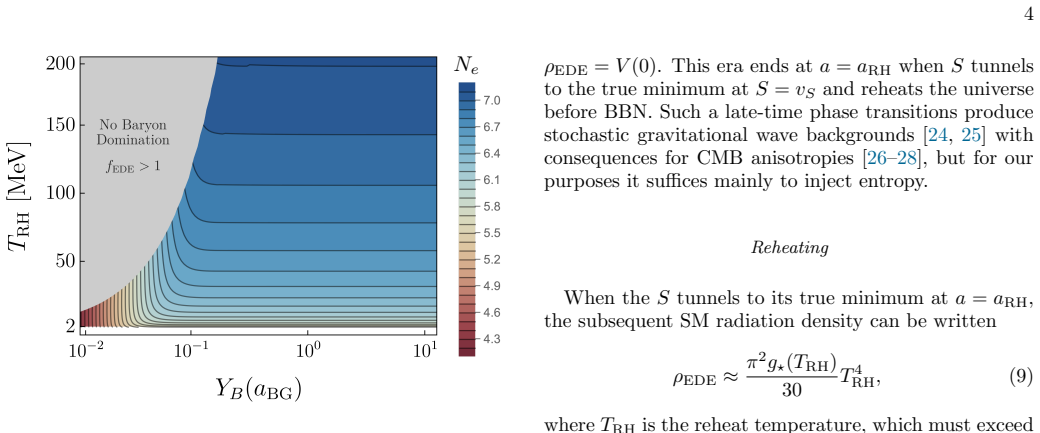


read the original abstract
We propose a novel cosmological scenario in which baryonic neutron stars could plausibly form in the early universe. If baryogenesis initially produces an excessively-large baryon asymmetry, $Y_B \gg 10^{-10},$ the baryonic mass inside the horizon can exceed the minimum neutron star mass before big bang nucleosynthesis (BBN). While this large asymmetry is present, non-relativistic baryons can dominate the universe and enhanced density perturbations on small scales can gravitationally collapse Hubble patches shortly after horizon re-entry. For some initial perturbations, just below the threshold for black hole formation, this collapse will be arrested only by nuclear pressure, possibly resulting in neutron star formation. Afterwards, there must be a large entropy injection to restore the observed baryon asymmetry, $Y_B \sim 10^{-10}$, and preserve the successful predictions of standard BBN. Unlike neutron stars that form from stellar collapse, primordial neutron stars can, in principle, be as light as $\sim 0.1 M_\odot$, limited only by the nuclear equation of state.
Editorial analysis
A structured set of objections, weighed in public.
Referee Report
Summary. The manuscript proposes a novel cosmological scenario in which primordial neutron stars form in the early universe. If baryogenesis produces an initial baryon asymmetry Y_B ≫ 10^{-10}, the baryonic mass inside the horizon can exceed the minimum neutron-star mass before BBN; non-relativistic baryons then dominate, and enhanced small-scale perturbations cause Hubble patches to collapse shortly after horizon re-entry. For perturbations just below the black-hole threshold, nuclear pressure arrests the collapse, yielding neutron stars as light as ~0.1 M_⊙. A subsequent large entropy injection is required to dilute Y_B back to the observed value ~10^{-10} while preserving successful BBN.
Significance. If the central claim can be made quantitatively viable, the scenario would link baryogenesis to the formation of compact objects and introduce a new channel for light neutron stars, with potential implications for primordial black-hole constraints and early-universe entropy production. The proposal builds on standard cosmological premises and offers falsifiable predictions once a concrete dilution mechanism is supplied.
major comments (3)
- [Abstract] Abstract: the requirement of a large entropy injection after neutron-star formation but before T ~ 1 MeV is stated as mandatory, yet no mechanism (e.g., out-of-equilibrium decay, phase transition), timing window, or calculation demonstrating that the injection preserves BBN abundances and does not unbind the newly formed objects is supplied. This step is load-bearing for observational viability.
- [Abstract] Abstract: the claim that collapse of Hubble patches is arrested by nuclear pressure for perturbations just below the black-hole threshold rests on unverified assumptions about perturbation evolution in a baryon-dominated phase; no equations, Jeans-mass estimates, or thresholds for the transition from gravitational collapse to nuclear-pressure support are provided.
- [Abstract] Abstract: the statement that primordial neutron stars can be as light as ~0.1 M_⊙ is limited only by the nuclear equation of state, but no reference to a specific EOS, mass-radius relation, or comparison with the minimum stable mass in the early-universe context is given to support this lower bound.
minor comments (1)
- The manuscript is presented at a purely qualitative level; inclusion of order-of-magnitude estimates for the required perturbation amplitude or the horizon mass at BBN would improve clarity without altering the conceptual scope.
Simulated Author's Rebuttal
We thank the referee for their detailed and constructive report. We address each major comment below, indicating revisions where the manuscript will be strengthened. Our responses focus on clarifying the conceptual framework while acknowledging where additional detail is warranted.
read point-by-point responses
-
Referee: [Abstract] Abstract: the requirement of a large entropy injection after neutron-star formation but before T ~ 1 MeV is stated as mandatory, yet no mechanism (e.g., out-of-equilibrium decay, phase transition), timing window, or calculation demonstrating that the injection preserves BBN abundances and does not unbind the newly formed objects is supplied. This step is load-bearing for observational viability.
Authors: We agree that a specific mechanism for entropy injection is essential to establish the scenario's viability. The manuscript identifies the need for post-formation dilution to restore the observed Y_B while preserving BBN but does not elaborate on implementation. In the revised version we will add a dedicated paragraph discussing candidate mechanisms (e.g., out-of-equilibrium decay of a heavy scalar or a brief period of late reheating), the required timing window between neutron-star formation and T ~ 1 MeV, and order-of-magnitude estimates showing that the injected energy density remains well below the gravitational binding energy of the ~0.1 M_⊙ objects, thereby avoiding unbinding. revision: yes
-
Referee: [Abstract] Abstract: the claim that collapse of Hubble patches is arrested by nuclear pressure for perturbations just below the black-hole threshold rests on unverified assumptions about perturbation evolution in a baryon-dominated phase; no equations, Jeans-mass estimates, or thresholds for the transition from gravitational collapse to nuclear-pressure support are provided.
Authors: The referee correctly notes the absence of explicit supporting calculations. The argument in the manuscript rests on the standard Jeans criterion applied to a baryon-dominated, matter-like era in which small-scale perturbations grow rapidly after horizon re-entry. In the revision we will insert a short subsection (or appendix) that derives the Jeans mass under the high baryon-to-photon ratio, provides an order-of-magnitude estimate for the density at which nuclear pressure becomes dominant, and sketches the threshold separating black-hole formation from pressure-supported collapse. A full numerical hydrodynamical treatment lies beyond the scope of the present conceptual work. revision: partial
-
Referee: [Abstract] Abstract: the statement that primordial neutron stars can be as light as ~0.1 M_⊙ is limited only by the nuclear equation of state, but no reference to a specific EOS, mass-radius relation, or comparison with the minimum stable mass in the early-universe context is given to support this lower bound.
Authors: We thank the referee for highlighting this omission. The quoted lower mass bound follows from the minimum stable mass obtained in standard nuclear equations of state (e.g., APR and certain Skyrme parametrizations) that permit stable configurations near 0.1 M_⊙. In the revised manuscript we will cite the relevant EOS literature, reproduce the corresponding minimum-mass values, and note that the early-universe formation temperature drops rapidly below nuclear saturation, rendering the minimum mass essentially identical to the zero-temperature case. revision: yes
Circularity Check
No circularity: scenario proposal with no self-referential derivations
full rationale
The paper advances a hypothetical cosmological scenario in which an initial large baryon asymmetry Y_B ≫ 10^{-10} allows baryonic mass within the horizon to exceed the minimum neutron-star mass, permitting gravitational collapse of Hubble patches that may be halted by nuclear pressure to form primordial neutron stars, followed by a required later entropy injection to restore the observed Y_B ∼ 10^{-10}. No equations, fitted parameters, or first-principles derivations are presented that reduce by construction to their own inputs; the entropy-injection step is explicitly stated as a necessary external condition rather than derived from the model. The proposal rests on standard cosmological premises without self-citation load-bearing, ansatz smuggling, or renaming of known results as new predictions.
Axiom & Free-Parameter Ledger
free parameters (2)
- Initial baryon asymmetry Y_B =
>> 10^{-10}
- Perturbation amplitude
axioms (2)
- domain assumption Small-scale density perturbations re-enter the horizon and grow gravitationally in a baryon-dominated phase
- domain assumption Nuclear pressure can halt collapse at neutron-star densities in the early-universe environment
Reference graph
Works this paper leans on
-
[1]
Remarks on Super-Novae and Cosmic Rays,
W. Baade and F. Zwicky, “Remarks on Super-Novae and Cosmic Rays,”Phys. Rev.46no. 1, (1934) 76
1934
-
[2]
Observation of a rapidly pulsating radio source,
A. Hewish, S. J. Bell, J. D. H. Pilkington, P. F. Scott, and R. A. Collins, “Observation of a rapidly pulsating radio source,”Nature217(1968) 709–713
1968
-
[3]
From hadrons to quarks in neutron stars: a review,
G. Baym, T. Hatsuda, T. Kojo, P. D. Powell, Y. Song, and T. Takatsuka, “From hadrons to quarks in neutron stars: a review,”Rept. Prog. Phys.81no. 5, (2018) 056902,arXiv:1707.04966 [astro-ph.HE]
-
[4]
The Hypothesis of Cores Retarded during Expansion and the Hot Cosmological Model,
Y. B. Zel’dovich and I. D. Novikov, “The Hypothesis of Cores Retarded during Expansion and the Hot Cosmological Model,”Sov. Astron.10(1967) 602
1967
-
[5]
Black holes in the early Universe,
B. J. Carr and S. W. Hawking, “Black holes in the early Universe,”Mon. Not. Roy. Astron. Soc.168(1974) 399–415
1974
-
[6]
The Basics of Primordial Black Hole Formation and Abundance Estimation,
C.-M. Yoo, “The Basics of Primordial Black Hole Formation and Abundance Estimation,”Galaxies10 no. 6, (2022) 112,arXiv:2211.13512 [astro-ph.CO]. 12
-
[7]
Primordial Black Holes as a dark matter candidate
A. M. Green and B. J. Kavanagh, “Primordial Black Holes as a dark matter candidate,”J. Phys. G48no. 4, (2021) 043001,arXiv:2007.10722 [astro-ph.CO]
work page internal anchor Pith review arXiv 2021
-
[8]
Computation of neutron star structure using modern equation of state,
G. H. Bordbar and M. Hayati, “Computation of neutron star structure using modern equation of state,” Int. J. Mod. Phys. A21(2006) 1555–1565, arXiv:0810.3482 [astro-ph]
-
[9]
Analytical representations of unified equations of state for neutron-star matter,
A. Y. Potekhin, A. F. Fantina, N. Chamel, J. M. Pearson, and S. Goriely, “Analytical representations of unified equations of state for neutron-star matter,” Astron. Astrophys.560(2013) A48,arXiv:1310.0049 [astro-ph.SR]
-
[10]
Uniformly rotating neutron stars in the global and local charge neutrality cases,
R. Belvedere, K. Boshkayev, J. A. Rueda, and R. Ruffini, “Uniformly rotating neutron stars in the global and local charge neutrality cases,”Nucl. Phys. A 921(2014) 33–59,arXiv:1307.2836 [astro-ph.SR]
-
[11]
Thermal Neutrinos from the Explosion of a Minimum-Mass Neutron Star,
A. V. Yudin, N. V. Dunina-Barkovskaya, and S. I. Blinnikov, “Thermal Neutrinos from the Explosion of a Minimum-Mass Neutron Star,”Astron. Lett.48no. 9, (2022) 497–502,arXiv:2301.10003 [astro-ph.HE]
-
[12]
R. Barkana and A. Loeb, “In the beginning: The First sources of light and the reionization of the Universe,” Phys. Rept.349(2001) 125–238, arXiv:astro-ph/0010468
-
[13]
T. Bringmann, D. Croon, and S. Sevillano Mu˜ noz, “Updated constraints on the primordial power spectrum at sub-Mpc scales,”arXiv:2506.20704 [astro-ph.CO]
-
[14]
H. V. Ragavendra and L. Sriramkumar, “Observational Imprints of Enhanced Scalar Power on Small Scales in Ultra Slow Roll Inflation and Associated Non-Gaussianities,”Galaxies11no. 1, (2023) 34, arXiv:2301.08887 [astro-ph.CO]. [15]Particle Data GroupCollaboration, R. L. Workman et al., “Review of Particle Physics,”PTEP2022(Aug.,
-
[15]
Planck 2018 results. VI. Cosmological parameters
083C01. [16]PlanckCollaboration, N. Aghanimet al., “Planck 2018 results. VI. Cosmological parameters,”Astron. Astrophys.641(2020) A6,arXiv:1807.06209 [astro-ph.CO]. [Erratum: Astron.Astrophys. 652, C4 (2021)]
work page internal anchor Pith review Pith/arXiv arXiv 2018
-
[16]
D. Bodeker and W. Buchmuller, “Baryogenesis from the weak scale to the grand unification scale,”Rev. Mod. Phys.93no. 3, (2021) 035004,arXiv:2009.07294 [hep-ph]
-
[17]
A. Riotto, “Theories of baryogenesis,” inICTP Summer School in High-Energy Physics and Cosmology, pp. 326–436. 7, 1998.arXiv:hep-ph/9807454
work page internal anchor Pith review arXiv 1998
-
[18]
A New Mechanism for Baryogenesis,
I. Affleck and M. Dine, “A New Mechanism for Baryogenesis,”Nucl. Phys. B249(1985) 361–380
1985
-
[19]
V. A. Rubakov and D. S. Gorbunov,Introduction to the Theory of the Early Universe: Hot big bang theory. World Scientific, Singapore, 2017
2017
-
[20]
Twenty-first Century Lattice Gauge Theory: Results from the QCD Lagrangian,
A. S. Kronfeld, “Twenty-first Century Lattice Gauge Theory: Results from the QCD Lagrangian,”Ann. Rev. Nucl. Part. Sci.62(2012) 265–284,arXiv:1203.1204 [hep-lat]
-
[21]
T. Karwal and M. Kamionkowski, “Dark energy at early times, the Hubble parameter, and the string axiverse,”Phys. Rev. D94no. 10, (2016) 103523, arXiv:1608.01309 [astro-ph.CO]
-
[22]
Early Dark Energy Can Resolve The Hubble Tension
V. Poulin, T. L. Smith, T. Karwal, and M. Kamionkowski, “Early Dark Energy Can Resolve The Hubble Tension,”Phys. Rev. Lett.122no. 22, (2019) 221301,arXiv:1811.04083 [astro-ph.CO]
work page Pith review arXiv 2019
-
[23]
Stochastic Gravitational Wave Backgrounds,
N. Christensen, “Stochastic Gravitational Wave Backgrounds,”Rept. Prog. Phys.82no. 1, (2019) 016903,arXiv:1811.08797 [gr-qc]
-
[24]
Cosmological Backgrounds of Gravitational Waves,
C. Caprini and D. G. Figueroa, “Cosmological Backgrounds of Gravitational Waves,”Class. Quant. Grav.35no. 16, (2018) 163001,arXiv:1801.04268 [astro-ph.CO]
-
[25]
Observable CMB B-modes from Cosmological Phase Transitions
K. Greene, A. Ireland, G. Krnjaic, and Y. Tsai, “Observable CMB B-modes from Cosmological Phase Transitions,”arXiv:2410.23348 [astro-ph.CO]
work page internal anchor Pith review Pith/arXiv arXiv
- [26]
-
[27]
J. A. Zebrowski, A. Ireland, C. L. Reichardt, K. Greene, G. Krnjaic, Y. Tsai, and F. R. Bouchet, “First constraints on causal sources of primordial gravitational waves from BICEP/Keck, SPTpol, SPT-3G, Planck and WMAPB-mode data,”arXiv:2601.20958 [astro-ph.CO]
-
[28]
T. Hasegawa, N. Hiroshima, K. Kohri, R. S. L. Hansen, T. Tram, and S. Hannestad, “MeV-scale reheating temperature and thermalization of oscillating neutrinos by radiative and hadronic decays of massive particles,” JCAP12(2019) 012,arXiv:1908.10189 [hep-ph]
-
[29]
F. Douchin and P. Haensel, “A unified equation of state of dense matter and neutron star structure,”Astron. Astrophys.380(2001) 151,arXiv:astro-ph/0111092
-
[30]
Equation of state for beta-stable hot nuclear matter,
C. C. Moustakidis and C. P. Panos, “Equation of state for beta-stable hot nuclear matter,”Phys. Rev. C79 (2009) 045806,arXiv:0805.0353 [nucl-th]
-
[31]
Y. Fujimoto, K. Fukushima, S. Kamata, and K. Murase, “Uncertainty quantification in the machine-learning inference from neutron star probability distribution to the equation of state,”Phys. Rev. D110no. 3, (2024) 034035,arXiv:2401.12688 [nucl-th]
-
[32]
QCD phase diagram and astrophysical implications,
K. Fukushima, “QCD phase diagram and astrophysical implications,”J. Subatomic Part. Cosmol.3(2025) 100066,arXiv:2501.01907 [hep-ph]
-
[33]
Threshold of primordial black hole formation
T. Harada, C.-M. Yoo, and K. Kohri, “Threshold of primordial black hole formation,”Phys. Rev. D88 no. 8, (2013) 084051,arXiv:1309.4201 [astro-ph.CO]. [Erratum: Phys.Rev.D 89, 029903 (2014)]
work page Pith review arXiv 2013
-
[34]
Pulsar J0453+1559: A Double Neutron Star System with a Large Mass Asymmetry
J. G. Martinez, K. Stovall, P. C. C. Freire, J. S. Deneva, F. A. Jenet, M. A. McLaughlin, M. Bagchi, S. D. Bates, and A. Ridolfi, “Pulsar J0453+1559: A Double Neutron Star System with a Large Mass Asymmetry,” Astrophys. J.812no. 2, (2015) 143,arXiv:1509.08805 [astro-ph.HE]
work page Pith review arXiv 2015
-
[35]
Missing Black Holes Unveil the Supernova Explosion Mechanism,
K. Belczynski, G. Wiktorowicz, C. L. Fryer, D. E. Holz, and V. Kalogera, “Missing Black Holes Unveil the Supernova Explosion Mechanism,”Astrophys. J.757 no. 1, (Sept., 2012) 91,arXiv:1110.1635 [astro-ph.GA]
-
[36]
Constraints on the epoch of dark matter formation from Milky Way satellites,
S. Das and E. O. Nadler, “Constraints on the epoch of dark matter formation from Milky Way satellites,” Phys. Rev. D103no. 4, (2021) 043517, arXiv:2010.01137 [astro-ph.CO]
-
[37]
A. Ireland, G. Krnjaic, and T. Okawa, “The Affleck-Dine Curvaton,”arXiv:2410.13712 [hep-ph]
-
[38]
Singlet Neighbors of the Higgs Boson,
B. Batell, D. McKeen, and M. Pospelov, “Singlet Neighbors of the Higgs Boson,”JHEP10(2012) 104, arXiv:1207.6252 [hep-ph]
-
[39]
G. Krnjaic, “Probing Light Thermal Dark-Matter With a Higgs Portal Mediator,”Phys. Rev. D94no. 7, 13 (2016) 073009,arXiv:1512.04119 [hep-ph]
-
[40]
Revisiting supernova constraints on a light CP-even scalar,
P. S. B. Dev, R. N. Mohapatra, and Y. Zhang, “Revisiting supernova constraints on a light CP-even scalar,”JCAP08(2020) 003,arXiv:2005.00490 [hep-ph]. [Erratum: JCAP 11, E01 (2020)]
-
[41]
Adams,General solutions for tunneling of scalar fields with quartic potentials,Phys
F. C. Adams, “General solutions for tunneling of scalar fields with quartic potentials,”Phys. Rev. D48(1993) 2800–2805,arXiv:hep-ph/9302321
-
[42]
Gravitational Radiation from First-Order Phase Transitions
M. Kamionkowski, A. Kosowsky, and M. S. Turner, “Gravitational radiation from first order phase transitions,”Phys. Rev. D49(1994) 2837–2851, arXiv:astro-ph/9310044
work page Pith review arXiv 1994
-
[43]
Static solutions of einstein’s field equations for spheres of fluid,
R. C. Tolman, “Static solutions of einstein’s field equations for spheres of fluid,”Physical Review55 no. 4, (1939) 364–373
1939
-
[44]
On massive neutron cores,
J. R. Oppenheimer and G. M. Volkoff, “On massive neutron cores,”Physical Review55no. 4, (1939) 374–381
1939
-
[45]
Accurate results for primordial black holes from spectra with a distinguished scale,
D. Blais, T. Bringmann, C. Kiefer, and D. Polarski, “Accurate results for primordial black holes from spectra with a distinguished scale,”Phys. Rev. D67 (2003) 024024,arXiv:astro-ph/0206262
-
[46]
Generalised constraints on the curvature perturbation from primordial black holes
A. S. Josan, A. M. Green, and K. A. Malik, “Generalised constraints on the curvature perturbation from primordial black holes,”Phys. Rev. D79(2009) 103520,arXiv:0903.3184 [astro-ph.CO]
work page Pith review arXiv 2009
discussion (0)
Sign in with ORCID, Apple, or X to comment. Anyone can read and Pith papers without signing in.