Recognition: 2 theorem links
· Lean TheoremOptical spin defect pairs in cubic boron nitride
Pith reviewed 2026-05-10 16:40 UTC · model grok-4.3
The pith
Cubic boron nitride hosts optical spin defect pairs that produce the same ODMR signatures as in hexagonal boron nitride.
A machine-rendered reading of the paper's core claim, the machinery that carries it, and where it could break.
Core claim
We report ODMR signatures in cubic boron nitride (cBN) showing all the characteristic properties identified in hBN. These signatures are explained by a charge transfer mechanism in which charges move between adjacent defects to form weakly coupled spin pairs. The same signatures appear across cBN samples of varying size, including ODMR from a single sub-micron cBN particle, which supports sensing applications and indicates that optical spin defect pairs are not limited to one crystal phase.
What carries the argument
Charge transfer between adjacent spin defects that form weakly coupled spin pairs, producing the observed room-temperature ODMR.
If this is right
- The full set of hBN ODMR properties is preserved when the host lattice changes to the cubic phase.
- ODMR can be detected from an individual sub-micron cBN particle.
- The spin-pair mechanism supplies a route to optical spin control that does not require a specific crystal symmetry.
- Quantum sensing experiments become feasible in cBN particles using the same readout protocol demonstrated for hBN.
Where Pith is reading between the lines
- If the mechanism is truly material-agnostic, similar defect-pair ODMR should appear in other wide-band-gap insulators once suitable defect densities are achieved.
- Single-particle cBN sensors could be integrated into devices where the cubic phase offers better mechanical stability than layered crystals.
- Varying the separation or charge state of the paired defects in cBN would provide a direct test of the charge-transfer model without changing the host lattice.
Load-bearing premise
The ODMR signals measured in cBN arise from the same charge-transfer process between neighboring defects that operates in hBN.
What would settle it
Absence of the characteristic ODMR lineshape, power dependence, or magnetic-field response in cBN samples whose defect density has been independently verified by another technique would indicate the signals do not share the proposed origin.
Figures




read the original abstract
Room-temperature optically active solid-state spin defects are widely known to be useful in quantum sensing applications, however, only a select range of materials have been found to host such systems. Recent measurements in the van der Waals material hexagonal boron nitride (hBN) have shown optically detected magnetic resonance (ODMR) with spin-1/2-like signatures can be explained by a charge transfer mechanism where charges move between adjacent defects forming weakly coupled spin pairs. Interestingly, these ODMR signatures have been reported in a variety of materials aside from hBN, suggesting the spin pair model provides a potentially material agnostic approach for enabling ODMR. Here, we test whether the charge transfer mechanism is supported in a different crystal phase, and report on ODMR signatures in cubic boron nitride (cBN), showing all the characteristic properties identified in hBN are preserved. We consider a selection of different cBN samples of varying size and observe ODMR from a single sub-micron cBN particle, paving the way towards sensing applications. This work further expands understanding of the ubiquity of optical spin defect pairs, and establishes the potential for exploring quantum technologies with a wider range of materials.
Editorial analysis
A structured set of objections, weighed in public.
Referee Report
Summary. The manuscript reports observation of room-temperature ODMR in cubic boron nitride (cBN) across samples of varying size, including a single sub-micron particle. It claims that the signals exhibit all characteristic properties previously seen in hBN and attributes them to the same charge-transfer mechanism between adjacent spin-1/2 defects, thereby supporting a material-agnostic spin-pair model for ODMR.
Significance. If the similarity to hBN is quantitatively verified, the result would extend the known host materials for optically addressable spin pairs from the van der Waals hexagonal phase to the cubic phase, which offers distinct mechanical and thermal properties. The single-particle demonstration is a concrete step toward nanoscale sensing applications and strengthens the case for a general defect-pair mechanism.
major comments (2)
- [Abstract] Abstract: the central claim that 'all the characteristic properties identified in hBN are preserved' is load-bearing for the mechanism assignment yet is presented without quantitative metrics (resonance positions, linewidths, power saturation, or magnetic-field splitting parameters) or explicit side-by-side comparison to hBN data; this leaves open the possibility of unrelated defects or artifacts.
- [Results] The assignment of the observed ODMR to the weakly coupled charge-transfer spin-pair model (rather than alternative sources) rests on qualitative similarity; direct tests such as the expected dependence of resonance contrast on optical excitation power or the absence of signal from substrate controls are required to secure the interpretation.
Simulated Author's Rebuttal
We thank the referee for their careful reading of the manuscript and for the constructive comments, which have helped us strengthen the presentation of our results. We address each major comment below and have revised the manuscript to incorporate quantitative comparisons and additional controls where needed.
read point-by-point responses
-
Referee: [Abstract] Abstract: the central claim that 'all the characteristic properties identified in hBN are preserved' is load-bearing for the mechanism assignment yet is presented without quantitative metrics (resonance positions, linewidths, power saturation, or magnetic-field splitting parameters) or explicit side-by-side comparison to hBN data; this leaves open the possibility of unrelated defects or artifacts.
Authors: We agree that the abstract claim benefits from explicit quantitative support. In the revised manuscript we have added a new table (Table 1) that lists the central ODMR parameters measured in cBN—resonance positions, linewidths, power-saturation behavior, and magnetic-field splitting coefficients—together with the corresponding values reported for hBN in the literature. We have also inserted a supplementary figure that overlays representative cBN and hBN spectra for direct visual comparison. These additions provide the quantitative metrics requested and reduce the scope for alternative interpretations. revision: yes
-
Referee: [Results] The assignment of the observed ODMR to the weakly coupled charge-transfer spin-pair model (rather than alternative sources) rests on qualitative similarity; direct tests such as the expected dependence of resonance contrast on optical excitation power or the absence of signal from substrate controls are required to secure the interpretation.
Authors: The original manuscript already contains power-dependent ODMR data (Figure 3) that exhibit the saturation behavior expected for the charge-transfer pair model. To further secure the assignment we have added substrate-control measurements on bare SiO2/Si chips that show no detectable ODMR signal under identical conditions. We have expanded the discussion to explicitly reference these controls and to address possible alternative defect sources. These revisions directly respond to the request for additional tests. revision: yes
Circularity Check
No circularity: purely experimental observations with external comparisons
full rationale
The manuscript reports experimental ODMR measurements on cBN particles of varying sizes, including single-particle detection, and notes preservation of signatures previously identified in hBN. No mathematical derivations, fitted parameters, predictions, or ansatzes are present that could reduce to self-defined inputs or self-citations. All mechanistic attribution to charge-transfer spin pairs is framed as an external hypothesis drawn from prior hBN literature rather than a result derived within this work; the central claims rest on direct spectral observations and sample controls, which remain independently falsifiable. This is the standard case of an experimental report whose reasoning chain does not loop back on its own fitted quantities or definitions.
Axiom & Free-Parameter Ledger
axioms (1)
- domain assumption Standard principles of optically detected magnetic resonance and charge transfer between defects apply equally to cBN as to hBN.
Lean theorems connected to this paper
-
IndisputableMonolith/Foundation/RealityFromDistinction.leanreality_from_one_distinction unclear?
unclearRelation between the paper passage and the cited Recognition theorem.
ODMR signatures in cubic boron nitride (cBN), showing all the characteristic properties identified in hBN are preserved... charge transfer mechanism where charges move between adjacent defects forming weakly coupled spin pairs
-
IndisputableMonolith/Cost/FunctionalEquation.leanwashburn_uniqueness_aczel unclear?
unclearRelation between the paper passage and the cited Recognition theorem.
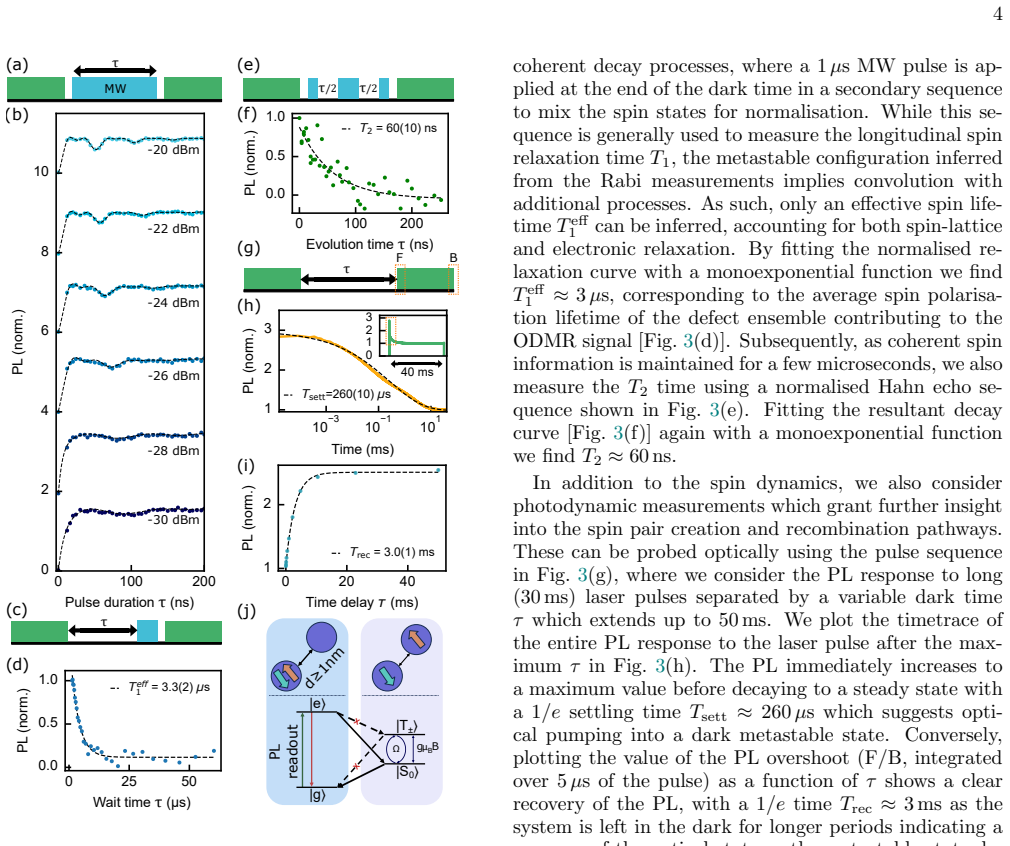
Rabi curves... fitted to a two frequency function with frequencies Ω1 and Ω2, where Ω2 = 2Ω1, as expected from a weakly coupled spin pair system
What do these tags mean?
- matches
- The paper's claim is directly supported by a theorem in the formal canon.
- supports
- The theorem supports part of the paper's argument, but the paper may add assumptions or extra steps.
- extends
- The paper goes beyond the formal theorem; the theorem is a base layer rather than the whole result.
- uses
- The paper appears to rely on the theorem as machinery.
- contradicts
- The paper's claim conflicts with a theorem or certificate in the canon.
- unclear
- Pith found a possible connection, but the passage is too broad, indirect, or ambiguous to say the theorem truly supports the claim.
Reference graph
Works this paper leans on
-
[1]
The 165 nm powder was purchased from PlasmaChem GmbH, and the 2µm and 65µm were purchased from MSE Sup- pliers (Tucson, Arizona, USA)
Sample preparation We investigated four cBN samples in this work: large cBN crystals with≈0.5 mm average diameter, and three cBN micro/nano particle samples of different sizes with ≈50µm,≈2µm, and≈165 nm average diameters. The 165 nm powder was purchased from PlasmaChem GmbH, and the 2µm and 65µm were purchased from MSE Sup- pliers (Tucson, Arizona, USA)....
2017
-
[2]
Experimental setup The ensemble measurements were carried out on a custom-built wide-field fluorescence microscope. Opti- cal excitation from a continuous-wave (CW)λ= 532 nm laser (Laser Quantum Opus 2 W) was gated using an acousto-optic modulator (Gooch & Housego R35085-5) and focused using a widefield lens to the back aperture of the objective lens (Nik...
-
[3]
Material characterisation Without significant defining features in the spin and optical properties (e.g. hyperfine features in ODMR or 7 zero-phonon lines) to distinguish the samples from hBN, we perform a series of material characterisation measure- ments to confirm the samples are cBN. Raman spectroscopy was conducted using a Renishaw inVia confocal mic...
-
[4]
E. J. Davis, B. Ye, F. Machado, S. A. Meynell, W. Wu, T. Mittiga, W. Schenken, M. Joos, B. Kobrin, Y. Lyu, Z. Wang, D. Bluvstein, S. Choi, C. Zu, A. C. B. Jayich, and N. Y. Yao, Probing many-body dynamics in a two- dimensional dipolar spin ensemble, Nature Physics19, 836 (2023)
2023
-
[5]
S. L. N. Hermans, M. Pompili, H. K. C. Beukers, S. Baier, J. Borregaard, and R. Hanson, Qubit teleportation be- tween non-neighbouring nodes in a quantum network, Nature605, 663 (2022)
2022
-
[6]
Healey, S
A. Healey, S. Scholten, T. Yang, J. Scott, G. Abrahams, I. Robertson, X. Hou, Y. Guo, S. Rahman, Y. Lu,et al., Quantum microscopy with van der waals heterostruc- tures, Nature Physics19, 87 (2023)
2023
-
[7]
Wolfowicz, F
G. Wolfowicz, F. J. Heremans, C. P. Anderson, S. Kanai, H. Seo, A. Gali, G. Galli, and D. D. Awschalom, Quan- tum guidelines for solid-state spin defects, Nature Re- views Materials6, 906 (2021)
2021
-
[8]
M. W. Doherty, N. B. Manson, P. Delaney, F. Jelezko, J. Wrachtrup, and L. C. Hollenberg, The nitrogen- vacancy colour centre in diamond, Physics Reports528, 1 (2013), 1302.3288
work page Pith review arXiv 2013
-
[9]
W. F. Koehl, B. B. Buckley, F. J. Heremans, G. Calu- sine, and D. D. Awschalom, Room temperature coherent control of defect spin qubits in silicon carbide, Nature 479, 84 (2011)
2011
-
[10]
Widmann, S.-Y
M. Widmann, S.-Y. Lee, T. Rendler, N. T. Son, H. Fedder, S. Paik, L.-P. Yang, N. Zhao, S. Yang, I. Booker, A. Denisenko, M. Jamali, S. A. Momen- zadeh, I. Gerhardt, T. Ohshima, A. Gali, E. Janz´ en, and J. Wrachtrup, Coherent control of single spins in silicon carbide at room temperature, Nature Materials14, 164 (2015)
2015
-
[11]
Gottscholl, M
A. Gottscholl, M. Kianinia, V. Soltamov, S. Orlin- skii, G. Mamin, C. Bradac, C. Kasper, K. Krambrock, A. Sperlich, M. Toth, I. Aharonovich, and V. Dyakonov, Initialization and read-out of intrinsic spin defects in a van der Waals crystal at room temperature, Nature Ma- terials19, 540 (2020)
2020
-
[12]
Gottscholl, M
A. Gottscholl, M. Diez, V. Soltamov, C. Kasper, A. Sper- lich, M. Kianinia, C. Bradac, I. Aharonovich, and V. Dyakonov, Room temperature coherent control of spin defects in hexagonal boron nitride, Science Advances7, eabf3630 (2021)
2021
-
[13]
Gottscholl, M
A. Gottscholl, M. Diez, V. Soltamov, C. Kasper, D. Krausse, A. Sperlich, M. Kianinia, C. Bradac, I. Aharonovich, and V. Dyakonov, Spin defects in hBN as promising temperature, pressure and magnetic field quantum sensors, Nature Communications12, 4480 (2021)
2021
-
[14]
Atat¨ ure, D
M. Atat¨ ure, D. Englund, N. Vamivakas, S.-Y. Lee, and J. Wrachtrup, Material platforms for spin-based photonic 8 50 um Powder ABulk sample Powder B Powder C 2 um 165 nm(a) 1000 1200 1400 Wavenumber (cm )−1 Intensity (arb.) 1000 1200 1400 Wavenumber (cm )−1 Intensity (arb.) 1000 1200 1400 Wavenumber (cm )−1 Intensity (arb.) 20 40 60 80 100 120 2 (degrees)...
2018
-
[15]
Chejanovsky, A
N. Chejanovsky, A. Mukherjee, J. Geng, Y.-C. Chen, Y. Kim, A. Denisenko, A. Finkler, T. Taniguchi, K. Watanabe, D. B. R. Dasari, P. Auburger, A. Gali, J. H. Smet, and J. Wrachtrup, Single-spin resonance in a van der Waals embedded paramagnetic defect, Nature Materials20, 1079 (2021). 9 (a) (c) (b) (d) 0 100 200 Pulse duration (ns)τ 0 2 4 6 8 10 ΔPL/PL (%)...
2021
-
[16]
H. L. Stern, Q. Gu, J. Jarman, S. Eizagirre Barker, N. Mendelson, D. Chugh, S. Schott, H. H. Tan, H. Sirringhaus, I. Aharonovich, and M. Atat¨ ure, Room- temperature optically detected magnetic resonance of single defects in hexagonal boron nitride, Nature Com- munications13, 618 (2022)
2022
-
[17]
N.-J. Guo, S. Li, W. Liu, Y.-Z. Yang, X.-D. Zeng, S. Yu, Y. Meng, Z.-P. Li, Z.-A. Wang, L.-K. Xie, R.-C. Ge, J.-F. Wang, Q. Li, J.-S. Xu, Y.-T. Wang, J.-S. Tang, A. Gali, C.-F. Li, and G.-C. Guo, Coherent control of an ultra- bright single spin in hexagonal boron nitride at room temperature, Nature Communications14, 2893 (2023)
2023
-
[18]
S. C. Scholten, P. Singh, A. J. Healey, I. O. Robertson, G. Haim, C. Tan, D. A. Broadway, L. Wang, H. Abe, T. Ohshima,et al., Multi-species optically addressable spin defects in a van der waals material, Nature Commu- nications15, 6727 (2024)
2024
-
[19]
H. L. Stern, C. M. Gilardoni, Q. Gu, S. Eizagirre Barker, O. F. J. Powell, X. Deng, S. A. Fraser, L. Follet, C. Li, A. J. Ramsay, H. H. Tan, I. Aharonovich, and M. Atat¨ ure, A quantum coherent spin in hexagonal boron nitride at ambient conditions, Nature Materials 23, 1379–1385 (2024)
2024
-
[20]
X. Gao, S. Vaidya, K. Li, Z. Ge, S. Dikshit, S. Zhang, P. Ju, K. Shen, Y. Jin, Y. Ping, and T. Li, Single nuclear spin detection and control in a van der Waals material, Nature , 1 (2025)
2025
-
[21]
I. O. Robertson, B. Whitefield, S. C. Scholten, P. Singh, A. J. Healey, P. Reineck, M. Kianinia, G. Barcza, V. Iv´ ady, D. A. Broadway, I. Aharonovich, and J.-P. Tetienne, A charge transfer mechanism for optically ad- dressable solid-state spin pairs, Nature Physics21, 1981 (2025)
1981
-
[22]
Whitefield, H
B. Whitefield, H. Z. J. Zeng, J. Liddle-Wesolowski, I. O. Robertson, ´A. Ganyecz, V. Iv´ ady, K. Watanabe, T. Taniguchi, M. Toth, J.-P. Tetienne, I. Aharonovich, and M. Kianinia, Narrowband quantum emitters in hexagonal boron nitride with optically addressable spins, Nature Materials , 1 (2026)
2026
-
[23]
J. Luo, Y. Geng, F. Rana, and G. D. Fuchs, Room tem- perature optically detected magnetic resonance of single spins in GaN, Nature Materials23, 512 (2024)
2024
-
[24]
W. Liu, S. Li, N.-J. Guo, X.-D. Zeng, L.-K. Xie, J.-Y. Liu, Y.-H. Ma, Y.-Q. Wu, Y.-T. Wang, Z.-A. Wang, J.- M. Ren, C. Ao, J.-S. Xu, J.-S. Tang, A. Gali, C.-F. Li, and G.-C. Guo, Experimental observation of spin defects in the van der Waals material GeS 2, Nano Letters25, 16330 (2025)
2025
-
[25]
Vaidya, X
S. Vaidya, X. Gao, S. Dikshit, Z. Fang, A. E. Llac- sahuanga Allcca, Y. P. Chen, Q. Yan, and T. Li, Coherent spins in van der Waals semiconductor GeS 2 at ambient conditions, Nano Letters25, 14356 (2025)
2025
-
[26]
L. Vel, G. Demazeau, and J. Etourneau, Cubic boron nitride: Synthesis, physicochemical properties and appli- cations, Materials Science and Engineering: B10, 149 (1991)
1991
-
[27]
Weston, D
L. Weston, D. Wickramaratne, M. Mackoit, A. Alka- uskas, and C. G. Van de Walle, Native point defects and impurities in hexagonal boron nitride, Physical Review B97, 214104 (2018)
2018
-
[28]
Piquini, R
P. Piquini, R. Mota, T. M. Schmidt, and A. Fazzio, The- oretical studies of native defects in cubic boron nitride, Physical Review B56, 3556 (1997)
1997
-
[29]
Orellana and H
W. Orellana and H. Chacham, Stability of native defects in hexagonal and cubic boron nitride, Physical Review B 63, 125205 (2001)
2001
- [30]
-
[31]
S. V. Nistor, M. Stefan, D. Schoemaker, and G. Dinca, EPR observation of first point defects in cubic boron ni- tride crystalline powders, Solid State Communications 115, 39 (2000)
2000
-
[32]
S. V. Nistor, M. Stefan, D. Ghica, and E. Goovaerts, Multifrequency ESR characterization of paramagnetic point defects in semiconducting cubic bn crystals, Ap- plied Magnetic Resonance39, 87 (2010)
2010
-
[33]
Buividas, I
R. Buividas, I. Aharonovich, G. Seniutinas, X. W. Wang, L. Rapp, A. V. Rode, T. Taniguchi, and S. Juodkazis, Photoluminescence from voids created by femtosecond- laser pulses inside cubic-BN, Optics Letters40, 5711 (2015)
2015
-
[34]
Tararan, S
A. Tararan, S. di Sabatino, M. Gatti, T. Taniguchi, K. Watanabe, L. Reining, L. H. G. Tizei, M. Kociak, and A. Zobelli, Optical gap and optically active intra- gap defects in cubic BN, Physical Review B98, 094106 (2018)
2018
-
[35]
G. I. L´ opez-Morales, A. Almanakly, S. Satapathy, N. V. Proscia, H. Jayakumar, V. N. Khabashesku, P. M. Ajayan, C. A. Meriles, and V. M. Menon, Room- temperature single photon emitters in cubic boron nitride nanocrystals, Optical Materials Express10, 843 (2020)
2020
-
[36]
Singh, I
P. Singh, I. O. Robertson, S. C. Scholten, A. J. Healey, H. Abe, T. Ohshima, H. H. Tan, M. Kianinia, I. Aharonovich, D. A. Broadway, P. Reineck, and J.-P. Tetienne, Violet to near-infrared optical addressing of spin pairs in hexagonal boron nitride, Advanced Mate- rials37, 2414846 (2025)
2025
-
[37]
Werninghaus, J
T. Werninghaus, J. Hahn, F. Richter, and D. R. T. Zahn, Raman spectroscopy investigation of size effects in cubic boron nitride, Applied Physics Letters70, 958 (1997)
1997
-
[38]
D. R. McCamey, K. J. van Schooten, W. J. Baker, S.-Y. Lee, S.-Y. Paik, J. M. Lupton, and C. Boehme, Hyperfine-field-mediated spin beating in electrostatically bound charge carrier pairs, Phys. Rev. Lett.104, 017601 (2010)
2010
-
[39]
Eldemrdash, G
S. Eldemrdash, G. Thalassinos, A. Alzahrani, Q. Sun, E. Walsh, E. Grant, H. Abe, T. L. Greaves, T. Ohshima, P. Cigler, P. Matˇ ej´ ıˇ cek, D. A. Simpson, A. D. Greentree, G. Bryant, B. C. Gibson, and P. Reineck, Fluorescent HPHT nanodiamonds have disk- and rod-like shapes, Carbon206, 268 (2023)
2023
-
[40]
J.-P. Tetienne, L. Rondin, P. Spinicelli, M. Chipaux, T. Debuisschert, J.-F. Roch, and V. Jacques, Magnetic- field-dependent photodynamics of single NV defects in diamond: An application to qualitative all-optical mag- netic imaging, New Journal of Physics14, 103033 (2012), 1206.1201
-
[41]
I. O. Robertson, B. C. Johnson, G. Thalassinos, S. C. Scholten, K. J. Rietwyk, B. C. Gibson, J.-P. Tetienne, and D. A. Broadway, Radiofrequency Receiver Based on Isotropic Solid-State Spins, ACS Photonics12, 581 (2025)
2025
-
[42]
X. Gao, S. Vaidya, S. Dikshit, P. Ju, K. Shen, Y. Jin, S. Zhang, and T. Li, Nanotube spin defects for omnidi- rectional magnetic field sensing, Nature Communications 15, 7697 (2024)
2024
-
[43]
Zhang, S
Z.-M. Zhang, S. Chen, and Y.-Z. Liang, Baseline correc- tion using adaptive iteratively reweighted penalized least squares, Analyst135, 1138 (2010)
2010
discussion (0)
Sign in with ORCID, Apple, or X to comment. Anyone can read and Pith papers without signing in.