Recognition: 2 theorem links
· Lean TheoremCrossover Equation of State Constrained by Astronomical Observations and pQCD
Pith reviewed 2026-05-10 17:53 UTC · model grok-4.3
The pith
A smooth hadron-quark crossover in neutron-star matter, with NJL couplings fixed by pQCD and observations, produces higher maximum masses than pure hadronic models while satisfying all current bounds.
A machine-rendered reading of the paper's core claim, the machinery that carries it, and where it could break.
Core claim
When the Nambu-Jona-Lasinio vector and diquark couplings are restricted by perturbative QCD at high density together with astronomical data, the hadron-quark crossover equation of state supports neutron-star maximum masses above those of the underlying hadronic models, remains consistent with observed masses and tidal deformabilities, and produces distinct fundamental radial frequencies for stars in the 1.4-2 solar-mass range.
What carries the argument
The scale-averaging likelihood that maps perturbative QCD results onto the Nambu-Jona-Lasinio parameters, used to select the vector and diquark couplings before constructing a parameter-free crossover with relativistic mean-field hadronic equations of state.
If this is right
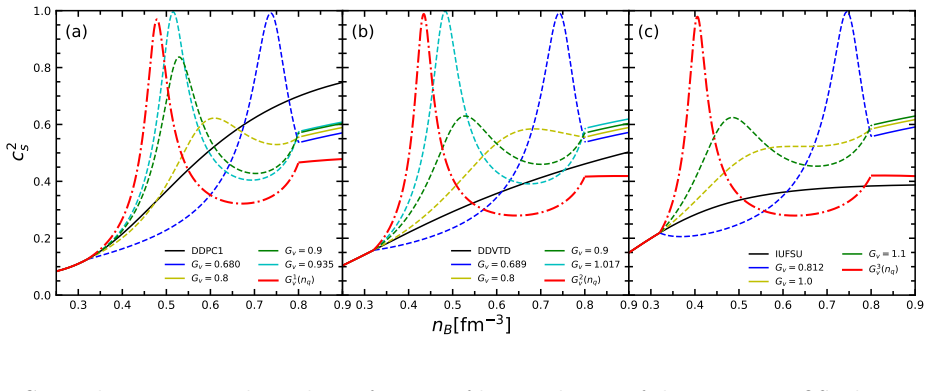
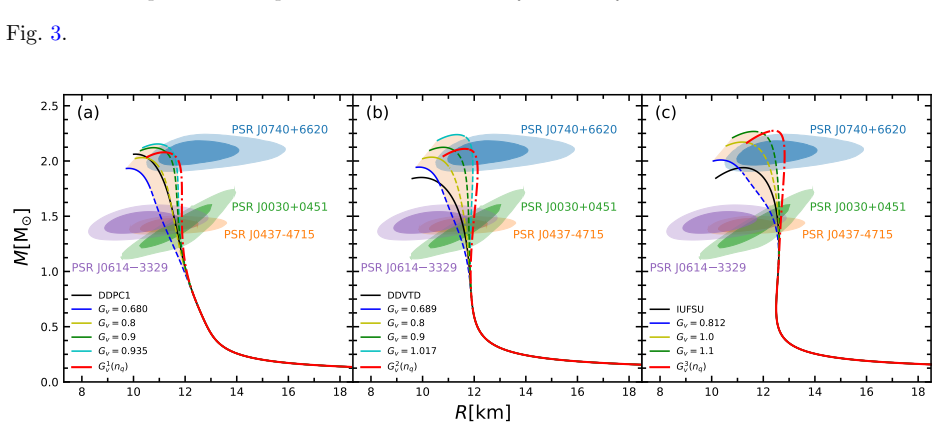
- Maximum neutron-star masses rise, especially when the hadronic equation of state is soft, while staying below the causality limit.
- Sound-speed and trace-anomaly profiles remain monotonic through the crossover region.
- Fundamental radial frequencies separate cleanly between crossover and pure hadronic models for stars of the same mass.
- Tidal deformabilities and mass-radius curves stay within current observational windows.
Where Pith is reading between the lines
- If radial frequencies can be measured for known-mass stars, they could distinguish crossover interiors from purely hadronic ones even when global properties look similar.
- The same constrained couplings could be reused to predict properties of hybrid stars in binary mergers, where the crossover might affect post-merger gravitational-wave signals.
- Extending the same matching procedure to finite temperature would allow direct comparison with heavy-ion collision data at comparable densities.
Load-bearing premise
A smooth crossover can be formed simply by interpolating the relativistic mean-field and Nambu-Jona-Lasinio thermodynamic quantities without introducing extra transition parameters, and the high-density perturbative QCD likelihood directly constrains the couplings inside neutron-star densities.
What would settle it
A measured fundamental radial oscillation frequency for an intermediate-mass neutron star (around 1.4-1.8 solar masses) that lies outside the range predicted by any of the crossover equations of state while still satisfying the same mass-radius and tidal constraints.
Figures




read the original abstract
The hadron--quark crossover equation of state (EOS) of neutron star (NS) matter is investigated by combining relativistic mean-field (RMF) hadronic models with the Nambu--Jona-Lasinio (NJL) model for quark matter. The vector and diquark coupling constants of the NJL model are constrained using perturbative QCD (pQCD) calculations at high density through a scale-averaging likelihood approach, together with constraints from NS observations and the causality condition on the speed of sound. It is found that the diquark coupling is tightly constrained to $H \simeq 1.5G_s$, while the vector coupling is restricted to $G_v \lesssim 1.1G_s$ by the combined pQCD and astrophysical constraints. Crossover EOSs are constructed based on three hadronic RMF parameter sets, and their thermodynamic properties, sound speed behaviour, and trace anomaly are analysed. The resulting EOSs are applied to calculate NS global and dynamical properties, including mass--radius relations, tidal deformabilities, and fundamental radial oscillation frequencies. Compared with pure hadronic EOSs, the hadron--quark crossover is shown to significantly enhance the maximum NS mass, particularly for softer hadronic EOSs, while remaining consistent with observational bounds. It is further shown that the fundamental radial oscillation frequencies predicted by different EOSs exhibit pronounced differences, especially for intermediate-mass NSs, indicating that radial modes may provide a sensitive probe of the internal composition of NSs. These results indicate that quantitative NS observables may provide potential signatures of quark matter in NS interiors.
Editorial analysis
A structured set of objections, weighed in public.
Referee Report
Summary. The manuscript develops a crossover equation of state for neutron star matter by interpolating between relativistic mean-field (RMF) descriptions of hadronic matter and the Nambu-Jona-Lasinio (NJL) model for deconfined quark matter. NJL model parameters, specifically the diquark coupling H and vector coupling G_v, are constrained via a scale-averaging likelihood approach applied to perturbative QCD results at high densities, in conjunction with neutron star mass-radius observations and the causality condition. For three different RMF parameter sets, the resulting crossover EOS are used to compute mass-radius relations, tidal deformabilities, and fundamental radial oscillation frequencies, with the key finding that the inclusion of the crossover significantly increases the maximum neutron star mass compared to pure hadronic EOS, particularly when the hadronic sector is soft, while remaining consistent with observations.
Significance. Should the construction of the crossover prove thermodynamically consistent and free of artifacts, the results would be significant in providing observationally and theoretically constrained EOS that bridge the hadronic and quark regimes. The demonstration that radial oscillation frequencies are sensitive to the internal composition offers a potential new observable for distinguishing EOS models, and the tight constraints on NJL couplings represent a step toward more predictive models of dense matter.
major comments (2)
- [Crossover EOS construction] In the section describing the crossover EOS construction, the direct combination of RMF and NJL models without additional transition parameters must be shown to preserve thermodynamic consistency. Specifically, continuity of pressure P, energy density ε, and first derivatives (including sound speed) at the matching densities for each of the three RMF sets should be explicitly verified and plotted; any discontinuity would render the reported enhancement of maximum NS mass (and the comparison to pure hadronic EOS) unreliable.
- [pQCD likelihood and parameter constraints] In the section on the scale-averaging likelihood applied to pQCD (and the resulting constraints on H and G_v), the manuscript should provide the specific pQCD data points used, the density range for averaging, and the full error propagation procedure. This is load-bearing for the central claim that H ≃ 1.5 G_s and G_v ≲ 1.1 G_s are tightly constrained by the combined inputs.
minor comments (2)
- [Abstract] The abstract refers to 'three hadronic RMF parameter sets' without naming them; specifying the sets (e.g., NL3, TM1) at first mention would aid readability.
- [Figures] Figures displaying mass-radius curves and radial frequencies should include bands reflecting variation across the three RMF sets or the allowed range of NJL couplings to illustrate robustness.
Simulated Author's Rebuttal
We thank the referee for the detailed and constructive report. The comments highlight important aspects of thermodynamic consistency and methodological transparency that we will address explicitly in the revision. Below we respond point by point to the major comments.
read point-by-point responses
-
Referee: [Crossover EOS construction] In the section describing the crossover EOS construction, the direct combination of RMF and NJL models without additional transition parameters must be shown to preserve thermodynamic consistency. Specifically, continuity of pressure P, energy density ε, and first derivatives (including sound speed) at the matching densities for each of the three RMF sets should be explicitly verified and plotted; any discontinuity would render the reported enhancement of maximum NS mass (and the comparison to pure hadronic EOS) unreliable.
Authors: We agree that explicit verification of thermodynamic consistency is essential for the reliability of the maximum-mass results. The crossover construction matches the RMF and NJL pressures at chosen densities and employs a smooth interpolation that is designed to enforce continuity of P and ε by construction; the sound-speed continuity follows from the matching procedure. However, we acknowledge that these properties were not plotted or tabulated in the original manuscript. In the revised version we will add dedicated figures (and accompanying tables) showing P, ε, and c_s^2 versus density across the matching region for all three RMF parameter sets. These plots will confirm the absence of discontinuities and thereby substantiate the reported increase in maximum neutron-star mass relative to the pure hadronic cases. revision: yes
-
Referee: [pQCD likelihood and parameter constraints] In the section on the scale-averaging likelihood applied to pQCD (and the resulting constraints on H and G_v), the manuscript should provide the specific pQCD data points used, the density range for averaging, and the full error propagation procedure. This is load-bearing for the central claim that H ≃ 1.5 G_s and G_v ≲ 1.1 G_s are tightly constrained by the combined inputs.
Authors: We accept that additional technical detail is required to make the likelihood analysis fully reproducible. The scale-averaging procedure incorporates pQCD results for the pressure and trace anomaly at high densities (from the references cited in the manuscript) together with their theoretical uncertainties. In the revised manuscript we will explicitly list the pQCD data points employed, state the density interval over which the averaging is performed, and provide the complete error-propagation formula used in constructing the likelihood function. These additions will directly support the reported tight constraints on the diquark and vector couplings. revision: yes
Circularity Check
No significant circularity; constraints and results derive from independent external inputs
full rationale
The paper constrains NJL vector and diquark couplings via an external pQCD scale-averaging likelihood combined with independent NS observational bounds and causality, then applies the resulting crossover EOS (built from standard RMF hadronic sets) to compute mass-radius relations, tidal deformabilities, and radial frequencies. These computed properties are compared to the same external bounds for consistency, but the enhancement of maximum NS mass for softer hadronic EOSs follows directly from the blended high-density behavior without any self-definitional reduction, fitted input renamed as prediction, or load-bearing self-citation chain. The derivation remains self-contained against external benchmarks.
Axiom & Free-Parameter Ledger
free parameters (2)
- diquark coupling H =
1.5 G_s
- vector coupling G_v =
≤ 1.1 G_s
axioms (3)
- domain assumption The Nambu-Jona-Lasinio model with adjusted couplings provides a reliable description of deconfined quark matter at densities relevant to neutron-star cores when matched to perturbative QCD.
- ad hoc to paper A smooth hadron-quark crossover can be constructed by direct interpolation or matching between RMF and NJL equations of state without introducing extra transition parameters.
- standard math The speed of sound must remain below the speed of light everywhere in the star.
Lean theorems connected to this paper
-
IndisputableMonolith/Cost/FunctionalEquation.leanwashburn_uniqueness_aczel unclear?
unclearRelation between the paper passage and the cited Recognition theorem.
Crossover EOSs are constructed based on three hadronic RMF parameter sets... The pressure is expanded as a fifth-order polynomial of the chemical potential, PI(μ_B) = Σ C_i μ^i_B, with matching of derivatives up to second order at the boundaries.
-
IndisputableMonolith/Foundation/RealityFromDistinction.leanreality_from_one_distinction unclear?
unclearRelation between the paper passage and the cited Recognition theorem.
The vector and diquark coupling constants of the NJL model are constrained using perturbative QCD (pQCD) calculations at high density through a scale-averaging likelihood approach
What do these tags mean?
- matches
- The paper's claim is directly supported by a theorem in the formal canon.
- supports
- The theorem supports part of the paper's argument, but the paper may add assumptions or extra steps.
- extends
- The paper goes beyond the formal theorem; the theorem is a base layer rather than the whole result.
- uses
- The paper appears to rely on the theorem as machinery.
- contradicts
- The paper's claim conflicts with a theorem or certificate in the canon.
- unclear
- Pith found a possible connection, but the passage is too broad, indirect, or ambiguous to say the theorem truly supports the claim.
Reference graph
Works this paper leans on
-
[1]
7, when the crossover is taken into account, the trace anomalies of the hybrid EOSs corresponding to different quark vector coupling strengths exhibit significant differences
As shown in Fig. 7, when the crossover is taken into account, the trace anomalies of the hybrid EOSs corresponding to different quark vector coupling strengths exhibit significant differences. A stiffer quark EOS leads to a rapid decrease of the 18 0 2 4 6 8 0.3 0.2 0.1 0.0 0.1 0.2 0.3 DDPC1 Gv = 0.680 Gv = 0.8 Gv = 0.9 Gv = 0.935 G1 v (nq) 0 2 4 6 8 DDVT...
-
[2]
J. M. Lattimer and M. Prakash, Science304, 536 (2004)
2004
-
[3]
Glendenning and S
N. Glendenning and S. Moszkowski, Physical Review Letters67, 2414 (1991)
1991
-
[4]
Drago, A
A. Drago, A. Lavagno, G. Pagliara, and D. Pigato, Physical Review C90, 065809 (2014)
2014
-
[5]
Drago, A
A. Drago, A. Lavagno, and G. Pagliara, Physical Review D89, 043014 (2014). 22
2014
-
[6]
Z.-Y. Zhu, A. Li, J.-N. Hu, and H. Sagawa, Physical Review C94, 045803 (2016)
2016
-
[7]
J. J. Li, A. Sedrakian, and F. Weber, Physics Letters B783, 234 (2018)
2018
-
[8]
V. B. Thapa and M. Sinha, Physical Review C105, 015802 (2022)
2022
-
[9]
Barshay, G
S. Barshay, G. Vagradov, and G. Brown, Physics Letters B43, 359 (1973)
1973
-
[10]
Baym, Physical Review Letters30, 1340 (1973)
G. Baym, Physical Review Letters30, 1340 (1973)
1973
-
[11]
Pandharipande, C
V. Pandharipande, C. Pethick, and V. Thorsson, Physical Review Letters75, 4567 (1995)
1995
-
[12]
N. K. Glendenning and J. Schaffner-Bielich, Physical Review C60, 025803 (1999)
1999
-
[13]
A. Li, G. Burgio, U. Lombardo, and W. Zuo, Physical Review C74, 055801 (2006)
2006
-
[14]
Ambartsumyan and G
V. Ambartsumyan and G. Saakyan, Soviet Astronomy, Vol. 4, p. 1874, 187 (1960)
1960
-
[15]
N. K. Glendenning, The Astrophysical Journal293, 470 (1985)
1985
-
[16]
Schaffner and I
J. Schaffner and I. N. Mishustin, Physical Review C53, 1416 (1996)
1996
-
[17]
Shen, Physical Review C65, 035802 (2002)
H. Shen, Physical Review C65, 035802 (2002)
2002
-
[18]
Weber, Progress in Particle and Nuclear Physics54, 193 (2005)
F. Weber, Progress in Particle and Nuclear Physics54, 193 (2005)
2005
-
[19]
Weissenborn, D
S. Weissenborn, D. Chatterjee, and J. Schaffner-Bielich, Physical Review C85, 065802 (2012)
2012
-
[20]
Katayama and K
T. Katayama and K. Saito, Physics Letters B747, 43 (2015)
2015
-
[21]
Huang, J
K. Huang, J. Hu, Y. Zhang, and H. Shen, Nuclear Physics Review39, 135 (2022)
2022
-
[22]
K. Huang and J. Hu, Nuclear Physics Review41, 10.48550/arXiv.2409.07038 (2024)
-
[23]
Baym, Physica A: Statistical Mechanics and its Applications96, 131 (1979)
G. Baym, Physica A: Statistical Mechanics and its Applications96, 131 (1979)
1979
-
[24]
Celik, F
T. Celik, F. Karsch, and H. Satz, Physics Letters B97, 128 (1980)
1980
-
[25]
N. K. Glendenning, Physical Review D46, 1274 (1992)
1992
-
[26]
Satz, Nuclear Physics A642, c130 (1998)
H. Satz, Nuclear Physics A642, c130 (1998)
1998
-
[27]
Burgio, H.-J
G. Burgio, H.-J. Schulze, I. Vida˜ na, and J.-B. Wei, Progress in Particle and Nuclear Physics 120, 103879 (2021)
2021
-
[28]
Karsch, E
F. Karsch, E. Laermann, and A. Peikert, Physics Letters B478, 447 (2000)
2000
-
[29]
Karsch et al., Journal of Physics G35, 104096 (2008)
F. Karsch et al., Journal of Physics G35, 104096 (2008)
2008
-
[30]
Bors´ anyi, Z
S. Bors´ anyi, Z. Fodor, C. Hoelbling, S. D. Katz, S. Krieg, and K. K. Szabo, Physics Letters B730, 99 (2014)
2014
-
[31]
Bazavov, T
A. Bazavov, T. Bhattacharya, C. DeTar, H.-T. Ding, S. Gottlieb, R. Gupta, P. Hegde, U. Heller, F. Karsch, E. Laermann, et al., Physical Review D90, 094503 (2014)
2014
-
[32]
Baym and S
G. Baym and S. Chin, Physics Letters B62, 241 (1976)
1976
-
[33]
Steiner, M
A. Steiner, M. Prakash, and J. Lattimer, Physics Letters B486, 239 (2000). 23
2000
-
[34]
Buballa, Physics Reports407, 205 (2005)
M. Buballa, Physics Reports407, 205 (2005)
2005
-
[35]
Oertel, M
M. Oertel, M. Hempel, T. Kl¨ ahn, and S. Typel, Reviews of Modern Physics89, 015007 (2017)
2017
-
[36]
Annala, T
E. Annala, T. Gorda, A. Kurkela, J. N¨ attil¨ a, and A. Vuorinen, Nature Physics16, 907 (2020)
2020
-
[37]
Annala, T
E. Annala, T. Gorda, J. Hirvonen, O. Komoltsev, A. Kurkela, J. N¨ attil¨ a, and A. Vuorinen, Nature Communications14, 8451 (2023)
2023
-
[38]
N. K. Glendenning, Physics Reports342, 393 (2001)
2001
-
[39]
T. Kojo, P. D. Powell, Y. Song, and G. Baym, Physical Review D91, 045003 (2015)
2015
-
[40]
Constantinou, T
C. Constantinou, T. Zhao, S. Han, and M. Prakash, Physical Review D107, 074013 (2023)
2023
-
[41]
M. Ju, J. Hu, and H. Shen, The Astrophysical Journal923, 250 (2021)
2021
-
[42]
Masuda, T
K. Masuda, T. Hatsuda, and T. Takatsuka, Progress of Theoretical and Experimental Physics 2013, 073D01 (2013)
2013
-
[43]
Masuda, T
K. Masuda, T. Hatsuda, and T. Takatsuka, The Astrophysical Journal764, 12 (2013)
2013
-
[44]
Hell and W
T. Hell and W. Weise, Physical Review C90, 045801 (2014)
2014
-
[45]
Landry and R
P. Landry and R. Essick, Physical Review D99, 084049 (2019)
2019
-
[46]
Essick, P
R. Essick, P. Landry, and D. E. Holz, Physical Review D101, 063007 (2020)
2020
-
[47]
Huang, J
K. Huang, J. Hu, Y. Zhang, and H. Shen, The Astrophysical Journal935, 88 (2022)
2022
-
[48]
I. Tews, T. Kr¨ uger, K. Hebeler, and A. Schwenk, Physical Review Letters110, 032504 (2013)
2013
-
[49]
Drischler, K
C. Drischler, K. Hebeler, and A. Schwenk, Physical Review Letters122, 042501 (2019)
2019
-
[50]
Gorda, A
T. Gorda, A. Kurkela, P. Romatschke, S. S¨ appi, and A. Vuorinen, Physical Review Letters 121, 202701 (2018)
2018
-
[51]
Gorda, A
T. Gorda, A. Kurkela, R. Paatelainen, S. S¨ appi, and A. Vuorinen, Physical Review Letters 127, 162003 (2021)
2021
-
[52]
Komoltsev and A
O. Komoltsev and A. Kurkela, Physical Review Letters128, 202701 (2022)
2022
-
[53]
Somasundaram, I
R. Somasundaram, I. Tews, and J. Margueron, Physical Review C107, L052801 (2023)
2023
-
[54]
Albino, T
M. Albino, T. Malik, M. Ferreira, and C. Providˆ encia, Physical Review D110, 083037 (2024)
2024
-
[55]
Malik, V
T. Malik, V. Dexheimer, and C. Providˆ encia, Physical Review D110, 043042 (2024)
2024
-
[56]
Zhou, Physical Review C111, 015810 (2025)
D. Zhou, Physical Review C111, 015810 (2025)
2025
-
[57]
Gao, arXiv preprint arXiv:2505.21970 10.48550/arXiv.2505.21970 (2025)
B. Gao, arXiv preprint arXiv:2505.21970 10.48550/arXiv.2505.21970 (2025)
-
[58]
Komoltsev, R
O. Komoltsev, R. Somasundaram, T. Gorda, A. Kurkela, J. Margueron, and I. Tews, Physical Review D109, 094030 (2024). 24
2024
-
[59]
E. Finch, I. Legred, K. Chatziioannou, R. Essick, S. Han, and P. Landry, arXiv preprint arXiv:2505.13691 10.48550/arXiv.2505.13691 (2025)
-
[60]
Constrained Gaussian-process bridge prior for neutron-star equation-of-state inference
T. Gorda, O. Komoltsev, A. Kurkela, and E. Sunde, arXiv preprint arXiv:2512.18044 10.48550/arXiv.2512.18044 (2025)
work page internal anchor Pith review doi:10.48550/arxiv.2512.18044 2025
-
[61]
Semposki, C
A. Semposki, C. Drischler, R. Furnstahl, and D. Phillips, Physical Review C113, 015808 (2026)
2026
-
[62]
B. C. Barrois, Nuclear Physics B129, 390 (1977)
1977
-
[63]
Bailin and A
D. Bailin and A. Love, Physics Reports107, 325 (1984)
1984
-
[64]
Alford, K
M. Alford, K. Rajagopal, and F. Wilczek, Physics Letters B422, 247 (1998)
1998
-
[65]
Kurkela, K
A. Kurkela, K. Rajagopal, and R. Steinhorst, Physical Review Letters132, 262701 (2024)
2024
-
[66]
Antoniadis, P
J. Antoniadis, P. C. Freire, N. Wex, T. M. Tauris, R. S. Lynch, M. H. Van Kerkwijk, M. Kramer, C. Bassa, V. S. Dhillon, T. Driebe, et al., Science340, 1233232 (2013)
2013
-
[67]
H. T. Cromartie, E. Fonseca, S. M. Ransom, P. B. Demorest, Z. Arzoumanian, H. Blumer, P. R. Brook, M. E. DeCesar, T. Dolch, J. A. Ellis, et al., Nature Astronomy4, 72 (2020)
2020
-
[68]
Hartley, The Astrophysical Journal Letters848, L12 (2017)
W. Hartley, The Astrophysical Journal Letters848, L12 (2017)
2017
-
[69]
B. P. Abbott, R. Abbott, T. D. Abbott, F. Acernese, K. Ackley, C. Adams, T. Adams, P. Addesso, R. X. Adhikari, V. B. Adya, et al., Physical Review Letters119, 161101 (2017)
2017
-
[70]
Mauviard et al., arXiv:2506.14883 [astro-ph.HE] (2025),https://arxiv
L. Mauviard, S. Guillot, T. Salmi, D. Choudhury, B. Dorsman, D. Gonz´ alez-Caniulef, M. Hoogkamer, D. Huppenkothen, C. Kazantsev, Y. Kini, et al., arXiv e-prints 10.48550/arXiv.2506.14883 (2025)
-
[71]
J. D. Walecka, Annals of Physics83, 491 (1974)
1974
-
[72]
Mueller and B
H. Mueller and B. D. Serot, Nuclear Physics A606, 508 (1996)
1996
-
[73]
Horowitz and J
C. Horowitz and J. Piekarewicz, Physical Review Letters86, 5647 (2001)
2001
-
[74]
Bao and H
S. Bao and H. Shen, Physical Review C89, 045807 (2014)
2014
-
[75]
Brockmann and H
R. Brockmann and H. Toki, Physical Review Letters68, 3408 (1992)
1992
-
[76]
Nikˇ si´ c, D
T. Nikˇ si´ c, D. Vretenar, P. Finelli, and P. Ring, Physical Review C66, 024306 (2002)
2002
-
[77]
Nikolaus, T
B. Nikolaus, T. Hoch, and D. Madland, Physical Review C46, 1757 (1992)
1992
-
[78]
B¨ urvenich, D
T. B¨ urvenich, D. Madland, J. Maruhn, and P.-G. Reinhard, Physical Review C65, 044308 (2002)
2002
-
[79]
Fattoyev and J
F. Fattoyev and J. Piekarewicz, Physical Review C82, 025805 (2010). 25
2010
-
[80]
F. J. Fattoyev, C. J. Horowitz, J. Piekarewicz, and G. Shen, Physical Review C82, 055803 (2010)
2010
discussion (0)
Sign in with ORCID, Apple, or X to comment. Anyone can read and Pith papers without signing in.