Recognition: unknown
Sub-Doppler laser cooling and optical transport of cesium with static magnetic fields
Pith reviewed 2026-05-10 17:12 UTC · model grok-4.3
The pith
Blue-detuned Type-II MOT cools cesium to 17 μK in static magnetic fields for direct lattice transport.
A machine-rendered reading of the paper's core claim, the machinery that carries it, and where it could break.
Core claim
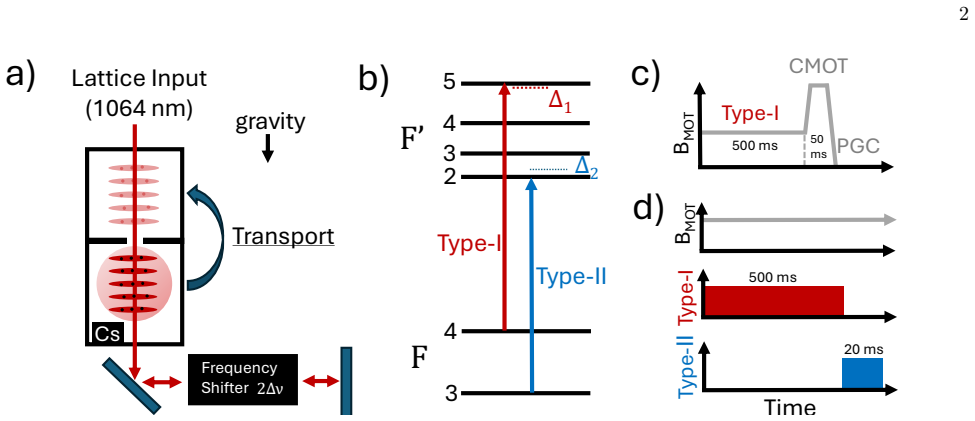
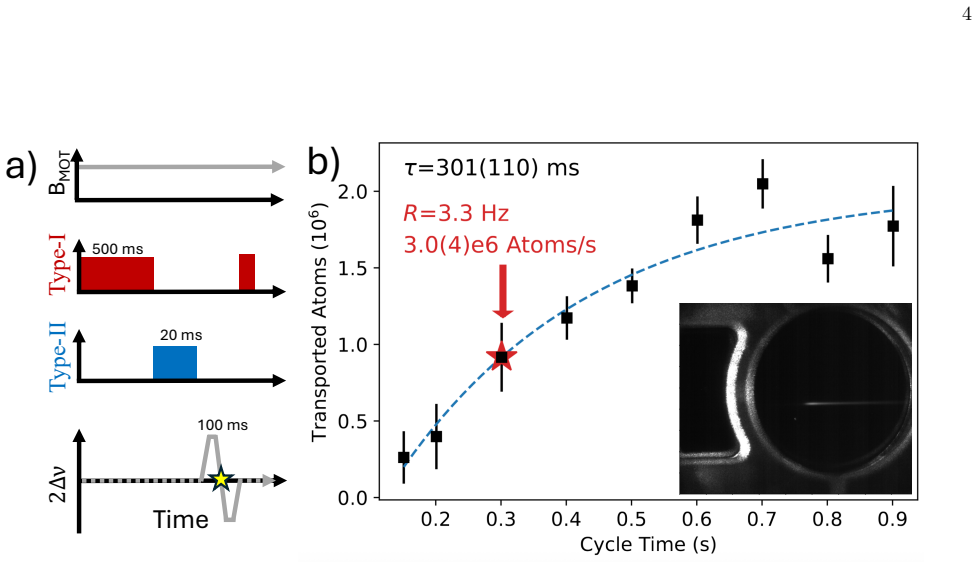
Using a blue-detuned Type-II magneto-optical trap (MOT) operating on the closed F=3 → F'=2 transition of the D2 line in cesium, we achieve temperatures of 17(1) μK without changing the magnetic-field gradient between cooling stages. This enables direct loading into a shallow optical lattice and transport over 17 cm within the same static-field environment.
What carries the argument
blue-detuned Type-II MOT on the closed F=3 to F'=2 transition of the D2 line
Load-bearing premise
The blue-detuned Type-II MOT on the closed F=3 to F'=2 transition provides effective sub-Doppler cooling and is compatible with direct optical lattice loading and transport in a fully static magnetic field configuration for cesium.
What would settle it
If the temperature stays above 17 μK or atoms cannot load into the lattice and travel 17 cm without any change to the magnetic-field gradient, the static-field cooling and transport method does not perform as claimed.
Figures


read the original abstract
Laser cooling of alkali atoms typically requires time-varying magnetic fields, introducing unwanted coupling between atom preparation and coherent operations. Here we demonstrate sub-Doppler laser cooling and optical transport of alkali atoms in a fully static magnetic-field configuration. Using a blue-detuned Type-II magneto-optical trap (MOT) operating on the closed $F=3 \rightarrow F'=2$ transition of the D2 line in cesium, we achieve temperatures of 17(1) $\mu$K without changing the magnetic-field gradient between cooling stages. This enables direct loading into a shallow optical lattice and transport over 17 cm within the same static-field environment. In contrast to conventional alkali cooling schemes with dynamic fields, our approach establishes a continuous cooling and transport protocol compatible with static-field platforms. These results validate Type-II cooling as a practical technique for alkali atoms and provide a new route toward continuous-operation architectures in sensing and quantum computing.
Editorial analysis
A structured set of objections, weighed in public.
Referee Report
Summary. The manuscript demonstrates sub-Doppler laser cooling of cesium to 17(1) μK using a blue-detuned Type-II MOT on the closed F=3 → F'=2 transition of the D2 line, achieved without altering the magnetic-field gradient between stages. This static-field configuration enables direct loading into a shallow optical lattice followed by 17 cm transport, providing a continuous protocol that avoids the dynamic fields required in conventional alkali schemes.
Significance. If the experimental results hold, the work is significant for enabling continuous cooling and transport in static-field platforms relevant to atomic sensing and quantum computing. The specific achieved temperature and transport distance, together with the validation of Type-II cooling for alkali atoms, offer a practical route to architectures that minimize unwanted magnetic couplings.
major comments (2)
- [Experimental Setup] Experimental Setup section: the claim that the F=3 → F'=2 transition remains closed under the applied blue detuning and static gradient requires explicit confirmation via measured scattering rates or leakage to other hyperfine levels; without this, the sub-Doppler mechanism and achieved temperature cannot be fully attributed to the stated configuration.
- [Results] Results section, time-of-flight analysis: the extraction of 17(1) μK from expansion data assumes a Gaussian velocity distribution and ballistic regime; the manuscript should report the fitted expansion times, initial size, and any density-dependent corrections, as these directly support the central temperature claim and its uncertainty.
minor comments (2)
- [Figure 1] Figure 1 caption: the labeling of beam polarizations and detuning values should be cross-referenced to the text for immediate clarity.
- [Results] The transport distance of 17 cm is stated without the corresponding transport duration or velocity; adding this datum would aid assessment of the protocol's practicality.
Simulated Author's Rebuttal
We thank the referee for their careful reading of the manuscript and for the constructive comments, which we have addressed below. We agree that the suggested additions will improve the clarity and rigor of the presentation.
read point-by-point responses
-
Referee: [Experimental Setup] Experimental Setup section: the claim that the F=3 → F'=2 transition remains closed under the applied blue detuning and static gradient requires explicit confirmation via measured scattering rates or leakage to other hyperfine levels; without this, the sub-Doppler mechanism and achieved temperature cannot be fully attributed to the stated configuration.
Authors: We agree that explicit support for the closed character of the transition strengthens the attribution of the observed sub-Doppler cooling. The F=3 → F'=2 line is closed by electric-dipole selection rules, and the large blue detuning (several linewidths) suppresses off-resonant excitation to neighboring hyperfine levels. In the revised manuscript we have added a short paragraph in the Experimental Setup section that reports the calculated on-resonance scattering rate together with an upper limit on leakage (derived from the absence of detectable fluorescence on the F=4 → F'=5 cycling transition after the cooling stage). These additions confirm that population transfer to other hyperfine states remains below our detection threshold and is consistent with the reported temperature. revision: yes
-
Referee: [Results] Results section, time-of-flight analysis: the extraction of 17(1) μK from expansion data assumes a Gaussian velocity distribution and ballistic regime; the manuscript should report the fitted expansion times, initial size, and any density-dependent corrections, as these directly support the central temperature claim and its uncertainty.
Authors: We thank the referee for this request for additional detail. The temperature was obtained from a linear fit to the squared rms width versus expansion time squared under the assumption of a Gaussian velocity distribution in the ballistic regime. In the revised Results section we now explicitly state the expansion times used (5–15 ms), the measured initial rms cloud size (0.8 mm), and the confirmation that mean-field and density-dependent corrections are negligible at our atom number and optical density. The quoted uncertainty of 1 μK reflects the standard deviation across repeated measurements; no additional systematic corrections were required. revision: yes
Circularity Check
No significant circularity; purely experimental result
full rationale
The manuscript is an experimental demonstration reporting measured temperatures of 17(1) μK, direct lattice loading, and 17 cm transport in a fixed-gradient static magnetic field using a blue-detuned Type-II MOT on the closed F=3→F'=2 transition. No derivation chain, equations, fitted parameters renamed as predictions, or load-bearing self-citations appear in the abstract or described content. The central claims follow directly from the supplied experimental sequence, polarization choices, detuning values, and time-of-flight data, rendering the result self-contained with no reduction of outputs to inputs by construction.
Axiom & Free-Parameter Ledger
Reference graph
Works this paper leans on
-
[1]
G. J. Dick, Local oscillator induced instabilities in trapped ion frequency standards, inProceedings of the 19th Annual Precise Time and Time Interval Systems and Applications Meeting(1989) pp. 133–147
1989
-
[2]
Holland, K
M. Holland, K. Burnett, C. Gardiner, J. Cirac, and P. Zoller, Theory of an atom laser, Physical Review A 54, R1757 (1996)
1996
-
[3]
Meiser, J
D. Meiser, J. Ye, D. Carlson, and M. Holland, Prospects for a millihertz-linewidth laser, Physical review letters 102, 163601 (2009)
2009
-
[4]
Kwolek and A
J. Kwolek and A. Black, Continuous sub-doppler-cooled atomic beam interferometer for inertial sensing, Physical Review Applied17, 024061 (2022)
2022
-
[5]
Aharonov and M
D. Aharonov and M. Ben-Or, Fault-tolerant quantum computation with constant error, inProceedings of the twenty-ninth annual ACM symposium on Theory of com- puting(1997) pp. 176–188
1997
-
[6]
A. Y. Kitaev, Quantum computations: algorithms and error correction, Russian Mathematical Surveys52, 1191 (1997)
1997
-
[7]
Li and J
Y. Li and J. D. Thompson, High-rate and high-fidelity modular interconnects between neutral atom quantum processors, PRX Quantum5, 020363 (2024)
2024
-
[8]
C.-C. Chen, R. Gonz´ alez Escudero, J. Min´ aˇ r, B. Pasquiou, S. Bennetts, and F. Schreck, Contin- uous Bose–Einstein condensation, Nature606, 683 (2022)
2022
-
[9]
M. A. Norcia, H. Kim, W. B. Cairncross, M. Stone, A. Ryou, M. Jaffe, M. Brown, K. Barnes, P. Battaglino, T. Bohdanowicz,et al., Iterative assembly of 171 Yb atom arrays with cavity-enhanced optical lattices, PRX Quantum5, 030316 (2024)
2024
-
[10]
N.-C. Chiu, E. C. Trapp, J. Guo, M. H. Abobeih, L. M. Stewart, S. Hollerith, P. L. Stroganov, M. Kalinowski, A. A. Geim, S. J. Evered,et al., Continuous operation of a coherent 3,000-qubit system, Nature646, 1075 (2025)
2025
-
[11]
W. Ketterle, D. S. Durfee, and D. Stamper-Kurn, Mak- ing, probing and understanding Bose-Einstein conden- sates, arXiv preprint cond-mat/9904034 (1999)
-
[12]
H. J. Metcalf and P. Van der Straten,Laser cooling and trapping(Springer Science & Business Media, 1999)
1999
-
[13]
K. N. Jarvis, J. Devlin, T. Wall, B. Sauer, and M. Tar- butt, Blue-detuned magneto-optical trap, Physical re- view letters120, 083201 (2018)
2018
-
[14]
Tarbutt, Magneto-optical trapping forces for atoms and molecules with complex level structures, New Jour- nal of Physics17, 015007 (2015)
M. Tarbutt, Magneto-optical trapping forces for atoms and molecules with complex level structures, New Jour- nal of Physics17, 015007 (2015)
2015
-
[15]
Devlin and M
J. Devlin and M. Tarbutt, Three-dimensional doppler, polarization-gradient, and magneto-optical forces for atoms and molecules with dark states, New Journal of Physics18, 123017 (2016)
2016
-
[16]
J. J. Burau, P. Aggarwal, K. Mehling, and J. Ye, Blue- detuned magneto-optical trap of molecules, Physical Re- view Letters130, 193401 (2023)
2023
-
[17]
S. J. Li, C. M. Holland, Y. Lu, and L. W. Cheuk, Blue- detuned magneto-optical trap of CaF molecules, Physical review letters132, 233402 (2024)
2024
-
[18]
Monroe, W
C. Monroe, W. Swann, H. Robinson, and C. Wieman, Very cold trapped atoms in a vapor cell, Physical Review Letters65, 1571 (1990)
1990
-
[19]
Grimm, M
R. Grimm, M. Weidem¨ uller, and Y. B. Ovchinnikov, Optical dipole traps for neutral atoms, inAdvances in atomic, molecular, and optical physics, Vol. 42 (Elsevier,
-
[20]
Klostermann, C
T. Klostermann, C. R. Cabrera, H. von Raven, J. F. Wienand, C. Schweizer, I. Bloch, and M. Aidelsburger, Fast long-distance transport of cold cesium atoms, Phys- ical Review A105, 043319 (2022)
2022
-
[21]
J´ auregui, N
R. J´ auregui, N. Poli, G. Roati, and G. Modugno, Anhar- monic parametric excitation in optical lattices, Physical Review A64, 033403 (2001)
2001
-
[22]
Petrich, M
W. Petrich, M. H. Anderson, J. R. Ensher, and E. A. Cor- nell, Behavior of atoms in a compressed magneto-optical trap, Journal of the optical society of America B11, 1332 (1994)
1994
-
[23]
Dalibard and C
J. Dalibard and C. Cohen-Tannoudji, Laser cooling below the doppler limit by polarization gradients: simple theo- retical models, Journal of the Optical Society of America B6, 2023 (1989)
2023
-
[24]
Arpornthip, C
T. Arpornthip, C. Sackett, and K. Hughes, Vacuum- pressure measurement using a magneto-optical trap, Physical Review A—Atomic, Molecular, and Optical Physics85, 033420 (2012)
2012
-
[25]
J. Lee, J. H. Lee, J. Noh, and J. Mun, Core-shell magneto-optical trap for alkaline-earth-metal-like atoms, Physical Review A91, 053405 (2015)
2015
-
[26]
J. Miles, M. Lichtman, A. Scott, J. Scott, S. Nor- rell, M. Bedalov, D. Belknap, D. Cole, S. Eubanks, M. Gillette,et al., Qubit syndrome measurements with a high fidelity Rb-Cs rydberg gate, arXiv preprint arXiv:2603.13492 (2026)
-
[27]
D. K. Ruttley, A. Guttridge, S. Spence, R. C. Bird, C. R. Le Sueur, J. M. Hutson, and S. L. Cornish, Formation of ultracold molecules by merging optical tweezers, Physical Review Letters130, 223401 (2023)
2023
-
[28]
Hussein, F
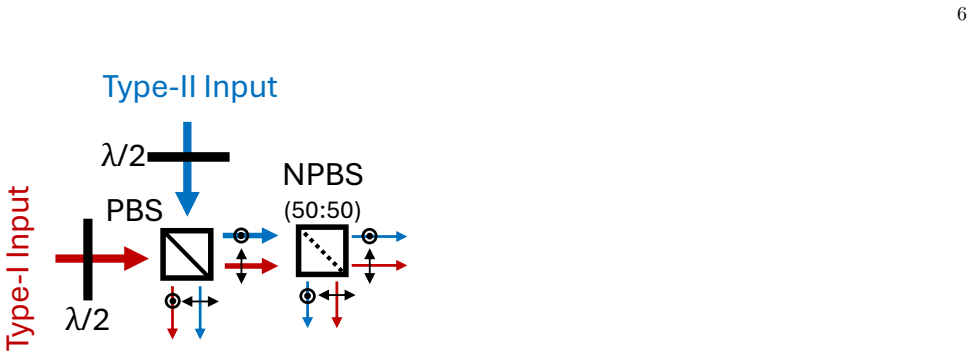
O. Hussein, F. Forouhar-Manesh, P. D. Franco, M. Byres, M. Jones, A. Lagno, A. Okell, and A. Jamison, Type-II blue-detuned mot for cesium and lithium (2026), confer- ence abstract, DAMOP 2026. APPENDIX A: MUL TIPLEXING TYPE-I MOT AND TYPE-II BDM P A THS The handedness of the Type-II BDM light is oppo- site to the Type-I light due to a combination of blue-...
2026
discussion (0)
Sign in with ORCID, Apple, or X to comment. Anyone can read and Pith papers without signing in.