Recognition: unknown
New physics searches at NA62
Pith reviewed 2026-05-10 17:15 UTC · model grok-4.3
The pith
NA62 sets upper limits at the 10^{-11} level on K+ to pi+ X branching ratios to constrain new physics in portal models.
A machine-rendered reading of the paper's core claim, the machinery that carries it, and where it could break.
Core claim
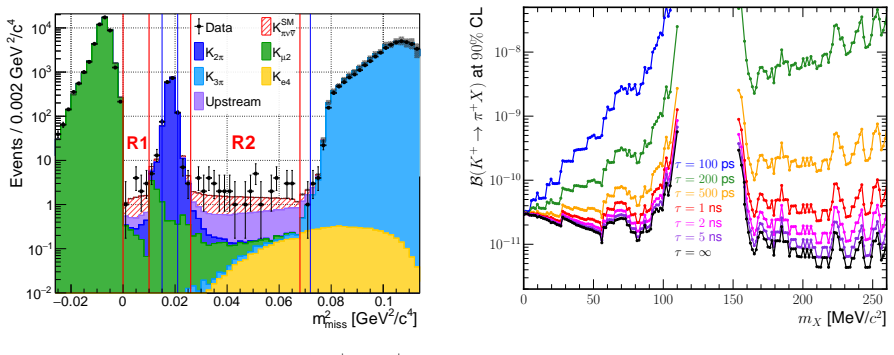
Searches for the decays K+→π+X and π+→e+N in NA62 data from 2016-2022 and 2017-2024, respectively, find no signals. Upper limits on the K+→π+X branching ratio are established at the 10^{-11} level, providing constraints on dark photon, scalar and ALP couplings. From the search for heavy neutral lepton production in π+→e+N decays, upper limits of |U_e4|^2 are established at the 10^{-8} level over the mass range 95-126 MeV/c².
What carries the argument
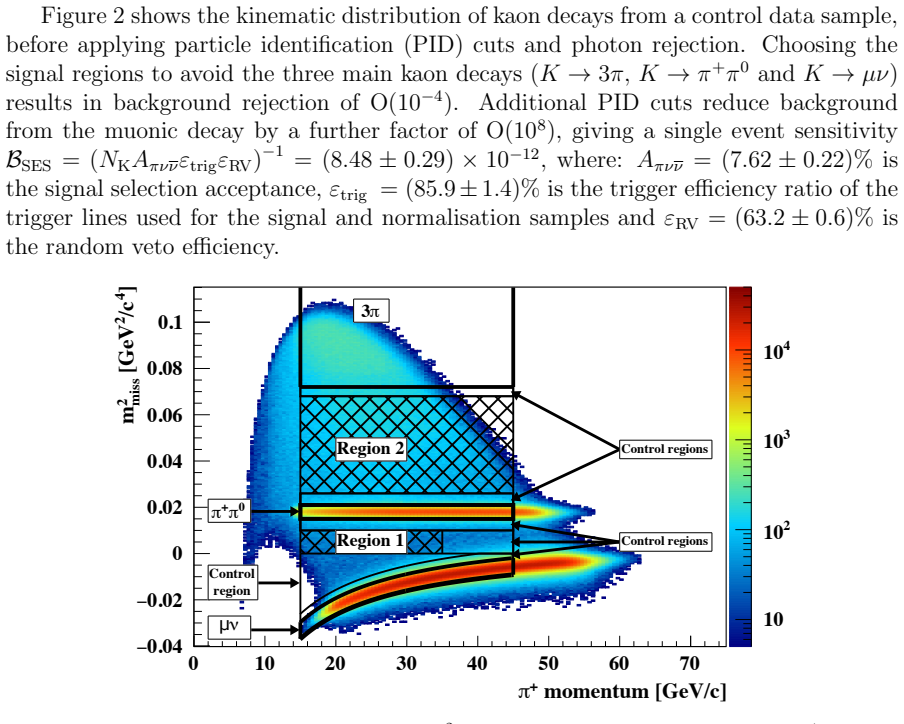
Kinematic reconstruction of missing mass or invariant mass distributions in selected kaon and pion decay events to search for narrow peaks or missing energy signatures from new particles.
If this is right
- Dark photon couplings to standard model particles are bounded in the relevant mass ranges.
- Scalar particle and ALP couplings receive direct limits from the branching ratio constraints.
- Heavy neutral lepton mixing matrix elements are restricted at the 10^{-8} level for masses between 95 and 126 MeV/c².
- The results apply uniformly across all four portal model scenarios for new physics.
Where Pith is reading between the lines
- Ongoing NA62 data collection could push these branching ratio limits lower in future updates.
- The limits can be combined with results from other experiments to further restrict portal model parameter spaces.
- Null results imply that any new physics in these channels, if present, must occur at higher masses or weaker couplings than currently probed.
Load-bearing premise
The new-physics interpretations assume signals would appear in the four portal scenarios with no additional backgrounds or detector effects beyond those modeled in the analysis.
What would settle it
An excess of events above expected background in the missing-mass signal region for K+→π+X at a specific mass value would indicate a new particle and invalidate the null-result limits.
Figures




read the original abstract
The NA62 experiment at CERN has collected a large sample of $K^+$ and $\pi^+$ decays in flight during Run 1 in 2016--2018 and the ongoing Run 2 which started in 2021. Searches for the decays $K^+\rightarrow\pi^+X$ and $\pi^+\rightarrow e^+N$ are presented using NA62 data collected in 2016--2022 and 2017--2024, respectively. Results are interpreted to constrain a range of new physics scenarios covering all four portal model scenarios. Upper limits on the $K^+\rightarrow\pi^+X$ branching ratio are established at the $10^{-11}$ level, providing constraints on dark photon, scalar and ALP couplings. From the search for heavy neutral lepton production in $\pi^+\rightarrow e^+N$ decays of beam pions, upper limits of the extended neutrino mixing matrix element $|U_{e4}|^2$ are established at the $10^{-8}$ level over the heavy neutral lepton mass range 95--126~MeV/$c^2$.
Editorial analysis
A structured set of objections, weighed in public.
Referee Report
Summary. The manuscript reports searches for the rare decays K⁺ → π⁺X and π⁺ → e⁺N using NA62 data collected in 2016–2022 and 2017–2024, respectively. Non-observation of signals is interpreted in the four portal models to set upper limits on the K⁺ → π⁺X branching ratio at the 10^{-11} level (constraining dark-photon, scalar, and ALP couplings) and on the heavy-neutral-lepton mixing parameter |U_{e4}|^2 at the 10^{-8} level for masses 95–126 MeV/c².
Significance. If the efficiency and background modeling are robust, the results provide competitive, data-driven constraints on beyond-Standard-Model scenarios that are directly relevant to current portal-model phenomenology. The use of a large in-flight decay sample from both Run 1 and Run 2 strengthens the experimental reach relative to earlier searches.
major comments (1)
- [Analysis and Results sections] The central limits on BR(K⁺ → π⁺X) and |U_{e4}|^2 are obtained only after folding in signal efficiencies and background estimates that are model-dependent. The manuscript must demonstrate, with quantitative validation (e.g., control-sample studies or sideband fits), that missing-mass resolution, particle identification, and pile-up effects are correctly modeled for each portal scenario; any mismatch directly scales the quoted limits.
Simulated Author's Rebuttal
We thank the referee for the careful reading of our manuscript and the positive assessment of its significance. We address the single major comment below.
read point-by-point responses
-
Referee: [Analysis and Results sections] The central limits on BR(K⁺ → π⁺X) and |U_{e4}|^2 are obtained only after folding in signal efficiencies and background estimates that are model-dependent. The manuscript must demonstrate, with quantitative validation (e.g., control-sample studies or sideband fits), that missing-mass resolution, particle identification, and pile-up effects are correctly modeled for each portal scenario; any mismatch directly scales the quoted limits.
Authors: We agree that explicit quantitative validation of the modeling is required to support the robustness of the limits. In the revised manuscript we have added dedicated subsections in the Analysis section that present control-sample studies for particle identification and sideband fits for background modeling. These studies demonstrate agreement between data and simulation for missing-mass resolution and pile-up effects over the relevant mass ranges. The validations are performed using data-driven methods that are independent of the specific portal-model assumptions; model-dependent signal efficiencies are applied only after the underlying detector response has been validated. Additional figures and tables have been included to quantify the level of agreement. revision: yes
Circularity Check
No circularity: experimental upper limits are data-driven with no self-referential derivation.
full rationale
The paper reports direct experimental searches for K+→π+X and π+→e+N decays using NA62 data, setting upper limits on branching ratios and |U_e4|^2 from non-observation. These limits follow from counting observed events against modeled backgrounds and signal efficiencies, without any mathematical derivation, fitted parameters renamed as predictions, or load-bearing self-citations to uniqueness theorems. The central results are falsifiable against external data and do not reduce to inputs by construction.
Axiom & Free-Parameter Ledger
axioms (2)
- domain assumption Standard Model decay kinematics and detector response are correctly modeled.
- domain assumption New physics appears only through the four portal scenarios with no additional interactions.
Reference graph
Works this paper leans on
-
[1]
K + →π +ννand KL →π 0ννin the Standard Model: status and perspectives,
A. J. Buras, D. Buttazzo, J. Girrbach-Noe, and R. Knegjens, “K + →π +ννand KL →π 0ννin the Standard Model: status and perspectives,”Journal of High Energy Physics, vol. 2015, no. 11, p. 033, Nov. 2015. doi:10.1007/JHEP11(2015)033
-
[2]
The exclusive vision of rare K and B decays and of the quark mixing in the Standard Model
Buras, A.J., Venturini, E. The exclusive vision of rare K and B decays and of the quark mixing in the Standard Model. Eur. Phys. J. C 82, 615 (2022). doi.org:10.1140/epjc/s10052-022-10583-8
-
[3]
Cortina Gilet al.[NA62], JHEP02(2025), 191 doi:10.1007/JHEP02(2025)191 [arXiv:2412.12015 [hep-ex]]
E. Cortina Gilet al.[NA62], JHEP02(2025), 191 doi:10.1007/JHEP02(2025)191 [arXiv:2412.12015 [hep-ex]]
-
[4]
Cortina Gilet al.[NA62], JHEP11(2025), 143 doi:10.1007/JHEP11(2025)143 [arXiv:2507.17286 [hep-ex]]
E. Cortina Gilet al.[NA62], JHEP11(2025), 143 doi:10.1007/JHEP11(2025)143 [arXiv:2507.17286 [hep-ex]]
-
[5]
Bloch-Devauxet al.[NA62], Phys
B. Bloch-Devauxet al.[NA62], Phys. Lett. B872(2026), 140119 doi:10.1016/j.physletb.2025.140119 [arXiv:2507.07345 [hep-ex]]. 6
discussion (0)
Sign in with ORCID, Apple, or X to comment. Anyone can read and Pith papers without signing in.