Recognition: unknown
Towards better nuclear charge radii
Pith reviewed 2026-05-10 16:50 UTC · model grok-4.3
The pith
Combining results from independent groups using different methods yields more precise nuclear charge radii.
A machine-rendered reading of the paper's core claim, the machinery that carries it, and where it could break.
Core claim
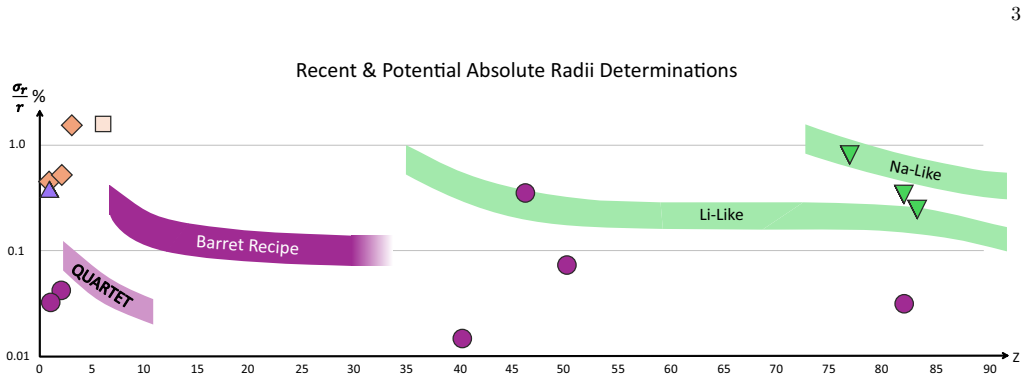
The present effort is directed toward a more precise and reliable extraction of charge radii, as well as the development of a modern, transparent, and methodologically robust compilation of recommended values.
What carries the argument
The merging of outcomes from several independent working groups that employ distinct methodological approaches and evaluation strategies.
If this is right
- Recommended charge radii values become more consistent across different experimental techniques.
- Theoretical nuclear models gain a stronger, less ambiguous set of input data.
- Transparency increases in how final recommended values are selected from raw results.
- Applications in atomic physics and astrophysics benefit from reduced systematic uncertainties in nuclear sizes.
Where Pith is reading between the lines
- The new compilation could serve as a standard reference for experiments at radioactive beam facilities.
- Literature discrepancies in charge radii might decrease once a single transparent set replaces older conflicting tables.
- Periodic updates to the compilation could incorporate fresh data from next-generation measurements to keep values current.
Load-bearing premise
That combining outcomes from several independent working groups employing distinct methodological approaches and evaluation strategies will produce a more precise and reliable set of charge radii values than currently available.
What would settle it
A new high-precision measurement of a nuclear charge radius that lies well outside the uncertainty band of the compiled recommended value would indicate that the combined approach does not improve reliability.
Figures

read the original abstract
Nuclear charge radii constitute a physical observable of growing significance across multiple subdisciplines of physics and related fields. Their determination relies on a combination of complementary experimental techniques and advanced theoretical frameworks. Current recommended values are informed by the outcomes of several independent working groups, each employing distinct methodological approaches and evaluation strategies. The present effort is directed toward a more precise and reliable extraction of charge radii, as well as the development of a modern, transparent, and methodologically robust compilation of recommended values.
Editorial analysis
A structured set of objections, weighed in public.
Referee Report
Summary. The manuscript states that nuclear charge radii are observables of growing importance across physics subdisciplines, that current recommended values draw from multiple independent working groups with distinct methods, and that the present effort aims to achieve more precise and reliable extraction together with a modern, transparent, and methodologically robust compilation of recommended values.
Significance. A completed compilation meeting the stated criteria of transparency and robustness would provide a useful community resource for nuclear structure studies, atomic physics, and related fields that rely on charge-radii data. The paper correctly identifies the complementary nature of experimental techniques and theoretical frameworks but does not yet demonstrate any concrete advance.
major comments (1)
- [Abstract] Abstract and introduction: the central claim that combining results from independent groups will yield a 'more precise and reliable' set of values is presented as an intention rather than a demonstrated outcome; no weighting scheme, discrepancy-resolution protocol, or quantitative comparison with existing compilations is supplied, leaving the improvement unverified.
minor comments (1)
- The manuscript would benefit from an explicit outline of the planned evaluation criteria or a pilot application to a small set of nuclei to illustrate the approach.
Simulated Author's Rebuttal
We thank the referee for their careful reading and constructive feedback on our manuscript. We address the major comment below and have revised the text to improve clarity and provide the requested details on our methodology.
read point-by-point responses
-
Referee: [Abstract] Abstract and introduction: the central claim that combining results from independent groups will yield a 'more precise and reliable' set of values is presented as an intention rather than a demonstrated outcome; no weighting scheme, discrepancy-resolution protocol, or quantitative comparison with existing compilations is supplied, leaving the improvement unverified.
Authors: We agree that the original abstract and introduction framed the benefits of combining independent results as a project goal rather than a completed demonstration. The manuscript outlines the rationale and overall strategy for an improved compilation. In the revised version we have updated the abstract to emphasize the methodological framework under development. We have added a dedicated subsection describing the weighting scheme (based on combined experimental uncertainties and consistency checks across techniques), the protocol for resolving discrepancies (prioritizing overlapping high-precision data and cross-checks with theory), and a quantitative comparison against the Angeli-Marinova compilation for selected nuclei that illustrates the reduction in recommended uncertainties. These revisions supply the concrete elements requested. revision: yes
Circularity Check
No circularity; aspirational compilation without derivations
full rationale
The paper states an intent to improve extraction and compilation of nuclear charge radii by integrating independent experimental and theoretical results from multiple groups. No equations, first-principles derivations, fitted parameters, or predictions appear in the provided abstract or described content. The central claim is a forward-looking statement of purpose rather than a quantitative result or model that could reduce to its own inputs by construction. Per the evaluation rules, absence of any load-bearing derivation chain means the paper is self-contained against external benchmarks with no circularity to flag.
Axiom & Free-Parameter Ledger
Reference graph
Works this paper leans on
-
[1]
E. W. Otten, Nuclear radii and moments of unstable isotopes, inTreatise on Heavy Ion Science: Volume 8: Nuclei Far From Stability, edited by D. A. Bromley (Springer US, Boston, MA, 1989) pp. 517–638. 10
1989
-
[2]
P. G. Reinhard and W. Nazarewicz, Toward a global de- scription of nuclear charge radii: Exploring the Fayans energy density functional, Phys. Rev. C95, 064328 (2017)
2017
-
[3]
X. Yang, S. Wang, S. Wilkins, and R. G. Ruiz, Laser spectroscopy for the study of exotic nuclei, Progress in Particle and Nuclear Physics129, 104005 (2023)
2023
-
[4]
Koszorus, R
A. Koszorus, R. P. de Groote, B. Cheal, P. Campbell, and I. D. Moore, Nuclear structure studies by collinear laser spectroscopy, The European Physical Journal A 60, 20 (2024)
2024
-
[5]
Verney, History of the concept of nuclear shape, The European Physical Journal A61, 82 (2025)
D. Verney, History of the concept of nuclear shape, The European Physical Journal A61, 82 (2025)
2025
-
[6]
B. A. Brown, Mirror Charge Radii and the Neutron Equation of State, Phys. Rev. Lett.119, 122502 (2017)
2017
-
[7]
B. A. Brown, K. Minamisono, J. Piekarewicz, H. Herg- ert, D. Garand, A. Klose, K. K¨ onig, J. D. Lantis, Y. Liu, B. Maaß, A. J. Miller, W. N¨ ortersh¨ auser, S. V. Pineda, R. C. Powel, D. M. Rossi, F. Sommer, C. Sum- ithrarachchi, A. Teigelh¨ ofer, J. Watkins, and R. Wirth, Implications of the 36ca-36s and 38ca-38ar difference in mirror charge radii on th...
2020
-
[8]
K¨ onig, J
K. K¨ onig, J. C. Berengut, A. Borschevsky, A. Brin- son, B. A. Brown, A. Dockery, S. Elhatisari, E. Eliav, R. F. G. Ruiz, J. D. Holt, B.-S. Hu, J. Karthein, D. Lee, Y.-Z. Ma, U.-G. Meißner, K. Minamisono, A. V. Oleyn- ichenko, S. V. Pineda, S. D. Prosnyak, M. L. Reitsma, L. V. Skripnikov, A. Vernon, and A. Zaitsevskii, Nu- clear charge radii of silicon i...
2024
-
[9]
Reinhard and W
P.-G. Reinhard and W. Nazarewicz, Information con- tent of the differences in the charge radii of mirror nu- clei, Physical Review C105, L021301 (2022)
2022
-
[10]
J. C. Hardy and I. S. Towner, Superallowed 0 + →0 + nuclearβdecays: 2020 critical survey, with implications for Vud and CKM unitarity, Phys. Rev. C102, 045501 (2020)
2020
-
[11]
M. Gorchtein and C. Y. Seng, Superallowed Nuclear Beta Decays and Precision Tests of the Standard Model, Ann. Rev. Nucl. Part. Sci.74, 23 (2024), arXiv:2311.00044 [nucl-th]
-
[12]
D. Androi´ cet al.(Qweak), Precision measurement of the weak charge of the proton, Nature557, 207 (2018), arXiv:1905.08283 [nucl-ex]
-
[13]
Delaunay, C
C. Delaunay, C. Frugiuele, E. Fuchs, and Y. Soreq, Probing new spin-independent interactions through pre- cision spectroscopy in atoms with few electrons, Phys. Rev. D96, 115002 (2017)
2017
-
[14]
D. S. Akulov, R. R. Abdullin, D. V. Chubukov, D. A. Glazov, and A. V. Volotka,g-Factor Isotopic Shifts: Theoretical Limits on New Physics Search, Atoms13 (2025)
2025
-
[15]
Antognini, F
A. Antognini, F. Hagelstein, and V. Pascalutsa, The proton structure in and out of muonic hydrogen, Annual Review of Nuclear and Particle Science72, 389 (2022)
2022
-
[16]
Pachucki, V
K. Pachucki, V. Lensky, F. Hagelstein, S. S. Li Muli, S. Bacca, and R. Pohl, Comprehensive theory of the Lamb shift in light muonic atoms, Rev. Mod. Phys.96, 015001 (2024)
2024
-
[17]
D. Adhikari, H. Albataineh, D. Androic, K. Aniol, D. S. Armstrong, T. Averett, C. Ayerbe Gayoso, S. Barcus, V. Bellini, R. S. Beminiwattha, J. F. Benesch, H. Bhatt, D. Bhatta Pathak, D. Bhetuwal, B. Blaikie, Q. Cam- pagna, A. Camsonne, G. D. Cates, Y. Chen, C. Clarke, J. C. Cornejo, S. Covrig Dusa, P. Datta, A. Deshpande, D. Dutta, C. Feldman, E. Fuchey, ...
-
[18]
D. Adhikari, H. Albataineh, D. Androic, K. A. Aniol, D. S. Armstrong, T. Averett, C. Ayerbe Gayoso, S. K. Barcus, V. Bellini, R. S. Beminiwattha, J. F. Benesch, H. Bhatt, D. Bhatta Pathak, D. Bhetuwal, B. Blaikie, J. Boyd, Q. Campagna, A. Camsonne, G. D. Cates, Y. Chen, C. Clarke, J. C. Cornejo, S. Covrig Dusa, M. M. Dalton, P. Datta, A. Deshpande, D. Dut...
-
[19]
Y. Aoki, T. Blum, S. Collins, L. D. Debbio, M. D. Morte, P. Dimopoulos, X. Feng, M. Golterman, S. Got- tlieb, R. Gupta, G. Herdoiza, P. Hernandez, A. J¨ uttner, T. Kaneko, E. Lunghi, S. Meinel, C. Monahan, A. Nicholson, T. Onogi, P. Petreczky, A. Portelli, A. Ramos, S. R. Sharpe, J. N. Simone, S. Sint, R. Sommer, N. Tantalo, R. V. de Water, A. Vaquero, U....
-
[20]
A. Ekstr¨ om, C. Forss´ en, G. Hagen, G. R. Jansen, W. Jiang, and T. Papenbrock, What is ab initio 11 in nuclear theory?, Front. Phys.11, 1129094 (2023), arXiv:2212.11064 [nucl-th]
-
[21]
Angeli and K
I. Angeli and K. P. Marinova, Table of experimental nuclear ground state charge radii: An update, Atom. Data Nucl. Data Tabl.99, 69 (2013)
2013
-
[22]
Angeli, A consistent set of nuclear rms charge radii: properties of the radius surface R(N,Z), Atom
I. Angeli, A consistent set of nuclear rms charge radii: properties of the radius surface R(N,Z), Atom. Data Nucl. Data Tabl.87, 185 (2004)
2004
-
[23]
Fricke, C
G. Fricke, C. Bernhardt, K. Heilig, L. A. Schaller, L. Schellenberg, E. B. Shera, and C. W. de Jager, Nuclear Ground State Charge Radii from Electromag- netic Interactions, Atom. Data Nucl. Data Tabl.60, 177 (1995)
1995
-
[24]
Fricke and K
G. Fricke and K. Heilig,Nuclear Charge Radii, edited by H. Schopper, Landolt-B¨ ornstein: Numerical Data and Functional Relationships in Science and Technology - New Series (Springer-Verlag Berlin Heidelberg 2004, 2004)
2004
-
[25]
Ohayon, Critical evaluation of reference charge radii and applications in mirror nuclei, Atomic Data and Nu- clear Data Tables165, 101732 (2025)
B. Ohayon, Critical evaluation of reference charge radii and applications in mirror nuclei, Atomic Data and Nu- clear Data Tables165, 101732 (2025)
2025
-
[26]
P. J. Mohr, D. B. Newell, B. N. Taylor, and E. Tiesinga, Codata recommended values of the fundamental physi- cal constants: 2022, Rev. Mod. Phys.97, 025002 (2025)
2022
-
[27]
Sick, Precise root-mean-square radius of 4He, Phys
I. Sick, Precise root-mean-square radius of 4He, Phys. Rev. C77, 041302 (2008)
2008
-
[28]
N¨ ortersh¨ auser, T
W. N¨ ortersh¨ auser, T. Neff, R. S´ anchez, and I. Sick, Charge radii and ground state structure of lithium iso- topes: Experiment and theory reexamined, Phys. Rev. C84, 024307 (2011)
2011
-
[29]
Xiong, A
W. Xiong, A. Gasparian, H. Gao, D. Dutta, M. Khan- daker, N. Liyanage, E. Pasyuk, C. Peng, X. Bai, L. Ye, et al., A small proton charge radius from an electron– proton scattering experiment, Nature575, 147 (2019)
2019
-
[30]
Z. Sun, K. A. Beyer, Z. A. Mandrykina, I. A. Val- uev, C. H. Keitel, and N. S. Oreshkina, 208Pb nu- clear charge radius revisited: Closing the fine-structure- anomaly gap, Phys. Rev. Lett.135, 163002 (2025)
2025
- [31]
-
[32]
T. Y. Saito, M. Niikura, T. Matsuzaki, H. Saku- rai, M. Igashira, H. Imao, K. Ishida, T. Katabuchi, Y. Kawashima, M. K. Kubo, Y. Miyake, Y. Mori, K. Ninomiya, A. Sato, K. Shimomura, P. Strasser, A. Taniguchi, D. Tomono, and Y. Watanabe, Muonic x-ray measurement for the nuclear charge distribution: The case of stable palladium isotopes, Phys. Rev. C111, 03...
2025
-
[33]
V. A. Yerokhin and B. Ohayon, Model-independent de- termination of nuclear charge radii from li-like ions, Phys. Rev. A113, 012804 (2026)
2026
-
[34]
Staiger, G
H. Staiger, G. Mondeel, S. A. Blundell, Dipti, G. O’Neil, R. Silwal, A. Lapierre, G. Gwinner, J. N. Tan, J. D. Gillaspy, Y. Ralchenko, and E. Takacs, Measurement of D-line energies in sodiumlike Ir, Physical Review A112, 012807 (2025)
2025
-
[35]
Ohayon, A
B. Ohayon, A. Abeln, S. Bara, T. E. Cocolios, O. Eizenberg, A. Fleischmann, L. Gastaldo, C. God- inho, M. Heines, D. Hengstler, G. Hupin, P. Indeli- cato, K. Kirch, A. Knecht, D. Kreuzberger, J. Machado, P. Navratil, N. Paul, R. Pohl, D. Unger, S. M. Vo- giatzi, K. v. Schoeler, and F. Wauters, Towards Pre- cision Muonic X-ray Measurements of Charge Radii ...
2024
-
[36]
V. A. Yerokhin, Z. Harman, and C. H. Keitel, Qed cal- culations of the 2p− −2stransition energies in li-like ions, Phys. Rev. A112, 042801 (2025)
2025
-
[37]
Sikora, V
B. Sikora, V. A. Yerokhin, C. H. Keitel, and Z. Harman, Improved Bound-Electrong-Factor Theory through Complete Two-Loop QED Calculations, Phys. Rev. Lett.134, 123001 (2025)
2025
-
[38]
J. D. Gillaspy, D. Osin, Y. Ralchenko, J. Reader, and S. A. Blundell, Transition energies of the D lines in Na- like ions, Physical Review A87, 062503 (2013)
2013
-
[39]
Hofstadter, Electron scattering and nuclear struc- ture, Rev
R. Hofstadter, Electron scattering and nuclear struc- ture, Rev. Mod. Phys.28, 214 (1956)
1956
-
[40]
De Vries, C
H. De Vries, C. De Jager, and C. De Vries, Nu- clear charge-density-distribution parameters from elas- tic electron scattering, Atomic Data and Nuclear Data Tables36, 495 (1987)
1987
-
[41]
de Vries, C
H. de Vries, C. W. de Jager, and C. de Vries, Nuclear Charge-Density-Distribution Parameters from Electron Scattering, Atomic Data and Nuclear Data Tables36, 495 (1987)
1987
-
[42]
Afanasevet al., Radiative corrections: from medium to high energy experiments, Eur
A. Afanasevet al., Radiative corrections: from medium to high energy experiments, Eur. Phys. J. A60, 91 (2024), arXiv:2306.14578 [hep-ph]
-
[43]
Gueye, A
P. Gueye, A. Kabir, P. Giuliani, J. Glister, B. Lee, R. Gilman, D. Higinbotham, E. Piasetzky, G. Ron, A. Sarty, W. Armstrong, J. Arrington, Z.-E. Meziani, and P. Solvignon, Dispersive corrections in elastic electron-nucleus scattering: An investigation in the in- termediate energy regime and their impact on the nu- clear matter, European Physical Journal ...
2020
-
[44]
E. Takacs, H. Staiger, S. A. Blundell, N. Kimura, H. A. Sakaue, R. F. G. Ruiz, W. Nazarewicz, P.-G. Reinhard, C. A. Faiyaz, C. Suzuki, Dipti, I. Angeli, Y. Ralchenko, I. Murakami, D. Kato, Y. Nagai, R. Takaoka, Y. Miya, and N. Nakamura, Puzzling isotonic odd-even stagger- ing of charge radii in deformed rare earth nuclei (2025), arXiv:2511.19395 [physics.atom-ph]
-
[45]
Fricke, J
G. Fricke, J. Herberz, T. Hennemann, G. Mallot, L. A. Schaller, L. Schellenberg, C. Piller, and R. Jacot- Guillarmod, Behavior of the nuclear charge radii sys- tematics in the s-d shell from muonic atom measure- ments, Phys. Rev. C45, 80 (1992)
1992
-
[46]
K. A. Beyer, T. E. Cocolios, C. Costache, M. De- seyn, P. Demol, A. Doinaki, O. Eizenberg, M. Gor- shteyn, M. Heines, A. Herz´ aˇ n, P. Indelicato, K. Kirch, A. Knecht, R. Lica, V. Matousek, E. A. Maugeri, B. Ohayon, N. S. Oreshkina, W. W. M. M. Phyo, R. Pohl, S. Rathi, W. Ryssens, A. Turturica, K. von Schoeler, I. A. Valuev, S. M. Vogiatzi, F. Wauters, a...
-
[47]
Barrett, Model-independent parameters of the nu- clear charge distribution from muonic X-rays, Physics Letters B33, 388 (1970)
R. Barrett, Model-independent parameters of the nu- clear charge distribution from muonic X-rays, Physics Letters B33, 388 (1970)
1970
-
[48]
Engfer, H
R. Engfer, H. Schneuwly, J. Vuilleumier, H. Walter, and A. Zehnder, Charge-distribution parameters, iso- tope shifts, isomer shifts, and magnetic hyperfine con- stants from muonic atoms, Atomic Data and Nuclear Data Tables14, 509 (1974), nuclear Charge and Mo- ment Distributions. 12
1974
-
[49]
Miska, B
H. Miska, B. Norum, M. Hynes, W. Bertozzi, S. Kowal- ski, F. Rad, C. Sargent, T. Sasanuma, and B. Berman, Precise measurement of the charge-distribution differ- ences of the oxygen isotopes, Physics Letters B83, 165 (1979)
1979
-
[50]
Emrich, G
H. Emrich, G. Fricke, G. Mallot, H. Miska, H.-G. Sieber- ling, J. Cavedon, B. Frois, and D. Goutte, Radial dis- tribution of nucleons in the isotopes 48,40ca, Nuclear Physics A396, 401 (1983)
1983
-
[51]
R. Pohl, A. Antognini, F. Nez, F. D. Amaro, F. Biraben, J. M. R. Cardoso, D. S. Covita, A. Dax, S. Dhawan, L. M. P. Fernandes, A. Giesen, T. Graf, T. W. H ˜A¤nsch, P. Indelicato, L. Julien, C.-Y. Kao, P. Knowles, E.-O. Le Bigot, Y.-W. Liu, J. A. M. Lopes, L. Ludhova, C. M. B. Monteiro, F. Mulhauser, T. Nebel, P. Rabinowitz, dos Santos, Joaquim M. F., L. A...
2010
-
[52]
R. Pohl, F. Nez, L. M. P. Fernandes, F. D. Amaro, F. Biraben, J. M. R. Cardoso, D. S. Covita, A. Dax, S. Dhawan, M. Diepold, A. Giesen, A. L. Gouvea, T. Graf, T. W. H¨ ansch, P. Indelicato, L. Julien, P. Knowles, F. Kottmann, E.-O. L. Bigot, Y.-W. Liu, J. A. M. Lopes, L. Ludhova, C. M. B. Monteiro, F. Mul- hauser, T. Nebel, P. Rabinowitz, J. M. F. dos San...
2016
-
[53]
J. J. Krauth, K. Schuhmann, M. A. Ahmed, F. D. Amaro, P. Amaro, F. Biraben, T.-L. Chen, D. S. Covita, A. J. Dax, M. Diepold, L. M. P. Fernandes, B. Franke, S. Galtier, A. L. Gouvea, J. G¨ otzfried, T. Graf, T. W. H¨ ansch, J. Hartmann, M. Hildebrandt, P. Indelicato, L. Julien, K. Kirch, A. Knecht, Y.-W. Liu, J. Machado, C. M. B. Monteiro, F. Mulhauser, B....
2021
-
[54]
Schuhmann, L
K. Schuhmann, L. M. P. Fernandes, F. Nez, M. A. Ahmed, F. D. Amaro, P. Amaro, F. Biraben, T.-L. Chen, D. S. Covita, A. J. Dax, M. Diepold, B. Franke, S. Galtier, A. L. Gouvea, J. G¨ otzfried, T. Graf, T. W. H¨ ansch, M. Hildebrandt, P. Indelicato, L. Julien, K. Kirch, A. Knecht, F. Kottmann, J. J. Krauth, Y.- W. Liu, J. Machado, C. M. B. Monteiro, F. Mulh...
2025
-
[55]
S. S. Li Muli, T. R. Richardson, and S. Bacca, Revisit- ing the helium isotope-shift puzzle with improved uncer- tainties from nuclear structure corrections, Phys. Rev. Lett.134, 032502 (2025)
2025
- [56]
-
[57]
C. G. Parthey, A. Matveev, J. Alnis, R. Pohl, T. Udem, U. D. Jentschura, N. Kolachevsky, and T. W. H¨ ansch, Precision measurement of the hydrogen-deuterium 1s− 2sisotope shift, Phys. Rev. Lett.104, 233001 (2010)
2010
-
[58]
Pachucki, V
K. Pachucki, V. c. v. Patk´ oˇ s, and V. A. Yerokhin, Three- photon-exchange nuclear structure correction in hydro- genic systems, Phys. Rev. A97, 062511 (2018)
2018
-
[59]
R. C. Brown, S. Wu, J. V. Porto, C. J. Sansonetti, C. E. Simien, S. M. Brewer, J. N. Tan, and J. D. Gillaspy, Quantum interference and light polarization effects in unresolvable atomic lines: Application to a precise mea- surement of the 6,7liD 2 lines, Phys. Rev. A87, 032504 (2013)
2013
-
[60]
Krieger, K
A. Krieger, K. Blaum, M. L. Bissell, N. Fr¨ ommgen, C. Geppert, M. Hammen, K. Kreim, M. Kowal- ska, J. Kr¨ amer, T. Neff, R. Neugart, G. Neyens, W. N¨ ortersh¨ auser, C. Novotny, R. S´ anchez, and D. T. Yordanov, Nuclear charge radius of 12Be, Phys. Rev. Lett.108, 142501 (2012)
2012
-
[61]
Koszor´ us, X
´A. Koszor´ us, X. F. Yang, W. G. Jiang, S. J. Novario, S. W. Bai, J. Billowes, C. L. Binnersley, M. L. Bis- sell, T. E. Cocolios, B. S. Cooper, R. P. de Groote, A. Ekstr¨ om, K. T. Flanagan, C. Forss´ en, S. Franchoo, R. F. Ruiz, F. P. Gustafsson, G. Hagen, G. R. Jansen, A. Kanellakopoulos, M. Kortelainen, W. Nazarewicz, G. Neyens, T. Papenbrock, P. G. R...
2021
-
[62]
Ohayon, J
B. Ohayon, J. E. Padilla-Castillo, S. C. Wright, G. Mei- jer, and B. K. Sahoo, Reconciling mean-squared radius differences in the silver chain through improved mea- surement and ab initio calculations, Phys. Rev. Res.6, 033040 (2024)
2024
-
[63]
Katyal, A
V. Katyal, A. Chakraborty, B. K. Sahoo, B. Ohayon, C.- Y. Seng, M. Gorchtein, and J. Behr, Testing for isospin symmetry breaking by combining isotope shift measure- ments with precise calculations in potassium, Phys. Rev. A111, 042813 (2025)
2025
-
[64]
B. K. Sahoo and B. Ohayon, All-optical differential radii in zinc, Phys. Rev. Res.5, 043142 (2023)
2023
-
[65]
Ohayon, S
B. Ohayon, S. Hofs¨ ass, J. E. Padilla-Castillo, S. C. Wright, G. Meijer, S. Truppe, K. Gibble, and B. K. Sahoo, Isotope shifts in cadmium as a sensitive probe for physics beyond the standard model, New Journal of Physics24, 123040 (2022)
2022
-
[66]
R¨ oser, J
D. R¨ oser, J. E. Padilla-Castillo, B. Ohayon, R. Thomas, S. Truppe, G. Meijer, S. Stellmer, and S. C. Wright, Hyperfine structure and isotope shifts of the (4s2)1s0 → (4s4p)1p1 transition in atomic zinc, Phys. Rev. A109, 012806 (2024)
2024
-
[67]
Hofs¨ ass, J
S. Hofs¨ ass, J. E. Padilla-Castillo, S. C. Wright, S. Kray, R. Thomas, B. G. Sartakov, B. Ohayon, G. Meijer, and S. Truppe, High-resolution isotope-shift spectroscopy of Cd I, Phys. Rev. Res.5, 013043 (2023)
2023
-
[68]
Barzakh, A
A. Barzakh, A. N. Andreyev, C. Raison, J. G. Cu- biss, P. Van Duppen, S. P´ eru, S. Hilaire, S. Goriely, B. Andel, S. Antalic, M. Al Monthery, J. C. Berengut, J. Biero´ n, M. L. Bissell, A. Borschevsky, K. Chrysa- lidis, T. E. Cocolios, T. Day Goodacre, J.-P. Dognon, M. Elantkowska, E. Eliav, G. J. Farooq-Smith, D. V. Fedorov, V. N. Fedosseev, L. P. Gaffn...
2021
-
[69]
E. Riis, A. G. Sinclair, O. Poulsen, G. W. F. Drake, W. R. C. Rowley, and A. P. Levick, Lamb shifts and hyperfine structure in 6Li+ and 7Li+: Theory and ex- periment, Phys. Rev. A49, 207 (1994)
1994
-
[70]
van der Werf, K
Y. van der Werf, K. Steinebach, R. Jannin, H. L. Beth- lem, and K. S. E. Eikema, Alpha and helion parti- cle charge radius difference determined from quantum- degenerate helium, Science388, 850 (2025)
2025
-
[71]
Clausen and F
G. Clausen and F. Merkt, Ionization energy of metastable 3He (2 3S1) and the alpha- and helion- particle charge-radius difference from precision spec- troscopy of thenprydberg series, Phys. Rev. Lett.134, 223001 (2025)
2025
-
[72]
Qi, P.-P
X.-Q. Qi, P.-P. Zhang, Z.-C. Yan, L.-Y. Tang, A.-X. Chen, T.-Y. Shi, and Z.-X. Zhong, Toward resolving the discrepancy in helium-3 and helium-4 nuclear charge radii, Phys. Rev. Res.7, L022020 (2025)
2025
-
[73]
Clausen, K
G. Clausen, K. Gamlin, J. A. Agner, H. Schmutz, and F. Merkt, Metrology in a two-electron atom: The ion- ization energy of metastable triplet helium 2 3S1, Phys. Rev. A111, 012817 (2025)
2025
-
[74]
Pachucki, V
K. Pachucki, V. c. v. Patk´ oˇ s, and V. A. Yerokhin, Second-order hyperfine correction to h, d, and 3He en- ergy levels, Phys. Rev. A110, 062806 (2024)
2024
-
[75]
M¨ uller, M
P. M¨ uller, M. Heinz, P. Imgram, K. K¨ onig, B. Maass, T. Miyagi, W. N¨ ortersh¨ auser, R. Roth, and A. Schwenk, The nuclear charge radius of 13C, Nature Comm.16, 6234 (2025)
2025
-
[76]
Sailer, V
T. Sailer, V. Debierre, Z. Harman, F. Heiße, C. K¨ onig, J. Morgner, B. Tu, A. V. Volotka, C. H. Keitel, K. Blaum, and S. Sturm, Measurement of the bound- electrong-factor difference in coupled ions, Nature606, 479 (2022)
2022
-
[77]
Silwal, A
R. Silwal, A. Lapierre, J. D. Gillaspy, J. M. Dreiling, S. A. Blundell, Dipti, A. B. Jr., G. Gwinner, A. C. C. Villari, Y. Ralchenko, and E. Takacs, Determination of the isotopic change in nuclear charge radius from extreme-ultraviolet spectroscopy of highly charged ions of Xe, Physical Review A101, 062512 (2020)
2020
-
[78]
A. Hosier, Dipti, S. A. Blundell, A. Lapierre, R. Sil- wal, G. Gwinner, J. N. Tan, A. Naing, J. D. Gillaspy, Y. Yang, P. Szypryt, G. O’Neil, H. Staiger, J. M. Dreiling, A. C. C. Villari, I. Angeli, Y. Ralchenko, and E. Takacs, Determination of nuclear charge ra- dius by extreme-ultraviolet spectroscopy of Na-like ions, Physical Review Research7, 10.1103/P...
-
[79]
K¨ onig, S
K. K¨ onig, S. Fritzsche, G. Hagen, J. D. Holt, A. Klose, J. Lantis, Y. Liu, K. Minamisono, T. Miyagi, W. Nazarewicz, T. Papenbrock, S. V. Pineda, R. Powel, and P.-G. Reinhard, Surprising Charge-Radius Kink in the Sc Isotopes atN= 20, Phys. Rev. Lett.131, 102501 (2023)
2023
-
[80]
S. W. Bai, X. F. Yang, A. Koszor´ us, J. C. Berengut, J. Billowes, M. L. Bissell, K. Blaum, A. Borschevsky, P. Campbell, B. Cheal, C. S. Devlin, K. T. Flanagan, R. F. Garcia Ruiz, H. Heylen, J. D. Holt, B. S. Hu, A. Kanellakopoulos, J. Kr¨ amer, V. Lagaki, B. Maaß, S. Malbrunot-Ettenauer, T. Miyagi, K. K¨ onig, M. Ko- rtelainen, W. Nazarewicz, R. Neugart,...
2025
discussion (0)
Sign in with ORCID, Apple, or X to comment. Anyone can read and Pith papers without signing in.