Recognition: unknown
From binding and saturation to criticality in nuclear matter with lattice effective field theory
Pith reviewed 2026-05-10 17:24 UTC · model grok-4.3
The pith
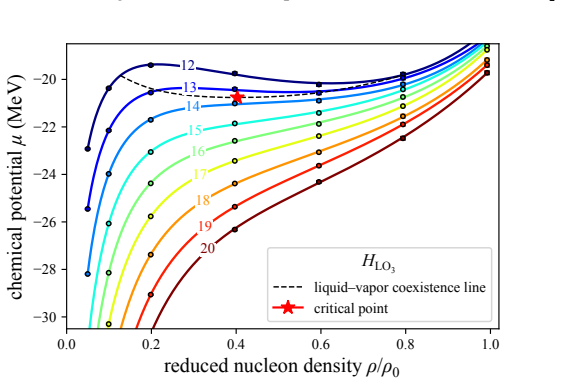
Improved lattice interactions that better reproduce nuclear binding and saturation lower the liquid-gas critical temperature from 15.33 MeV to 13.5-13.7 MeV.
A machine-rendered reading of the paper's core claim, the machinery that carries it, and where it could break.
Core claim
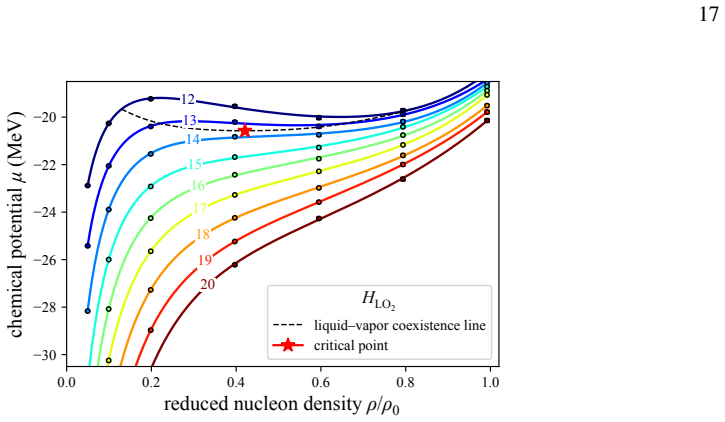
Across the sequence of sign-friendly lattice Hamiltonians, refinements that improve the description of finite-nucleus binding energies and move the zero-temperature saturation point closer to the empirical region also lower the critical temperature of symmetric nuclear matter from 15.33(6) MeV for the SU(4) case to 13.50(17)-13.71(19) MeV for the improved leading-order cases, showing that finite-temperature criticality is not fixed by zero-temperature saturation and binding alone.
What carries the argument
The pinhole-trace algorithm with first-order perturbative treatment applied to a sequence of lattice Hamiltonians ranging from SU(4)-symmetric to those incorporating physical 1S0 and 3S1 dependence and three improved leading-order terms, used to extract both the finite-temperature equation of state and zero-temperature observables.
If this is right
- Finite-temperature criticality in nuclear matter cannot be predicted from zero-temperature saturation and binding energies alone.
- The benchmarked perturbative strategy can be used reliably for thermodynamic calculations in this regime.
- Future lattice interactions must be constrained separately by finite-temperature observables in addition to zero-temperature data.
- Improved leading-order Hamiltonians provide better overall nuclear descriptions but systematically alter the location of the critical point.
Where Pith is reading between the lines
- The observed lowering of the critical temperature with added channel dependence suggests that spin-isospin structure plays an independent role in setting the phase transition.
- These results supply an independent test that could guide the inclusion of higher-order terms or three-nucleon forces in future lattice models.
- Similar Hamiltonian sequences could be used to study how criticality changes in asymmetric matter or at different densities.
Load-bearing premise
The first-order perturbative treatment accurately captures the finite-temperature thermodynamics for the Hamiltonians and density-temperature regime examined.
What would settle it
A non-perturbative or higher-order lattice calculation that yields an unchanged critical temperature even after the saturation point and binding energies have been shifted toward empirical values would show that criticality is in fact fixed by those zero-temperature properties.
Figures





read the original abstract
We investigate the interaction dependence of the liquid-gas critical point of symmetric nuclear matter in finite-temperature lattice effective field theory. Building on the pinhole-trace algorithm, we benchmark a first-order perturbative treatment for representative Hamiltonian splittings and then compute the finite-temperature equation of state for a sequence of sign-friendly lattice Hamiltonians ranging from an SU(4)-symmetric interaction to Hamiltonians with physical ${}^{1}S_{0}$ and ${}^{3}S_{1}$ channel dependence and three improved leading-order Hamiltonians. The finite-temperature analysis is complemented by zero-temperature calculations of the symmetric-matter saturation point and the binding energies of selected nuclei within the same lattice framework. We find that the benchmarked perturbative strategy is quantitatively reliable in the thermodynamic regime studied. Across this Hamiltonian sequence, the LO Hamiltonians improve the overall description of finite-nucleus binding energies and move the zero-temperature saturation point toward the empirical region, while lowering the critical temperature from 15.33(6) MeV to 13.50(17)-13.71(19) MeV. These calculations show that finite-temperature criticality is not fixed by zero-temperature saturation and binding alone, and provide a complementary benchmark for future lattice interaction development.
Editorial analysis
A structured set of objections, weighed in public.
Referee Report
Summary. The paper uses finite-temperature lattice effective field theory with the pinhole-trace algorithm to study the liquid-gas critical point of symmetric nuclear matter. It benchmarks a first-order perturbative treatment for representative Hamiltonian splittings, then computes the equation of state across a sequence of sign-friendly lattice Hamiltonians (from SU(4)-symmetric to those incorporating physical 1S0 and 3S1 dependence and improved leading-order interactions). Zero-temperature calculations of saturation density and selected nuclear binding energies are performed in the same framework. The results show that the perturbative approach is quantitatively reliable in the studied regime, that improved Hamiltonians better describe binding energies and shift saturation toward empirical values, and that the critical temperature decreases from 15.33(6) MeV to 13.50(17)–13.71(19) MeV, indicating that finite-T criticality is not fixed by zero-T saturation and binding alone.
Significance. If the central results hold, the work establishes that interaction details beyond zero-temperature saturation and binding control the liquid-gas critical temperature in nuclear matter, providing a concrete benchmark for lattice EFT Hamiltonian development. The explicit benchmarking of the first-order perturbative method and the direct lattice computations of both finite-T EOS and zero-T observables are strengths that support reproducibility and falsifiability.
major comments (1)
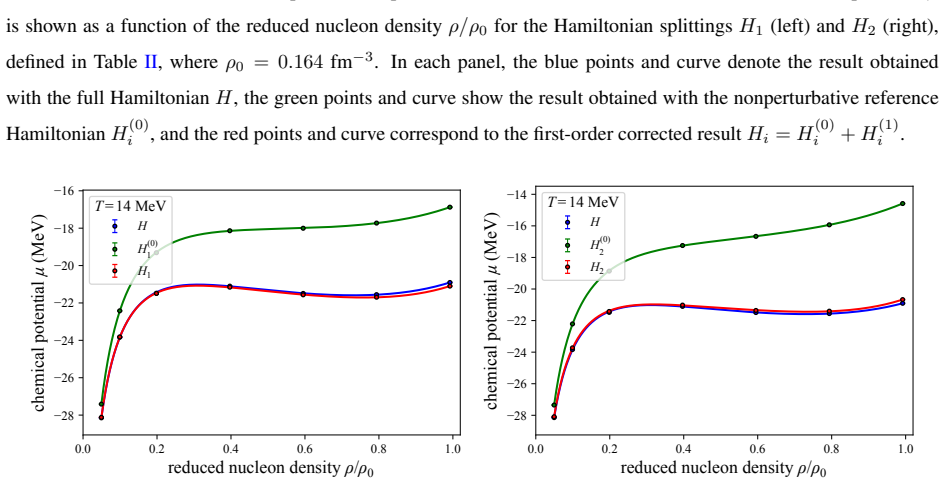
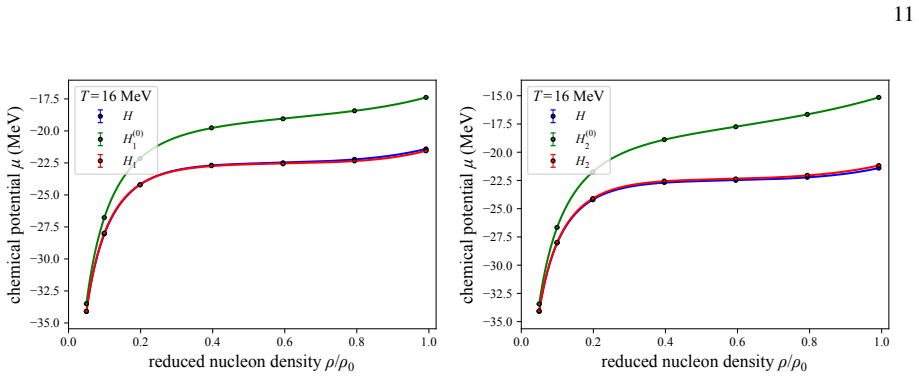
- [finite-temperature analysis and perturbative benchmark] The finite-temperature analysis and perturbative benchmark: The central claim that Tc is not fixed by zero-T properties rests on the accuracy of the reported Tc values (15.33(6) MeV down to 13.50(17)–13.71(19) MeV) across the Hamiltonian sequence. While the manuscript benchmarks first-order perturbation for representative splittings and states quantitative reliability in the thermodynamic regime, the liquid-gas critical point is extracted from the EOS where long-wavelength fluctuations are important; explicit estimates or higher-order checks for O(λ²) shifts to Tc (comparable to the quoted uncertainties) are needed to confirm that the differences in Tc are robust.
Simulated Author's Rebuttal
We thank the referee for the careful reading of our manuscript, the positive assessment of its strengths, and the constructive major comment. We address the point below and have revised the manuscript accordingly to strengthen the robustness of the critical temperature results.
read point-by-point responses
-
Referee: The finite-temperature analysis and perturbative benchmark: The central claim that Tc is not fixed by zero-T properties rests on the accuracy of the reported Tc values (15.33(6) MeV down to 13.50(17)–13.71(19) MeV) across the Hamiltonian sequence. While the manuscript benchmarks first-order perturbation for representative splittings and states quantitative reliability in the thermodynamic regime, the liquid-gas critical point is extracted from the EOS where long-wavelength fluctuations are important; explicit estimates or higher-order checks for O(λ²) shifts to Tc (comparable to the quoted uncertainties) are needed to confirm that the differences in Tc are robust.
Authors: We agree that explicit checks for O(λ²) effects on the extracted Tc are valuable, given the role of long-wavelength fluctuations near criticality. Our original benchmarking compared first-order perturbation directly to non-perturbative lattice results for the equation of state at multiple temperatures and densities, including near the critical region, with differences remaining within statistical uncertainties. To address the referee's concern specifically for Tc, we have added new calculations estimating the second-order perturbative corrections to the pressure in the critical region for the improved Hamiltonians. These estimates indicate O(λ²) shifts to Tc of order 0.1–0.2 MeV, smaller than both the quoted statistical errors on Tc and the observed differences across the Hamiltonian sequence (~1.8 MeV). We have incorporated a description of these checks, together with a supporting figure, into the revised Section IV. This confirms that the reported Tc variations remain robust under the perturbative approximation. revision: yes
Circularity Check
No circularity; results from explicit lattice computations across independent Hamiltonian sequence
full rationale
The derivation consists of direct lattice EFT computations: benchmarking first-order perturbation on representative splittings, then evaluating the finite-T EOS for a sequence of distinct sign-friendly Hamiltonians (SU(4)-symmetric through physical-channel and improved LO variants). Saturation points, nuclear binding energies, and critical temperatures are all obtained from these explicit calculations within the same framework. The central claim—that Tc is not fixed by zero-T saturation and binding alone—follows from the observed variation in computed Tc values as the Hamiltonian is varied, rather than from any definitional equivalence, fitted-input renaming, or load-bearing self-citation. No equation or step reduces to its inputs by construction; external benchmarks and direct numerical results provide the support.
Axiom & Free-Parameter Ledger
free parameters (1)
- Lattice Hamiltonian parameters
axioms (2)
- domain assumption Effective field theory power counting at leading order
- domain assumption Validity of first-order perturbative treatment
Reference graph
Works this paper leans on
-
[2]
Baldo and L
M. Baldo and L. S. Ferreira, Phys. Rev. C59, 682 (1999)
1999
- [3]
-
[4]
A. Carbone, A. Rios, and A. Polls, Phys. Rev. C88, 044302 (2013), 1307.1889
-
[5]
C. Wellenhofer, J. W. Holt, N. Kaiser, and W. Weise, Phys. Rev. C89, 064009 (2014), 1404.2136
-
[6]
A. Carbone, A. Polls, and A. Rios, Phys. Rev. C98, 025804 (2018), 1807.00596
-
[7]
A. Carbone and A. Schwenk, Phys. Rev. C100, 025805 (2019), 1904.00924
- [8]
- [9]
- [10]
-
[11]
Composition and thermodynamics of nuclear matter with light clusters
S. Typel, G. Ropke, T. Klahn, D. Blaschke, and H. H. Wolter, Phys. Rev. C81, 015803 (2010), 0908.2344. 20 0.0 0.4 0.8 1.2 1.6 (MeV 1) 310 290 270 250 E (MeV) 36Ar 0.0 0.4 0.8 1.2 1.6 (MeV 1) 350 330 310 290 40Ca ESU(4) ESU(4) + V3S1 + V1S0 ELO3 0.0 0.4 0.8 1.2 1.6 (MeV 1) 220.0 186.7 153.3 120.0 E (MeV) 24Mg 0.0 0.4 0.8 1.2 1.6 (MeV 1) 240 210 180 150 28S...
work page Pith review arXiv 2010
- [12]
-
[13]
J. W. Holt, M. Rho, and W. Weise, Phys. Rept.621, 2 (2016), 1411.6681. 21 0.0 0.3 0.6 0.9 (MeV 1) 20 17 14 11 E/A (MeV) A = 80, L = 6 0.0 0.3 0.6 0.9 (MeV 1) 17 14 11 8 A = 24, L = 5 0.0 0.3 0.6 0.9 (MeV 1) 20 17 14 11 A = 96, L = 6 1 A ESU(4) 1 A ESU(4) + S 1 A ELO 0.0 0.3 0.6 0.9 (MeV 1) 18 15 12 9 E/A (MeV) A = 32, L = 5 0.0 0.3 0.6 0.9 (MeV 1) 19 16 1...
-
[14]
K. Hebeler and A. Schwenk, Phys. Rev. C82, 014314 (2010), 0911.0483
-
[15]
K. Hebeler, S. K. Bogner, R. J. Furnstahl, A. Nogga, and A. Schwenk, Phys. Rev. C83, 031301 (2011), 1012.3381
-
[16]
C. Drischler, K. Hebeler, and A. Schwenk, Phys. Rev. C93, 054314 (2016), 1510.06728
-
[17]
C. Drischler, K. Hebeler, and A. Schwenk, Phys. Rev. Lett.122, 042501 (2019), 1710.08220
-
[18]
C. Wellenhofer, J. W. Holt, and N. Kaiser, Phys. Rev. C92, 015801 (2015), 1504.00177
- [19]
- [20]
- [21]
- [22]
-
[23]
B.-N. Lu, N. Li, S. Elhatisari, D. Lee, J. E. Drut, T. A. L¨ahde, E. Epelbaum, and U.-G. Meißner, Phys. Rev. Lett. 125, 192502 (2020)
2020
- [24]
- [25]
-
[26]
S. Elhatisari, L. Bovermann, Y .-Z. Ma, E. Epelbaum, D. Frame, F. Hildenbrand, M. Kim, Y . Kim, H. Krebs, T. A. L¨ahde, et al., Nature630, 59 (2024), 2210.17488
- [27]
-
[28]
K ¨onig, J
K. K ¨onig, J. C. Berengut, A. Borschevsky, A. Brinson, B. A. Brown, A. Dockery, S. Elhatisari, E. Eliav, R. F. G. Ruiz, J. D. Holt, et al., Phys. Rev. Lett.132, 162502 (2024)
2024
- [29]
- [30]
- [31]
- [32]
-
[33]
F. Hildenbrand, S. Elhatisari, U.-G. Meißner, H. Meyer, Z. Ren, A. Herten, and M. Bode (2025), 2509.08579
-
[34]
F. Hildenbrand, S. Elhatisari, Z. Ren, and U.-G. Meißner, Eur. Phys. J. A60, 215 (2024), 2406.17638
- [35]
- [36]
- [37]
-
[38]
S. Elhatisari, F. Hildenbrand, and U.-G. Meißner, Phys. Lett. B859, 139086 (2024), 2408.06670
- [39]
-
[40]
S. Elhatisari, F. Hildenbrand, and U.-G. Meißner (2025), 2507.08495
- [41]
- [42]
- [43]
- [44]
-
[45]
T. A. L ¨ahde and U.-G. Meißner,Nuclear Lattice Effective Field Theory: An introduction, vol. 957 (Springer, 2019)
2019
- [46]
-
[47]
V . G. J. Stoks, R. A. M. Klomp, M. C. M. Rentmeester, and J. J. de Swart, Phys. Rev. C48, 792 (1993)
1993
- [48]
-
[49]
Elhatisari, U.-G
S. Elhatisari, U.-G. Meißner, and Z. Ren,Work in progress. 23
-
[50]
Modern Theory of Nuclear Forces
E. Epelbaum, H.-W. Hammer, and U.-G. Meißner, Rev. Mod. Phys.81, 1773 (2009), 0811.1338
work page Pith review arXiv 2009
-
[51]
Widom, The Journal of Chemical Physics39, 2808–2812 (1963)
B. Widom, The Journal of Chemical Physics39, 2808–2812 (1963)
1963
-
[52]
J. B. Elliott, P. T. Lake, L. G. Moretto, and L. Phair, Phys. Rev. C87, 054622 (2013)
2013
-
[53]
H. A. Bethe, Ann. Rev. Nucl. Part. Sci.21, 93 (1971)
1971
discussion (0)
Sign in with ORCID, Apple, or X to comment. Anyone can read and Pith papers without signing in.