Linking Calendar and Cycle Ageing in Lithium-Ion Batteries through Consistent Parameterisation of an Electrochemical-Thermal-Degradation Model
Pith reviewed 2026-05-10 16:44 UTC · model grok-4.3
The pith
A P2D model with consistent parameters for SEI growth, lithium plating and material loss predicts NMC cell capacity fade under calendar and combined ageing.
A machine-rendered reading of the paper's core claim, the machinery that carries it, and where it could break.
Core claim
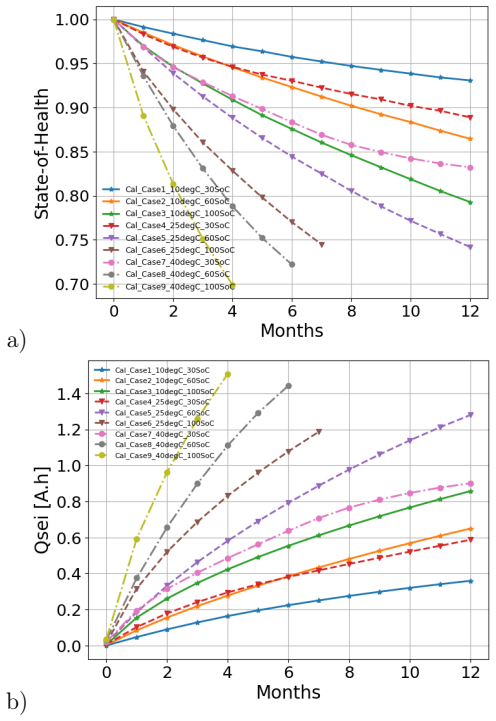
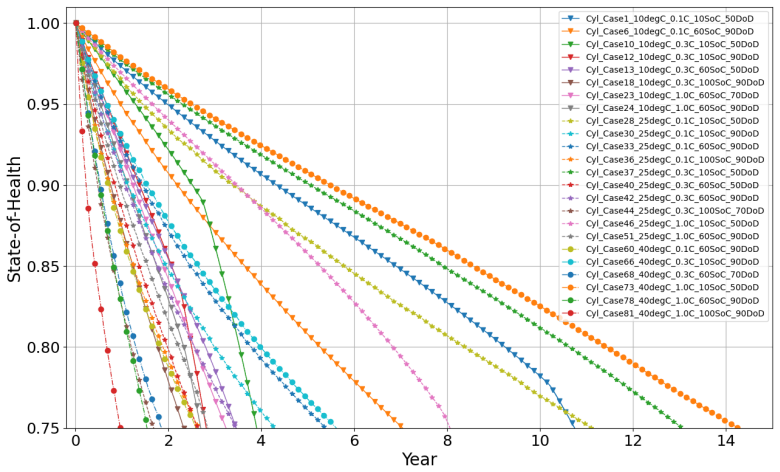
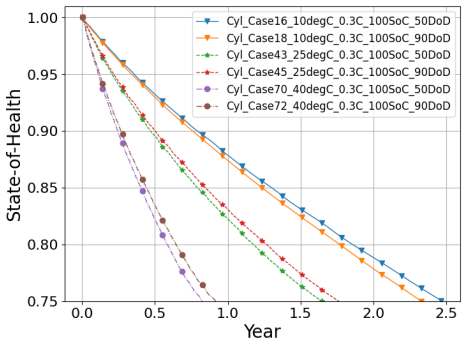
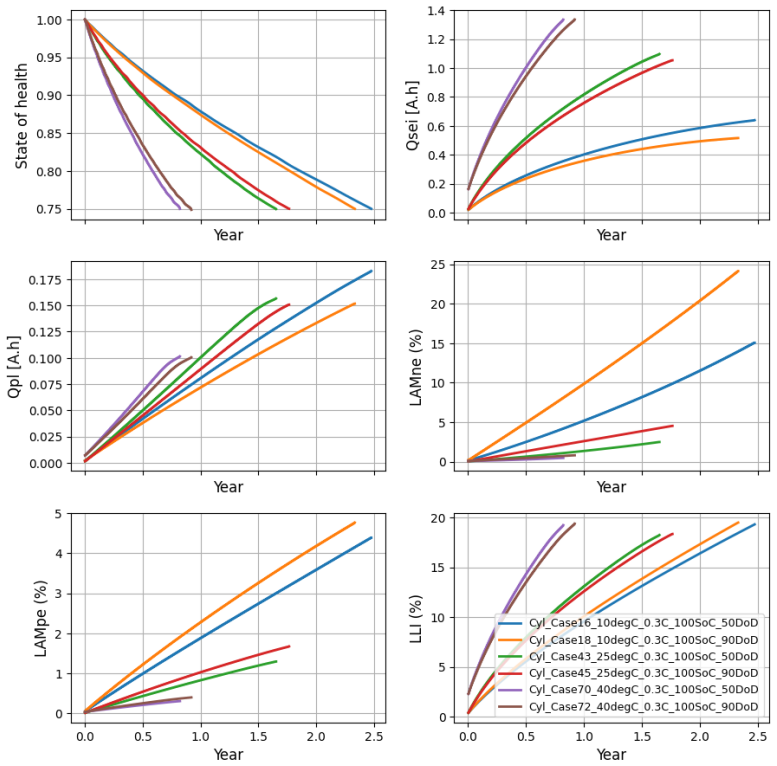
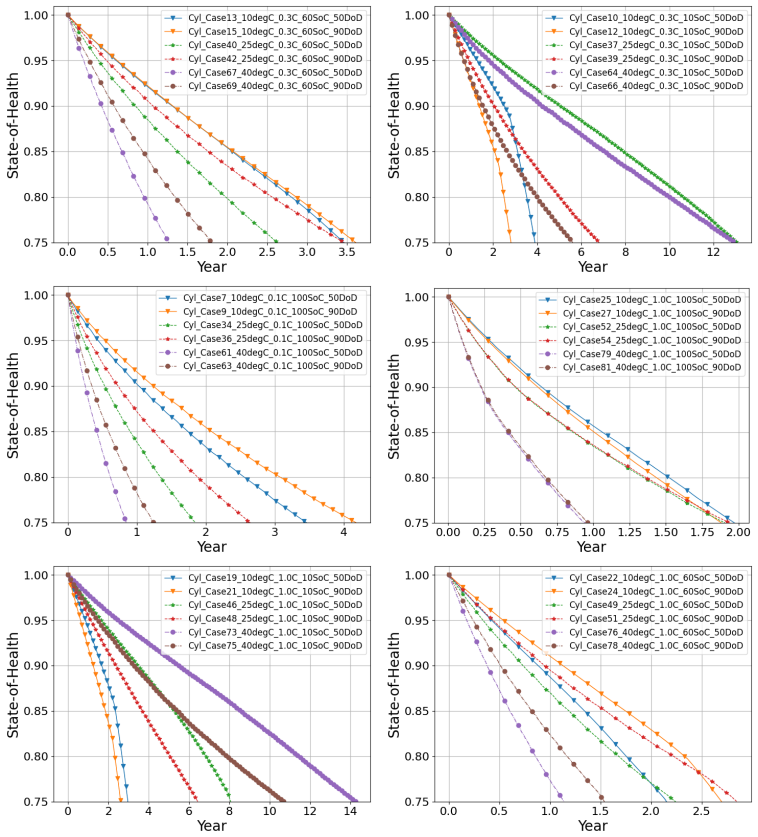
The work parameterises SEI growth, lithium plating and active-material loss in both electrodes from degradation-mode analysis and inserts the resulting constants into a P2D electrochemical-thermal-degradation model. The model then predicts capacity-fade trajectories, state-of-health, remaining-useful-life and internal degradation modes for an NMC cell under pure calendar ageing and under combined calendar-cyclic ageing at 81 operating points (three temperatures, three C-rates, three rest SoCs, three DoDs). Cycle life to 75 % SoH ranges from 0.8 to 14 years, and the simulations reveal competing calendar-versus-cyclic effects that produce sub-linear, linear or sup-linear fade.
What carries the argument
P2D electrochemical-thermal-degradation model whose SEI-growth, lithium-plating and active-material-loss parameters are fixed once from degradation-mode analysis data and then used without refitting across all conditions.
If this is right
- The same parameter set generates both pure-calendar and combined-calendar-cyclic trajectories without separate fitting.
- Capacity fade changes from sub-linear to sup-linear according to the specific combination of temperature, C-rate, rest SoC and DoD.
- Predicted cycle life to 75 % SoH spans more than an order of magnitude (0.8–14 years) across the 81 cases.
- Internal degradation-mode contributions can be extracted for any operating point, showing how calendar and cyclic mechanisms compete or reinforce each other.
Where Pith is reading between the lines
- Battery-management algorithms could embed the same model for online SoH and RUL estimation across mixed usage profiles.
- The released simulation dataset offers a ready benchmark for testing other degradation models that claim to cover both calendar and cyclic regimes.
- If the consistent-parameter approach generalises, it reduces the experimental effort needed to characterise new cell formats or chemistries.
Load-bearing premise
A single set of parameters for SEI growth, lithium plating and active material loss remains valid across the full range of temperatures, C-rates, rest SoCs and DoDs without any further adjustment.
What would settle it
Capacity and degradation-mode measurements on the same NMC cell at one or more of the 81 tested condition combinations that deviate markedly from the model's predicted fade curve.
Figures
read the original abstract
Parameterisation of coupled degradation mechanisms in lithium-ion batteries is a major challenge. Interactions between the mechanisms depend on usage conditions: C-rate, rest state-of-charge (SoC), depth-of-discharge (DoD) and temperature. This work presents a framework to consistently parameterise key degradation modes--solid-electrolyte interphase (SEI) growth, lithium plating, and active material loss in both electrodes--using insights derived from degradation mode analysis data. The work predicts capacity fade trajectories of a NMC-based lithium-ion cell under both calendar and combined calendar-cyclic ageing, using a P2D electrochemical-thermal-degradation model. The work predicts state-of-health (SoH), remaining-useful-life (RUL) and internal degradation modes of the cell--under 81 combinations of temperature (10$^o$C, 25$^o$C, 40$^o$C), C-rate (0.1 C, 0.3 C and 1.0 C), rest SoC (10%, 60%, and 100%) and DoD (50%, 70%, and 90%)--using PyBaMM. The predicted cycle-life varies between 0.8 to 14 years to reach 75% of SoH. The work provides mechanistic insights into competing effects between calendar and cyclic ageing, during cycling. The model demonstrates sub-linear, linear, and sup-linear/accelerated capacity fade based on the usage conditions. The simulated dataset for all the cases is made available.
Editorial analysis
A structured set of objections, weighed in public.
Referee Report
Summary. The paper presents a framework for consistently parameterizing key degradation modes (SEI growth, lithium plating, and active material loss in both electrodes) in a P2D electrochemical-thermal-degradation model for NMC-based lithium-ion cells. Drawing on degradation mode analysis (DMA) data, it uses PyBaMM to predict capacity fade trajectories, SoH, RUL, and internal degradation modes under 81 combinations of temperature (10–40 °C), C-rate (0.1–1 C), rest SoC (10–100 %), and DoD (50–90 %) for both calendar and combined calendar-cyclic ageing. The work reports cycle lives ranging from 0.8 to 14 years to 75 % SoH, demonstrates sub-linear to super-linear fade behaviors, provides mechanistic insights into competing ageing effects, and releases the full simulated dataset.
Significance. If the single consistent parameter set derived from DMA data remains valid without condition-specific adjustments, the work would provide a useful advance for mechanistic prediction of mixed ageing in Li-ion batteries, with open data release and PyBaMM implementation aiding reproducibility. The ability to link calendar and cyclic contributions mechanistically could inform RUL estimation and usage optimization.
major comments (2)
- [Parameterization framework (methods section describing DMA-to-parameter mapping)] The central claim rests on a single fixed parameter vector for SEI growth rate constant, Li plating rate constant, and electrode active-material loss rates (positive and negative) that is valid across all 81 condition combinations. No cross-validation is described in which parameters are identified from a subset of DMA conditions and then applied without adjustment to held-out combinations of T, C-rate, rest SoC, and DoD. This test is required to confirm that the model's built-in temperature/voltage dependencies suffice and that no residual condition-specific effects necessitate post-hoc refitting.
- [Results section on capacity fade predictions and dataset release] The abstract and results claim quantitative predictions of capacity fade trajectories and RUL, yet no validation metrics (RMSE, MAE, or similar), error bars on the simulated SoH curves, or direct comparisons against independent long-term experimental cycling data are reported. Post-hoc consistency checks on the DMA-derived rates versus the model's output fade curves are also not described, leaving open the possibility that the 'predictions' largely reproduce the input rates by construction.
minor comments (2)
- [Abstract and results summary] The reported cycle-life range (0.8–14 years) would benefit from explicit mapping to the extreme condition combinations and from any sensitivity analysis on the free parameters.
- [Figures and dataset description] Figure captions and text should clarify whether the simulated dataset includes any stochastic variability or is purely deterministic from the P2D model.
Simulated Author's Rebuttal
We thank the referee for their constructive and detailed review of our manuscript. We address each major comment point by point below, providing the strongest honest defense of the work while acknowledging areas where revisions can improve clarity and rigor.
read point-by-point responses
-
Referee: [Parameterization framework (methods section describing DMA-to-parameter mapping)] The central claim rests on a single fixed parameter vector for SEI growth rate constant, Li plating rate constant, and electrode active-material loss rates (positive and negative) that is valid across all 81 condition combinations. No cross-validation is described in which parameters are identified from a subset of DMA conditions and then applied without adjustment to held-out combinations of T, C-rate, rest SoC, and DoD. This test is required to confirm that the model's built-in temperature/voltage dependencies suffice and that no residual condition-specific effects necessitate post-hoc refitting.
Authors: We appreciate the referee highlighting the value of cross-validation to demonstrate the robustness of the single fixed parameter set. The parameters for SEI growth, lithium plating, and active material loss were derived from DMA data spanning a range of conditions, with the P2D model then using its inherent physical dependencies (temperature via Arrhenius relations and voltage-dependent kinetics) to generate predictions for all 81 combinations without any condition-specific refitting. While an explicit cross-validation procedure (fitting on a DMA subset and testing on held-out conditions) was not described in the original manuscript, we agree this would strengthen the claims. In the revised version, we will add such an analysis to the methods section, splitting the DMA data where feasible to validate predictive performance on unseen combinations and confirm that the built-in dependencies are sufficient. revision: partial
-
Referee: [Results section on capacity fade predictions and dataset release] The abstract and results claim quantitative predictions of capacity fade trajectories and RUL, yet no validation metrics (RMSE, MAE, or similar), error bars on the simulated SoH curves, or direct comparisons against independent long-term experimental cycling data are reported. Post-hoc consistency checks on the DMA-derived rates versus the model's output fade curves are also not described, leaving open the possibility that the 'predictions' largely reproduce the input rates by construction.
Authors: We thank the referee for this important point on validation. The capacity fade trajectories and RUL estimates are not direct reproductions of the input DMA rates by construction; they emerge from the full coupled solution of the P2D electrochemical-thermal-degradation equations in PyBaMM, which accounts for dynamic interactions, competing mechanisms, and condition-dependent effects during both calendar and cyclic operation. We agree that the results would be strengthened by quantitative metrics (e.g., RMSE or MAE where comparable data exist), error bars on SoH curves (e.g., from parameter sensitivity), and explicit post-hoc consistency checks between DMA-derived rates and simulated outputs. We will revise the results section to include these elements. Direct comparisons to fully independent long-term cycling datasets were not performed, as the study centered on consistent parameterization from DMA and broad simulation across conditions; the released dataset supports such external validations. revision: partial
Circularity Check
No significant circularity; parameterisation from DMA insights is independent of the forward predictions
full rationale
The derivation chain begins with degradation-mode-analysis data used to extract a single consistent parameter vector for SEI growth, lithium plating and active-material loss. These parameters are then inserted into the P2D electrochemical-thermal model whose temperature, voltage and C-rate dependencies are already present in the governing equations. The model is subsequently run forward to generate capacity-fade trajectories under 81 condition combinations. Because the DMA-derived rates are not re-adjusted to the same fade curves they are later asked to predict, and because no self-citation chain or uniqueness theorem is invoked to force the functional form, the predictions remain logically downstream of the inputs rather than equivalent to them by construction. The absence of reported cross-validation is a methodological limitation but does not constitute circularity in the derivation itself.
Axiom & Free-Parameter Ledger
free parameters (3)
- SEI growth rate constant
- Lithium plating rate constant
- Active material loss rate constants (positive and negative electrodes)
axioms (2)
- domain assumption The P2D electrochemical-thermal model equations accurately capture lithium transport, heat generation, and voltage response under the tested conditions.
- domain assumption Degradation mode analysis data provide independent, mechanism-specific information that can be mapped one-to-one onto the three rate constants without cross-talk or additional parameters.
Reference graph
Works this paper leans on
-
[1]
C. R. Birkl, M. R. Roberts, E. McTurk, P. G. Bruce, D. A. Howey, Degradation diagnostics for lithium ion cells, Journal of Power Sources 341 (2017) 373–386. URL:http://dx.doi.org/10.1016/j.jpowsour. 2016.12.011. doi:10.1016/j.jpowsour.2016.12.011. 31
- [2]
-
[3]
J. S. Edge, S. O’Kane, R. Prosser, N. D. Kirkaldy, A. N. Patel, A. Hales, A. Ghosh, W. Ai, J. Chen, J. Yang, S. Li, M.-C. Pang, L. B. Diaz, A. Tomaszewska, M. W. Marzook, K. N. Radhakrishnan, H. Wang, Y. Patel, B. Wu, G. J. Offer, Lithium ion battery degradation: what you need to know, Physical Chemistry Chemical Physics 23 (2021) 8200–8221. doi:10.1039/d...
-
[4]
S. E. J. O’Kane, W. Ai, G. Madabattula, D. Alonso-Alvarez, R. Timms, V. Sulzer, J. S. Edge, B. Wu, G. J. Offer, M. Marinescu, Lithium-ion battery degradation: how to model it, Physical Chemistry Chemical Physics 24 (2022) 7909–7922. doi:10.1039/d2cp00417h
-
[5]
D. Aurbach, Y. Ein-Eli, B. Markovsky, A. Zaban, S. Luski, Y. Carmeli, H. Yamin, The study of electrolyte solutions based on ethylene and diethyl carbonates for rechargeable li batteries: Ii. graphite electrodes, Journal of The Electrochemical Society 142 (1995) 2882–2890
work page 1995
-
[6]
D. Aurbach, E. Pollak, R. Elazari, G. Salitra, C. S. Kelley, J. Affinito, Onthesurfacechemicalaspectsofveryhighenergydensity, rechargeable li–sulfur batteries, Journal of The Electrochemical Society 156 (2009) A694–A702
work page 2009
- [7]
-
[8]
S. Wang, K. Yang, F. Gao, D. Wang, C. Shen, Direct visualization of solid electrolyte interphase on li 4 ti 5 o 12 by in situ afm, Rsc Advances 6 (2016) 77105–77110
work page 2016
-
[10]
N. Kamyab, J. W. Weidner, R. E. White, Mixed mode growth model for the solid electrolyte interface (sei), Journal of The Electrochemical Society 166 (2019) A334–A341. doi:10.1149/2.1101902jes
-
[11]
U. R. Koleti, T. Q. Dinh, J. Marco, A new on-line method for lithium plating detection in lithium-ion batteries, Journal of power sources 451 (2020) 227798
work page 2020
-
[12]
C. Uhlmann, J. Illig, M. Ender, R. Schuster, E. Ivers-Tiffée, In situ detection of lithium metal plating on graphite in experimental cells, Journal of Power Sources 279 (2015) 428–438
work page 2015
- [13]
-
[14]
Q. Liu, C. Du, B. Shen, P. Zuo, X. Cheng, Y. Ma, G. Yin, Y. Gao, 33 Understanding undesirable anode lithium plating issues in lithium-ion batteries, RSC advances 6 (2016) 88683–88700
work page 2016
-
[15]
T. Waldmann, B.-I. Hogg, M. Wohlfahrt-Mehrens, Li plating as un- wanted side reaction in commercial li-ion cells–a review, Journal of Power Sources 384 (2018) 107–124
work page 2018
-
[16]
H. Ge, T. Aoki, N. Ikeda, S. Suga, T. Isobe, Z. Li, Y. Tabuchi, J. Zhang, Investigating lithium plating in lithium-ion batteries at low tempera- tures using electrochemical model with nmr assisted parameterization, Journal of The Electrochemical Society 164 (2017) A1050–A1060
work page 2017
-
[17]
N. Legrand, B. Knosp, P. Desprez, F. Lapicque, S. Raël, Physical char- acterization of the charging process of a li-ion battery and prediction of li plating by electrochemical modelling, Journal of Power Sources 245 (2014) 208–216
work page 2014
-
[18]
J. P. Allen, C. Szczuka, H. E. Smith, E. Jónsson, R.-A. Eichel, J. Granwehr, C. P. Grey, Coordination of dissolved transition metals in pristine battery electrolyte solutions determined by nmr and epr spec- troscopy, Physical Chemistry Chemical Physics 26 (2024) 19505–19520
work page 2024
-
[19]
C. Zhan, T. Wu, J. Lu, K. Amine, Dissolution, migration, and deposi- tion of transition metal ions in li-ion batteries exemplified by mn-based cathodes–a critical review, Energy & Environmental Science 11 (2018) 243–257
work page 2018
-
[20]
N.Hellar, Y.Iwai, M.Ohzu, S.Brox, A.Dorai, R.Takekawa, N.Kuwata, J. Kawamura, M. Winter, Direct observation of mn-ion dissolution from 34 limn2o4 lithium battery cathode to electrolyte, Communications Mate- rials 6 (2025) 23
work page 2025
-
[21]
C. Zhan, T. Wu, J. Lu, K. Amine, Dissolution, migration, and deposi- tion of transition metal ions in Li-ion batteries exemplified by Mn-based cathodes-A critical review, Energy and Environmental Science 11 (2018) 243–257. doi:10.1039/c7ee03122j
- [22]
-
[23]
D. Li, Y. Wang, J. Hu, B. Lu, Y.-T. Cheng, J. Zhang, In situ measure- ment of mechanical property and stress evolution in a composite silicon electrode, Journal of Power Sources 366 (2017) 80–85
work page 2017
-
[24]
R. E. Warburton, F. C. Castro, S. Deshpande, K. E. Madsen, K. L. Bassett, R. Dos Reis, A. A. Gewirth, V. P. Dravid, J. Greeley, Oriented limn2o4 particle fracture from delithiation-driven surface stress, ACS applied materials & interfaces 12 (2020) 49182–49191
work page 2020
-
[25]
J. Christensen, J. Newman, Stress generation and fracture in lithium insertion materials, Journal of Solid State Electrochemistry 10 (2006) 293–319
work page 2006
- [26]
-
[27]
J. M. Reniers, G. Mulder, D. A. Howey, Review and performance com- parison of mechanical-chemical degradation models for lithium-ion bat- teries, Journal of The Electrochemical Society 166 (2019) A3189–A3200
work page 2019
-
[28]
W. Ai, L. Kraft, J. Sturm, A. Jossen, B. Wu, Electrochemical thermal- mechanical modelling of stress inhomogeneity in lithium-ion pouch cells, Journal of The Electrochemical Society 167 (2020) 013512
work page 2020
-
[29]
I. Laresgoiti, S. Käbitz, M. Ecker, D. U. Sauer, Modeling mechanical degradation in lithium ion batteries during cycling: Solid electrolyte interphase fracture, Journal of Power Sources 300 (2015) 112–122
work page 2015
-
[30]
J. Li, K. Adewuyi, N. Lotfi, R. G. Landers, J. Park, A single par- ticle model with chemical/mechanical degradation physics for lithium ion battery state of health (soh) estimation, Applied energy 212 (2018) 1178–1190
work page 2018
- [31]
-
[32]
C. Hendricks, N. Williard, S. Mathew, M. Pecht, A failure modes, mech- anisms, and effects analysis (fmmea) of lithium-ion batteries, Journal of Power Sources 297 (2015) 113–120
work page 2015
-
[33]
X. Han, L. Lu, Y. Zheng, X. Feng, Z. Li, J. Li, M. Ouyang, A review on the key issues of the lithium ion battery degradation among the whole life cycle, ETransportation 1 (2019) 100005. 36
work page 2019
-
[34]
D. H. Jeon, S. Kim, R. Hempelmann, State-of-the-art review of degrada- tion mechanisms of commercial lithium-ion batteries, Journal of Power Sources 646 (2025) 237242
work page 2025
-
[35]
R. Li, N. D. Kirkaldy, F. F. Oehler, M. Marinescu, G. J. Offer, S. E. O’Kane, Theimportanceofdegradationmodeanalysisinparameterising lifetime prediction models of lithium-ion battery degradation, Nature communications 16 (2025) 2776
work page 2025
- [36]
-
[37]
Modeling of Galvanostatic Charge and Discharge of the Lithium/Polymer/Insertion Cell
M. Doyle, T. F. Fuller, J. Newman, Modeling of Galvanostatic Charge and Discharge of the Lithium/Polymer/Insertion Cell, Journal of The Electrochemical Society 140 (1993) 1526–1533. doi:10.1149/1.2221597
-
[38]
C.-H. Chen, F. B. Planella, K. O’Regan, D. Gastol, W. D. Widanage, E. Kendrick, Development of experimental techniques for parameteriza- tion of multi-scale lithium-ion battery models, Journal of The Electro- chemical Society 167 (2020) 080534. doi:10.1149/1945-7111/ab9050
-
[39]
PyBaMM Developers, Doyle-fuller-newman (dfn) model — pybamm documentation,https://docs.pybamm.org/en/stable/source/ examples/notebooks/models/DFN.html, 2026. Accessed: 2026-02-28
work page 2026
-
[40]
PyBaMM Developers, OKane2022 lithium-ion parameter set — Py- BaMM,https://github.com/pybamm-team/PyBaMM/blob/main/src/ 37 pybamm/input/parameters/lithium_ion/OKane2022.py, 2025. Ac- cessed: 2026-02-28
work page 2025
-
[41]
Electrochimica Acta , author =
K. O’Regan, F. B. Planella, W. D. Widanage, E. Kendrick, Thermal- electrochemical parameters of a high energy lithium-ion cylindrical battery, Electrochimica Acta 425 (2022) 140700. URL:https://www. sciencedirect.com/science/article/pii/S0013468622008593. doi:10.1016/J.ELECTACTA.2022.140700
- [42]
- [43]
-
[44]
A. J. Bard, L. R. Faulkner, H. S. White, Electrochemical methods: fun- damentals and applications, John Wiley & Sons, 2022
work page 2022
-
[45]
S. E. O’Kane, I. D. Campbell, M. W. Marzook, G. J. Offer, M. Mari- nescu, Physical origin of the differential voltage minimum associated with lithium plating in li-ion batteries, Journal of The Electrochemical Society 167 (2020) 090540
work page 2020
-
[46]
K. N. Wood, E. Kazyak, A. F. Chadwick, K.-H. Chen, J.-G. Zhang, K. Thornton, N. P. Dasgupta, Dendrites and pits: untangling the complex behavior of lithium metal anodes through operando video mi- croscopy, ACS central science 2 (2016) 790–801. 38
work page 2016
-
[47]
Y. Dai, L. Cai, R. E. White, Simulation and analysis of stress in a li-ion battery with a blended limn2o4 and lini0. 8co0. 15al0. 05o2 cathode, Journal of power sources 247 (2014) 365–376
work page 2014
-
[48]
E. Bohn, T. Eckl, M. Kamlah, R. McMeeking, A model for lithium diffusion and stress generation in an intercalation storage particle with phase change, Journal of the Electrochemical Society 160 (2013) A1638– A1652
work page 2013
-
[49]
J. Li, N. Lotfi, R. G. Landers, J. Park, A single particle model for lithium-ion batteries with electrolyte and stress-enhanced diffusion physics, Journal of The Electrochemical Society 164 (2017) A874–A883
work page 2017
-
[50]
R. Fu, M. Xiao, S.-Y. Choe, Modeling, validation and analysis of me- chanical stress generation and dimension changes of a pouch type high power li-ion battery, Journal of Power Sources 224 (2013) 211–224
work page 2013
-
[51]
C. R. Pals, J. Newman, Thermal modeling of the lithium/polymer bat- tery: I.dischargebehaviorofasinglecell, JournaloftheElectrochemical Society 142 (1995) 3274–3281
work page 1995
-
[52]
M. Guo, G. Sikha, R. E. White, Single-particle model for a lithium-ion cell: Thermal behavior, Journal of The Electrochemical Society 158 (2011) A122–A132
work page 2011
-
[53]
N. Kirkaldy, M. A. Samieian, G. J. Offer, M. Marinescu, Y. Patel, Lithium-ion battery degradation: Comprehensive cycle ageing data and analysis for commercial 21700 cells, Journal of Power Sources 603 (2024) 234185. 39
work page 2024
-
[54]
M. Broussely, S. Herreyre, P. Biensan, P. Kasztejna, K. Nechev, R. J. Staniewicz, Aging mechanism in li ion cells and calendar life predic- tions, in: JournalofPowerSources, 2001.doi:10.1016/S0378-7753(01) 00722-4
-
[55]
M. Dubarry, N. Qin, P. Brooker, Calendar aging of commercial li-ion cells of different chemistries–a review, Current Opinion in Electrochem- istry 9 (2018) 106–113
work page 2018
-
[56]
P. Keil, S. F. Schuster, J. Wilhelm, J. Travi, A. Hauser, R. C. Karl, A. Jossen, Calendar aging of lithium-ion batteries: I. impact of the graphite anode on capacity fade, Journal of The Electrochemical Society 163 (2016) A1872–A1880. 40
work page 2016
discussion (0)
Sign in with ORCID, Apple, or X to comment. Anyone can read and Pith papers without signing in.