Recognition: unknown
Competing thermalization pathways of photoexcited hot electrons
Pith reviewed 2026-05-10 16:30 UTC · model grok-4.3
The pith
Each scattering mechanism can independently thermalize photoexcited hot electrons along distinct paths in phase space.
A machine-rendered reading of the paper's core claim, the machinery that carries it, and where it could break.
Core claim
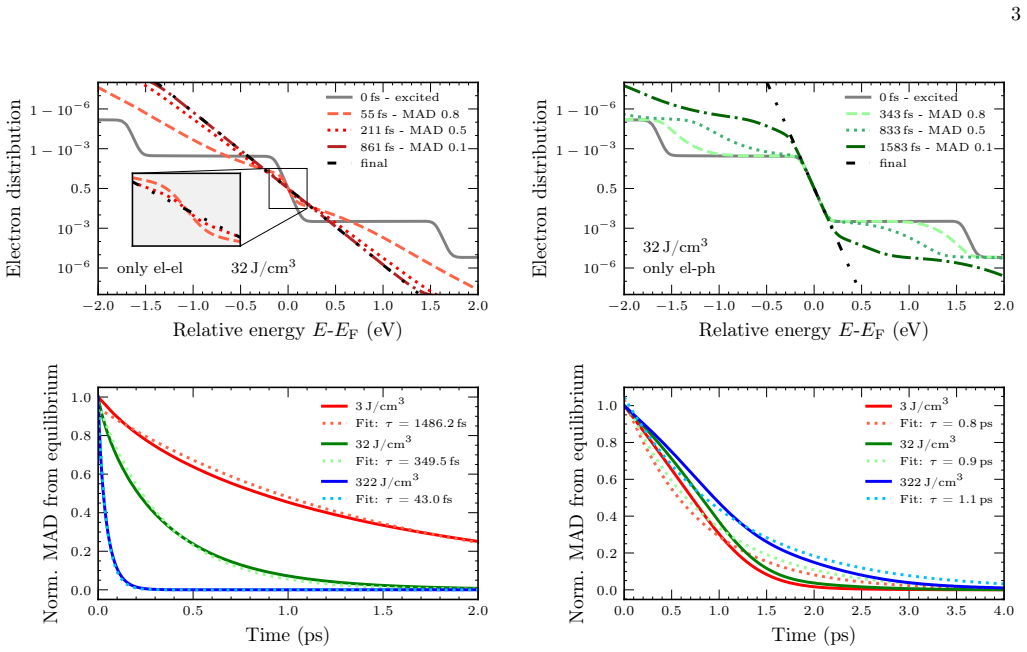
With a kinetic model based on full Boltzmann collision integrals, each scattering mechanism alone can thermalize the electron distribution, albeit along different trajectories in phase space. The thermalization times display an opposite dependence on excitation strength for electron-electron versus electron-phonon scattering, and the two processes become comparable for weak excitations that correspond to a sample temperature increase of a few Kelvin. The results map the relative contributions of both mechanisms across the full experimental range of excitation strengths up to the melting regime.
What carries the argument
A kinetic model based on full Boltzmann collision integrals that isolates and evolves the separate effects of electron-electron and electron-phonon scattering on the nonequilibrium electron distribution.
If this is right
- Thermalization times shorten with rising excitation strength for electron-electron scattering but lengthen for electron-phonon scattering.
- The two mechanisms contribute on comparable timescales for weak excitations that heat the sample by only a few Kelvin.
- Predictions of thermalization times become possible for hot-carrier applications over the entire range from weak excitation to the melting point.
- The electron distribution follows different paths through phase space depending on which scattering process dominates.
Where Pith is reading between the lines
- In materials with strong electron-phonon coupling, thermalization at low light intensities may occur faster than models that include only electron-electron scattering would predict.
- Device designs relying on hot electrons at low excitation levels may need to account for both mechanisms to estimate carrier lifetimes accurately.
- Time-resolved photoemission experiments that systematically vary pump intensity could directly map the crossover between the two thermalization regimes.
Load-bearing premise
The kinetic model with full Boltzmann collision integrals accurately captures the dominant thermalization pathways without needing additional mechanisms or approximations that would change the reported trajectories and timescales.
What would settle it
Time-resolved measurements of the electron energy distribution at varying excitation fluences that check whether thermalization times decrease with strength for one mechanism and increase for the other, becoming equal at low fluences that raise temperature by a few Kelvin.
Figures


read the original abstract
Photoexcited hot carriers in solids can drive processes, such as photocatalytic reactions on the surface, beyond those available in thermal equilibrium. Hot-electron-mediated reaction pathways are limited by the thermalization of the nonequilibrium electron distribution through microscopic scattering events. Commonly, thermalization is exclusively attributed to electron-electron scattering, whereas electron-phonon scattering is considered relevant mainly for the energy equilibration with the lattice. With a kinetic model based on full Boltzmann collision integrals, we demonstrate that each scattering mechanism alone can thermalize the electron distribution, albeit along different trajectories in phase space. We find an opposite dependence on the excitation strength of the respective thermalization times and show that both processes can become comparable for weak excitations, corresponding to a sample temperature increase of a few Kelvin. Our results unravel the contributions of electron-electron and electron-phonon scattering to the thermalization across the full range of experimental excitation strengths up to the melting regime, thus facilitating the prediction of thermalization times for hot-carrier-based applications.
Editorial analysis
A structured set of objections, weighed in public.
Referee Report
Summary. The manuscript develops a kinetic model based on the full Boltzmann collision integrals to investigate the thermalization of photoexcited hot electrons in solids. It shows that electron-electron scattering and electron-phonon scattering can each independently thermalize the nonequilibrium electron distribution, but along different paths in phase space. The thermalization times exhibit opposite dependencies on the excitation strength, with both mechanisms becoming comparable at weak excitations corresponding to temperature increases of a few Kelvin. The work covers the range from weak to strong excitations up to the melting regime.
Significance. If the results hold, this is significant because it challenges the conventional attribution of electron thermalization exclusively to electron-electron scattering, while positioning electron-phonon scattering as relevant primarily for lattice equilibration. The use of full Boltzmann collision integrals without additional approximations enables the identification of distinct phase-space trajectories and the opposite excitation-strength dependence of the timescales, providing a framework for predicting thermalization in hot-carrier applications such as photocatalysis across weak to strong excitation regimes. The numerical demonstration that both processes can compete at low excitations (few-Kelvin heating) is a clear strength.
major comments (1)
- [Methods] Methods section on the Boltzmann collision integrals: the manuscript should specify the momentum-space discretization, energy-conservation enforcement in the scattering kernels, and any cutoff procedures, as these directly determine the reported phase-space trajectories and the claimed independence of thermalization pathways; without this, the central numerical result cannot be independently verified.
minor comments (2)
- [Results] Figure captions for the phase-space plots should explicitly label the axes in terms of energy and momentum or occupation deviation to clarify the distinct trajectories for e-e versus e-ph scattering.
- [Abstract and Results] The abstract states the central result but the main text should include a brief table or paragraph comparing the computed thermalization times at weak excitation to known experimental orders of magnitude for a reference material.
Simulated Author's Rebuttal
We thank the referee for the positive assessment of our work and the constructive comment on the Methods section. We address the request for additional numerical details below and will incorporate them in the revised manuscript.
read point-by-point responses
-
Referee: [Methods] Methods section on the Boltzmann collision integrals: the manuscript should specify the momentum-space discretization, energy-conservation enforcement in the scattering kernels, and any cutoff procedures, as these directly determine the reported phase-space trajectories and the claimed independence of thermalization pathways; without this, the central numerical result cannot be independently verified.
Authors: We agree that these implementation details are essential for independent verification. In the revised manuscript we will expand the Methods section to explicitly state: (i) the momentum-space discretization (uniform k-grid with N_k points per direction and the corresponding Brillouin-zone sampling), (ii) the numerical enforcement of energy conservation in the collision integrals (including the broadening parameter used to approximate the delta function and the integration quadrature), and (iii) all cutoff criteria applied to momentum transfers, energy windows, and occupation thresholds. These additions will directly document the phase-space trajectories and confirm the independence of the two thermalization pathways. revision: yes
Circularity Check
No significant circularity; results emerge from numerical solution of Boltzmann integrals
full rationale
The paper's central results are obtained by numerically integrating the full Boltzmann collision integrals for electron-electron and electron-phonon scattering treated separately. No parameters are fitted to the reported thermalization times or phase-space trajectories; the opposite excitation-strength dependence and comparability at weak excitation arise directly from the dynamics of the scattering kernels. No self-citations are invoked as load-bearing uniqueness theorems, no ansatz is smuggled in, and no known empirical pattern is merely renamed. The derivation chain is therefore self-contained and does not reduce to its inputs by construction.
Axiom & Free-Parameter Ledger
axioms (1)
- domain assumption The Boltzmann collision integrals fully describe the thermalization dynamics of the nonequilibrium electron distribution.
Forward citations
Cited by 1 Pith paper
-
From Code to Figure: A FAIR-Aligned Data Provenance Chain for Reproducible Simulation Research in Numerical Physics
An integrated workflow using version control, code review, automated testing, structured logging, metadata-rich output, and standardized post-processing creates a FAIR-aligned provenance chain from code development to...
Reference graph
Works this paper leans on
-
[1]
K. Wu, J. Chen, J. R. McBride, and T. Lian, Efficient hot-electron transfer by a plasmon-induced interfacial charge-transfer transition, Science349, 632 (2015)
2015
-
[2]
Sousa-Castillo, M
A. Sousa-Castillo, M. Comesa˜ na-Hermo, B. Rodr´ ıguez- Gonz´ alez, M. P´ erez-Lorenzo, Z. Wang, X.-T. Kong, A. O. Govorov, and M. A. Correa-Duarte, Boosting hot electron-driven photocatalysis through anisotropic plas- monic nanoparticles with hot spots in Au–TiO 2 nanoar- chitectures, The Journal of Physical Chemistry C120, 11690 (2016)
2016
-
[3]
D. S. Ivanov, V. P. Lipp, A. Blumenstein, F. Kleinwort, V. P. Veiko, E. Yakovlev, V. Roddatis, M. E. Garcia, B. Rethfeld, J. Ihlemann, and P. Simon, Experimental and Theoretical Investigation of Periodic Nanostructur- ing of Au with Ultrashort UV Laser Pulses near the Dam- age Threshold, Phys. Rev. Applied4, 064006 (2015)
2015
-
[4]
B. N. Chichkov, C. Momma, S. Nolte, F. Alvensleben, and A. T¨ unnermann, Femtosecond, picosecond and nanosecond laser ablation of solids, Appl. Phys. A63, 109 (1996)
1996
-
[5]
Lubatschowski, G
H. Lubatschowski, G. Maatz, A. Heisterkamp, U. Hetzel, W. Drommer, H. Welling, and W. Ertmer, Application of ultrashort laser pulses for intrastromal refractive surgery, Graefe’s archive for clinical and experimental ophthal- mology238, 33 (2000)
2000
-
[6]
Tang, C.-J
H. Tang, C.-J. Chen, Z. Huang, J. Bright, G. Meng, R.- S. Liu, and N. Wu, Plasmonic hot electrons for sensing, photodetection, and solar energy applications: A per- spective, The Journal of Chemical Physics152(2020)
2020
-
[7]
Heide, Y
C. Heide, Y. Kobayashi, S. R. U. Haque, and S. Ghimire, Ultrafast high-harmonic spectroscopy of solids, Nature Physics20, 1546 (2024)
2024
-
[8]
Caruso, M
F. Caruso, M. A. Sentef, C. Attaccalite, M. Bonitz, C. Draxl, U. De Giovannini, M. Eckstein, R. Ernstor- fer, M. Fechner, M. Gr¨ uning,et al., The 2025 roadmap to ultrafast dynamics: frontiers of theoretical and computa- tional modeling, Journal of Physics: Materials9, 012501 (2026)
2025
-
[9]
Khurgin, A
J. Khurgin, A. Y. Bykov, and A. V. Zayats, Hot-electron dynamics in plasmonic nanostructures: fundamentals, applications and overlooked aspects, eLight4, 15 (2024)
2024
-
[10]
Bennemann, Ultrafast dynamics in solids, Journal of Physics: Condensed Matter16, R995 (2004)
K. Bennemann, Ultrafast dynamics in solids, Journal of Physics: Condensed Matter16, R995 (2004)
2004
-
[11]
Hohlfeld, J
J. Hohlfeld, J. G. M¨ uller, S.-S. Wellershoff, and E. Matthias, Time-resolved thermoreflectivity of thin gold films and its dependence on film thickness, Appl. Phys. B64, 387 (1997)
1997
-
[12]
Rethfeld, D
B. Rethfeld, D. S. Ivanov, M. E. Garcia, and S. I. Anisimov, Modelling ultrafast laser ablation, Journal of Physics D: Applied Physics50, 193001 (2017)
2017
-
[13]
P. E. Hopkins and P. M. Norris, Contribution of ballis- tic electron transport to energy transfer during electron- phonon nonequilibrium in thin metal films, Journal of Heat Transfer131, 043208 (2009)
2009
-
[14]
D. Lei, D. Su, and S. A. Maier, New insights into plas- monic hot-electron dynamics, Light: Science & Applica- tions13, 243 (2024)
2024
-
[15]
P. D. Ndione, S. T. Weber, D. O. Gericke, and B. Reth- feld, Nonequilibrium band occupation and optical re- sponse of gold after ultrafast XUV excitation, Scientific Reports12, 1 (2022)
2022
-
[16]
Jiang, A.-D
L. Jiang, A.-D. Wang, B. Li, T.-H. Cui, and Y.-F. Lu, Electrons dynamics control by shaping femtosec- ond laser pulses in micro/nanofabrication: modeling, method, measurement and application, Light: Science & Applications7, 17134 (2018)
2018
-
[17]
Pincelli, T
T. Pincelli, T. Vasileiadis, S. Dong, S. Beaulieu, M. Dendzik, D. Zahn, S.-e. Lee, H. Seiler, Y. Qi, R. P. Xian, et al., Observation of multi-directional energy transfer in a hybrid plasmonic–excitonic nanostructure, Advanced Materials35, 2209100 (2023)
2023
-
[18]
Y. Gao, J. Diederich, Y. Xie, Q. Zhu, C. H¨ ohn, K. Har- bauer, F. Fan, C. Li, R. van de Krol, and D. Friedrich, Ultrafast nonthermal electron transfer at plasmonic in- terfaces, Nature Communications (2025)
2025
-
[19]
W. S. Fann, R. Storz, H. W. K. Tom, and J. Bokor, Electron thermalization in gold, Phys. Rev. B46, 13592 (1992)
1992
-
[20]
W. S. Fann, R. Storz, H. W. K. Tom, and J. Bokor, Direct measurement of nonequilibrium electron-energy distribu- tions in subpicosecond laser-heated gold films, Phys. Rev. Lett.68, 2834 (1992)
1992
-
[21]
Bauer, A
M. Bauer, A. Marienfeld, and M. Aeschlimann, Hot elec- tron lifetimes in metals probed by time-resolved two- photon photoemission, Progress in Surface Science90, 319 (2015)
2015
-
[22]
Petek and S
H. Petek and S. Ogawa, Femtosecond time-resolved two- photon photoemission studies of electron dynamics in metals, Progress in Surface Science56, 239 (1997)
1997
-
[23]
Rethfeld, A
B. Rethfeld, A. Kaiser, M. Vicanek, and G. Simon, Ul- trafast dynamics of nonequilibrium electrons in metals under femtosecond laser irradiation, Phys. Rev. B65, 214303 (2002)
2002
-
[24]
Bovensiepen, H
U. Bovensiepen, H. Petek, and M. Wolf, Dynamics at Solid State Surfaces and Interfaces (Wiley Online Library, 2010)
2010
-
[25]
Dubi and Y
Y. Dubi and Y. Sivan, ”‘Hot”’ electrons in metallic nanostructures – non-thermal carriers or heating?, Light: Science & Applications8, 1 (2019)
2019
-
[26]
Medvedev, U
N. Medvedev, U. Zastrau, E. F¨ orster, D. O. Gericke, and B. Rethfeld, Short-Time Electron Dynamics in Alu- minum Excited by Femtosecond Extreme Ultraviolet Ra- diation, Phys. Rev. Lett.107, 165003 (2011)
2011
-
[27]
N. A. Inogamov and Y. V. Petrov, Thermal conductivity of metals with hot electrons, Journal of Experimental and Theoretical Physics110, 446 (2010)
2010
-
[28]
Y. V. Petrov, K. P. Migdal, N. Inogamov, and S. I. Anisi- mov, Transfer processes in a metal with hot electrons excited by a laser pulse, JETP letters104, 431 (2016)
2016
-
[29]
C.-K. Sun, F. Vall´ ee, L. H. Acioli, E. P. Ippen, and J. G. Fujimoto, Femtosecond-tunable measurement of electron thermalization in gold, Phys. Rev. B50, 15337 (1994)
1994
-
[30]
C. Guo, G. Rodriguez, and A. J. Taylor, Ultrafast Dy- namics of Electron Thermalization in Gold, Physical Re- view Letters86, 1638 (2001)
2001
-
[31]
Schirato, M
A. Schirato, M. Maiuri, G. Cerullo, and G. Della Valle, Ultrafast hot electron dynamics in plasmonic nanostruc- tures: experiments, modelling, design, Nanophotonics 12, 1 (2023)
2023
-
[32]
Mathias, C
S. Mathias, C. La-O-Vorakiat, P. Grychtol, P. Granitzka, E. Turgut, J. M. Shaw, R. Adam, H. T. Nembach, M. E. Siemens, S. Eich, et al., Probing the timescale of the ex- 8 change interaction in a ferromagnetic alloy, Proceedings of the National Academy of Sciences109, 4792 (2012)
2012
-
[33]
Bejan and G
D. Bejan and G. Ra ¸ seev, Nonequilibrium electron distri- bution in metals, Phys. Rev. B55, 4250 (1997)
1997
-
[34]
A. V. Lugovskoy and I. Bray, Ultrafast electron dynamics in metals under laser irradiation, Phys. Rev. B60, 3279 (1999)
1999
-
[35]
Bernardi, J
M. Bernardi, J. Mustafa, J. B. Neaton, and S. G. Louie, Theory and computation of hot carriers generated by sur- face plasmon polaritons in noble metals, Nature commu- nications6, 7044 (2015)
2015
-
[36]
S. Mocatti, G. Marini, G. Volpato, P. Cudazzo, and M. Calandra, Nonequilibrium photocarrier and phonon dynamics from first principles: a unified treatment of carrier-carrier, carrier-phonon, and phonon-phonon scat- tering, arXiv preprint arXiv:2512.08618 (2025)
-
[37]
Tong and M
X. Tong and M. Bernardi, Toward precise simulations of the coupled ultrafast dynamics of electrons and atomic vibrations in materials, Physical Review Research3, 023072 (2021)
2021
-
[38]
F. Caruso, Nonequilibrium Lattice Dynam- ics in Monolayer MoS 2, The Journal of Physical Chemistry Letters12, 1734 (2021), https://doi.org/10.1021/acs.jpclett.0c03616
-
[39]
Obergfell and J
M. Obergfell and J. Demsar, Tracking the Time Evo- lution of the Electron Distribution Function in Copper by Femtosecond Broadband Optical Spectroscopy, Phys. Rev. Lett.124, 037401 (2020)
2020
-
[40]
Kratzer, L
P. Kratzer, L. Rettig, I. Y. Sklyadneva, E. V. Chulkov, and U. Bovensiepen, Relaxation of photoexcited hot car- riers beyond multitemperature models: General theory description verified by experiments on Pb/Si (111), Phys- ical Review Research4, 033218 (2022)
2022
-
[41]
V. V. Kabanov and A. Alexandrov, Electron relaxation in metals: Theory and exact analytical solutions, Physical Review B—Condensed Matter and Materials Physics78, 174514 (2008)
2008
-
[42]
Baranov and V
V. Baranov and V. Kabanov, Theory of electronic relax- ation in a metal excited by an ultrashort optical pump, Physical Review B89, 125102 (2014)
2014
-
[43]
B. Y. Mueller and B. Rethfeld, Relaxation dynamics in laser-excited metals under nonequilibrium conditions, Phys. Rev. B87, 035139 (2013)
2013
-
[44]
D. M. Nenno, S. Kaltenborn, and H. C. Schneider, Boltz- mann transport calculation of collinear spin transport on short timescales, Phys. Rev. B94, 115102 (2016)
2016
-
[45]
Seibel, M
C. Seibel, M. Uehlein, T. Held, P. N. Terekhin, S. T. We- ber, and B. Rethfeld, Time-Resolved Spectral Densities of Nonthermal Electrons in Gold, The Journal of Physical Chemistry C127, 23349 (2023)
2023
-
[46]
Caruso and D
F. Caruso and D. Novko, Ultrafast dynamics of elec- trons and phonons: from the two-temperature model to the time-dependent Boltzmann equation, Advances in Physics: X7, 2095925 (2022)
2022
-
[47]
Weber, K
M. Weber, K. Leckron, L. F. Haag, R. Jaeschke-Ubiergo, L. ˇSmejkal, J. Sinova, and H. C. Schneider, Ultrafast elec- tron dynamics in a planar d-wave altermagnet, Newton (2025)
2025
-
[48]
Z. Lin, L. V. Zhigilei, and V. Celli, Electron-phonon cou- pling and electron heat capacity of metals under con- ditions of strong electron-phonon nonequilibrium, Phys. Rev. B77, 075133 (2008)
2008
-
[49]
Uehlein, H
M. Uehlein, H. T. Snowden, C. Seibel, T. Held, S. T. Weber, R. J. Maurer, and B. Rethfeld, Capturing non-equilibrium electron dynamics in metals accurately and efficiently, Journal of Applied Physics138, 063103 (2025)
2025
-
[50]
D. R. Lide, G. Baysinger, L. I. Berger, R. N. Goldberg, H. V. Kehiaian, K. Kuchitsu, G. Rosenblatt, D. L. Roth, and D. Zwillinger, CRC Handbook of Chemistry and Physics (CRC press, 2005)
2005
- [51]
-
[52]
Lisowski, P
M. Lisowski, P. Loukakos, U. Bovensiepen, J. St¨ ahler, C. Gahl, and M. Wolf, Ultra-fast dynamics of electron thermalization, cooling and transport effects in Ru(001), Appl. Phys. A78, 165 (2004)
2004
-
[53]
S. T. Weber and B. Rethfeld, Phonon-induced long- lasting nonequilibrium in the electron system of a laser- excited solid, Physical Review B99, 174314 (2019)
2019
-
[54]
V. E. Gusev and O. B. Wright, Ultrafast nonequilibrium dynamics of electrons in metals, Physical Review B57, 2878 (1998)
1998
-
[55]
M. Z. Mo, Z. Chen, R. K. Li, M. Dunning, B. B. L. Witte, J. K. Baldwin, L. B. Fletcher, J. B. Kim, A. Ng, R. Redmer, A. H. Reid, P. Shekhar, X. Z. Shen, M. Shen, K. Sokolowski-Tinten, Y. Y. Tsui, Y. Q. Wang, Q. Zheng, X. J. Wang, and S. H. Glenzer, Heterogeneous to homo- geneous melting transition visualized with ultrafast elec- tron diffraction, Science3...
2018
-
[56]
Y. Sun, C. Chen, T. J. Albert, H. Li, M. I. Arefev, Y. Chen, M. Dunne, J. M. Glownia, M. Jerman, M. Hoff- mann, et al., Dynamics of nanoscale phase decomposition in laser ablation, Communications Materials6, 69 (2025)
2025
-
[57]
Bonse and J
J. Bonse and J. Kr¨ uger, Structuring of thin films by ul- trashort laser pulses, Applied physics A129, 14 (2023)
2023
-
[58]
K¨ uhne, Y
F. K¨ uhne, Y. Beyazit, B. Sothmann, J. Jayabalan, D. Diesing, P. Zhou, and U. Bovensiepen, Ultrafast transport and energy relaxation of hot electrons in Au/Fe/MgO(001) heterostructures analyzed by linear time-resolved photoelectron spectroscopy, Phys. Rev. Res.4, 033239 (2022)
2022
-
[59]
Knorren, K
R. Knorren, K. H. Bennemann, R. Burgermeister, and M. Aeschlimann, Dynamics of excited electrons in copper and ferromagnetic transition metals: Theory and exper- iment, Phys. Rev. B61, 9427 (2000)
2000
-
[60]
Brand, T
C. Brand, T. Witte, M. Tajik, J. D. Fortmann, B. Finke, H. Pfn¨ ur, C. Tegenkamp, and M. Horn-von Hoegen, Thermal boundary conductance under large temperature discontinuities of ultrathin Pb(111) films on Si(111), Ap- plied Physics Letters127(2025)
2025
-
[61]
R. Li, K. Sundqvist, J. Chen, H. Elsayed-Ali, J. Zhang, and P. M. Rentzepis, Transient lattice deformations of crystals studied by means of ultrafast time-resolved x-ray and electron diffraction, Structural Dynamics5(2018)
2018
-
[62]
Boerigter, U
C. Boerigter, U. Aslam, and S. Linic, Mechanism of charge transfer from plasmonic nanostructures to chem- ically attached materials, ACS nano10, 6108 (2016)
2016
-
[63]
Hofherr, S
M. Hofherr, S. H¨ auser, J. Dewhurst, P. Tengdin, S. Sak- shath, H. T. Nembach, S. Weber, J. M. Shaw, T. J. Silva, H. Kapteyn, et al., Ultrafast optically induced spin trans- fer in ferromagnetic alloys, Science advances6, eaay8717 (2020)
2020
-
[64]
Tengdin, W
P. Tengdin, W. You, C. Chen, X. Shi, D. Zusin, Y. Zhang, C. Gentry, A. Blonsky, M. Keller, P. M. Oppeneer, 9 et al., Critical behavior within 20 fs drives the out-of- equilibrium laser-induced magnetic phase transition in nickel, Science advances4, eaap9744 (2018)
2018
-
[65]
M. Mo, V. Becker, B. Ofori-Okai, X. Shen, Z. Chen, B. Witte, R. Redmer, R. Li, M. Dunning, S. Weath- ersby, et al., Determination of the electron-lattice cou- pling strength of copper with ultrafast MeV electron diffraction, Review of Scientific Instruments89(2018)
2018
-
[66]
Waldecker, R
L. Waldecker, R. Bertoni, R. Ernstorfer, and J. Vor- berger, Electron-Phonon Coupling and Energy Flow in a Simple Metal beyond the Two-Temperature Approxi- mation, Phys. Rev. X6, 021003 (2016)
2016
-
[67]
Pudell, A
J. Pudell, A. Maznev, M. Herzog, M. Kronseder, C. Back, G. Malinowski, A. von Reppert, and M. Bargheer, Layer specific observation of slow thermal equilibration in ul- trathin metallic nanostructures by femtosecond X-ray diffraction, Nature communications9, 3335 (2018)
2018
-
[68]
Seibel, T
C. Seibel, T. Held, M. Uehlein, S. T. Weber, and B. Reth- feld, Intrinsically energy-dependent spin dynamics in ul- trafast demagnetization, Communications Physics8, 416 (2025)
2025
-
[69]
Del Fatti, C
N. Del Fatti, C. Voisin, M. Achermann, S. Tzortzakis, D. Christofilos, and F. Vall´ ee, Nonequilibrium electron dynamics in noble metals, Phys. Rev. B61, 16956 (2000)
2000
-
[70]
T. Held, S. T. Weber, and B. Rethfeld, Influence of band occupation on electron-phonon coupling in gold, Journal of Physics: Condensed Matter37, 095001 (2024)
2024
-
[71]
T. Held, C. Seibel, M. Uehlein, S. T. Weber, and B. Reth- feld, Collapse of electron–phonon coupling due to non- thermal phonon populations, Journal of Physics: Con- densed Matter37, 47LT01 (2025)
2025
discussion (0)
Sign in with ORCID, Apple, or X to comment. Anyone can read and Pith papers without signing in.