Recognition: unknown
The near equilibrium Einstein-Boltzmann system with a simplified collision term
Pith reviewed 2026-05-10 16:49 UTC · model grok-4.3
The pith
A BGK-type collision term reduces the Einstein-Boltzmann system to first-order differential equations for spatially homogeneous models with viscosity and heat flow.
A machine-rendered reading of the paper's core claim, the machinery that carries it, and where it could break.
Core claim
Using a BGK-type simplified collision term, the Boltzmann equation is rewritten in tetrad form, thermal coefficients are determined to first order in the Chapman-Enskog expansion for general spacetimes, and the results are used to construct a self-consistent system of first order differential equations equivalent to the Einstein-Boltzmann system for some spatially homogeneous models with viscosity and heat flow.
What carries the argument
The BGK-type collision term in the tetrad-form Boltzmann equation, together with the first-order Chapman-Enskog expansion that supplies the transport coefficients for viscosity and heat flow.
Load-bearing premise
The chosen BGK-type collision term remains an adequate approximation to the true collision integral throughout the near-equilibrium regime for gases possessing internal degrees of freedom.
What would settle it
A quantitative comparison of the transport coefficients obtained from the BGK model against those computed from the full collision integral, performed for a specific gas in flat Minkowski spacetime or a simple FLRW background, would settle whether the approximation holds.
Figures
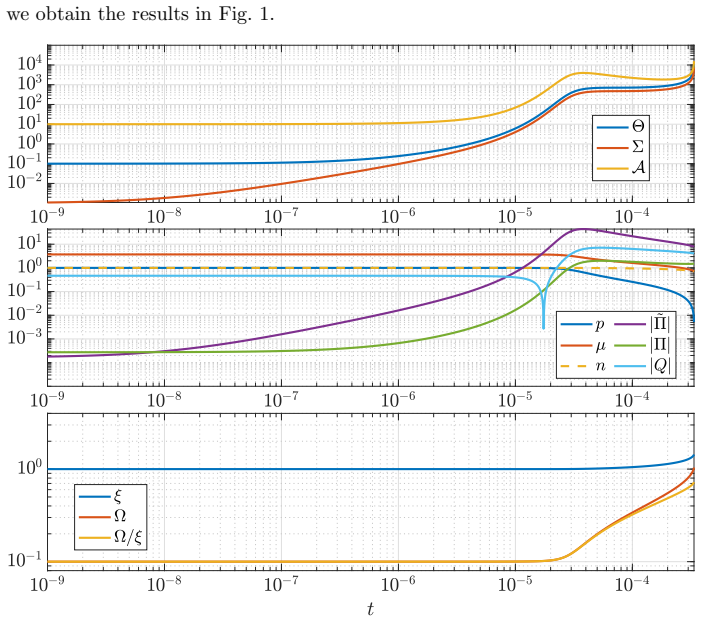


read the original abstract
A simplified relativistic kinetic theory for gases with internal degrees of freedom, based on a BGK-type collision term, is considered. First the Boltzmann equation is rewritten in tetrad form and then thermal coefficients are determined to first order in the Chapman-Enskog expansion for general spacetimes. The results are used to construct a self-consistent system of first order differential equations, equivalent to the Einstein-Boltzmann system, for some spatially homogeneous models with viscosity and heat flow.
Editorial analysis
A structured set of objections, weighed in public.
Referee Report
Summary. The manuscript develops a simplified model for the relativistic Boltzmann equation for gases with internal degrees of freedom by adopting a BGK-type collision term. The Boltzmann equation is expressed in tetrad form, and first-order thermal coefficients are computed using the Chapman-Enskog expansion applicable to general spacetimes. These coefficients are then employed to derive a closed system of first-order ordinary differential equations that is claimed to be equivalent to the Einstein-Boltzmann system for specific spatially homogeneous cosmological models that include effects of viscosity and heat flow.
Significance. Should the derivations prove correct and the BGK approximation suitable, the work offers a tractable set of evolution equations for near-equilibrium relativistic gases in homogeneous spacetimes. This reduction from the full kinetic description to a first-order ODE system could be valuable for studying dissipative effects in general relativistic hydrodynamics, particularly in contexts like early universe cosmology or compact object mergers where full Boltzmann simulations are prohibitive.
major comments (1)
- Abstract: The abstract asserts that the constructed system is 'equivalent to the Einstein-Boltzmann system'. This equivalence holds precisely only for the adopted BGK collision term. Given that the true collision integral for particles with internal degrees of freedom includes additional relaxation mechanisms and detailed balance conditions not necessarily reproduced by a single-relaxation-time BGK operator, the manuscript should explicitly address in the introduction or §4 whether the BGK choice affects the first-order transport coefficients at the order retained in the final ODE system. This clarification is necessary to substantiate the scope of the equivalence claim.
Simulated Author's Rebuttal
We thank the referee for their careful reading of the manuscript and for the constructive comment. We address the point raised below and have revised the manuscript to incorporate the suggested clarification.
read point-by-point responses
-
Referee: Abstract: The abstract asserts that the constructed system is 'equivalent to the Einstein-Boltzmann system'. This equivalence holds precisely only for the adopted BGK collision term. Given that the true collision integral for particles with internal degrees of freedom includes additional relaxation mechanisms and detailed balance conditions not necessarily reproduced by a single-relaxation-time BGK operator, the manuscript should explicitly address in the introduction or §4 whether the BGK choice affects the first-order transport coefficients at the order retained in the final ODE system. This clarification is necessary to substantiate the scope of the equivalence claim.
Authors: We agree that the equivalence claim in the abstract is stated in a manner that could benefit from greater precision. The manuscript explicitly develops a simplified model based on a BGK-type collision term, and the derived first-order ODE system is equivalent to the Einstein-Boltzmann system equipped with this specific collision operator. The Chapman-Enskog expansion is performed directly on the BGK term, so the resulting transport coefficients (viscosity and heat flow) are those consistent with the single-relaxation-time approximation by construction. We will revise the abstract to read 'equivalent to the Einstein-Boltzmann system with the adopted BGK collision term' and add an explicit statement in the introduction (with a cross-reference in §4) clarifying that, while a more complete collision integral for particles with internal degrees of freedom may involve additional relaxation channels, the present work employs the BGK operator and the first-order coefficients are computed accordingly. This does not alter the internal consistency or the applicability of the closed ODE system to the spatially homogeneous models considered. revision: yes
Circularity Check
No circularity: derivation proceeds from explicit BGK input via standard expansion
full rationale
The paper takes the Boltzmann equation with a chosen BGK-type collision term as its starting point (an explicit modeling assumption), rewrites it in tetrad form, performs the Chapman-Enskog expansion to first order to obtain transport coefficients, and assembles those coefficients into a closed first-order ODE system for the selected spacetimes. The claimed equivalence therefore holds exactly to the Einstein-Boltzmann system equipped with the adopted BGK operator; it does not reduce any derived quantity back to itself by definition, nor does it rely on fitted parameters renamed as predictions or on load-bearing self-citations. The BGK choice is an input simplification whose adequacy is stated as an assumption rather than derived from the output, so the chain remains non-circular and self-contained.
Axiom & Free-Parameter Ledger
axioms (1)
- domain assumption The BGK-type collision term is a valid approximation for the collision integral in the near-equilibrium regime for gases with internal degrees of freedom.
Reference graph
Works this paper leans on
-
[1]
J¨ uttner, Ann
F. J¨ uttner, Ann. Physik 339, 856 (1911)
1911
-
[2]
Lichnerowicz & R
A. Lichnerowicz & R. Marrot, C. R. Acad. Sci. 210, 759 (1940)
1940
-
[3]
Israel, J
W. Israel, J. Math. Phys. 4, 1163 (1963)
1963
-
[4]
D. C. Kelly, The Kinetic Theory of a Relativistic Gas, unpublished report, Miami University, Oxford (1963)
1963
-
[5]
Cercignani & G.M
C. Cercignani & G.M. Kremer,The Relativistic Boltzmann Equation: T he- ory and Applications, Birkh¨ auser Verlag, Basel, Switzerland (2002 )
2002
-
[6]
Chapman & T.G
S. Chapman & T.G. Cowling, The Mathematical Theory of Non-Uniform Gases, Cambride University Press (1970)
1970
-
[7]
Eckart, Phys
C. Eckart, Phys. Rev. 58, 919 (1940)
1940
-
[8]
Kovtun, J
P. Kovtun, J. High Energy Phys. 10, 034 (2019)
2019
-
[9]
F. S. Bemfica, M. M. Disconzi & J. Noronha, Phys. Rev. X 12, 021044 (2022)
2022
-
[10]
G. S. Rocha, D. Wagner, G. S. Denicol, J. Noronha & D. H. Rischk e, Entropy 26 (2024),
2024
-
[11]
A. L. Garc ´ ıa-Perciante, A. R. M´ endez & O. Sarbach, J. Nonequil. Thermo. 50 295-311 (2025)
2025
-
[12]
A. L. Garc ´ ıa-Perciante, A. R. M´ endez & O. Sarbach, [arXiv:25 12.14060 [gr-qc]]
-
[13]
Bhatnagar, E.P
P.I. Bhatnagar, E.P. Gross & M. Krook, Phys. Rev. 94, 511 (1954)
1954
-
[14]
Marle, Ann
C. Marle, Ann. Inst. Henri Poincar´ e 10, 67 (1969)
1969
-
[15]
Marle, Ann
C. Marle, Ann. Inst. Henri Poincar´ e 10, 127 (1969)
1969
-
[16]
Anderson & H.R
J.L. Anderson & H.R. Witting, Physica, 74, 466 (1974)
1974
-
[17]
Pennisi & T
S. Pennisi & T. Ruggeri, J. Phys. Conf. Ser 1035, 012005 (2018)
2018
-
[18]
Kremer, The Boltzmann equation in special and general rela tivity, AIP Conference Proceedings, 1501, 160 (2012)
G.M. Kremer, The Boltzmann equation in special and general rela tivity, AIP Conference Proceedings, 1501, 160 (2012)
2012
-
[19]
Kremer, J
G.M. Kremer, J. Stat. Mech., P04016, 1 (2013)
2013
-
[20]
Kremer, Physica A, 393, 76 (2014)
G.M. Kremer, Physica A, 393, 76 (2014)
2014
-
[21]
Pennisi & T
S. Pennisi & T. Ruggeri, Ann. Phys. 377, 414 (2017). 33
2017
-
[22]
Oliveira, M.P
J.M.S. Oliveira, M.P. Machado Ramos & A.J. Soares, Continuum Mech . Thermodyn. 34, 681 (2022)
2022
-
[23]
Pavi´ c, T
M. Pavi´ c, T. Ruggeri & S. Simi´ c, Physica A 392, 1302 (2013)
2013
-
[24]
Acu˜ na-C´ ardenas, C
R.O. Acu˜ na-C´ ardenas, C. Gabarrete & O. Sarbach, Gen. Re l. Gravit. 54, 23 (2022)
2022
-
[25]
Causal Thermodynamics in Relativity
R. Marteens, astro-ph/9609119v1 (1996)
work page internal anchor Pith review arXiv 1996
-
[26]
Gargantini & T
I. Gargantini & T. Pometale, Commun. ACM, 7, 727 (1964)
1964
-
[27]
Milgram, J
M.S. Milgram, J. Math. Phys., 18, 2456 (1977)
1977
-
[28]
Bradley & E
J.M. Bradley & E. Sviestins, Gen. Rel. Grav. 16, 1119 (1984)
1984
-
[29]
Clarkson, Phys
C.A. Clarkson, Phys. Rev. D 76, 104034 (2007)
2007
-
[30]
Bradley & M
M. Bradley & M. Marklund, Class. Quantum Grav., 13, 3021 (1996)
1996
-
[31]
King & G.F.R
A.R. King & G.F.R. Ellis, Commun. Math. Phys. 31, 209 (1973)
1973
-
[32]
Semr´ en & M
P. Semr´ en & M. Bradley, Class. Quantum Grav., 39, 235003 (2022)
2022
-
[33]
Arfken, Mathematical Methods for Physicists, Academic Pr ess, New York (1970)
G. Arfken, Mathematical Methods for Physicists, Academic Pr ess, New York (1970)
1970
-
[34]
Kremer, An introduction to the Boltzmann equation and tran sport pro- cesses in gases, Interaction of Mechanics and Mathematics, Sprin ger (2010)
G. Kremer, An introduction to the Boltzmann equation and tran sport pro- cesses in gases, Interaction of Mechanics and Mathematics, Sprin ger (2010)
2010
-
[35]
Ellis & H
G.F.R. Ellis & H. van Elst, NATO Adv. Study Inst. Ser. C. Math. Phy s. Sci., 541, 1 (1999)
1999
-
[36]
Hervik & W.C
S. Hervik & W.C. Lim, Class. Quantum. Grav 23, 3017 (2006)
2006
-
[37]
Shogin & S
D. Shogin & S. Hervik, Class. Quantum. Grav 31, 135006 (2014). 34
2014
discussion (0)
Sign in with ORCID, Apple, or X to comment. Anyone can read and Pith papers without signing in.