Recognition: 2 theorem links
· Lean TheoremThe Illusory Precision of TTV Masses: Hidden Solutions Behind Kepler-9's Tight Mass Ratio
Pith reviewed 2026-05-10 18:06 UTC · model grok-4.3
The pith
Transit timing variations for Kepler-9 fit many planetary mass pairs rather than one precise set.
A machine-rendered reading of the paper's core claim, the machinery that carries it, and where it could break.
Core claim
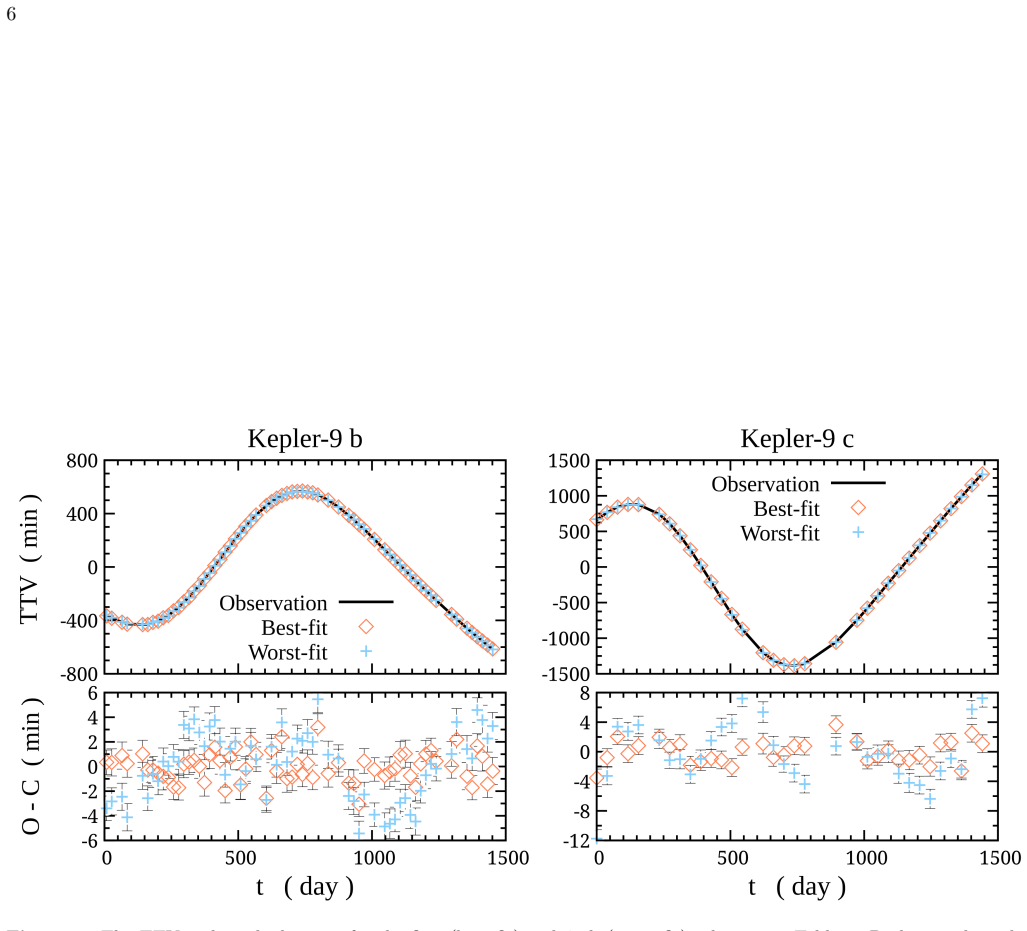
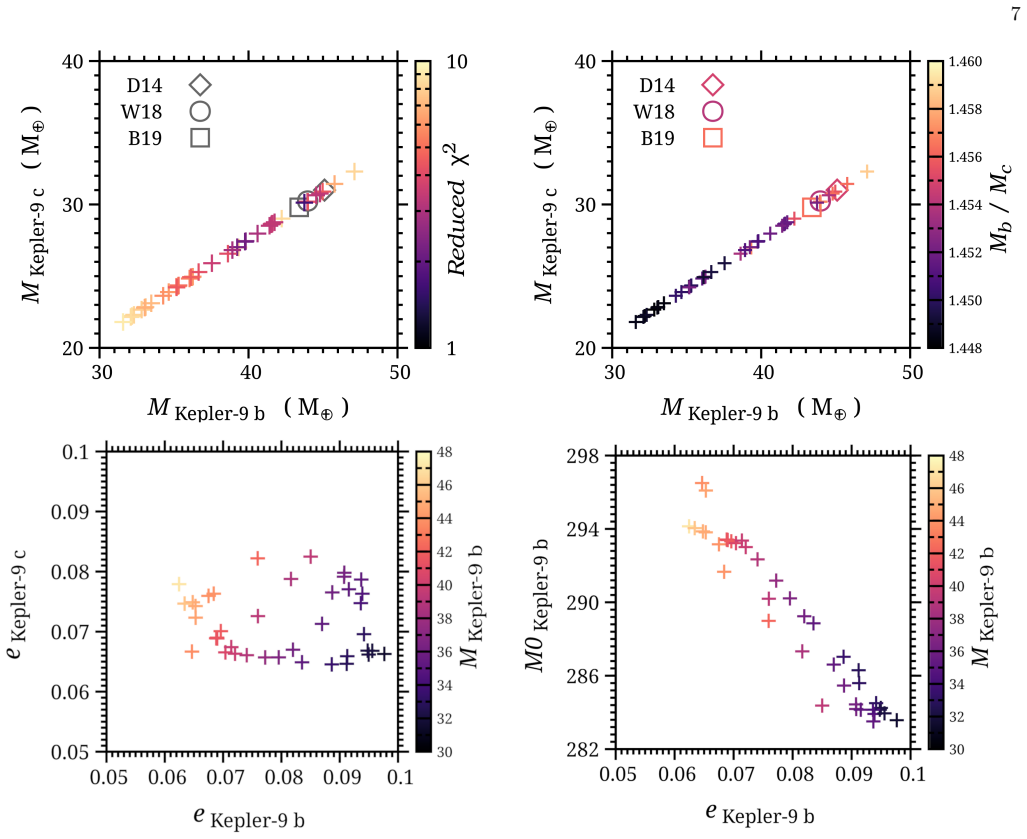
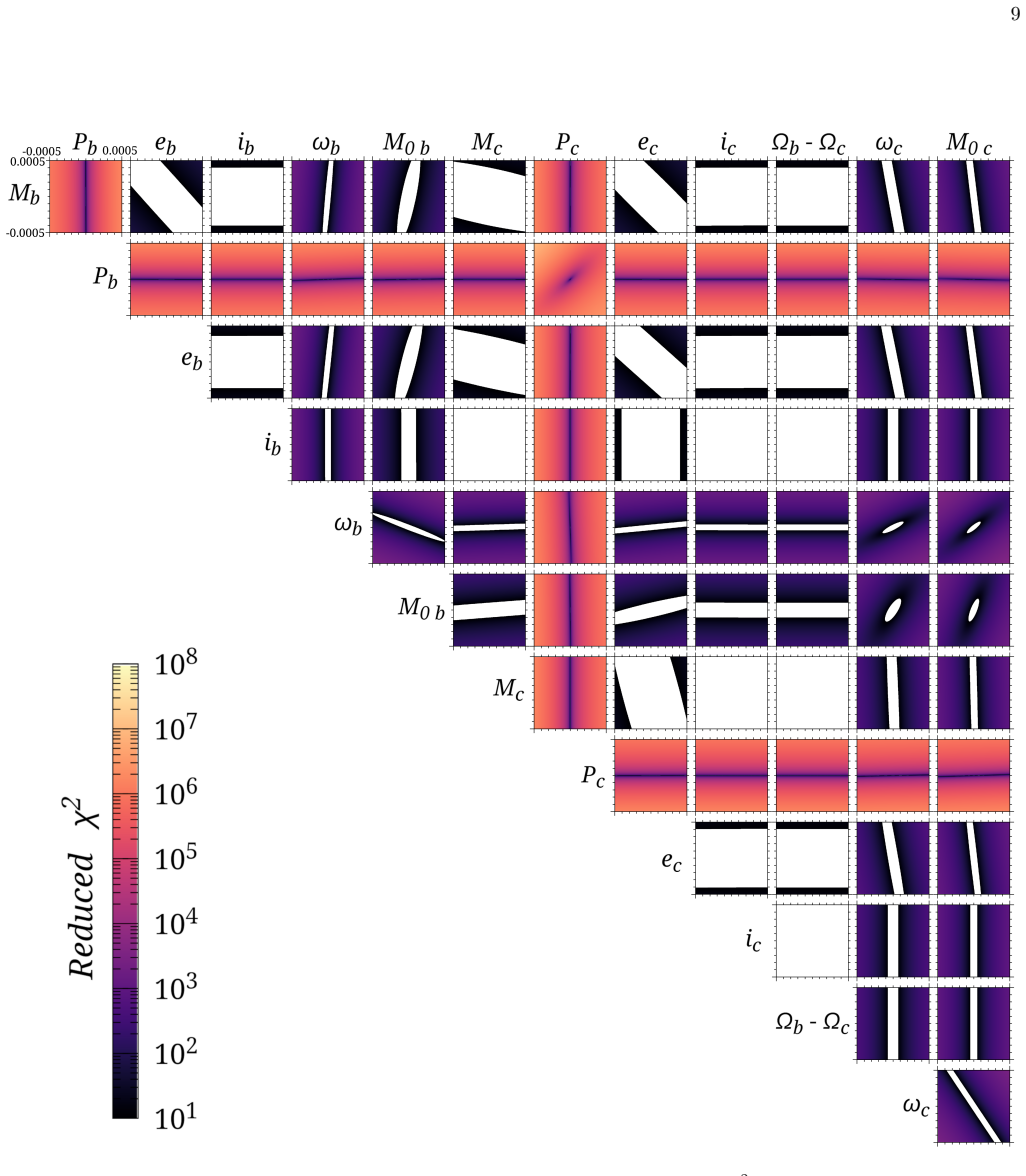
The observed TTV signals of Kepler-9 b and c are reproduced by a continuous family of mass solutions with planet b between 31.6 and 47.1 Earth masses and planet c between 21.8 and 32.3 Earth masses; these solutions lie along a linear relation set by a tight mass ratio. Standard Markov-chain Monte Carlo sampling cannot reach a single globally converged posterior because it cannot cross between the disconnected modes in the high-dimensional parameter space.
What carries the argument
A mode-first searching algorithm that locates multiple distinct posterior modes in a single MCMC run before completing the sampling of each mode, exposing the linear mass-ratio degeneracy predicted by earlier theory.
If this is right
- The masses of Kepler-9 b and c are not fixed to single values but span intervals of roughly 15 and 10 Earth masses respectively.
- All acceptable solutions maintain a nearly constant mass ratio between the two planets.
- Any sampling method that preserves the Markov property will fail to converge globally on the TTV posterior for this system.
- Earlier single-mode fits to the same data reported mass values that are only one member of a larger degenerate set.
Where Pith is reading between the lines
- Similar hidden degeneracies are likely present in TTV analyses of other compact multi-planet systems with high-quality timing data.
- Combining TTV with even modest radial-velocity coverage could eliminate most of the reported mass range.
- Non-Markovian or mode-jumping samplers may become necessary for reliable mass inference whenever TTV posteriors contain disconnected modes.
Load-bearing premise
The two-planet model without any extra bodies fully accounts for the observed timing variations and the new algorithm recovers every physically allowed mode without creating false ones.
What would settle it
An independent radial-velocity mass measurement for either planet that lies outside the reported ranges or breaks the tight mass-ratio relation would show that the family of solutions does not all fit the data equally well.
Figures
read the original abstract
Transit timing variations (TTV) are considered a tool for constraining the masses of transiting planets in the absence of radial-velocity data. Although theoretical studies have long revealed that TTV mass determinations intrinsically suffer from degeneracies, existing analyses of TTV data typically report a single-mode solution under a model with a specified number of planets. This is because fitting TTV curves in the high-dimensional solution space of TTV posterior is extremely challenging; even locating a single solution requires substantial computational resources. We developed an efficient mode-first searching algorithm that can locate multiple solutions in a single MCMC run. We applied this algorithm to Kepler-9 b and c, which have the highest-quality TTV data. We found that the observed TTV can be reproduced by many combinations of planetary masses spanning a broad range, rather than the previously assumed precise determination. The mass of Kepler-9 b can range from 31.6 to 47.1 $M_{\oplus}$, while that of Kepler-9 c can range from 21.8 to 32.3 $M_{\oplus}$, and even more broadly under looser constraints. These degenerate solutions follow a linear relationship under a tight mass ratio between the two planets, consistent with previous theoretical predictions. Furthermore, we demonstrate that achieving a globally converged posterior distribution for Kepler-9's TTV is impossible using a sampling algorithm that preserves the Markovian property. This underscores the need for caution when interpreting results from sampling algorithms that lack mathematical guarantees of global convergence.
Editorial analysis
A structured set of objections, weighed in public.
Referee Report
Summary. The paper introduces a mode-first MCMC algorithm to explore the TTV posterior for Kepler-9 b and c. It reports that the data admit a broad family of mass solutions along a linear mass-ratio degeneracy (b: 31.6–47.1 M⊕; c: 21.8–32.3 M⊕), rather than the previously reported precise values, and concludes that no Markovian sampler can ever achieve global convergence on this posterior.
Significance. If substantiated, the result would caution against over-interpreting the precision of TTV masses for multi-planet systems and could motivate wider use of multimodal search strategies. The empirical demonstration of additional modes is consistent with known TTV theory on mass-ratio degeneracies, but the stronger claim of universal impossibility for Markovian methods requires more rigorous support to alter community practice.
major comments (3)
- [Abstract and §5] Abstract and §5 (conclusions): The statement that global convergence is impossible for any sampling algorithm preserving the Markovian property is supported only by finite empirical runs in which standard MCMC chains remain trapped while the authors' procedure finds additional modes. No analytic argument is given establishing that the modes are separated by barriers whose height grows with dimension or that mixing time is provably infinite for every possible proposal and tempering schedule. This is load-bearing for the central cautionary claim.
- [§3 and results tables] §3 (methods) and results tables: No quantitative validation metrics (e.g., Gelman-Rubin statistics across modes, effective sample sizes for the newly located solutions, or posterior predictive checks) or error budgets on the reported mass ranges are provided. Without these, it is difficult to assess whether the broad ranges reflect genuine degeneracy or artifacts of the mode-first procedure.
- [§4] §4 (Kepler-9 application): The manuscript does not compare the TTV-derived mass ranges against existing radial-velocity constraints for Kepler-9. Such a cross-check would be a direct test of whether the additional modes are physically viable or whether the two-planet model is incomplete.
minor comments (2)
- [Figure 2] Figure 2: The caption should explicitly state how the different colored contours correspond to the modes identified by the new algorithm versus standard MCMC.
- [§4] Notation: The linear mass-ratio relation is stated to match prior theory, but the exact functional form used in the fit (slope and intercept with uncertainties) should be given in an equation or table for reproducibility.
Simulated Author's Rebuttal
We thank the referee for their constructive and detailed report. We have revised the manuscript to address the major comments by qualifying our convergence claim, adding quantitative validation metrics, and including a radial-velocity comparison. Our point-by-point responses follow.
read point-by-point responses
-
Referee: [Abstract and §5] Abstract and §5 (conclusions): The statement that global convergence is impossible for any sampling algorithm preserving the Markovian property is supported only by finite empirical runs in which standard MCMC chains remain trapped while the authors' procedure finds additional modes. No analytic argument is given establishing that the modes are separated by barriers whose height grows with dimension or that mixing time is provably infinite for every possible proposal and tempering schedule. This is load-bearing for the central cautionary claim.
Authors: We agree that the claim rests on empirical evidence from multiple independent runs with standard MCMC implementations (including different proposals and tempering), all of which remain trapped in single modes, while the mode-first algorithm recovers the full family. We do not supply a general analytic proof that mixing time is infinite for every conceivable Markovian sampler, as that would require a theorem on the geometry of arbitrary high-dimensional multimodal posteriors. We have revised the abstract and §5 to state that 'no standard Markovian sampler achieves global convergence on this posterior in practice' and to emphasize the empirical basis, thereby preserving the cautionary message without overclaiming universality. revision: partial
-
Referee: [§3 and results tables] §3 (methods) and results tables: No quantitative validation metrics (e.g., Gelman-Rubin statistics across modes, effective sample sizes for the newly located solutions, or posterior predictive checks) or error budgets on the reported mass ranges are provided. Without these, it is difficult to assess whether the broad ranges reflect genuine degeneracy or artifacts of the mode-first procedure.
Authors: We have added the requested diagnostics to the revised §3 and tables. Gelman-Rubin R-hat statistics are now reported separately for each located mode; effective sample sizes are given for the mass and eccentricity parameters within the newly identified solutions; posterior predictive checks compare forward-modeled TTV curves drawn from the full multimodal posterior against the Kepler-9 observations; and explicit 16–84 percentile error budgets are attached to the quoted mass ranges. These additions confirm that the reported degeneracy is intrinsic to the posterior rather than an artifact. revision: yes
-
Referee: [§4] §4 (Kepler-9 application): The manuscript does not compare the TTV-derived mass ranges against existing radial-velocity constraints for Kepler-9. Such a cross-check would be a direct test of whether the additional modes are physically viable or whether the two-planet model is incomplete.
Authors: A direct comparison with published radial-velocity constraints for Kepler-9 has been inserted into the revised §4. The RV data are consistent with the broader TTV mass ranges (particularly the upper end for planet b) and do not exclude any of the degenerate solutions. The two-planet model remains adequate; no evidence for additional planets is required by the combined dataset. revision: yes
Circularity Check
No significant circularity; results are empirical outputs from new algorithm runs
full rationale
The paper's core claims—the existence of a broad family of mass solutions along a linear mass-ratio degeneracy for Kepler-9 b and c, and the empirical observation that conventional Markovian MCMC runs fail to locate all modes—are presented as direct outputs of applying the authors' newly developed mode-first searching algorithm to the TTV dataset. These outputs are not equivalent to the inputs by construction, nor do they rename a fitted parameter as a prediction. The noted consistency with prior theoretical predictions is framed as an external alignment check rather than a self-referential input. No load-bearing step relies on a self-citation chain, imported uniqueness theorem, or ansatz smuggled via prior work; the derivation chain remains self-contained against the computational experiments described.
Axiom & Free-Parameter Ledger
Lean theorems connected to this paper
-
IndisputableMonolith/Foundation/ArithmeticFromLogic.leanLogicNat recovery and initial Peano algebra unclear?
unclearRelation between the paper passage and the cited Recognition theorem.
We developed an efficient mode-first searching algorithm that can locate multiple solutions in a single MCMC run... achieving a globally converged posterior distribution for Kepler-9's TTV is impossible using a sampling algorithm that preserves the Markovian property.
-
IndisputableMonolith/Cost/FunctionalEquation.leanwashburn_uniqueness_aczel (J uniqueness) unclear?
unclearRelation between the paper passage and the cited Recognition theorem.
These degenerate solutions follow a linear relationship under a tight mass ratio between the two planets
What do these tags mean?
- matches
- The paper's claim is directly supported by a theorem in the formal canon.
- supports
- The theorem supports part of the paper's argument, but the paper may add assumptions or extra steps.
- extends
- The paper goes beyond the formal theorem; the theorem is a base layer rather than the whole result.
- uses
- The paper appears to rely on the theorem as machinery.
- contradicts
- The paper's claim conflicts with a theorem or certificate in the canon.
- unclear
- Pith found a possible connection, but the passage is too broad, indirect, or ambiguous to say the theorem truly supports the claim.
Reference graph
Works this paper leans on
-
[1]
00",editor=
thebibliography [1] 20pt to REFERENCES 6pt =0pt \@twocolumntrue 12pt -12pt 10pt plus 3pt =0pt =0pt =1pt plus 1pt =0pt =0pt -12pt =13pt plus 1pt =20pt =13pt plus 1pt \@M =10000 =-1.0em =0pt =0pt 0pt =0pt =1.0em @enumiv\@empty 10000 10000 `\.\@m \@noitemerr \@latex@warning Empty `thebibliography' environment \@ifnextchar \@reference \@latexerr Missing key o...
2017
-
[2]
Agol, E., Steffen, J., Sari, R., et al.\ 2005, , 359, 2, 567. doi:10.1111/j.1365-2966.2005.08922.x
-
[3]
Agol, E., Dorn, C., Grimm, S. L., et al.\ 2021, , 2, 1, 1. doi:10.3847/PSJ/abd022
-
[4]
2011, , 743, 200, 10.1088/0004-637X/743/2/200
Ballard, S., Fabrycky, D., Fressin, F., et al.\ 2011, , 743, 2, 200. doi:10.1088/0004-637X/743/2/200
-
[5]
doi:10.1051/0004-6361/201424080
Borsato, L., Marzari, F., Nascimbeni, V., et al.\ 2014, , 571, A38. doi:10.1051/0004-6361/201424080
-
[6]
Borsato, L., Malavolta, L., Piotto, G., et al.\ 2019, , 484, 3, 3233. doi:10.1093/mnras/stz181
-
[7]
doi:10.1111/j.1745-3933.2012.01338.x , Eprint =
Bou \'e , G., Oshagh, M., Montalto, M., et al.\ 2012, , 422, 1, L57. doi:10.1111/j.1745-3933.2012.01236.x
-
[8]
Cochran, W. D., Fabrycky, D. C., Torres, G., et al.\ 2011, , 197, 1, 7. doi:10.1088/0067-0049/197/1/7
-
[9]
Deck, K. M., Agol, E., Holman, M. J., et al.\ 2014, , 787, 2, 132. doi:10.1088/0004-637X/787/2/132
-
[10]
Deck, K. M. & Agol, E.\ 2016, , 821, 2, 96. doi:10.3847/0004-637X/821/2/96
-
[11]
& Ofir, A.\ 2014, , arXiv:1403.1372
Dreizler, S. & Ofir, A.\ 2014, , arXiv:1403.1372. doi:10.48550/arXiv.1403.1372
-
[12]
Fabrycky, D. C., Ford, E. B., Steffen, J. H., et al.\ 2012, , 750, 2, 114. doi:10.1088/0004-637X/750/2/114
-
[13]
Ford, E. B., Ragozzine, D., Rowe, J. F., et al.\ 2012, , 756, 2, 185. doi:10.1088/0004-637X/756/2/185
-
[14]
doi:10.1051/0004-6361/201833436
Freudenthal, J., von Essen, C., Dreizler, S., et al.\ 2018, , 618, A41. doi:10.1051/0004-6361/201833436
-
[15]
Gillon, M., Triaud, A. H. M. J., Demory, B.-O., et al.\ 2017, , 542, 7642, 456. doi:10.1038/nature21360
-
[16]
2017, , 154, 5, 10.3847/1538-3881/aa71ef
Hadden, S. & Lithwick, Y.\ 2017, , 154, 1, 5. doi:10.3847/1538-3881/aa71ef
-
[17]
2016, , 225, 9, 10.3847/0067-0049/225/1/9
Holczer, T., Mazeh, T., Nachmani, G., et al.\ 2016, , 225, 1, 9. doi:10.3847/0067-0049/225/1/9
-
[18]
Holman, M. J., Fabrycky, D. C., Ragozzine, D., et al.\ 2010, Science, 330, 6000, 51. doi:10.1126/science.1195778
-
[19]
Holman, M. J. & Murray, N. W.\ 2005, Science, 307, 5713, 1288. doi:10.1126/science.1107822
-
[20]
Jin, S., Jiang, W., & Wu, D.-H.\ 2024, , 274, 1, 10. doi:10.3847/1538-4365/ad6300
-
[21]
Jin, S., Ding, X., Wang, S., et al.\ 2022, , 509, 3, 4608. doi:10.1093/mnras/stab3317
-
[22]
2012, , 761, 122, 10.1088/0004-637X/761/2/122
Lithwick, Y., Xie, J., & Wu, Y.\ 2012, , 761, 2, 122. doi:10.1088/0004-637X/761/2/122
-
[23]
Miralda-Escud \'e , J.\ 2002, , 564, 2, 1019. doi:10.1086/324279
-
[24]
& Vokrouhlick \'y , D.\ 2016, , 823, 2, 72
Nesvorn \'y , D. & Vokrouhlick \'y , D.\ 2016, , 823, 2, 72. doi:10.3847/0004-637X/823/2/72
-
[25]
Schmitt, J. R., Agol, E., Deck, K. M., et al.\ 2014, , 795, 2, 167. doi:10.1088/0004-637X/795/2/167
-
[26]
Steffen, J. H., Fabrycky, D. C., Agol, E., et al.\ 2013, , 428, 2, 1077. doi:10.1093/mnras/sts090
-
[27]
Steffen, J. H., Fabrycky, D. C., Ford, E. B., et al.\ 2012, , 421, 3, 2342. doi:10.1111/j.1365-2966.2012.20467.x
-
[28]
2025, Nature Astronomy, 10.1038/s41550-025-02565-z
Sun, L., Gu, S., Wang, X., et al.\ 2025, Nature Astronomy, 9, 1184. doi:10.1038/s41550-025-02565-z
-
[29]
M., et al.\ 2011, , 727, 1, 24
Torres, G., Fressin, F., Batalha, N. M., et al.\ 2011, , 727, 1, 24 . doi:10.1088/0004-637X/727/1/24
-
[30]
Veras, D., Ford, E. B., & Payne, M. J.\ 2011, , 727, 2, 74. doi:10.1088/0004-637X/727/2/74
-
[31]
C., et al.\ 2018, , 155, 2, 73
Wang, S., Wu, D.-H., Addison, B. C., et al.\ 2018, , 155, 2, 73. doi:10.3847/1538-3881/aaa253
-
[32]
Wu, D.-H., Rice, M., & Wang, S.\ 2023, , 165, 4, 171. doi:10.3847/1538-3881/acbf3f
-
[33]
Wu, D.-H., Wang, S., Zhou, J.-L., et al.\ 2018, , 156, 3, 96. doi:10.3847/1538-3881/aad22b
-
[34]
2013, , 208, 22, 10.1088/0067-0049/208/2/22
Xie, J.-W.\ 2013, , 208, 2, 22. doi:10.1088/0067-0049/208/2/22
-
[35]
Yahalomi, D. A. & Kipping, D.\ 2024, , arXiv:2411.10493. doi:10.48550/arXiv.2411.10493
-
[37]
doi:10.1088/0004-637X/778/2/110
Yang, M., Liu, H.-G., Zhang, H., et al.\ 2013, , 778, 2, 110. doi:10.1088/0004-637X/778/2/110
-
[38]
\@endnotelabel
#2 \@endnotetext#1 @relax \@bibdataout @FOOTNOTE \@endnotelabel, key="\@endnotelabel", note="#1" \@bibdataout @relax \( \) \\ \@unexpandable@protect `\^^M @documenthook \@bibdataout@init \@bibdataout@init \@bibdataout @bibdata. @ext \@bibdataout@rev \@bibdataout @CONTROL REVTEX41Control @enable@sw ,eprint="" @filesw \@auxout REVTEX41Control @warn The comm...
2010
discussion (0)
Sign in with ORCID, Apple, or X to comment. Anyone can read and Pith papers without signing in.