Recognition: unknown
Probing Solar Symmetrons with Direct Detection
Pith reviewed 2026-05-10 17:30 UTC · model grok-4.3
The pith
The Sun produces symmetrons through photon conversion in its tachocline that reach Earth and can be absorbed by underground xenon detectors, setting new limits on these screened scalar fields.
A machine-rendered reading of the paper's core claim, the machinery that carries it, and where it could break.
Core claim
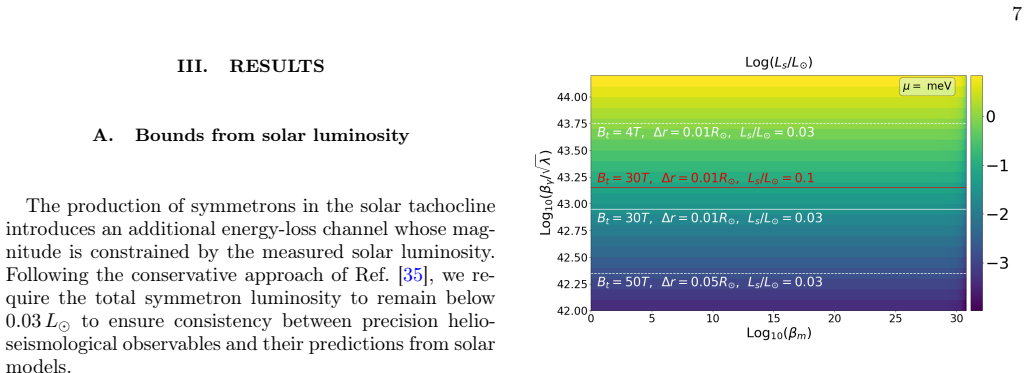
Symmetrons produced by photon conversion in the solar tachocline carry a keV-scale spectrum to Earth whose absorption in liquid xenon via conformal and disformal couplings to electrons yields direct-detection limits that tighten the parameter space already bounded by requiring symmetron luminosity to stay below three percent of solar output.
What carries the argument
Photon-to-symmetron conversion in the tachocline magnetic field, which generates the Earth flux, followed by density-dependent absorption on electrons in xenon targets.
If this is right
- Solar luminosity supplies astrophysical upper limits on symmetron mass and coupling strength in regions not previously excluded.
- The arriving symmetron spectrum at Earth is predicted to peak in the keV range.
- XENONnT electron-recoil data set complementary laboratory limits that narrow the allowed parameter space further.
- The Sun acts as a steady, exploitable source of symmetrons for testing screened scalar models.
Where Pith is reading between the lines
- The same production and detection strategy could be applied to other density-dependent scalars that couple to photons in stellar magnetic fields.
- More sensitive future xenon or other target detectors could probe lower coupling strengths or different mass ranges.
- If symmetrons contribute to cosmic acceleration, the solar bounds would restrict their possible role in late-time cosmology.
Load-bearing premise
Symmetron production is taken to occur only inside the tachocline with photon conversion as the dominant channel, and the total symmetron energy output is capped at three percent of the Sun's luminosity.
What would settle it
An observed solar energy loss in symmetrons exceeding three percent of luminosity, or a measured absorption rate in XENONnT that is inconsistent with the predicted keV spectrum, would invalidate the derived bounds.
Figures


read the original abstract
We provide the first investigation of the solar production of symmetrons, a well-motivated class of screened scalar fields with density dependent couplings to the Standard Model, and their subsequent absorption in underground direct detection experiments. We compute the flux of symmetrons produced through photon conversion in the magnetic field of the solar tachocline, and constrain the resulting luminosity to not exceed 3% of the observed solar output. Even under the conservative assumption that production occurs only in the tachocline, this criterion yields robust astrophysical bounds on previously uncharted regions of symmetron parameter space, and predicts a keV-scale symmetron spectrum at Earth. We then derive the corresponding absorption signal in liquid xenon detectors, where symmetrons can interact with electrons through both conformal and disformal couplings. Using binned data from XENONnT, we obtain new direct-detection limits that are complementary to the solar luminosity constraint, further tightening the viable symmetron parameter space. Our results demonstrate that the Sun provides a testable, previously unexploited, source of symmetrons, and highlight that the interplay of astrophysical and laboratory searches offers a powerful strategy for probing screened scalar theories.
Editorial analysis
A structured set of objections, weighed in public.
Referee Report
Summary. The paper claims to provide the first investigation of solar symmetron production via photon conversion in the tachocline magnetic field, with the resulting luminosity constrained to not exceed 3% of the observed solar output. Under the conservative tachocline-only assumption, this yields astrophysical bounds on symmetron parameter space and predicts a keV-scale spectrum at Earth. The work then derives the absorption signal in liquid xenon via conformal and disformal couplings, obtaining new limits from XENONnT binned data that are complementary to the solar constraint.
Significance. If the key assumptions hold, the result is significant as it opens a previously unexploited solar source for probing screened scalars, demonstrates complementarity between astrophysical luminosity bounds and direct-detection limits, and uses existing XENONnT data to tighten viable parameter space. The conservative framing and focus on falsifiable predictions strengthen the contribution.
major comments (2)
- [Abstract and luminosity-constraint section] The 3% solar-luminosity ceiling (abstract) is load-bearing for the flux normalization and all derived bounds, yet no derivation ties it to helioseismology, neutrino fluxes, or sound-speed profiles; the text must show how this specific fraction follows from solar observables rather than being chosen for conservatism.
- [Production mechanism and flux computation] The tachocline-only production assumption (abstract) together with the photon-conversion channel is central to the predicted Earth flux and XENONnT exclusion contours, but the manuscript does not propagate observational uncertainties in tachocline B-field strength or coherence length into the conversion probability; because the mixing angle is density-dependent, any additional channels or screening suppression would rescale the signal and weaken the claimed robustness.
minor comments (2)
- [Direct-detection analysis] Clarify the precise energy range and binning used for the XENONnT absorption signal to allow direct reproduction of the limits.
- [Results section] Add a short table or plot comparing the new DD limits with the solar-luminosity bounds across the symmetron parameter space.
Simulated Author's Rebuttal
We thank the referee for their careful reading and constructive comments on our manuscript. We address each major comment point by point below. Where the suggestions identify areas for improved clarity or justification, we have revised the text accordingly while preserving the conservative framing of our assumptions.
read point-by-point responses
-
Referee: [Abstract and luminosity-constraint section] The 3% solar-luminosity ceiling (abstract) is load-bearing for the flux normalization and all derived bounds, yet no derivation ties it to helioseismology, neutrino fluxes, or sound-speed profiles; the text must show how this specific fraction follows from solar observables rather than being chosen for conservatism.
Authors: We agree that the 3% threshold benefits from explicit justification tied to solar observables. This value is chosen conservatively so that the additional symmetron luminosity remains a small perturbation on the total solar output, which is known to high precision. In the revised manuscript we expand the luminosity-constraint section to note that standard solar models, calibrated to helioseismological sound-speed profiles and neutrino flux measurements, tolerate additional energy losses at the few-percent level before significant tension arises with observations. The 3% ceiling therefore provides a transparent, model-independent upper limit that is consistent with these constraints while remaining deliberately conservative; we do not claim a first-principles derivation from a full solar-model re-fit. revision: yes
-
Referee: [Production mechanism and flux computation] The tachocline-only production assumption (abstract) together with the photon-conversion channel is central to the predicted Earth flux and XENONnT exclusion contours, but the manuscript does not propagate observational uncertainties in tachocline B-field strength or coherence length into the conversion probability; because the mixing angle is density-dependent, any additional channels or screening suppression would rescale the signal and weaken the claimed robustness.
Authors: The tachocline-only assumption is explicitly labeled conservative in the abstract and main text precisely because production in other solar regions would be suppressed by the density-dependent screening mechanism. The conversion probability already incorporates the density-dependent mixing angle through the standard photon-scalar oscillation formalism evaluated at tachocline conditions. We acknowledge that a quantitative propagation of uncertainties in B-field strength and coherence length was not presented. In the revision we add a dedicated paragraph that (i) cites the observational ranges for these quantities from helioseismology, (ii) shows the scaling of the conversion probability with B and coherence length, and (iii) demonstrates that the resulting Earth flux and XENONnT limits vary by less than an order of magnitude under factor-of-two variations in either parameter. Additional production channels would only increase the predicted flux and therefore strengthen the bounds; our conservative choice to restrict to the tachocline therefore does not weaken the robustness claim but rather makes the reported limits a lower bound on the constraining power. revision: yes
Circularity Check
No significant circularity; central bounds and predictions use external solar luminosity data and XENONnT results
full rationale
The paper computes symmetron flux via photon conversion in the tachocline under an explicit conservative assumption (production only there, luminosity capped at 3% of observed solar output), then derives the keV-scale spectrum at Earth and absorption rates in xenon from standard mixing and coupling formulas. These steps rely on external solar output measurements and published XENONnT binned data rather than any parameter fitted inside the paper or any self-citation chain. No equation reduces a claimed prediction to an input by construction, and no uniqueness theorem or ansatz is smuggled via self-reference. The derivation is therefore self-contained against external benchmarks, consistent with the default expectation of no circularity.
Axiom & Free-Parameter Ledger
axioms (2)
- domain assumption Symmetrons are produced primarily through photon conversion in the solar tachocline magnetic field
- domain assumption Symmetron-electron interactions occur via both conformal and disformal couplings
Reference graph
Works this paper leans on
-
[1]
V. C. Rubin and W. K. Ford, Jr., Astrophys. J.159, 379 (1970)
1970
-
[2]
A. G. Riesset al.(Supernova Search Team), Astron. J. 116, 1009 (1998), arXiv:astro-ph/9805201
work page internal anchor Pith review arXiv 1998
-
[3]
Measurements of Omega and Lambda from 42 High-Redshift Supernovae
S.Perlmutteret al.(SupernovaCosmologyProject),As- trophys. J.517, 565 (1999), arXiv:astro-ph/9812133
work page internal anchor Pith review arXiv 1999
-
[4]
Weinberg, Rev
S. Weinberg, Rev. Mod. Phys.61, 1 (1989)
1989
-
[5]
A. G. Adameet al.(DESI), JCAP02, 021 (2025), arXiv:2404.03002 [astro-ph.CO]
work page internal anchor Pith review arXiv 2025
-
[6]
Evolving dark energy or supernovae systematics?
G. Efstathiou, Mon. Not. Roy. Astron. Soc.538, 875 (2025), arXiv:2408.07175 [astro-ph.CO]
-
[7]
Ratra and P
B. Ratra and P. J. E. Peebles, Phys. Rev. D37, 3406 (1988)
1988
-
[8]
Quintessence, Cosmic Coincidence, and the Cosmological Constant
I. Zlatev, L.-M. Wang, and P. J. Steinhardt, Phys. Rev. Lett.82, 896 (1999), arXiv:astro-ph/9807002
work page Pith review arXiv 1999
-
[9]
E.J.Copeland, M.Sami, andS.Tsujikawa,Int.J.Mod. Phys. D15, 1753 (2006), arXiv:hep-th/0603057
work page Pith review arXiv 2006
- [10]
-
[11]
C. Burrage and J. Sakstein, Living Rev. Rel.21, 1 (2018), arXiv:1709.09071 [astro-ph.CO]
-
[12]
Chameleon Fields: Awaiting Surprises for Tests of Gravity in Space
J. Khoury and A. Weltman, Phys. Rev. Lett.93, 171104 (2004), arXiv:astro-ph/0309300
work page Pith review arXiv 2004
- [13]
-
[14]
K. Hinterbichler and J. Khoury, Phys. Rev. Lett.104, 231301 (2010), arXiv:1001.4525 [hep-th]
- [15]
-
[16]
The string dilaton and a least co upling principle
T. Damour and A. M. Polyakov, Nucl. Phys. B423, 532 (1994), arXiv:hep-th/9401069
-
[17]
P. Brax, C. van de Bruck, A.-C. Davis, and D. Shaw, Phys. Rev. D82, 063519 (2010), arXiv:1005.3735 [astro- ph.CO]
work page Pith review arXiv 2010
-
[18]
C. Burrage, A. Macdonald, M. P. Ross, G. Rybka, and E. Todarello, Phys. Rev. D113, 063505 (2026), arXiv:2507.16526 [hep-ph]
-
[19]
A. I. Vainshtein, Phys. Lett. B39, 393 (1972)
1972
- [20]
-
[21]
P. Brax, A.-C. Davis, and B. Li, Phys. Lett. B715, 38 (2012), arXiv:1111.6613 [astro-ph.CO]
-
[22]
A. Upadhye, Phys. Rev. Lett.110, 031301 (2013), arXiv:1210.7804 [hep-ph]
-
[23]
C. Burrage, E. J. Copeland, C. Käding, and P. Milling- ton, Phys. Rev. D99, 043539 (2019), arXiv:1811.12301 [astro-ph.CO]
-
[24]
F. Feleppa, G. Lambiase, and S. Vagnozzi, Phys. Rev. D112, 084011 (2025), arXiv:2508.18448 [gr-qc]
-
[25]
K. Bartnick, K. Springmann, S. Stelzl, and A. Weiler, (2025), arXiv:2509.25305 [hep-ph]
- [26]
-
[27]
F. Feleppa, W. M. de Graaf, P. Brax, and G. Lambiase, Phys. Rev. Lett.136, 101002 (2026), arXiv:2511.08448 [gr-qc]
- [28]
-
[29]
J. Redondo and G. Raffelt, JCAP08, 034 (2013), arXiv:1305.2920 [hep-ph]
-
[30]
Redondo,Solar axion flux from the axion-electron coupling,JCAP12(2013) 008 [1310.0823]
J. Redondo, JCAP12, 008 (2013), arXiv:1310.0823 [hep-ph]
-
[31]
New axion and hidden photon constraints from a solar data global fit,
N. Vinyoles, A. Serenelli, F. L. Villante, S. Basu, J. Redondo, and J. Isern, JCAP10, 015 (2015), arXiv:1501.01639 [astro-ph.SR]
-
[32]
S. Vagnozzi, L. Visinelli, P. Brax, A.-C. Davis, and J. Sakstein, Phys. Rev. D104, 063023 (2021), arXiv:2103.15834 [hep-ph]
-
[33]
E. Aprileet al.(XENON), Phys. Rev. D102, 072004 (2020), arXiv:2006.09721 [hep-ex]
- [34]
-
[35]
T. O’Shea, A.-C. Davis, M. Giannotti, S. Vagnozzi, L. Visinelli, and J. K. Vogel, Phys. Rev. D110, 063027 (2024), arXiv:2406.01691 [hep-ph]
-
[36]
G.-W. Yuan, A.-C. Davis, M. Giannotti, S. Vagnozzi, L. Visinelli, and J. K. Vogel, (2025), arXiv:2511.01655 [hep-ph]
-
[37]
E. Aprileet al.(XENON), Phys. Rev. Lett.129, 161805 15 (2022), arXiv:2207.11330 [hep-ex]
-
[38]
G. G. Raffelt, Phys. Rept.198, 1 (1990)
1990
-
[39]
G. G. Raffelt,Stars as laboratories for fundamental physics: The astrophysics of neutrinos, axions, and other weakly interacting particles(University of Chicago Press, 1996)
1996
-
[40]
L. Di Luzio, M. Giannotti, E. Nardi, and L. Visinelli, Phys. Rept.870, 1 (2020), arXiv:2003.01100 [hep-ph]
-
[41]
K. Zioutaset al.(CAST), Phys. Rev. Lett.94, 121301 (2005), arXiv:hep-ex/0411033
-
[42]
J. Jaeckel and A. Ringwald, Ann. Rev. Nucl. Part. Sci. 60, 405 (2010), arXiv:1002.0329 [hep-ph]
- [43]
-
[44]
Andriamonjeet al.(CAST), JCAP04, 010 (2007), arXiv:hep-ex/0702006
S. Andriamonjeet al.(CAST), JCAP04, 010 (2007), arXiv:hep-ex/0702006
-
[45]
M. Ariket al.(CAST), Phys. Rev. D92, 021101 (2015), arXiv:1503.00610 [hep-ex]
-
[46]
Anastassopouloset al.(CAST), Phys
V. Anastassopouloset al.(CAST), Phys. Lett. B749, 172 (2015), arXiv:1503.04561 [astro-ph.SR]
-
[47]
V. Anastassopouloset al.(CAST), Nature Phys.13, 584 (2017), arXiv:1705.02290 [hep-ex]
-
[48]
Anastassopouloset al.(CAST), JCAP01, 032 (2019), arXiv:1808.00066 [hep-ex]
V. Anastassopouloset al.(CAST), JCAP01, 032 (2019), arXiv:1808.00066 [hep-ex]
-
[49]
Armengaudet al.(IAXO), JCAP06, 047 (2019), arXiv:1904.09155 [hep-ph]
E. Armengaudet al.(IAXO), JCAP06, 047 (2019), arXiv:1904.09155 [hep-ph]
-
[50]
Arcusaet al.(IAXO), (2025), arXiv:2504.00079 [hep-ph]
A. Arcusaet al.(IAXO), (2025), arXiv:2504.00079 [hep-ph]
-
[51]
D. Zhanget al.(PandaX), Phys. Rev. Lett.129, 161804 (2022), arXiv:2206.02339 [hep-ex]
-
[52]
T. Liet al.(PandaX), Phys. Rev. Lett.134, 071004 (2025), arXiv:2409.00773 [hep-ex]
-
[53]
X. Zenget al.(PandaX), Phys. Rev. Lett.134, 041001 (2025), arXiv:2408.07641 [hep-ex]
-
[54]
J. Aalberset al.(LZ), Phys. Rev. D108, 072006 (2023), arXiv:2307.15753 [hep-ex]
- [55]
-
[56]
I. Dominguez, O. Straniero, and J. Isern, Mon. Not. Roy. Astron. Soc.306, 1 (1999), arXiv:astro- ph/9905033
-
[57]
Neutrino and axion bounds from the globular cluster M5 (NGC 5904),
N. Viaux, M. Catelan, P. B. Stetson, G. Raffelt, J. Redondo, A. A. R. Valcarce, and A. Weiss, Phys. Rev. Lett.111, 231301 (2013), arXiv:1311.1669 [astro- ph.SR]
-
[58]
O. Stranieroet al., Astron. Astrophys.644, A166 (2020), arXiv:2010.03833 [astro-ph.SR]
- [59]
-
[60]
I. Domínguez, O. Straniero, L. Piersanti, M. Giannotti, and A. Mirizzi, Astron. Astrophys.702, A240 (2025), arXiv:2508.17779 [astro-ph.SR]
- [61]
-
[62]
Christensen-Dalsgaardet al., Science272, 1286 (1996)
J. Christensen-Dalsgaardet al., Science272, 1286 (1996)
1996
-
[63]
D. O. Goughet al., Science272, 1296 (1996)
1996
-
[64]
D. O. Gough and M. E. McIntyre, Nature394, 755 (1998)
1998
-
[65]
Grevesse and A
N. Grevesse and A. J. Sauval, Space Sci. Rev.85, 161 (1998)
1998
-
[66]
The chemical composition of the Sun
M. Asplund, N. Grevesse, A. J. Sauval, and P. Scott, Ann. Rev. Astron. Astrophys.47, 481 (2009), arXiv:0909.0948 [astro-ph.SR]
work page Pith review arXiv 2009
-
[67]
E. Caffau, H.-G. Ludwig, M. Steffen, B. Frey- tag, and P. Bonifacio, Solar Phys.268, 255 (2011), arXiv:1003.1190 [astro-ph.SR]
- [68]
- [69]
-
[70]
von Steiger and T
R. von Steiger and T. H. Zurbuchen, Astrophys. J.816, 13 (2016)
2016
-
[71]
S. Vagnozzi, K. Freese, and T. H. Zurbuchen, Astro- phys. J.839, 55 (2017), arXiv:1603.05960 [astro-ph.SR]
-
[72]
A new Generation of Standard Solar Models
N. Vinyoles, A. M. Serenelli, F. L. Villante, S. Basu, J. Bergström, M. C. Gonzalez-Garcia, M. Maltoni, C. Peña-Garay, and N. Song, Astrophys. J.835, 202 (2017), arXiv:1611.09867 [astro-ph.SR]
work page Pith review arXiv 2017
-
[73]
Vagnozzi, Atoms7, 41 (2019), arXiv:1703.10834 [astro-ph.SR]
S. Vagnozzi, Atoms7, 41 (2019), arXiv:1703.10834 [astro-ph.SR]
-
[74]
M. Benisty, A. M. Amarsi, and N. Grevesse, Astron. Astrophys.653, A141 (2021), arXiv:2105.01661 [astro- ph.SR]
- [75]
-
[76]
P. Gondolo and G. G. Raffelt, Phys. Rev. D79, 107301 (2009), arXiv:0807.2926 [astro-ph]
-
[77]
On Gauge couplings in string theory,
V. Kaplunovsky and J. Louis, Nucl. Phys. B444, 191 (1995), arXiv:hep-th/9502077
- [78]
-
[79]
P. Brax and C. Burrage, Phys. Rev. D90, 104009 (2014), arXiv:1407.1861 [astro-ph.CO]
- [80]
discussion (0)
Sign in with ORCID, Apple, or X to comment. Anyone can read and Pith papers without signing in.