Recognition: unknown
Association between projectile and target excitation in slow Ar^{q+}-CO₂ collisions
Pith reviewed 2026-05-10 16:37 UTC · model grok-4.3
The pith
Excitations in the scattered Ar projectile and ionized CO2 target are strongly associated in slow collisions.
A machine-rendered reading of the paper's core claim, the machinery that carries it, and where it could break.
Core claim
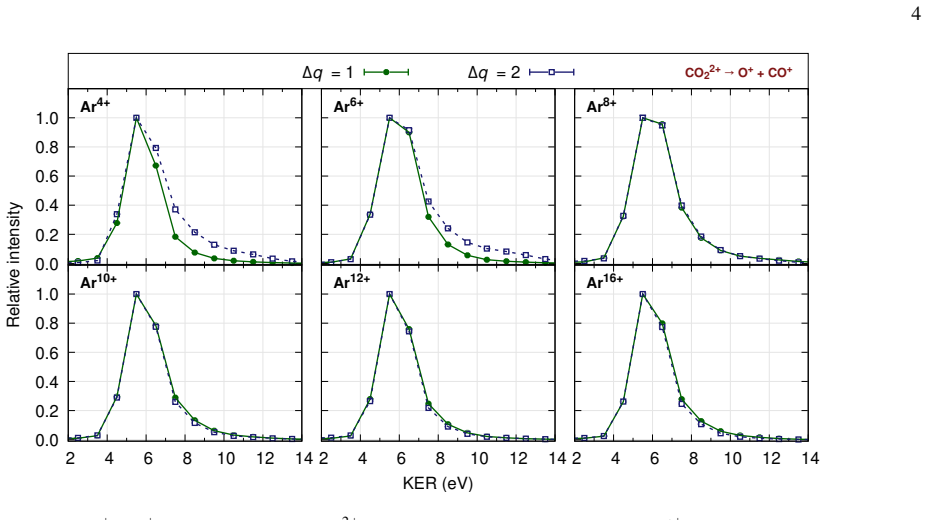
Interpreting projectile autoionization to be a consequence of capture into highly excited states and high fragment KER to be a consequence of excitation of the ionized target to high-lying states, we find a strong dependence between the target and scattered projectile excitations. The dependence is observed through systematic differences in kinetic energy release distributions for different projectile charge changes after the collision, with the extended classical over-the-barrier model supplying the reaction windows that connect the capture and autoionization steps.
What carries the argument
Kinetic energy release distributions compared across projectile charge changes Δq, with reaction windows supplied by the extended classical over-the-barrier model for multielectron capture.
If this is right
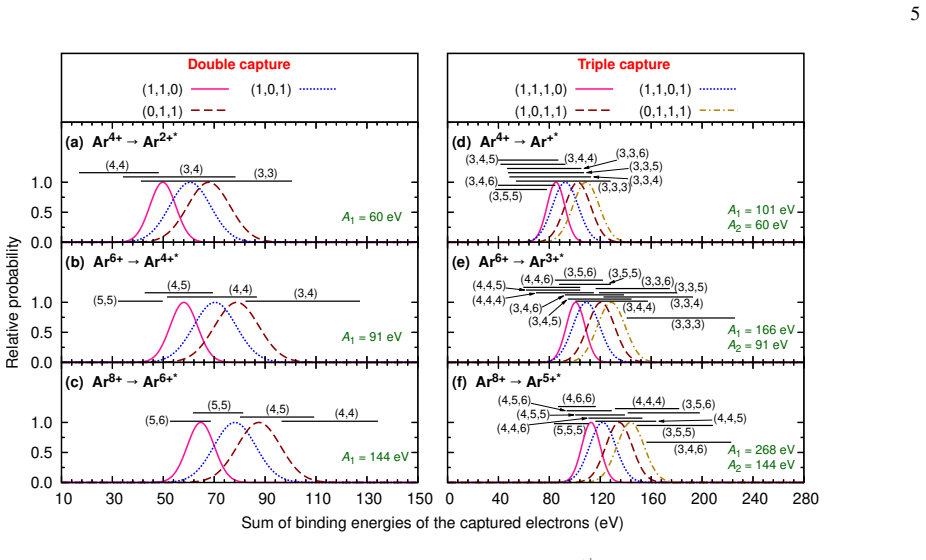
- Ionization of the target occurs via multielectron capture while the scattered projectile undergoes subsequent multi-fold autoionization.
- High fragment kinetic energy release indicates excitation of the ionized target to high-lying states.
- The dependence between projectile and target excitations generally weakens as the initial projectile charge increases.
- Specific deviations from the trend appear for CO2^{3+} fragmentation with Ar^{4+} at high KER and with Ar^{6+} at low KER.
Where Pith is reading between the lines
- The association implies that the initial electron capture step partitions excitation energy between projectile and target in a correlated way rather than independently.
- Coincidence measurements that record both projectile autoionizing electrons and fragment kinetic energies could directly test the linkage.
- Similar excitation correlations may appear in other slow highly charged ion–molecule systems and would affect models of charge transfer in low-temperature plasmas.
Load-bearing premise
Differences in kinetic energy release distributions with projectile charge change directly reflect the degree of target excitation to high-lying states, while projectile autoionization results from capture into highly excited states and the extended classical over-the-barrier model accurately predicts the relevant capture windows.
What would settle it
Observation that kinetic energy release distributions are identical for Δq=1 and Δq=2 across all projectile charges, or that the extended classical over-the-barrier model fails to predict the observed final charge-state distributions, would disprove the claimed dependence.
Figures

read the original abstract
We investigate ionic fragmentation of CO$_2^{n+}$~\mbox{($2\le n\le 4$)} produced in collisions with Ar$^{q+}$~\mbox{($4\le q\le 16$)} projectiles at a collision velocity of $\approx$~0.3~a.u. For most projectile and fragmentation channel combinations, the shape of the kinetic energy release distribution (KERD) differs with the electron capture mediated charge change (\mbox{$\Delta q$}) in the scattered projectile: KERD for \mbox{$\Delta q = 2$} is broader at high KER than for \mbox{$\Delta q =1$}. The difference generally diminishes with increasing projectile charge. Two deviations in this general trend are seen in the fragmentation of CO$_2^{3+}$, one for Ar$^{4+}$ impact in the high KER region and the other for Ar$^{6+}$ impact in the low KER region. The calculated reaction windows for multielectron capture within the framework of the extended classical over-the-barrier model (ECOBM) indicate that while ionization of the target occurs via multielectron capture, the scattered projectile may subsequently undergo multi-fold autoionization. Interpreting projectile autoionization to be a consequence of capture into highly excited states and high fragment KER to be a consequence of excitation of the ionized target to high-lying states, we find a strong dependence between the target and scattered projectile excitations.
Editorial analysis
A structured set of objections, weighed in public.
Referee Report
Summary. This manuscript presents experimental measurements of kinetic energy release distributions (KERDs) for the fragmentation of CO₂^{n+} (2 ≤ n ≤ 4) produced in slow (~0.3 a.u.) collisions with Ar^{q+} projectiles (4 ≤ q ≤ 16). For most combinations of projectile charge and fragmentation channel, the KERD is broader at high KER for Δq = 2 than for Δq = 1, with the difference generally diminishing as q increases. Two deviations from this trend are noted for CO₂^{3+} fragmentation. Using reaction windows calculated within the extended classical over-the-barrier model (ECOBM), the authors interpret projectile autoionization as resulting from capture into highly excited states and high fragment KER as resulting from target excitation to high-lying states, concluding a strong dependence between target and scattered projectile excitations.
Significance. If the interpretation holds, the work provides evidence for correlated excitations in multielectron capture processes during low-velocity ion-molecule collisions. The experimental observation of systematic KERD shape differences with Δq is a clear strength and could inform models of reaction windows and autoionization in such systems. However, the qualitative nature of the ECOBM-based mapping limits the immediate significance without further quantitative validation.
major comments (3)
- [Abstract and Results] Abstract and Results: The central claim of a strong dependence between target and projectile excitations rests on the observation that KERD for Δq=2 shows broader high-KER tails than for Δq=1. No state-specific KER spectra calculated from CO₂^{n+} potential energy curves are presented to directly link the high-KER tails to population of high-lying electronic states in the ionized target.
- [Discussion] Discussion: The ECOBM reaction windows are invoked to indicate that target ionization proceeds via multielectron capture followed by projectile autoionization, but no quantitative comparison is made between the predicted multielectron capture channels and the measured Δq distributions or branching ratios. This leaves the excitation correlation as a qualitative inference.
- [Abstract] Abstract: The two noted deviations from the general KERD trend (Ar^{4+} impact in the high-KER region and Ar^{6+} impact in the low-KER region for CO₂^{3+}) are reported but receive no detailed analysis regarding whether they support or challenge the proposed correlation between target and projectile excitations.
minor comments (2)
- [Figures] The KERD figures would benefit from inclusion of statistical uncertainties or error bars to allow assessment of the significance of the reported shape differences between Δq=1 and Δq=2.
- [Methods] Experimental details such as coincidence detection efficiency, energy resolution of the KER measurements, and target pressure conditions are not described and should be added for reproducibility.
Simulated Author's Rebuttal
We thank the referee for the thorough review and insightful comments on our manuscript. We address each major comment point by point below, providing the strongest honest defense of our work while acknowledging limitations. Revisions have been made where they strengthen the presentation without altering the core experimental findings or interpretations.
read point-by-point responses
-
Referee: [Abstract and Results] Abstract and Results: The central claim of a strong dependence between target and projectile excitations rests on the observation that KERD for Δq=2 shows broader high-KER tails than for Δq=1. No state-specific KER spectra calculated from CO₂^{n+} potential energy curves are presented to directly link the high-KER tails to population of high-lying electronic states in the ionized target.
Authors: We agree that explicit state-specific KER spectra computed from potential energy curves of CO₂^{n+} would provide a more direct mapping from high-KER tails to high-lying target states. Such curves for highly excited multiply charged CO₂ ions are not available in the literature and their ab initio calculation lies outside the scope of this experimental work. Our interpretation instead relies on the established physical principle that, in the Coulomb explosion of molecular ions, greater internal excitation energy leads to larger fragment kinetic energy release. We have added a clarifying sentence in the Results section to make this assumption explicit and to note the absence of state-resolved curves as a limitation. revision: partial
-
Referee: [Discussion] Discussion: The ECOBM reaction windows are invoked to indicate that target ionization proceeds via multielectron capture followed by projectile autoionization, but no quantitative comparison is made between the predicted multielectron capture channels and the measured Δq distributions or branching ratios. This leaves the excitation correlation as a qualitative inference.
Authors: The ECOBM is employed to identify the ranges of internuclear distances at which different numbers of electrons can be captured, thereby showing that multielectron capture is the dominant ionization pathway and that subsequent projectile autoionization accounts for the observed Δq values. A fully quantitative comparison of capture-channel probabilities with measured branching ratios would require detailed transition-rate calculations that are not part of the present study. The qualitative consistency between the model windows and the systematic KERD differences with Δq nevertheless supports the inferred correlation between target and projectile excitations. We have expanded the Discussion to include a more explicit description of how the calculated windows align with the experimental trends for representative q values. revision: partial
-
Referee: [Abstract] Abstract: The two noted deviations from the general KERD trend (Ar^{4+} impact in the high-KER region and Ar^{6+} impact in the low-KER region for CO₂^{3+}) are reported but receive no detailed analysis regarding whether they support or challenge the proposed correlation between target and projectile excitations.
Authors: The two deviations for CO₂^{3+} are reported in the manuscript. For Ar^{4+} the high-KER deviation occurs where the ECOBM window permits capture into states whose subsequent autoionization and target excitation are less tightly coupled; for Ar^{6+} the low-KER deviation reflects a narrower window that favors lower target excitation. We have added a concise paragraph in the Discussion that examines these cases against the specific ECOBM windows for q = 4 and q = 6, concluding that they illustrate the q-dependence of the correlation rather than contradicting it. revision: yes
Circularity Check
No circularity: experimental KERD data and standard ECOBM calculations remain independent inputs to a qualitative interpretation.
full rationale
The paper measures KERD shapes for CO₂ fragmentation channels as a function of projectile Δq, computes reaction windows via the established ECOBM framework, and offers an interpretive link between broader high-KER tails, projectile autoionization, and correlated high-lying excitations. This link is presented as an inference from the two independent data sources rather than a mathematical derivation, fitted parameter, or self-referential definition. No equations reduce the claimed association to the inputs by construction, no parameters are fitted to a subset and then relabeled as predictions, and no load-bearing uniqueness theorems or ansatzes are imported via self-citation. The derivation chain is therefore self-contained against external benchmarks.
Axiom & Free-Parameter Ledger
axioms (1)
- domain assumption The extended classical over-the-barrier model (ECOBM) accurately predicts reaction windows for multielectron capture in these slow collisions.
Reference graph
Works this paper leans on
-
[1]
For q=4, nearly half of the reaction window corresponding to the (1,0,1) string and the majority of that corresponding to the (0,1,1) string lie belowA 1 (see Fig
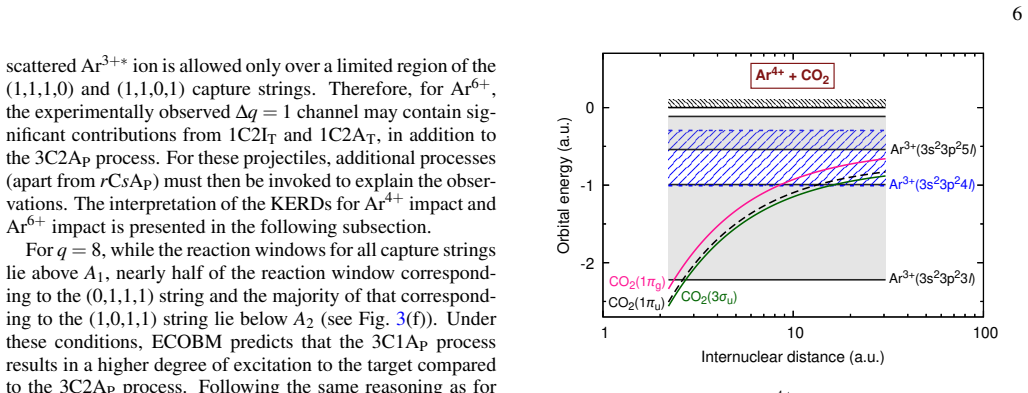
CO 2+ 2 The formation of CO 2+ 2 is predicted to be via the 2C1A P process for all projectile charge states considered here, con- sistent with the experimentally observed∆q=1 channel. For q=4, nearly half of the reaction window corresponding to the (1,0,1) string and the majority of that corresponding to the (0,1,1) string lie belowA 1 (see Fig. 3(a)). Fo...
-
[2]
On the other hand, the formation of CO 3+ 2 with∆q=1 forq≥8 is predicted to be predominantly via the 3C2AP process
CO 3+ 2 The formation of CO3+ 2 with∆q=2 is predicted to be pre- dominantly via the 3C1A P process for all projectiles in the present work. On the other hand, the formation of CO 3+ 2 with∆q=1 forq≥8 is predicted to be predominantly via the 3C2AP process. Forq=4, double autoionization of the scattered Ar+∗ ion is negligible for all capture strings. Conse-...
-
[3]
Vancura, J
J. Vancura, J. J. Perotti, J. Flidr, and V . O. Kostroun, Phys. Rev. A49, 2515 (1994)
1994
-
[4]
W. Wu, C. L. Cocke, J. P. Giese, F. Melchert, M. L. A. Raphaelian, and M. Stöckli, Phys. Rev. Lett.75, 1054 (1995)
1995
-
[5]
Wells, V
E. Wells, V . Krishnamurthi, K. D. Carnes, N. G. Johnson, H. D. Baxter, D. Moore, K. M. Bloom, B. M. Barnes, H. Tawara, and I. Ben-Itzhak, Phys. Rev. A72, 022726 (2005)
2005
-
[6]
R. J. Mawhorter, A. Chutjian, T. E. Cravens, N. Djuri´c, S. Hos- sain, C. M. Lisse, J. A. MacAskill, S. J. Smith, J. Simcic, and I. D. Williams, Phys. Rev. A75, 032704 (2007)
2007
-
[7]
H. Luna, W. Wolff, E. C. Montenegro, A. C. Tavares, H. J. Lüdde, G. Schenk, M. Horbatsch, and T. Kirchner, Phys. Rev. A93, 052705 (2016)
2016
-
[8]
Y . Wu, H. Yin, X. Tan, P. Ma, T. Meng, J. Xiao, K. Yao, Y . Zou, B. Tu, and B. Wei, Phys. Rev. A112, 022805 (2025)
2025
-
[9]
Stolterfoht, C
N. Stolterfoht, C. C. Havener, R. A. Phaneuf, J. K. Swenson, S. M. Shafroth, and F. W. Meyer, Phys. Rev. Lett.57, 74 (1986)
1986
-
[10]
Barat and P
M. Barat and P. Roncin, Journal of Physics B: Atomic, Molec- ular and Optical Physics25, 2205 (1992)
1992
-
[11]
Stolterfoht, Physica Scripta1994, 39 (1994)
N. Stolterfoht, Physica Scripta1994, 39 (1994)
1994
-
[12]
Frémont, C
F. Frémont, C. Bedouet, J. Y . Chesnel, H. Merabet, X. Husson, M. Grether, A. Spieler, and N. Stolterfoht, Phys. Rev. A54, R4609 (1996)
1996
-
[13]
Sobocinski, J
P. Sobocinski, J. Rangama, J.-Y . Chesnel, M. Tarisien, L. Adoui, A. Cassimi, X. Husson, and F. Frémont, Journal of Physics B: Atomic, Molecular and Optical Physics34, L367 (2001)
2001
-
[14]
Hoekstra, J
R. Hoekstra, J. P. M. Beijers, F. J. de Heer, and R. Morgenstern, Zeitschrift für Physik D Atoms, Molecules and Clusters25, 209 (1993). 8
1993
-
[15]
A. A. Hasan, E. D. Emmons, G. Hinojosa, and R. Ali, Phys. Rev. Lett.83, 4522 (1999)
1999
-
[16]
Z. Y . Song, X. C. Wang, Z. W. Li, K. L. Han, and D. Fischer, Phys. Rev. A102, 042820 (2020)
2020
-
[17]
Niehaus, Journal of Physics B: Atomic and Molecular Physics19, 2925 (1986)
A. Niehaus, Journal of Physics B: Atomic and Molecular Physics19, 2925 (1986)
1986
-
[18]
H. O. Folkerts, R. Hoekstra, and R. Morgenstern, Phys. Rev. Lett.77, 3339 (1996)
1996
-
[19]
H. O. Folkerts, T. Schlathölter, R. Hoekstra, and R. Morgen- stern, Journal of Physics B: Atomic, Molecular and Optical Physics30, 5849 (1997)
1997
-
[20]
Ehrich, B
M. Ehrich, B. Siegmann, U. Werner, and H. Lebius, Radia- tion Physics and Chemistry68, 127 (2003), proceedings of the 2nd Conference on Elementary Processess in Atomic Systems, CEPAS 2002. Gdansk, Poland, 2-6 September 2002
2003
-
[21]
Tezuka, K
H. Tezuka, K. Takahashi, J. Matsumoto, R. Karimi, J. H. Sanderson, and H. Shiromaru, Journal of Physics B: Atomic, Molecular and Optical Physics51, 035202 (2018)
2018
-
[22]
M. A. K. A. Siddiki, M. Nrisimhamurty, K. Kumar, J. Mukher- jee, L. C. Tribedi, A. Khan, and D. Misra, Review of Scientific Instruments93, 113313 (2022)
2022
-
[23]
M. A. K. A. Siddiki, K. Kumar, J. Mukherjee, L. C. Tribedi, and D. Misra, Phys. Rev. A108, 052805 (2023)
2023
-
[24]
Kumar, M
K. Kumar, M. A. Kalam Azad Siddiki, J. Mukherjee, H. Singh, and D. Misra, New Journal of Physics26, 053014 (2024)
2024
-
[25]
M. A. K. A. Siddiki and D. Misra, Phys. Rev. A111, 012804 (2025)
2025
-
[26]
Srivastav, V
A. Srivastav, V . P, and B. Bapat, International Journal of Mass Spectrometry508, 117392 (2025)
2025
-
[27]
B. Wang, J. Han, X. Zhu, L. Wei, B. Ren, Y . Zhang, W. Yu, S. Yan, X. Ma, Y . Zou, L. Chen, and B. Wei, Phys. Rev. A103, 042810 (2021)
2021
-
[28]
Y . Gao, Y . Pan, S. Xu, K.-C. Lau, H. Yuan, Z. Yan, D. Guo, D. Zhao, X. Zhu, S. Yan, S. Zhang, Z. Xu, and X. Ma, Phys. Rev. A107, 012811 (2023)
2023
-
[29]
Kumar, M
K. Kumar, M. A. K. A. Siddiki, J. Mukherjee, H. Singh, and D. Misra, Phys. Rev. A110, 062811 (2024)
2024
-
[30]
Mizuno, T
T. Mizuno, T. Yamada, H. Tsuchida, Y . Nakai, and A. Itoh, Phys. Rev. A81, 012704 (2010)
2010
-
[31]
Mizuno, T
T. Mizuno, T. Yamada, H. Tsuchida, Y . Nakai, and A. Itoh, Phys. Rev. A82, 054702 (2010)
2010
-
[32]
B. R. Lamichhane, A. Hasan, T. Arthanayaka, M. Dhital, K. Koirala, T. V oss, R. A. Lomsadze, and M. Schulz, Phys. Rev. A96, 042708 (2017)
2017
-
[33]
Bapat, D
B. Bapat, D. Sharma, and S. Srivastav, Journal of Physics: Con- ference Series1412, 152070 (2020)
2020
-
[34]
Sharma and B
V . Sharma and B. Bapat, The European Physical Journal D - Atomic, Molecular, Optical and Plasma Physics37, 223 (2006)
2006
-
[35]
Srivastav and B
S. Srivastav and B. Bapat, Review of Scientific Instruments93, 113306 (2022)
2022
-
[36]
W. C. Wiley and I. H. McLaren, Review of Scientific Instru- ments26, 1150 (1955)
1955
-
[37]
Bohr and J
N. Bohr and J. Lindhard, Kgl. Danske Videnskab. Selsk. Mat.- fys. Medd.28, 7(1954)
1954
-
[38]
M. W. Schmidt, K. K. Baldridge, J. A. Boatz, S. T. Elbert, M. S. Gordon, J. H. Jensen, S. Koseki, N. Matsunaga, K. A. Nguyen, S. Su, T. L. Windus, M. Dupuis, and J. A. Montgomery Jr, Jour- nal of Computational Chemistry14, 1347 (1993)
1993
-
[39]
M. F. Gu, Canadian Journal of Physics86, 675 (2008)
2008
-
[40]
Larimian, S
S. Larimian, S. Erattupuzha, S. Mai, P. Marquetand, L. González, A. Baltuška, M. Kitzler, and X. Xie, Phys. Rev. A95, 011404 (2017)
2017
-
[41]
Sharma, B
V . Sharma, B. Bapat, J. Mondal, M. Hochlaf, K. Giri, and N. Sathyamurthy, The Journal of Physical Chemistry A111, 10205 (2007)
2007
-
[42]
Bhatt, R
P. Bhatt, R. Singh, N. Yadav, and R. Shanker, Phys. Rev. A85, 042707 (2012)
2012
-
[43]
E. Wang, X. Shan, Y . Shi, Y . Tang, and X. Chen, Review of Scientific Instruments84, 123110 (2013)
2013
-
[44]
Duley and A
A. Duley and A. H. Kelkar, Atoms11(2023)
2023
-
[45]
A. Srivastav, S. Srivastav, and B. Bapat, arXiv e-prints , arXiv:2601.03711 (2026)
-
[46]
Srivastav, A
S. Srivastav, A. Sen, D. Sharma, and B. Bapat, Phys. Rev. A 103, 032821 (2021)
2021
-
[47]
E. Wang, X. Shan, Z. Shen, M. Gong, Y . Tang, Y . Pan, K.-C. Lau, and X. Chen, Phys. Rev. A91, 052711 (2015)
2015
-
[48]
Srivastav and B
S. Srivastav and B. Bapat, Phys. Rev. A105, 012801 (2022)
2022
discussion (0)
Sign in with ORCID, Apple, or X to comment. Anyone can read and Pith papers without signing in.