Recognition: unknown
Steady-state phonon heat currents and differential thermal conductance across a junction of two harmonic phonon reservoirs
Pith reviewed 2026-05-10 17:18 UTC · model grok-4.3
The pith
Phonon heat currents follow Fourier's law with thermal conductance peaking when the reservoirs' spectra match.
A machine-rendered reading of the paper's core claim, the machinery that carries it, and where it could break.
Core claim
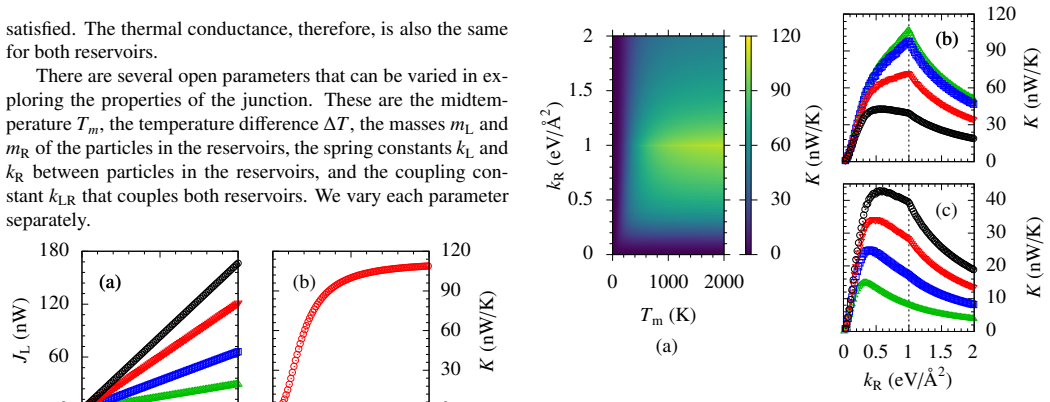
In this model of two harmonic phonon reservoirs coupled by a spring, the exact heat currents computed via NEGF satisfy Fourier's law exactly. The differential thermal conductance peaks when the phonon spectra of the left and right reservoirs coincide. At low temperatures this maximum may separate from the spectral-overlap condition because higher-frequency modes are excluded from transport. Both the currents and the conductance are unchanged when the temperature gradient is reversed, even with mass and spring-constant asymmetry between the sides. The conductance increases monotonically as the coupling spring constant is raised.
What carries the argument
The nonequilibrium Green's function formalism applied to the harmonic chain model with a single linear coupling spring, which produces closed-form steady-state expressions for heat currents and conductance.
If this is right
- Heat current is always proportional to the temperature difference, satisfying Fourier's law in this linear system.
- Thermal conductance is maximized precisely when the phonon spectra of the two reservoirs overlap.
- No thermal rectification arises from mass or spring asymmetry in the purely harmonic case.
- Increasing the coupling spring constant raises the conductance at all temperatures.
- The results supply an exact benchmark for adding anharmonicity or extended interfaces in more realistic phonon-transport models.
Where Pith is reading between the lines
- Matching vibrational spectra could be used as a design rule to maximize heat flow in nanoscale devices even when weak anharmonicity is present.
- Directional control of heat flow (thermal diodes) requires nonlinear interactions, since the harmonic limit enforces perfect symmetry under flow reversal.
- At low temperatures the selective exclusion of high-frequency modes suggests a route to temperature-tunable thermal filters in molecular junctions.
- The exact solvability of this minimal model makes it a useful testbed for validating approximate methods before they are applied to disordered or anharmonic systems.
Load-bearing premise
The model treats both reservoirs as purely harmonic oscillators linked only by one linear spring, which permits an exact solution but leaves out anharmonicity and more complex interfaces found in real materials.
What would settle it
Measure the thermal conductance of two coupled harmonic-like chains as a function of their frequency spectra and check whether the peak occurs exactly at spectral overlap, as the NEGF formulas predict.
Figures



read the original abstract
We study phonon transport in junctions of two harmonic reservoirs coupled together by a spring. The exact steady-state heat currents and thermal conductance are calculated using nonequilibrium Green's functions. We find that the heat currents follow Fourier's law and the thermal conductance has a peak whenever the phonon spectra match. At lower temperatures, however, the thermal conductance maximum may not coincide with the spectra-matching peak due to the exclusion of higher-frequency phonons, whose spectra may match, from participating in the transport. Furthermore, we find that increasing the coupling spring constant increases the thermal conductance. Lastly, the magnitude of the steady-state heat currents and thermal conductance are the same whether the direction of phonon flow is from left to right or vice versa, even with mass and spring constant asymmetry. The properties of this basic model can serve as a reference for more complicated setups of phonon transport in molecular junctions.
Editorial analysis
A structured set of objections, weighed in public.
Referee Report
Summary. The manuscript uses nonequilibrium Green's functions to compute the exact steady-state phonon heat currents and differential thermal conductance for two harmonic reservoirs coupled by a single spring. It reports that the currents obey Fourier's law, that thermal conductance peaks when the phonon spectra match (with possible low-temperature shifts due to exclusion of higher-frequency modes), that conductance increases with coupling strength, and that transport is symmetric under reversal of the temperature bias despite mass or spring-constant asymmetry. The model is presented as a reference for more complex phonon junctions.
Significance. If the results hold after correction, the work supplies an exact, parameter-free benchmark for ballistic phonon transport in a minimal junction model. The NEGF derivation, the spectral-matching effect on conductance maxima, and the temperature-dependent exclusion mechanism provide useful reference behavior for anharmonic or disordered extensions. The symmetry result follows from the harmonic structure and time-reversal invariance. The exact solvability and absence of fitted parameters are strengths.
major comments (2)
- [Abstract] Abstract and main results: the claim that 'the heat currents follow Fourier's law' is not supported by the calculation. The current takes the Landauer form J = ∫ ħω T(ω) [n_L(ω,T_L) − n_R(ω,T_R)] dω with transmission T(ω) obtained from the reservoir Green's functions; this is ballistic interface transport. Fourier's law requires diffusive scaling J ∝ ΔT/L with conductivity independent of system size, yet no reservoir length is varied and no anharmonic or disorder terms are present to generate a mean free path. This misstatement is load-bearing because it is listed as a primary finding.
- [Results] Results section on low-temperature conductance: the argument that the conductance maximum may shift from the spectra-matching peak 'due to the exclusion of higher-frequency phonons' is stated qualitatively but lacks a quantitative demonstration (e.g., explicit comparison of the transmission-weighted integral versus the bare spectral overlap at successive temperatures). Because this is presented as a central temperature-dependent effect, a concrete check or plot isolating the exclusion contribution is needed to substantiate the claim.
minor comments (2)
- [Methods] Notation for the transmission function T(ω) and the reservoir spectral densities should be defined explicitly in the main text (or a dedicated methods subsection) rather than assumed from standard NEGF literature.
- [Figures] Figure captions (if present) should state the precise parameter values used for the mass and spring-constant asymmetries when demonstrating symmetry.
Simulated Author's Rebuttal
We thank the referee for the careful reading and constructive comments on our manuscript. We address the major comments point by point below and will revise the manuscript to correct the identified issues.
read point-by-point responses
-
Referee: [Abstract] Abstract and main results: the claim that 'the heat currents follow Fourier's law' is not supported by the calculation. The current takes the Landauer form J = ∫ ħω T(ω) [n_L(ω,T_L) − n_R(ω,T_R)] dω with transmission T(ω) obtained from the reservoir Green's functions; this is ballistic interface transport. Fourier's law requires diffusive scaling J ∝ ΔT/L with conductivity independent of system size, yet no reservoir length is varied and no anharmonic or disorder terms are present to generate a mean free path. This misstatement is load-bearing because it is listed as a primary finding.
Authors: We agree that the use of 'Fourier's law' was imprecise and incorrect for this ballistic junction model. The heat current follows the Landauer form derived from NEGF as the referee notes, with no diffusive scaling or mean-free-path physics present. We will revise the abstract and main text to remove this claim entirely and describe the transport accurately as ballistic phonon transport across the harmonic junction. revision: yes
-
Referee: [Results] Results section on low-temperature conductance: the argument that the conductance maximum may shift from the spectra-matching peak 'due to the exclusion of higher-frequency phonons' is stated qualitatively but lacks a quantitative demonstration (e.g., explicit comparison of the transmission-weighted integral versus the bare spectral overlap at successive temperatures). Because this is presented as a central temperature-dependent effect, a concrete check or plot isolating the exclusion contribution is needed to substantiate the claim.
Authors: We agree that a quantitative check is needed to support the temperature-dependent shift. In the revised manuscript we will add an explicit comparison (new figure or inset) of the bare spectral overlap integral versus the transmission-weighted conductance at successive low temperatures, isolating the effect of higher-frequency mode exclusion. revision: yes
Circularity Check
No circularity: direct NEGF computation from model Hamiltonian
full rationale
The paper applies the standard nonequilibrium Green's function formalism to a harmonic two-reservoir model coupled by a single spring. The steady-state current is obtained exactly from the Landauer-like expression involving the transmission function T(ω) constructed from the retarded Green's functions of the reservoirs. All reported features (conductance peaks at spectral overlap, symmetry under reversal, increase with coupling strength) follow directly as algebraic consequences of that transmission function and the Bose-Einstein occupation factors; no parameters are fitted to subsets of data and then re-predicted, no self-citation supplies a uniqueness theorem or ansatz, and the derivation contains no self-referential definitions. The claim that currents 'follow Fourier's law' is an interpretive statement about linear response in the small-ΔT limit rather than a load-bearing step that reduces to prior inputs.
Axiom & Free-Parameter Ledger
axioms (1)
- domain assumption Phonon reservoirs are purely harmonic with linear coupling spring
Reference graph
Works this paper leans on
-
[1]
S. V . Aradhya, L. V enkataraman, Single-molecule junc- tions beyond electronic transport, Nat. Nanotechnol. 8 (2013) 399. doi:10.1038 /nnano.2013.91
2013
-
[2]
Gehring, J
P . Gehring, J. M. Thijssen, H. S. J. van der Zant, Single- molecule quantum-transport phenomena in break junc- tions, Nat. Rev. Phys. 1 (2019) 381. doi:10.1038 /s42254- 019-0055-1
2019
-
[3]
M. Galperin, M. A. Ratner, A. Nitzan, Molecular transpor t junctions: vibrational e ffects, J. Phys.: Condens. Matter 19 (2007) 103201. doi:10.1088/0953-8984/19/10/103201
-
[4]
Y . Dubi, M. Di V entra, Colloquium: Heat flow and thermoelectricity in atomic and molecu- lar junctions, Rev. Mod. Phys. 83 (2011) 131. doi:10.1103/RevModPhys.83.131
-
[5]
Mosso, H
N. Mosso, H. Sadeghi, A. Gemma, S. Sangtarash, U. Drechsler, C. Lambert, B. Gotsmann, Thermal trans- port through single-molecule junctions, Nano Lett. 19 (2019) 7614. doi:10.1021 /acs.nanolett.9b02089
2019
-
[6]
L. Cui, S. Hur, Z. A. Akbar, J. C. Klöckner, W . Jeong, F. Pauly, S.-Y . Jang, P . Reddy, E. Meyhofer, Thermal con- ductance of single-molecule junctions, Nature 572 (2019)
2019
-
[7]
doi:10.1038 /s41586-019-1420-z
-
[8]
Zhang, Y
H. Zhang, Y . Zhu, P . Duan, M. Shiri, S. Y elishala, S. Shen, Z. Song, C. Jia, X. Guo, L. Cui, K. Wang, Energy con- version and transport in molecular-scale junctions, App. Phys. Rev. 11 (2024) 041312. doi:10.1063 /5.0225756
2024
-
[9]
Q. Song, M. An, X. Chen, Z. Peng, J. Zang, N. Y ang, Adjustable thermal resistor by reversibly folding a graphene sheet, Nanoscale 8 (2016) 14943. doi:10.1039/C6NR01992G
-
[10]
P . Portugal, C. Flindt, N. Lo Gullo, Heat transport in a two-level system driven by a time-dependent temperature, Phys. Rev. B 104 (2021) 205420. doi:10.1103/PhysRevB.104.205420
-
[11]
A. Schilling, X. Zhang, O. Bossen, Heat flowing from cold to hot without external intervention by us- ing a "thermal inductor", Sci. Adv. 5 (2019) eaat9953. doi:10.1126/sciadv.aat9953
-
[12]
C. Chang, D. Okawa, A. Majumdar, Z. Zettl, Solid- state thermal rectifier, Science 314 (2006) 1121. doi:10.1126/science.1132898
-
[13]
H. Wang, S. Hu, K. Takahashi, X. Zhang, H. Takamatsu, J. Chen, Experimental study of thermal rectification in suspended monolayer graphene, Nat. Commun. 8 (2017) 15843. doi:10.1038 /ncomms15843
2017
-
[14]
B. Li, L. Wang, G. Casati, Thermal diode: Rectifica- tion of heat flux, Phys. Rev. Lett. 93 (2004) 184301. doi:10.1103/PhysRevLett.93.184301
-
[15]
L.-A. Wu, C. X. Y u, D. Segal, Nonlinear quantum heat transfer in hybrid structures: Su fficient conditions for thermal rectification, Phys. Rev. E 80 (2009) 041103. doi:10.1103/PhysRevE.80.041103
-
[16]
Kalantar, B
N. Kalantar, B. K. Agarwalla, D. Segal, Harmonic chains and the thermal diode e ffect, Phys. Rev. E 103 (2021) 052130. doi:10.1103 /PhysRevE.103.052130
2021
-
[17]
B. Li, L. Wang, G. Casati, Negative di fferential thermal resistance and thermal transistor, Appl. Phys. Lett. 88 (2006) 143501. doi:10.1063 /1.2191730
2006
-
[18]
Z. Zou, J. Gong, J. Wang, G. Casati, G. Be- nenti, Quantum vs classical thermal transport at low temperatures, Phys. Rev. Lett. 136 (2026) 066305. doi:10.1103/PhysRevLett.136.066305
-
[19]
Joulain, J
K. Joulain, J. Drevillon, Y . Ezzahri, J. Ordonez-Miran da, Quantum thermal transistor, Phys. Rev. Lett. 116 (2016) 200601. doi:10.1103 /PhysRevLett.116.200601
2016
-
[20]
A. H. A. Malavazi, B. Ahmadi, P . Mazurek, A. Man- darino, Detuning e ffects for heat-current control in quan- tum thermal devices, Phys. Rev. E 109 (2024) 064146. doi:10.1103/PhysRevE.109.064146
-
[21]
Kubytskyi, S.-A
V . Kubytskyi, S.-A. Biehs, P . Ben-Abdallah, Radiative bistability and thermal memory, Phys. Rev. Lett. 113 (2014) 074301. doi:10.1103 /PhysRevLett.113.074301
2014
-
[22]
J. Ordonez-Miranda, Y . Ezzahri, J. A. Tiburcio- Moreno, K. Joulain, J. Drevillon, Radiative ther- mal memristor, Phys. Rev. Lett. 123 (2019) 025901. doi:10.1103/PhysRevLett.123.025901
-
[23]
E. C. Cuansing, J.-S. Wang, Transient behavior of heat transport in a thermal switch, Phys. Rev. B 81 (2010) 052302. doi:10.1103 /PhysRevB.81.052302
2010
-
[24]
Dutta, J
B. Dutta, J. T. Peltonen, D. S. Antonenko, M. Meschke, M. A. Skvortsov, B. Kubala, J. König, C. B. Winkel- mann, H. Courtois, J. P . Pekola, Thermal conductance of a single-electron transistor, Phys. Rev. Lett. 119 (2017) 077701. doi:10.1103 /PhysRevLett.119.077701. 6
2017
-
[25]
C. Liu, C. Wu, Y . Zhao, Z. Chen, T.-L. Ren, Y . Chen, G. Zhang, Actively and reversibly controlling thermal conductivity in solid materials, Phys. Rep. 1058 (2024)
2024
-
[26]
doi:10.1016 /j.physrep.2024.01.001
2024
-
[27]
B. Dutta, D. Majidi, N. W . Talarico, N. Lo Gullo, H. Courtois, C. B. Winkelmann, Single-quantum-dot heat valve, Phys. Rev. Lett. 125 (2020) 237701. doi:10.1103/PhysRevLett.125.237701
-
[28]
A. Ronzani, B. Karimi, J. Senior, Y .-C. Chang, J. T. Pel- tonen, C. Chen, J. P . Pekola, Tunable photonic heat trans- port in a quantum heat valve, Nat. Phys. 14 (2018) 991. doi:10.1038/s41567-018-0199-4
-
[29]
L. G. C. Rego, G. Kirczenow, Quantized thermal con- ductance of dielectric quantum wires, Phys. Rev. Lett. 81 (1998) 232. doi:10.1103 /PhysRevLett.81.232
1998
-
[30]
D. Segal, A. Nitzan, P . Hänggi, Thermal conductance through molecular wires, J. Chem. Phys. 119 (2003) 6840. doi:10.1063/1.1603211
-
[31]
Dhar, Heat transport in low-dimensional systems, Ad v
A. Dhar, Heat transport in low-dimensional systems, Ad v. Phys. 57 (2008) 457. doi:10.1080 /00018730802538522
2008
-
[32]
D. G. Cahill, W . K. Ford, K. E. Goodson, G. D. Ma- han, A. Majumdar, H. J. Maris, R. Merlin, S. R. Phillpot, Nanoscale thermal transport, J. Appl. Phys. 93 (2003)
2003
-
[33]
doi:10.1063 /1.1524305
-
[34]
N. Li, J. Ren, L. Wang, G. Zhang, P . Hänggi, B. Li, Col- lquium: Phononics: Manipulating heat flow with elec- tronic analogs and beyond, Rev. Mod. Phys. 84 (2012)
2012
-
[35]
doi:10.1103 /RevModPhys.84.1045
-
[36]
Maldovan, Sound and heat revolutions in phononics, Nature 503 (2013) 209
M. Maldovan, Sound and heat revolutions in phononics, Nature 503 (2013) 209. doi:10.1038 /nature12608
2013
-
[37]
D. G. Cahill, P . V . Braun, G. Chen, D. R. Clarke, S. Fan, K. E. Goodson, P . Keblinski, W . P . King, G. D. Mahan, A. Majumdar, H. J. Maris, S. R. Phillpot, E. Pop, L. Shi, Nanoscale thermal transport. II. 2003-2012, Appl. Phys. Rev. 1 (2014) 011305. doi:10.1063 /1.4832615
2003
-
[38]
G. P . Srivastava, The Physics of Phonons, 2nd Edition, CRC Press, 2023
2023
-
[39]
Galperin, A
M. Galperin, A. Nitzan, M. A. Ratner, Heat conduction in molecular transport junctions, Phys. Rev. B 75 (2007) 155312. doi:10.1103 /PhysRevB.75.155312
2007
-
[40]
A.-P . Jauho, N. S. Wingreen, Y . Meir, Time-dependent transport in interacting and noninteracting resonant- tunneling systems, Phys. Rev. B 50 (1994) 5528. doi:10.1103/PhysRevB.50.5528
-
[41]
M. Ridley, N. W . Talarico, D. Karlsson, N. Lo Gullo, R. Tuovinen, A many-body approach to transport in quan- tum systems: from the transient regime to the station- ary state, J. Phys. A: Math. Theor. 55 (2022) 273001. doi:10.1088/1751-8121/ac7119
-
[42]
J.-S. Wang, B. K. Agarwalla, H. Li, J. Thingna, Nonequi- librium Green’s function method for quantum thermal transport, Front. Phys. 9 (2014) 673. doi:10.1007 /s11467- 013-0340-x
2014
-
[43]
D. C. Langreth, J. W . Wilkins, Theory of spin resonance in dilute magnetic alloys, Phys. Rev. B 6 (1972) 3189. doi:10.1103/PhysRevB.6.3189
-
[44]
Haug, A.-P
H. Haug, A.-P . Jauho, Quantum Kinetics in Transport and Optics of Semiconductors, Springer, Berlin, 2008
2008
-
[45]
E. C. Cuansing, J.-S. Wang, Tunable heat pump by mod- ulating the coupling to the leads, Phys. Rev. E 82 (2010) 021116. doi:10.1103 /PhysRevE.82.021116
2010
-
[46]
D. W . Hahn, M. Necati Özisik, Heat Conduction, 3rd Edi- tion, Wiley, 2012
2012
-
[47]
J.-S. Wang, N. Zeng, J. Wang, C. K. Gan, Nonequi- librium Green’s function method for thermal trans- port in junctions, Phys. Rev. E 75 (2007) 061128. doi:10.1103/PhysRevE.75.061128. 7
discussion (0)
Sign in with ORCID, Apple, or X to comment. Anyone can read and Pith papers without signing in.