Recognition: unknown
Oxygen-Mediated Phase Evolution in Sputtered Cu-W-O: Insights into Surface Chemistry Variability
Pith reviewed 2026-05-10 17:40 UTC · model grok-4.3
The pith
Sputtered Cu-W-O films show different phases and copper electronic states depending on oxygen during deposition, even when labeled as CuWO4.
A machine-rendered reading of the paper's core claim, the machinery that carries it, and where it could break.
Core claim
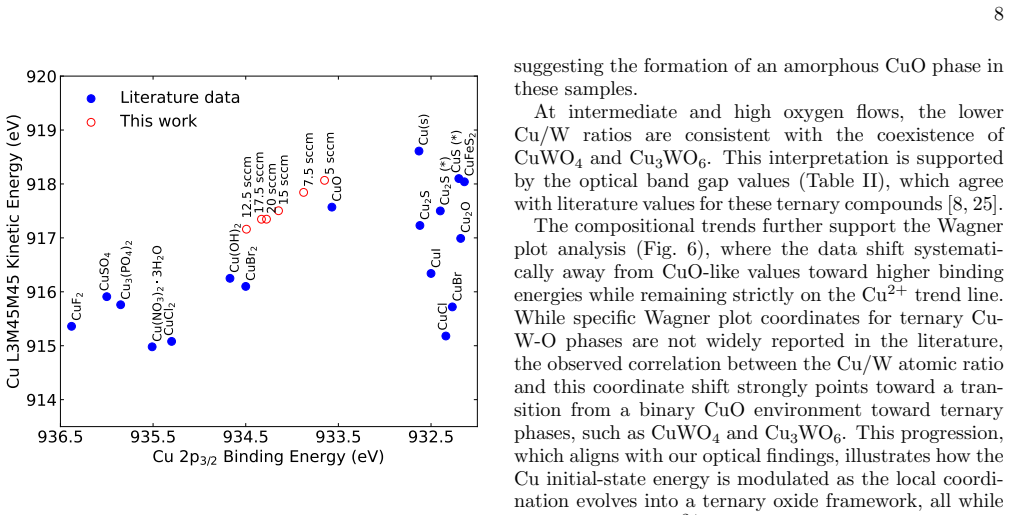
Oxygen partial pressure during DC magnetron co-sputtering from metallic Cu and W targets dictates phase outcome in Cu-W-O films, with low oxygen yielding single-phase CuWO4 and higher oxygen producing CuWO4 plus Cu3WO6 mixtures; XRD confirms orientation changes while XPS shows Cu migration causing compositional differences between surface and bulk, with W 4f levels unchanged but Cu 2p3/2 binding energy shifting in a manner confirmed by Wagner plots to arise from modified Cu ground-state electronic structure and Cu-O-W hybridization.
What carries the argument
The Wagner plot analysis applied to XPS core-level data, which isolates initial-state effects to link observed Cu 2p3/2 shifts directly to changes in copper's ground-state electronic structure and hybridization rather than final-state screening or artifacts.
If this is right
- Low oxygen partial pressures during sputtering produce single-phase CuWO4 films with one preferential orientation.
- Higher oxygen partial pressures yield mixed CuWO4 and Cu3WO6 phases together with altered optical absorption.
- Copper atoms migrate and segregate, creating measurable surface-bulk compositional differences that persist after annealing.
- Tungsten remains in a fixed chemical environment across all oxygen conditions while copper's environment varies.
- Nominal identification as CuWO4 is insufficient to guarantee identical structural or electronic properties.
Where Pith is reading between the lines
- Device applications that assume uniform CuWO4 behavior may need process-specific calibration to avoid variability in performance.
- Similar oxygen sensitivity during growth could appear in other ternary oxides, implying that standard phase diagrams may not capture deposition-route differences.
- In-situ monitoring of copper surface signals during sputtering might allow real-time correction for the observed migration effects.
Load-bearing premise
The systematic shift in Cu 2p3/2 binding energy arises from genuine modifications to the copper atoms' initial electronic state and bonding rather than from experimental artifacts, charging, or unaccounted final-state contributions.
What would settle it
High-resolution XPS measurements on a new set of Cu-W-O films deposited across the same range of oxygen partial pressures that show the Cu 2p3/2 binding energy shift can be fully reproduced by sample charging corrections or final-state screening models alone would falsify the initial-state interpretation.
Figures




read the original abstract
Thin films of Cu-W-O ternary compounds were fabricated via DC magnetron co-sputtering from Cu and W metallic targets under controlled oxygen partial pressures, followed by thermal annealing. Low-oxygen conditions favored the formation of a single CuWO4 phase, whereas higher oxygen levels produced a mixture of CuWO4 and Cu3WO6. Structural and optical properties were investigated by X-ray diffraction (XRD) and spectrophotometry, revealing phase coexistence and changes in preferential orientation depending on the deposition conditions. A detailed and carefully validated X-ray photoelectron spectroscopy (XPS) analysis provides insight into the surface chemical environment of Cu and W, indicating the presence of compositional inhomogeneities and surface-bulk differences associated with Cu migration and segregation. While the W 4f core levels remain remarkably stable across all tested oxygen partial pressures, a systematic shift is observed in the Cu 2p3/2 binding energy. Wagner plot analysis confirms that this displacement is dominated by initial-state effects, reflecting modifications of the Cu ground-state electronic structure and Cu-O-W hybridization rather than changes in final-state screening. Our findings demonstrate that sputtered Cu-W-O films, even when nominally identified as CuWO4, can exhibit substantially different structural and electronic states depending on synthesis conditions, highlighting the need for rigorous characterization to ensure reproducibility in ternary oxide research.
Editorial analysis
A structured set of objections, weighed in public.
Referee Report
Summary. The manuscript describes the DC magnetron co-sputtering of Cu-W-O thin films under varying oxygen partial pressures, followed by thermal annealing. Low-oxygen conditions yield single-phase CuWO4, while higher oxygen produces CuWO4 + Cu3WO6 mixtures, as determined by XRD and spectrophotometry. XPS shows stable W 4f core levels across conditions but a systematic shift in Cu 2p3/2 binding energy; Wagner plot analysis is used to attribute this shift to initial-state effects arising from changes in Cu ground-state electronic structure and Cu-O-W hybridization, rather than final-state screening. The work concludes that nominally CuWO4 films can exhibit synthesis-dependent structural and electronic states, underscoring the need for rigorous characterization in ternary oxide research.
Significance. If the central claims are substantiated, the results would demonstrate that synthesis conditions can produce substantial variability in phase coexistence, orientation, and surface electronic structure even for films identified as the same nominal compound. This has direct relevance to reproducibility in ternary oxide thin films used for photoelectrochemical or catalytic applications, where surface chemistry dominates performance. The application of Wagner plots to separate initial- and final-state contributions is a positive methodological choice, though its robustness depends on the details of the XPS protocol.
major comments (2)
- [XPS analysis (as described in the abstract and results)] The attribution of the Cu 2p3/2 binding-energy shift to initial-state effects (via Wagner plot) is load-bearing for the central claim about modified Cu ground-state electronic structure and Cu-O-W hybridization. However, in insulating ternary oxide films, differential charging, inconsistent adventitious-carbon referencing, or unaccounted surface segregation (explicitly noted as Cu migration) can produce apparent shifts. The manuscript provides no explicit details on the charge-correction protocol, use of multiple internal references, or verification that final-state screening variations are fully captured by the Auger parameter.
- [Results (XRD, XPS, and optical characterization)] Quantitative support for the phase-evolution and binding-energy claims is limited. The abstract and reported workflow lack error bars on the Cu 2p3/2 shifts, statistical measures of phase fractions from XRD, or tabulated deposition parameters (exact oxygen partial pressures, base pressures, sputtering powers, and annealing conditions). Without these, the magnitude and reproducibility of the observed synthesis dependence cannot be fully assessed.
minor comments (2)
- [Abstract] The abstract states that the XPS analysis is 'carefully validated' but does not specify the validation steps (e.g., reference materials, peak-fitting constraints, or cross-checks with other techniques). Adding a brief description would improve clarity.
- [Figures (XPS and Wagner plot)] Figure captions and axis labels for the Wagner plot and binding-energy data should explicitly state the charge-referencing method used and any uncertainty estimates.
Simulated Author's Rebuttal
We thank the referee for the constructive comments and the positive assessment of the significance of our work on synthesis-dependent variability in Cu-W-O thin films. We address each major comment point by point below.
read point-by-point responses
-
Referee: [XPS analysis (as described in the abstract and results)] The attribution of the Cu 2p3/2 binding-energy shift to initial-state effects (via Wagner plot) is load-bearing for the central claim about modified Cu ground-state electronic structure and Cu-O-W hybridization. However, in insulating ternary oxide films, differential charging, inconsistent adventitious-carbon referencing, or unaccounted surface segregation (explicitly noted as Cu migration) can produce apparent shifts. The manuscript provides no explicit details on the charge-correction protocol, use of multiple internal references, or verification that final-state screening variations are fully captured by the Auger parameter.
Authors: We appreciate the referee's emphasis on methodological rigor for the XPS analysis. The invariance of the W 4f core levels across all samples functions as an internal reference demonstrating that differential charging is negligible, since charging would shift both Cu and W signals in tandem. Charge correction was performed using the adventitious C 1s peak fixed at 284.8 eV, with consistency verified against the stable W 4f position. Cu surface segregation and migration are explicitly addressed in the manuscript as sources of surface-bulk inhomogeneity. We will add a dedicated methods subsection providing full XPS protocol details, including spectrometer settings, charge neutralization (electron flood gun), referencing procedures, and a transparent breakdown of the Wagner plot construction to confirm that the Auger parameter isolates initial-state effects from final-state screening contributions. revision: yes
-
Referee: [Results (XRD, XPS, and optical characterization)] Quantitative support for the phase-evolution and binding-energy claims is limited. The abstract and reported workflow lack error bars on the Cu 2p3/2 shifts, statistical measures of phase fractions from XRD, or tabulated deposition parameters (exact oxygen partial pressures, base pressures, sputtering powers, and annealing conditions). Without these, the magnitude and reproducibility of the observed synthesis dependence cannot be fully assessed.
Authors: We agree that expanded quantitative reporting will strengthen the manuscript. In revision we will add error bars to the Cu 2p3/2 binding-energy values, obtained from replicate spectra and fitting uncertainties. XRD phase fractions will be quantified via Rietveld refinement or integrated peak analysis, with associated statistical uncertainties reported. A new table will compile all deposition and processing parameters, including precise oxygen partial pressures, base pressures, individual Cu and W sputtering powers, and annealing conditions. These additions will enable readers to assess reproducibility and effect sizes directly. revision: yes
Circularity Check
No circularity: purely experimental characterization with standard techniques
full rationale
The manuscript reports fabrication of Cu-W-O films by DC magnetron co-sputtering and annealing, followed by XRD, spectrophotometry, and XPS measurements. Phase identification, binding-energy shifts, and Wagner-plot separation of initial- versus final-state effects are presented as direct experimental observations. No equations are derived, no parameters are fitted to subsets and then re-predicted, and no self-citation chain is invoked to justify uniqueness or ansatz choices. The central claim (synthesis-dependent structural/electronic states even for nominal CuWO4) rests on reproducible spectral and diffraction data rather than on any reduction to the paper's own inputs.
Axiom & Free-Parameter Ledger
axioms (2)
- domain assumption XRD patterns can be used to unambiguously identify CuWO4 and Cu3WO6 phases in thin films
- domain assumption Wagner plots can distinguish initial-state from final-state effects in core-level XPS shifts for transition-metal oxides
Reference graph
Works this paper leans on
-
[1]
Despite the XRD-apparent purity of these low-oxygen samples, optical characteri- zation reveals a reduced bandgap indicative of an un- detected amorphous CuO phase
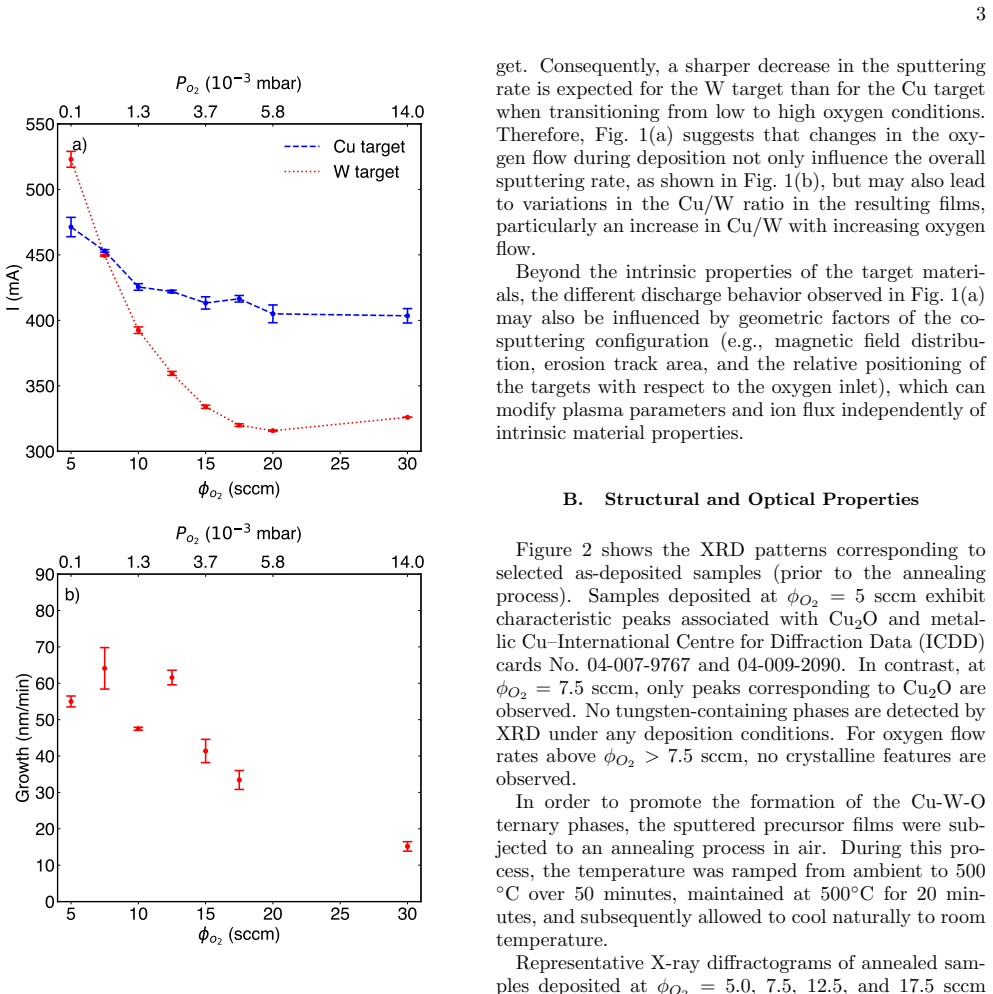
preferential orientation. Despite the XRD-apparent purity of these low-oxygen samples, optical characteri- zation reveals a reduced bandgap indicative of an un- detected amorphous CuO phase. Wagner plot analysis corroborates this finding: at low oxygen flows, the sam- ple coordinates align with the characteristic region for CuO, providing a chemical signa...
2024
-
[2]
Google Scholar, Literature search for “CuWO 4” (2015– 2025), data retrieved March 2026. (2026)
2015
-
[3]
P. Sivakumar, P. Subramanian, P. Kannan, J. Minar, H. Jung, Ternary transition metal oxides for electrochem- ical energy storage: Synthesis, advantages, design strate- gies, and future prospects, International Journal of En- ergy Research 2025 (1) (2025) 2511614.doi:10.1155/ er/2511614
-
[5]
K. Arunraj, M. Wilms, O. Kendall, M. Perrin, T. T. Nguyen, X. Li, P. C. Sherrell, J. van Embden, D. E. G´ omez, R. Yew, N. Duffy, Copper tungstate photoanodes with enhanced solar water splitting performance, Journal of Materials Chemistry A 13 (30) (2025) 24959–24970. doi:10.1039/D5TA02576A
-
[6]
B. Akila, T.-W. Chen, B. I. Benny, S.-M. Chen, L. George, S. Kogularasu, G.-P. Chang-Chien, J. N. Baby, Electrochemical detection of carcinogenic roxar- sone using CuWO 4 nanoparticles, Process Safety and Environmental Protection 206 (2026) 108299.doi:10. 1016/j.psep.2025.108299
-
[7]
J.-F. Li, Y. Chen, Z. Wang, Z.-Q. Liu, Self-templating synthesis of hollow copper tungstate spheres as adsor- bents for dye removal, Journal of Colloid and Interface Science 526 (2018) 459–469.doi:10.1016/j.jcis.2018. 05.023
-
[8]
D. Roy, G. F. Samu, M. K. Hossain, C. Jan´ aky, K. Ra- jeshwar, On the measured optical bandgap values of in- organic oxide semiconductors for solar fuels generation, Catalysis Today 300 (2018) 136–144, note: The High- lights section contains an erratum stating binary oxides vary more than ternary; however, the abstract and data confirm ternary compounds ...
-
[9]
K. Rajeshwar, M. K. Hossain, R. T. Macaluso, C. Jan´ aky, A. Varga, P. J. Kulesza, Review–copper oxide-based ternary and quaternary oxides: Where solid-state chem- istry meets photoelectrochemistry, Journal of The Elec- trochemical Society 165 (4) (2018) H3192–H3203.doi: 10.1149/2.0271804jes
-
[10]
X. Chu, D. Santos-Carballal, N. H. de Leeuw, Explor- ing the redox properties of the low-Miller index surfaces of copper tungstate (CuWO 4): Evaluating the impact of the environmental conditions on the water splitting and carbon dioxide reduction processes, The Journal of Physical Chemistry C 127 (38) (2023) 18944–18961. doi:https://doi.org/10.1021/acs.jp...
-
[11]
X. Chu, D. Santos-Carballal, N. H. de Leeuw, Water ad- sorption at the (010) and (101) surfaces of CuWO4, Phys- ical Chemistry Chemical Physics 26 (45) (2024) 28628– 28642.doi:10.1039/D4CP02699C
-
[12]
X. Chu, N. H. de Leeuw, A density functional theory study of the mechanism of water splitting on the CuWO4 (010) surface, The Journal of Chemical Physics 163 (8) (2025) 084712.doi:10.1063/5.0283631
-
[13]
J. Thyr, J. Montero, L. ¨Osterlund, T. Edvinsson, En- ergy alignment of quantum-confined ZnO particles with copper oxides for heterojunctions with improved photo- catalytic performance, ACS Nanoscience Au 2 (2) (2022) 128–139.doi:10.1021/acsnanoscienceau.1c00040
-
[14]
J. Montero, L. ¨Osterlund, Photodegradation of stearic acid adsorbed on copper oxide heterojunction thin films prepared by magnetron sputtering, ChemEngineering 2 (3) (2018) 40.doi:10.3390/chemengineering2030040
-
[15]
G. Atak, ˙I. B. Pehlivan, J. Montero, D. Primetzhofer, C. G. Granqvist, G. A. Niklasson, Electrochromism of nitrogen-doped tungsten oxide thin films, Materials To- day: Proceedings (2020).doi:10.1016/j.matpr.2020. 01.332
-
[16]
G. Atak, ˙I. B. Pehlivan, J. Montero, C. G. Granqvist, G. A. Niklasson, Electrochromic tungsten oxide films pre- pared by sputtering: Optimizing cycling durability by judicious choice of deposition parameters, Electrochim- ica Acta 367 (2021) 137233.doi:10.1016/j.electacta. 2020.137233
-
[17]
I. Safi, Recent aspects concerning DC reactive mag- netron sputtering of thin films: A review, Surface and Coatings Technology 127 (2–3) (2000) 203–218.doi: 10.1016/S0257-8972(00)00566-1
-
[18]
N. Fairley, V. Fernandez, M. Richard-Plouet, et al., Sys- tematic and collaborative approach to problem solving using x-ray photoelectron spectroscopy, Applied Surface Science Advances 5 (2021) 100112.doi:10.1016/j. apsadv.2021.100112
work page doi:10.1016/j 2021
-
[19]
G. H. Major, N. Fairley, P. M. A. Sherwood, M. R. Lin- ford, J. Terry, V. Fernandez, K. Artyushkova, Practi- cal guide for curve fitting in X-ray photoelectron spec- troscopy, Journal of Vacuum Science & Technology A 38 (6) (2020) 061203.doi:10.1116/6.0000377
-
[20]
ULVAC-PHI, Inc., Phi multipak: Data analysis software for X-ray photoelectron spectroscopy (2021)
2021
-
[21]
Gebert, L
E. Gebert, L. Kihlborg, S. E. Rasmussen, The crystal structure of a new copper wolfram oxide, Cu 3WO6, Acta Chemica Scandinavica 23 (1969) 221–231.doi:10.3891/ acta.chem.scand.23-0221
1969
-
[22]
J. Montero, C. Guill´ en, C. G. Granqvist, J. Herrero, G. A. Niklasson, Preferential orientation and surface ox- idation control in reactively sputter deposited nanocrys- talline SnO 2:Sb films: Electrochemical and optical re- sults, ECS Journal of Solid State Science and Technology 3 (11) (2014) N151–N156.doi:10.1149/2.0171411jss
-
[23]
K¨ orber, J
C. K¨ orber, J. Suffner, A. Klein, Surface energy con- trolled preferential orientation of thin films, Journal of Physics D: Applied Physics 43 (5) (2010).doi:10.1088/ 0022-3727/43/5/055301
2010
-
[24]
W. Q. Hong, Extraction of extinction coefficient of weak absorbing thin films from special absorption, Journal of Physics D: Applied Physics 22 (9) (1989).doi:10.1088/ 0022-3727/22/9/024
1989
-
[25]
J. I. Pankove, Optical Processes in Semiconductors, Dover Publications Inc., New York, NY, USA, 1975
1975
-
[26]
F. A. Benko, C. L. MacLaurin, F. P. Koffyberg, CuWO 4 and Cu3WO6 as anodes for the photoelectrolysis of water, Materials Research Bulletin 17 (1) (1982) 133–136.doi: 10.1016/0025-5408(82)90194-5. 14
-
[27]
R. Deo, M. Devi, D. Behera, Structural and optical prop- erties of CuO: A comprehensive experimental and first- principles dft investigation, Solid State Communications 411 (2026) 116369.doi:10.1016/j.ssc.2026.116369
-
[28]
G. Moretti, H. P. Beck, Relationship between the Auger parameter and the ground state valence charge of the core-ionized atom: The case of Cu (I) and Cu (II) com- pounds, Surface and Interface Analysis 51 (9) (2019) 755– 764.doi:10.1002/sia.6704
-
[29]
M. C. Biesinger, Advanced analysis of copper X-ray pho- toelectron spectra, Surface and Interface Analysis 49 (13) (2017) 1325–1334.doi:10.1002/sia.6239
-
[30]
D. L. Perry, J. A. Taylor, X-ray photoelectron and Auger spectroscopic studies of Cu 2S and CuS, Jour- nal of Materials Science Letters 5 (3) (1986) 384–386. doi:10.1007/BF01672333
-
[31]
J. F. Moulder, W. F. Stickle, P. E. Sobol, K. D. Bomben, Handbook of X-ray Photoelectron Spectroscopy, Perkin- Elmer Corporation, Eden Prairie, MN, USA, 1992
1992
-
[32]
T. Roychowdhury, D. Shah, V. Jain, D. I. Patel, B. Dod- son, W. Skinner, J. N. Hilfiker, S. J. Smith, M. R. Linford, Multi-instrument characterization of HiPIMS and DC magnetron sputtered tungsten and copper films, Surface and Interface Analysis 52 (7) (2020) 433–441. doi:https://doi.org/10.1002/sia.6753
-
[33]
M. C. Biesinger, L. W. M. Lau, A. R. Gerson, R. S. C. Smart, Resolving surface chemical states in XPS analysis of first-row transition metals, oxides and hydroxides: Sc, Ti, V, Cu and Zn, Applied Surface Science 257 (3) (2010) 887–898.doi:10.1016/j.apsusc.2010.07.086
-
[34]
G. Moretti, H. P. Beck, On the Auger parameter of Cu(II) compounds, Surface and Interface Analysis 54 (7) (2022) 803–812.doi:10.1002/sia.7093
-
[35]
C. K. Lee, D. Y. In, D. J. Oh, S. H. Lee, J. W. Lee, J. K. Jeong, Ca-doped CuO diffusion barrier for high-performance a-IGZO transistors with Cu-based source/drain material, IEEE Transactions on Electron Devices 65 (4) (2018) 1383–1388.doi:10.1109/TED. 2018.2806362
work page doi:10.1109/ted 2018
-
[36]
T. N. Kol’tsova, G. D. Nipan, System CuO-WO 3, Inor- ganic Materials 35 (1999) 383–384
1999
-
[37]
C. Gopalan, M. N. Kozicki, S. Bhagat, S. C. Puthen Thermadam, T. L. Alford, M. Mitkova, Structure of copper-doped tungsten oxide films for solid-state mem- ory, Journal of Non-Crystalline Solids 353 (18–21) (2007) 1844–1848.doi:10.1016/j.jnoncrysol.2007.02.054
-
[38]
M. Zubkins, V. Vibornijs, E. Strods, I. Aulika, A. Zajak- ina, A. Sarakovskis, K. Kundzins, K. Korotkaja, Z. Rude- vica, E. Letko, J. Purans, A stability study of transpar- ent conducting WO 3/Cu/WO3 coatings with antimicro- bial properties, Surfaces and Interfaces 41 (2023) 103259. doi:10.1016/j.surfin.2023.103259
-
[39]
P´ erez L´ opez, L
I. P´ erez L´ opez, L. Cattin, D.-T. Nguyen, M. Morsli, J. C. Bern` ede, Dielectric/metal/dielectric structures us- ing copper as metal and MoO 3 as dielectric for use as transparent electrode, Thin Solid Films 520 (2012) 6419– 6423
2012
-
[40]
S. Tuo, L. Cattin, H. Essaidi, L. Peres, G. Louarn, Z. El Jouad, M. Hssein, S. Touihri, S. Y. Abbe, P. Tor- chio, M. Addou, Stabilisation of the electrical and optical properties of dielectric/Cu/dielectric structures through the use of efficient dielectric and Cu:Ni alloy, Journal of Alloys and Compounds 729 (2017) 109–116.doi: 10.1016/j.jallcom.2017.09.087
-
[41]
M. Seah, Summary of ISO/TC 201 Standard: VII ISO 15472: 2001—surface chemical analysis—X-ray photo- electron spectrometers—calibration of energy scales, Sur- face and Interface Analysis 31 (8) (2001) 721–723.doi: 10.1002/sia.1076
-
[42]
D. A. Svintsitskiy, A. I. Stadnichenko, D. V. Demidov, S. V. Koscheev, A. I. Boronin, Investigation of oxygen states and reactivities on a nanostructured cupric oxide surface, Applied Surface Science 257 (20) (2011) 8542– 8549.doi:10.1016/j.apsusc.2011.05.012
-
[43]
Y. Tang, W. Zhang, Q. Wang, J. Li, Z. Chen, En- hancement of the photoelectrochemical performance of CuWO4 films for water splitting by hydrogen treatment, Applied Surface Science 361 (2016) 133–140.doi:10. 1016/j.apsusc.2015.11.129
2016
-
[44]
H. Li, X. Zhang, W. Li, L. Yang, J. Wang, Free-standing and flexible Cu/Cu2O/CuO heterojunction net: A novel material as cost-effective and easily recycled visible-light photocatalyst, Applied Catalysis B: Environmental 207 (2017) 134–142.doi:10.1016/j.apcatb.2017.02.013
-
[45]
M. Pi˜ non-Espitia, D. Lardizabal-Guti´ errez, M. L. Camacho-R´ ıos, G. Herrera-P´ erez, A. Duarte-Moller, M. T. Ochoa-Lara, Charge transfer effects and O 2- vacancies in pure CuO nanofibers and enriched with 3.0% Mn, Materials Chemistry and Physics 295 (2023) 126989. doi:10.1016/j.matchemphys.2022.126989
discussion (0)
Sign in with ORCID, Apple, or X to comment. Anyone can read and Pith papers without signing in.