Recognition: unknown
D2-brane probes of non-toric cDV threefolds via monopole superpotentials
Pith reviewed 2026-05-10 17:26 UTC · model grok-4.3
The pith
D2-branes probing non-toric cDV threefolds see their geometry encoded in a Higgs field that deforms affine Dynkin quivers with monopole superpotentials.
A machine-rendered reading of the paper's core claim, the machinery that carries it, and where it could break.
Core claim
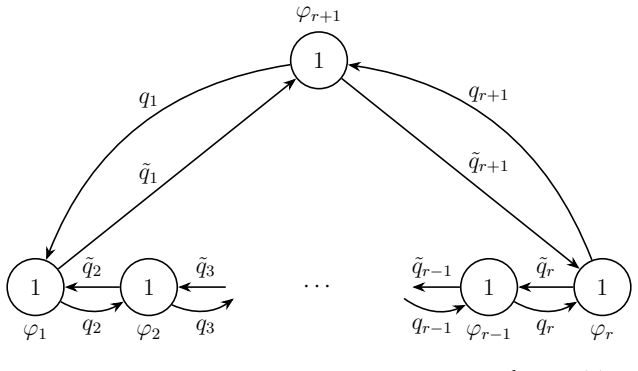
By viewing these singularities as ADE surface fibrations over the complex w-plane, their geometry is encoded in a Higgs field Φ(w). A D2-brane probe perceives Φ(w) as an N=2 deformation of its 3d N=4 affine Dynkin quiver gauge theory via polynomial and monopole superpotential terms. By exploiting 3d mirror symmetry, an effective theory is obtained that correctly reproduces the quiver-collapsing mechanism known in the mathematical literature. Several examples are presented, including non-toric and non-resolvable cases.
What carries the argument
The Higgs field Φ(w) that encodes the ADE surface fibration over the w-plane and induces the polynomial and monopole superpotential deformations on the 3d N=4 affine Dynkin quiver.
If this is right
- The deformed quiver theory after mirror symmetry reproduces the expected collapsed form for the probe theory at these singularities.
- This framework applies to non-toric cDV threefolds that were previously inaccessible by standard methods.
- The approach provides a brane realization of the mathematical quiver-collapsing mechanism for cDV singularities.
- Effective theories obtained this way correctly capture the geometry for both resolvable and non-resolvable cases.
Where Pith is reading between the lines
- This construction might extend to other families of Calabi-Yau singularities by encoding their geometry in similar Higgs fields.
- The role of monopole operators could connect to broader questions about infrared dynamics in 3d theories engineered from string theory.
- One could test whether the resulting moduli spaces of vacua align with geometric expectations from the original threefold singularity.
Load-bearing premise
The geometry of the cDV singularity can be faithfully captured by a single Higgs field Φ(w) whose polynomial and monopole deformations of the affine Dynkin quiver exactly reproduce the mathematical quiver-collapsing behavior when 3d mirror symmetry is applied.
What would settle it
An explicit computation for a specific non-toric cDV threefold where the effective theory obtained after 3d mirror symmetry fails to match the collapsed quiver predicted by algebraic geometry.
Figures






read the original abstract
We develop a framework to construct worldvolume gauge theories on D2-branes probing compound Du Val (cDV) Calabi-Yau threefold singularities. By viewing these singularities as ADE surface fibrations over the complex $w$-plane, we encode their geometry in a Higgs field $\Phi(w)$. A D2-brane probe perceives $\Phi(w)$ as an $\mathcal{N}=2$ deformation of its 3d $\mathcal{N}=4$ affine Dynkin quiver gauge theory via polynomial and monopole superpotential terms. By exploiting 3d mirror symmetry, we obtain an effective theory that correctly reproduces the quiver-collapsing mechanism known in the mathematical literature. We present several examples, including non-toric and non-resolvable cases.
Editorial analysis
A structured set of objections, weighed in public.
Referee Report
Summary. The paper develops a framework for worldvolume gauge theories on D2-branes probing compound Du Val (cDV) Calabi-Yau threefold singularities. It views these singularities as ADE surface fibrations over the complex w-plane, encoded in a Higgs field Φ(w). The D2-brane probe perceives Φ(w) as an N=2 deformation of its 3d N=4 affine Dynkin quiver gauge theory via polynomial and monopole superpotential terms. Exploiting 3d mirror symmetry yields an effective theory claimed to reproduce the quiver-collapsing mechanism known in the mathematical literature, with examples including non-toric and non-resolvable cases.
Significance. If the geometric data in Φ(w) rigorously determines the precise polynomial and monopole deformations such that 3d mirror symmetry produces moduli spaces matching the independently known mathematical quiver collapse for non-toric cDV threefolds, the work would provide a valuable physical realization of these singularities and extend D-brane probe techniques beyond toric settings. It leverages established 3d mirror symmetry in a deformed context and could offer new tools for studying Calabi-Yau geometry via gauge theory, with potential for falsifiable predictions in non-resolvable cases.
major comments (2)
- The central construction requires that the w-dependence of the single Higgs field Φ(w) fixes both the polynomial superpotential and the specific coefficients of the monopole terms so that mirror symmetry reproduces the exact quiver-collapsing behavior. The manuscript does not supply an explicit general derivation or step-by-step calculation showing how the threefold equation determines these monopole coefficients for a non-toric example; without this, it is unclear whether the terms follow from the geometry or are selected to match the known collapse.
- In the examples section (including the non-toric and non-resolvable cases), the paper asserts that the effective theory after mirror symmetry matches the mathematical quiver-collapsing mechanism, but provides no explicit computation of the resulting moduli space or direct comparison to the known mathematical results. This verification is load-bearing for the reproduction claim and must be supplied to confirm absence of post-hoc adjustments.
minor comments (1)
- The abstract and introduction should clarify the precise scope of 'several examples' and whether they include explicit checks against mathematical data for at least one non-toric case.
Simulated Author's Rebuttal
We thank the referee for their careful reading and constructive comments on our manuscript. We address each major comment point by point below, indicating the changes made to strengthen the presentation of the framework and its verification.
read point-by-point responses
-
Referee: The central construction requires that the w-dependence of the single Higgs field Φ(w) fixes both the polynomial superpotential and the specific coefficients of the monopole terms so that mirror symmetry reproduces the exact quiver-collapsing behavior. The manuscript does not supply an explicit general derivation or step-by-step calculation showing how the threefold equation determines these monopole coefficients for a non-toric example; without this, it is unclear whether the terms follow from the geometry or are selected to match the known collapse.
Authors: We agree that the original manuscript would benefit from a more explicit derivation. In the revised version we have added a new subsection (Section 2.3) that provides the general step-by-step procedure: starting from the threefold equation, one extracts the Higgs field Φ(w) as an ADE-valued polynomial in w; the N=2 deformation rules then fix the polynomial superpotential terms directly from the coefficients of Φ(w), while the monopole coefficients are determined by the requirement that the deformed quiver remains consistent with the 3d N=4 mirror map. For a concrete non-toric example we now walk through the calculation of each monopole coefficient from the geometry, showing that they are fixed by the fibration data rather than chosen to reproduce collapse. revision: yes
-
Referee: In the examples section (including the non-toric and non-resolvable cases), the paper asserts that the effective theory after mirror symmetry matches the mathematical quiver-collapsing mechanism, but provides no explicit computation of the resulting moduli space or direct comparison to the known mathematical results. This verification is load-bearing for the reproduction claim and must be supplied to confirm absence of post-hoc adjustments.
Authors: We have expanded the examples section and added a new appendix containing the explicit moduli-space computations. For each non-toric and non-resolvable case we now derive the effective superpotential after 3d mirror symmetry, compute the resulting Higgs and Coulomb branches (via the standard monopole and polynomial terms), and tabulate the generators and relations of the moduli space. These are compared term-by-term with the independently known mathematical descriptions of the collapsed quivers, confirming exact agreement. The superpotential coefficients remain those fixed by the geometric input, with no subsequent tuning. revision: yes
Circularity Check
No significant circularity; derivation grounded in external 3d mirror symmetry and known mathematical results.
full rationale
The paper encodes cDV singularities via a Higgs field Φ(w) as an N=2 deformation of affine Dynkin quivers, then applies established 3d mirror symmetry to reproduce the independently known quiver-collapsing mechanism from the mathematical literature. No steps reduce by construction to fitted inputs or self-citations; the central claim is tested against external benchmarks rather than being self-definitional. The derivation chain remains self-contained with independent content from prior results on mirror symmetry and singularity resolutions.
Axiom & Free-Parameter Ledger
free parameters (1)
- Higgs field Φ(w)
axioms (1)
- domain assumption 3d mirror symmetry maps the deformed quiver theory to an effective description whose moduli space reproduces the mathematical quiver-collapsing behavior
Reference graph
Works this paper leans on
- [1]
- [2]
-
[3]
A. Hanany and K. D. Kennaway,Dimer models and toric diagrams,unpublished (2005) [hep-th/0503149]
work page internal anchor Pith review arXiv 2005
- [4]
- [5]
- [6]
-
[7]
D. Berenstein and R. G. Leigh,Resolution of stringy singularities by non-commutative algebras,JHEP06(2001) 030, [hep-th/0105229]
-
[8]
Wijnholt,Large volume perspective on branes at singularities,Adv
M. Wijnholt,Large volume perspective on branes at singularities,Adv. Theor. Math. Phys.7(2003), no. 6 1117–1153, [hep-th/0212021]
work page internal anchor Pith review arXiv 2003
- [9]
- [10]
-
[11]
Coulomb and Higgs Branches from Canonical Singularities: Part 0,
C. Closset, S. Schafer-Nameki, and Y.-N. Wang,Coulomb and Higgs Branches from Canonical Singularities: Part 0,JHEP02(2021) 003, [arXiv:2007.15600]
-
[12]
A. Collinucci, M. Fazzi, and R. Valandro,Geometric engineering on flops of length two,JHEP04(2018) 090, [arXiv:1802.00813]
-
[13]
A. Collinucci, M. Fazzi, D. R. Morrison, and R. Valandro,High electric charges in M-theory from quiver varieties,JHEP11(2019) 111, [arXiv:1906.02202]. 46
-
[14]
Reid,Minimal models of canonical 3-folds,North-Holland, Amsterdam(1983)
M. Reid,Minimal models of canonical 3-folds,North-Holland, Amsterdam(1983)
1983
-
[15]
H. C. Pinkham,Factorization of birational maps in dimension 3,Amer. Math. Soc., Providence, RI40(1983) 343–371
1983
-
[16]
Karmazyn,The length classification of threefold flops via noncommutative algebras,Advances in Mathematics343(2019) 393–447
J. Karmazyn,The length classification of threefold flops via noncommutative algebras,Advances in Mathematics343(2019) 393–447
2019
-
[17]
Donovan and M
W. Donovan and M. Wemyss,Noncommutative deformations and flops,Duke Mathematical Journal165(June, 2016)
2016
-
[18]
A. Collinucci, A. Sangiovanni, and R. Valandro,Genus zero Gopakumar-Vafa invariants from open strings,JHEP09(2021) 059, [arXiv:2104.14493]
-
[19]
Higgs branches of 5d rank-zero theories from geometry,
A. Collinucci, M. De Marco, A. Sangiovanni, and R. Valandro,Higgs branches of 5d rank-zero theories from geometry,JHEP10(2021), no. 18 018, [arXiv:2105.12177]
-
[20]
M. De Marco and A. Sangiovanni,Higgs Branches of rank-0 5d theories from M-theory on (Aj, Al) and (Ak, Dn) singularities,JHEP03(2022) 099, [arXiv:2111.05875]
-
[21]
A. Collinucci, M. De Marco, A. Sangiovanni, and R. Valandro,Flops of any length, Gopakumar-Vafa invariants, and 5d Higgs Branches,arXiv:2204.10366
-
[22]
M. De Marco, A. Sangiovanni, and R. Valandro,5d Higgs branches from M-theory on quasi-homogeneous cDV threefold singularities,JHEP10(2022) 124, [arXiv:2205.01125]
-
[23]
A. Sangiovanni and R. Valandro,M-theory geometric engineering for rank-0 3d N= 2 theories,JHEP03(2025) 160, [arXiv:2410.13943]
-
[24]
Van den Bergh,Three-dimensional flops and noncommutative rings,Duke Math
M. Van den Bergh,Three-dimensional flops and noncommutative rings,Duke Math. J.122(2004), no. 3 423–455
2004
-
[25]
A. Collinucci, S. Giacomelli, R. Savelli, and R. Valandro,T-branes through 3d mirror symmetry,JHEP07(2016) 093, [arXiv:1603.00062]
- [26]
-
[27]
A. Collinucci, S. Giacomelli, and R. Valandro,T-branes, monopoles and S-duality,JHEP10(2017) 113, [arXiv:1703.09238]
-
[28]
Type IIB superstrings, BPS monopoles, and three-dimensional gauge dynamics,
A. Hanany and E. Witten,Type IIB superstrings, BPS monopoles, and three-dimensional gauge dynamics,Nucl. Phys. B492(1997) 152–190, [hep-th/9611230]
- [29]
-
[30]
J. de Boer, K. Hori, H. Ooguri, Y. Oz, and Z. Yin,Mirror symmetry in three-dimensional theories, SL(2,Z) and D-brane moduli spaces,Nucl. Phys. B 493(1997) 148–176, [hep-th/9612131]
-
[31]
A. Kapustin and M. J. Strassler,On mirror symmetry in three-dimensional Abelian gauge theories,JHEP04(1999) 021, [hep-th/9902033]
-
[32]
Yamazaki,Brane Tilings and Their Applications,Fortsch
M. Yamazaki,Brane Tilings and Their Applications,Fortsch. Phys.56(2008) 555–686, [arXiv:0803.4474]
-
[33]
Supersymmetric Boundary Conditions in N=4 Super Yang-Mills Theory,
D. Gaiotto and E. Witten,Supersymmetric Boundary Conditions in N=4 Super Yang-Mills Theory,J. Statist. Phys.135(2009) 789–855, [arXiv:0804.2902]
-
[34]
D. Bashkirov and A. Kapustin,Supersymmetry enhancement by monopole operators,JHEP05(2011) 015, [arXiv:1007.4861]
-
[35]
Monopole operators and Hilbert series of Coulomb branches of 3dN= 4gauge theories,
S. Cremonesi, A. Hanany, and A. Zaffaroni,Monopole operators and Hilbert series of Coulomb branches of3dN= 4gauge theories,JHEP01(2014) 005, [arXiv:1309.2657]
-
[36]
S. Benvenuti, R. Comi, S. Pasquetti, G. Pedde Ungureanu, S. Rota, and A. Shri, Planar Abelian mirror duals of N=2 SQCD3,Phys. Rev. D112(2025), no. 10 L101703, [arXiv:2411.05620]
-
[37]
S. Benvenuti, R. Comi, S. Pasquetti, G. Pedde Ungureanu, S. Rota, and A. Shri, A chiral-planar dualization algorithm for 3dN= 2 Chern-Simons-matter theories,JHEP10(2025) 211, [arXiv:2505.02913]
-
[38]
S-Duality of Boundary Conditions In N=4 Super Yang-Mills Theory,
D. Gaiotto and E. Witten,S-Duality of Boundary Conditions In N=4 Super Yang-Mills Theory,Adv. Theor. Math. Phys.13(2009), no. 3 721–896, [arXiv:0807.3720]. 48
-
[39]
Katz and D
S. Katz and D. R. Morrison,Gorenstein threefold singularities with small resolutions via invariant theory for weyl groups, 1992
1992
-
[40]
M. Moleti and R. Valandro,Universal flops of length 1 and 2 from D2-branes at surface singularities,JHEP01(2025) 013, [arXiv:2410.16767]
-
[41]
F. Cachazo, K. Intriligator, and C. Vafa,A large n duality via a geometric transition,Nucl.Phys.B603(2001) 3–41, [hep-th/0103067]
-
[42]
F. Cachazo, S. Katz, and C. Vafa,Geometric transitions and N=1 quiver theories,hep-th/0108120
work page internal anchor Pith review arXiv
-
[43]
A. Collinucci and R. Savelli,T-branes as branes within branes,JHEP09(2015) 161, [arXiv:1410.4178]
- [44]
-
[45]
Witten,Branes and the dynamics of QCD,Nucl
E. Witten,Branes and the dynamics of QCD,Nucl. Phys. B507(1997) 658–690, [hep-th/9706109]
- [46]
-
[47]
M. Aganagic and C. Vafa,Mirror symmetry, D-branes and counting holomorphic discs,hep-th/0012041
work page internal anchor Pith review arXiv
- [48]
-
[49]
Kollár,Flips, flops, minimal models, etc.,Surveys in Differential Geometry1 (1991) 113–199
J. Kollár,Flips, flops, minimal models, etc.,Surveys in Differential Geometry1 (1991) 113–199
1991
-
[50]
van Garderen,Donaldson-thomas invariants of length 2 flops, arXiv:2008.02591
O. van Garderen,Donaldson-thomas invariants of length 2 flops, arXiv:2008.02591. 49
discussion (0)
Sign in with ORCID, Apple, or X to comment. Anyone can read and Pith papers without signing in.