Multiscale perturbative approach to active matter with motility regulation
Pith reviewed 2026-05-10 16:49 UTC · model grok-4.3
The pith
A multiscale perturbative expansion derives effective large-scale equations for active matter with motility regulation.
A machine-rendered reading of the paper's core claim, the machinery that carries it, and where it could break.
Core claim
The central claim is that a multiscale perturbative expansion of the backward Kolmogorov equation supplies a coarse-graining procedure for dry scalar active matter with motility regulation that remains independent of the specific microscopic orientational dynamics, thereby identifying general conditions that produce an effective large-scale equilibrium regime while also capturing the emergence of large-scale particle currents when those conditions are violated.
What carries the argument
Multiscale perturbative expansion of the backward Kolmogorov equation, which averages fast orientational motion to obtain effective transport equations at slower positional scales.
If this is right
- Space-dependent self-propulsion speeds and taxis are treated by the same expansion without additional assumptions.
- Non-Markovian orientational dynamics are included inside the general framework.
- General conditions on the microscopic rules guarantee the appearance of an effective equilibrium regime at large scales.
- When those conditions are violated, the framework supplies quantitative predictions for the resulting large-scale particle currents.
- The same equations extend directly to density-mediated interactions such as quorum sensing.
Where Pith is reading between the lines
- The method offers a route to engineer microscopic motility rules that produce chosen macroscopic patterns in soft materials.
- It could be combined with other coarse-graining schemes to check consistency in broader classes of active systems.
- Application to systems with boundaries or external fields would likely reveal additional nonequilibrium transport phenomena.
- Higher-order terms in the expansion might be needed for stronger regulation or stronger interactions.
Load-bearing premise
The perturbative expansion converges and stays accurate across the different motility regulations and non-Markovian orientational dynamics examined in the work.
What would settle it
Numerical simulations of a model with space-dependent self-propulsion and non-Markovian orientations that produce large-scale currents or density profiles differing from the analytically derived effective equations would falsify the claim.
Figures



read the original abstract
We present a coarse-graining method applicable to dry scalar active matter with motility regulation. Our approach, based on a multiscale perturbative expansion of the backward Kolmogorov equation, does not rely on any specific microscopic dynamics for the particles' orientations. Its generality allows us to address different forms of motility regulation, from space-dependent self-propulsion speed to taxis, and to extend the analysis to a class of non-Markovian orientational dynamics. Furthermore, we identify general conditions on the microscopic dynamics that ensure the existence of an effective large-scale equilibrium regime. When the latter are violated, our theoretical framework is able to quantitatively capture the emergence of large-scale particle currents. We directly apply our coarse-grained theory to several models of self-propelled agents, ranging from single particles to active polymers, and test our analytical predictions with numerical simulations. Finally, we show that our theory naturally extends to active matter with density-mediated interactions, such as quorum sensing, with potential applications to self-organizing soft materials.
Editorial analysis
A structured set of objections, weighed in public.
Referee Report
Summary. The manuscript proposes a multiscale perturbative approach based on the backward Kolmogorov equation for coarse-graining dry scalar active matter with motility regulation. The method is presented as independent of specific microscopic orientational dynamics, allowing application to different motility regulations (e.g., space-dependent speed, taxis) and a class of non-Markovian dynamics. It identifies general conditions for an effective large-scale equilibrium regime and, when violated, predicts large-scale currents. The theory is tested on models including single particles, active polymers, and quorum-sensing interactions via comparison to numerical simulations.
Significance. This work could be significant for the field of active matter as it offers a general coarse-graining technique that unifies various motility regulation mechanisms and extends to non-Markovian cases. The identification of equilibrium conditions and the quantitative capture of currents provide a predictive tool. Strengths include the explicit derivations for multiple models and validation against simulations, which support the framework's applicability to self-organizing systems.
minor comments (3)
- [Abstract] The abstract states that analytical predictions were tested against numerical simulations but does not provide any specific equations, error metrics, or details on the models, which makes it difficult to immediately grasp the quantitative success of the approach.
- The manuscript could benefit from a clearer statement of the separation of scales assumptions in the perturbative expansion, perhaps in a dedicated subsection.
- [Applications] For the quorum-sensing model, the extension to density-mediated interactions is promising, but the discussion of potential applications to soft materials could be expanded with a specific example.
Simulated Author's Rebuttal
We thank the referee for their positive summary and significance assessment of our manuscript, as well as for recommending minor revision. We appreciate the recognition of the generality of our multiscale perturbative approach and its validation across models.
Circularity Check
No significant circularity in the multiscale perturbative derivation
full rationale
The paper presents a general coarse-graining procedure via multiscale perturbative expansion of the backward Kolmogorov equation for dry scalar active matter. It supplies explicit order-by-order derivations of effective Fokker-Planck and hydrodynamic equations for concrete models (single particles, polymers, quorum-sensing), identifies conditions for an effective large-scale equilibrium regime, and validates quantitative predictions for currents against direct numerical simulations. No load-bearing step reduces by construction to a fitted parameter, self-citation chain, or input definition; the expansion ansatz and separation-of-scales assumptions remain independent of the target results and are externally falsifiable.
Axiom & Free-Parameter Ledger
axioms (1)
- standard math The backward Kolmogorov equation governs the probability evolution of the particle dynamics
Reference graph
Works this paper leans on
-
[1]
Space-dependent self-propulsion In the presence of space-dependent self-propulsion v(r), our coarse-grained equations (76), (77) yield the following drift and diffusion terms: V α = ∂αv2(r) 2d τp ,(187) Dαβ = Dt + v2(r)τp d δαβ .(188) The corresponding coarse-grained, Boltzmann-like steady-state distributionp s(x) is then given by Eq. (113), see also Ref....
-
[2]
Taxis In the presence of tactic modulation of the self- propulsion speed,v=v 0 −v 1u· ∇c, our coarse-grained equations (76) and (77) give the following drift and dif- fusion terms: V α =− v1∂αc(r) d ,(189) Dαβ = Dt + v2 0τp d δαβ .(190) At the large-scale level, the coarse-grained particle distri- bution is an equilibrium distributionp s(x) = exp[−U(r)] w...
-
[3]
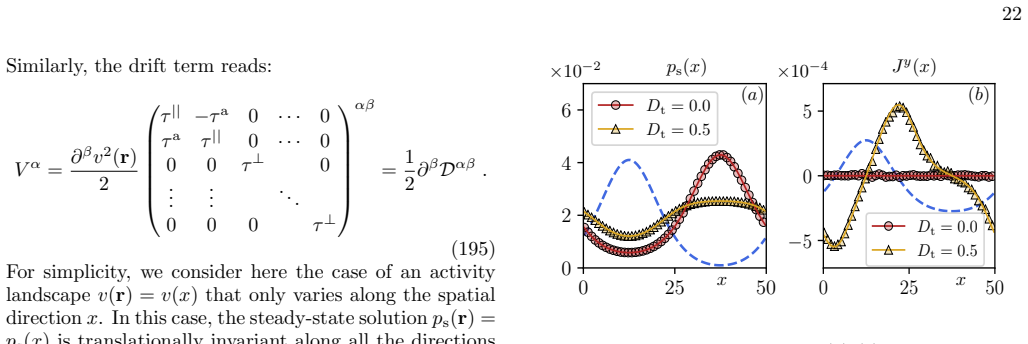
Space-dependent self-propulsion We first study the coarse-grained theory for chiral ABPs in the presence of space-dependent self-propulsion v(r), as described by Eqs. (58) and (57). The diffu- sion tensor resulting from Eqs. (58) and (144) eventually reads: D(r) =D t1+ v2(r) d τ || −τ a 0· · ·0 τ a τ || 0· · ·0 0 0τ ⊥ 0 ... ... ... 0 0 0τ ⊥ ...
-
[4]
Taxis We conclude our discussion by considering tactic mod- ulation of the self-propulsion speedv=v 0 −v 1u· ∇c(r), 0 25 50 0 2 4 6 Dt = 0.0 Dt = 0.5 0 25 50 −5 0 5 Dt = 0.0 Dt = 0.5 x x ×10−2 ×10⁻⁴ (a) (b) ps(x) J y(x) FIG. 2. Steady-state distributionp s(x) (a) and particle cur- rentJ y(x) (b) of chiral ABPs subjected to space-dependent self-propulsion ...
-
[5]
[85, 99] for AOUP- and ABP-monomers, respec- tively
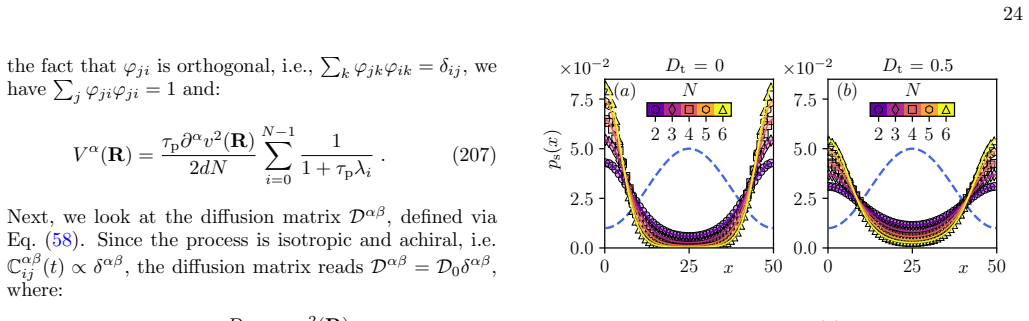
Space-dependent self-propulsion The physics of this system has recently been studied by Refs. [85, 99] for AOUP- and ABP-monomers, respec- tively. Under the hypothesis Eq. (205), the drift term reads: V α(R) = ∂βv2(R) 2N X ijk φjiφjk Z ∞ 0 dt e−λj tCαβ ik (t) =δ αβ ∂βv2(R) 2dN X ijk δikφjiφjk Z ∞ 0 dt e−(λj+1/τp)t =δ αβ ∂βv2(R) 2dN X ij φjiφji 1 λj + 1/τp...
-
[6]
1 1 +q + q 1 +q 1 1 + 1+q q κτp γ # = ∂αv2τp 2d(1 +q) 2
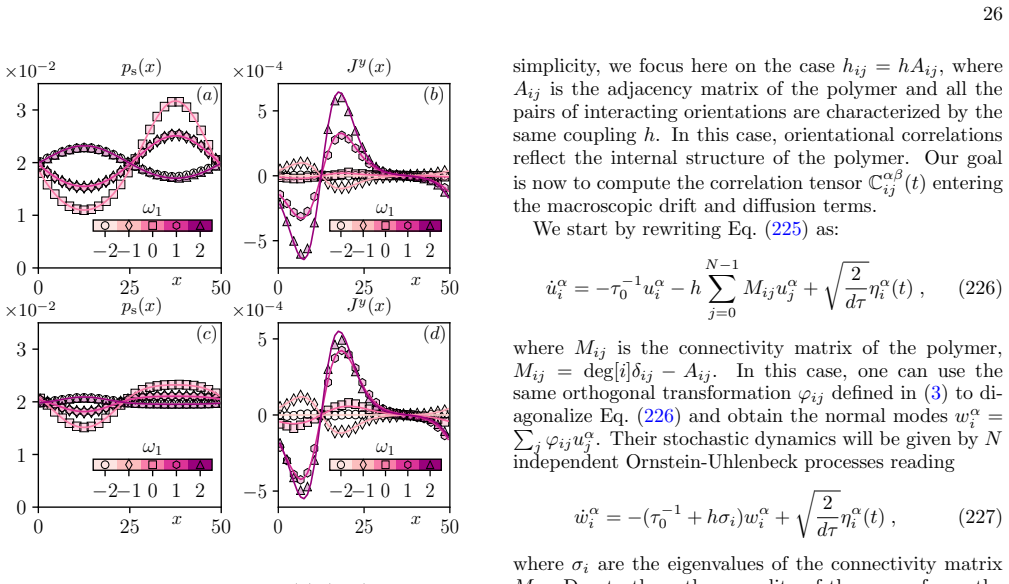
Taxis Next, we consider an active polymer whose monomers undergo a tactic active process. More specifically, the self-propulsion speed of monomeriadapts to local chem- ical gradients asv(r i) =v 0 −v 1uα i ∂αc(ri). To the best of our knowledge, the phenomenology emerging from this model has not been reported in the literature. We assume that the auto-corr...
-
[7]
E. O. Budrene and H. C. Berg, Complex patterns formed by motile cells of escherichia coli, Nature349, 630 (1991)
work page 1991
- [8]
- [9]
-
[10]
J. Palacci, S. Sacanna, A. P. Steinberg, D. J. Pine, and P. M. Chaikin, Living crystals of light-activated colloidal surfers, Science339, 936 (2013)
work page 2013
-
[11]
T. B¨ auerle, A. Fischer, T. Speck, and C. Bechinger, Self- organization of active particles by quorum sensing rules, Nat. Commun.9, 3232 (2018)
work page 2018
-
[12]
F. A. Lavergne, H. Wendehenne, T. B¨ auerle, and C. Bechinger, Group formation and cohesion of active particles with visual perception–dependent motility, Sci- ence364, 70 (2019)
work page 2019
-
[13]
M. B. Miller and B. L. Bassler, Quorum sensing in bac- teria, Annu. Rev. Microbiol.55, 165 (2001)
work page 2001
-
[14]
B. K. Hammer and B. L. Bassler, Quorum sensing con- trols biofilm formation in vibrio cholerae, Mol. Micro- biol.50, 101 (2003)
work page 2003
-
[15]
R. Daniels, J. Vanderleyden, and J. Michiels, Quorum sensing and swarming migration in bacteria, FEMS Mi- crobiol. Rev28, 261 (2004)
work page 2004
-
[16]
J. Tailleur and M. E. Cates, Statistical mechanics of interacting run-and-tumble bacteria, Phys. Rev. Lett. 100, 218103 (2008)
work page 2008
-
[17]
C. Liu, X. Fu, L. Liu, X. Ren, C. K. Chau, S. Li, L. Xi- ang, H. Zeng, G. Chen, L.-H. Tang,et al., Sequential establishment of stripe patterns in an expanding cell population, Science334, 238 (2011)
work page 2011
-
[18]
M. E. Cates and J. Tailleur, Motility-induced phase separation, Annu. Rev. Condens. Matter Phys.6, 219 (2015)
work page 2015
-
[19]
A. Curatolo, N. Zhou, Y. Zhao, C. Liu, A. Daerr, J. Tailleur, and J. Huang, Cooperative pattern forma- tion in multi-component bacterial systems through re- ciprocal motility regulation, Nat. Phys.16, 1152 (2020)
work page 2020
-
[20]
H. Zhao, A. Kosmrlj, and S. S. Datta, Chemotac- tic motility-induced phase separation, Phys. Rev. Lett. 131, 118301 (2023)
work page 2023
-
[21]
Y. Fily and M. C. Marchetti, Athermal phase separation of self-propelled particles with no alignment, Phys. Rev. Lett.108, 235702 (2012)
work page 2012
-
[22]
M. E. Cates, D. Marenduzzo, I. Pagonabarraga, and J. Tailleur, Arrested phase separation in reproducing bacteria creates a generic route to pattern formation, Proc. Natl. Acad. Sci. U.S.A.107, 11715 (2010)
work page 2010
-
[23]
A. Dinelli, J. O’Byrne, A. Curatolo, Y. Zhao, P. Sollich, and J. Tailleur, Non-reciprocity across scales in active mixtures, Nat. Commun.14, 7035 (2023)
work page 2023
-
[24]
Y. Duan, J. Agudo-Canalejo, R. Golestanian, and B. Mahault, Dynamical pattern formation without self- attraction in quorum-sensing active matter: the inter- play between nonreciprocity and motility, Phys. Rev. Lett.131, 148301 (2023)
work page 2023
-
[25]
G. Pisegna, S. Saha, and R. Golestanian, Emergent po- lar order in nonpolar mixtures with nonreciprocal inter- actions, Proc. Natl. Acad. Sci. U.S.A.121, e2407705121 33 (2024)
work page 2024
-
[26]
L. Caprini and U. Marini Bettolo Marconi, Bubble phase induced by odd interactions in chiral systems, J. Chem. Phys.162, 161101 (2025)
work page 2025
-
[27]
R. F. Fox, Uniform convergence to an effective fokker- planck equation for weakly colored noise, Phys. Rev. A 34, 4525 (1986)
work page 1986
-
[28]
R. F. Fox, Functional-calculus approach to stochastic differential equations, Phys. Rev. A33, 467 (1986)
work page 1986
- [29]
-
[30]
M. J. Schnitzer, Theory of continuum random walks and application to chemotaxis, Phys. Rev. E48, 2553 (1993)
work page 1993
-
[31]
M. E. Cates and J. Tailleur, When are active brownian particles and run-and-tumble particles equivalent? con- sequences for motility-induced phase separation, EPL 101, 20010 (2013)
work page 2013
-
[32]
R. Wittmann, C. Maggi, A. Sharma, A. Scacchi, J. M. Brader, and U. M. B. Marconi, Effective equilibrium states in the colored-noise model for active matter i. pairwise forces in the fox and unified colored noise ap- proximations, J. Stat. Mech.2017, 113207 (2017)
work page 2017
-
[33]
J. O’Byrne and J. Tailleur, Lamellar to micellar phases and beyond: when tactic active systems admit free en- ergy functionals, Phys. Rev. Lett.125, 208003 (2020)
work page 2020
-
[34]
A. Dinelli, J. O’Byrne, and J. Tailleur, Fluctuating hy- drodynamics of active particles interacting via taxis and quorum sensing: static and dynamics, J. Phys. A: Math. Theor.57, 395002 (2024)
work page 2024
-
[35]
G. Pisegna and S. Saha, Spinning mixtures: nonre- ciprocity transfers chirality across scales in scalar den- sities, arXiv preprint arXiv:2509.07630 (2025)
-
[36]
S. Burekovi´ c, F. De Luca, M. E. Cates, and C. Nardini, Active cahn–hilliard theory for non-equilibrium phase separation: quantitative macroscopic predictions and a microscopic derivation, arXiv preprint arXiv:2601.16539 (2026)
-
[37]
H. C. Berg,E. coli in Motion(Springer, 2004)
work page 2004
-
[38]
C. Kurzthaler, Y. Zhao, N. Zhou, J. Schwarz-Linek, C. Devailly, J. Arlt, J.-D. Huang, W. C. Poon, T. Fra- nosch, J. Tailleur,et al., Characterization and control of the run-and-tumble dynamics of escherichia coli, Phys. Rev. Lett.132, 038302 (2024)
work page 2024
-
[39]
R. Golestanian, T. Liverpool, and A. Ajdari, Designing phoretic micro-and nano-swimmers, New J. Phys.9, 126 (2007)
work page 2007
-
[40]
I. Theurkauff, C. Cottin-Bizonne, J. Palacci, C. Ybert, and L. Bocquet, Dynamic clustering in active colloidal suspensions with chemical signaling, Phys. Rev. Lett. 108, 268303 (2012)
work page 2012
-
[41]
N. Sep´ ulveda, L. Petitjean, O. Cochet, E. Grasland- Mongrain, P. Silberzan, and V. Hakim, Collective cell motion in an epithelial sheet can be quantitatively de- scribed by a stochastic interacting particle model, PLoS Comput. Biol.9, e1002944 (2013)
work page 2013
-
[42]
G. Szamel, Self-propelled particle in an external poten- tial: Existence of an effective temperature, Phys. Rev. E90, 012111 (2014)
work page 2014
-
[43]
R. Wittmann, U. M. B. Marconi, C. Maggi, and J. M. Brader, Effective equilibrium states in the colored-noise model for active matter ii. a unified framework for phase equilibria, structure and mechanical properties, J. Stat. Mech.2017, 113208 (2017)
work page 2017
- [44]
-
[45]
A. P. Solon, M. E. Cates, and J. Tailleur, Active brow- nian particles and run-and-tumble particles: A compar- ative study, Eur. Phys. J. Spec. Top.224, 1231 (2015)
work page 2015
-
[46]
A. Ghosh and N. S. Gov, Dynamics of active semiflexible polymers, Biophys. J.107, 1065 (2014)
work page 2014
-
[47]
R. E. Isele-Holder, J. Elgeti, and G. Gompper, Self- propelled worm-like filaments: spontaneous spiral for- mation, structure, and dynamics, Soft Matter11, 7181 (2015)
work page 2015
-
[48]
R. G. Winkler, J. Elgeti, and G. Gompper, Active poly- mers—emergent conformational and dynamical prop- erties: A brief review, J. Phys. Soc. Jpn.86, 101014 (2017)
work page 2017
- [49]
-
[50]
R. G. Winkler and G. Gompper, The physics of active polymers and filaments, J. Chem. Phys.153, 040901 (2020)
work page 2020
-
[51]
U. Pfreundt, J. S lomka, G. Schneider, A. Sen- gupta, F. Carrara, V. Fernandez, M. Ackermann, and R. Stocker, Controlled motility in the cyanobacterium trichodesmium regulates aggregate architecture, Science 380, 830 (2023)
work page 2023
-
[52]
M. Dedenon, C. Blanch-Mercader, K. Kruse, and J. El- geti, The importance of being discrete: fluctuations, de- fects, and density-orientation coupling in agent-based active nematics, New Journal of Physics28, 024401 (2026)
work page 2026
-
[53]
X. Hu, W. Chen, Z. Zhu, J. Lin, D. Nie, and Y. Xia, Cargo carrying by a spring connected chiral micro- swimmer in a square channel, J. Fluid Mech.1011, A50 (2025)
work page 2025
-
[54]
H. D. Vuijk, H. Merlitz, M. Lang, A. Sharma, and J.- U. Sommer, Chemotaxis of cargo-carrying self-propelled particles, Phys. Rev. Lett.126, 208102 (2021)
work page 2021
-
[55]
P. L. Muzzeddu, ´E. Rold´ an, A. Gambassi, and A. Sharma, Taxis of cargo-carrying microswimmers in traveling activity waves, EPL142, 67001 (2023)
work page 2023
-
[56]
P. L. Muzzeddu, H. D. Vuijk, H. L¨ owen, J.-U. Sommer, and A. Sharma, Active chiral molecules in activity gra- dients, J. Chem. Phys.157, 134902 (2022)
work page 2022
-
[57]
L. Caprini, I. Abdoli, U. M. B. Mar- coni, and H. L¨ owen, Spontaneous self- wrapping in chiral active polymers, Newton1, https://doi.org/10.1016/j.newton.2025.100253 (2025)
-
[58]
B. Valecha, H. Vahid, P. L. Muzzeddu, J.-U. Sommer, and A. Sharma, Active transport of cargo-carrying and interconnected chiral particles, Soft Matter21, 3384 (2025)
work page 2025
-
[59]
A. Dinelli and P. L. Muzzeddu, Unifying hydrodynamic theory for motility-regulated active matter: form sin- gle particles to interacting polymers, Companion paper (2026)
work page 2026
-
[60]
G. Pavliotis and A. Stuart,Multiscale methods: averag- ing and homogenization(Springer Science & Business Media, 2008). 34
work page 2008
-
[61]
Y. Duan, J. Agudo-Canalejo, R. Golestanian, and B. Mahault, Phase coexistence in nonreciprocal quorum-sensing active matter, Phys. Rev. Res.7, 013234 (2025)
work page 2025
-
[62]
J. O’Byrne and M. E. Cates, Geometric theory of (extended) time-reversal symmetries in stochastic pro- cesses: I. finite dimension, J. Stat. Mech.2024, 113207 (2024)
work page 2024
-
[63]
J. O’Byrne and M. Cates, Geometric theory of (ex- tended) time-reversal symmetries in stochastic pro- cesses: Ii. field theory, J. Stat. Mech.2025, 053204 (2025)
work page 2025
- [64]
-
[65]
C. W. Gardineret al.,Handbook of stochastic methods, Vol. 3 (springer Berlin, 2004)
work page 2004
-
[66]
M. S. Green, Markoff random processes and the sta- tistical mechanics of time-dependent phenomena. ii. ir- reversible processes in fluids, J. Chem. Phys.22, 398 (1954)
work page 1954
-
[67]
R. Kubo, M. Toda, and N. Hashitsume,Statistical physics II: nonequilibrium statistical mechanics, Vol. 31 (Springer Science & Business Media, 2012)
work page 2012
- [68]
- [69]
-
[70]
H. L¨ owen, Inertial effects of self-propelled particles: From active brownian to active langevin motion, J. Chem. Phys.152, 040901 (2020)
work page 2020
-
[71]
L. Caprini, R. K. Gupta, and H. L¨ owen, Role of rota- tional inertia for collective phenomena in active matter, Phys. Chem. Chem. Phys.24, 24910 (2022)
work page 2022
- [72]
-
[73]
A. R. Sprenger, L. Caprini, H. L¨ owen, and R. Wittmann, Dynamics of active particles with transla- tional and rotational inertia, J. Phys. Condens. Matter 35, 305101 (2023)
work page 2023
-
[74]
Detcheverry, Generalized run-and-turn motions: From bacteria to l´ evy walks, Phys
F. Detcheverry, Generalized run-and-turn motions: From bacteria to l´ evy walks, Phys. Rev. E96, 012415 (2017)
work page 2017
-
[75]
M. R. Shaebani, H. Rieger, and Z. Sadjadi, Kinematics of persistent random walkers with two distinct modes of motion, Phys. Rev. E106, 034105 (2022)
work page 2022
- [76]
-
[77]
M. Caraglio, H. Kaur, L. J. Fiderer, A. L´ opez-Incera, H. J. Briegel, T. Franosch, and G. Mu˜ noz-Gil, Learn- ing how to find targets in the micro-world: the case of intermittent active brownian particles, Soft Matter20, 2008 (2024)
work page 2008
- [78]
-
[79]
K. W. Foster and R. D. Smyth, Light antennas in pho- totactic algae, Microbiol. Rev.44, 572 (1980)
work page 1980
- [80]
discussion (0)
Sign in with ORCID, Apple, or X to comment. Anyone can read and Pith papers without signing in.