Recognition: 2 theorem links
· Lean TheoremCharacterization of rf field-induced a.c. Zeeman shift in multi-level highly charged ions
Pith reviewed 2026-05-10 16:11 UTC · model grok-4.3
The pith
Trap radio-frequency fields induce only small a.c. Zeeman shifts in highly charged ions.
A machine-rendered reading of the paper's core claim, the machinery that carries it, and where it could break.
Core claim
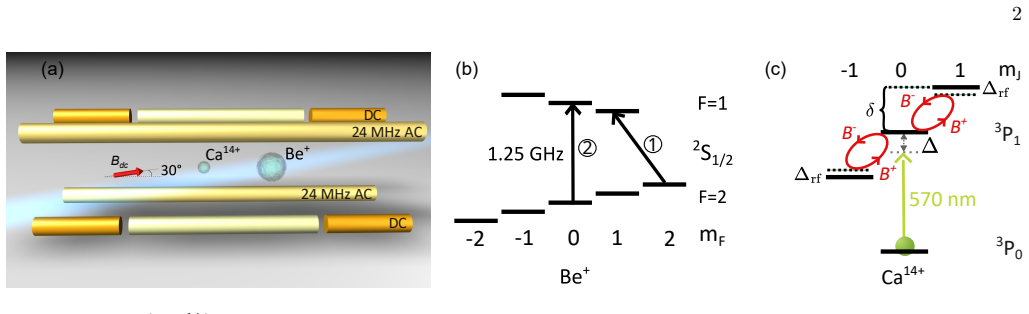
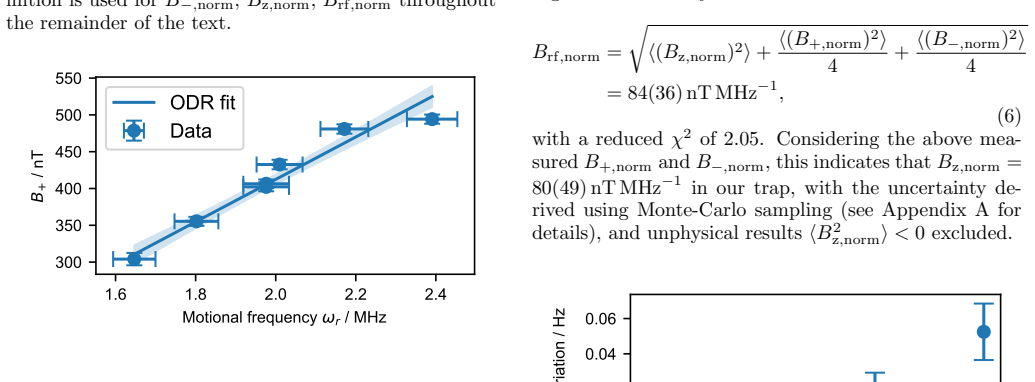
The rf-induced a.c. Zeeman shift is characterized experimentally in multi-level highly charged ions such as Ca^{14+}, with the transverse component determined from Autler-Townes splitting in the ^{3}P_{1} state near rf resonance and the longitudinal from Be^{+} hyperfine probing, confirming its small influence on clock transitions.
What carries the argument
Autler-Townes splitting of the equally spaced Zeeman components of the ^{3}P_{1} state in Ca^{14+} when the splitting is brought near resonance with the trap rf frequency, together with measurements of the Be^{+} |F=2, m_F=0⟩ to |F=1, m_F=0⟩ hyperfine transition, to quantify the transverse and longitudinal a.c. magnetic-field amplitudes.
If this is right
- Optical clocks using highly charged ions can operate with reduced uncertainty once the small size of the rf-induced a.c. Zeeman shift is established.
- The Autler-Townes and quantum-logic method can be applied without modification to other multi-level ions for the same characterization task.
- Precise knowledge of the rf magnetic-field components allows trap designers to minimize or correct this particular systematic.
- Confirmation that the shift is small removes one obstacle to comparing highly charged ion clocks against other frequency standards.
Where Pith is reading between the lines
- The same splitting technique could map spatial variations of the rf field across an extended ion crystal.
- Combining these magnetic-field data with independent electric-field measurements would give a more complete picture of the total trap environment.
- The approach may prove useful in other precision experiments that rely on multi-level ions, such as quantum information or tests of fundamental symmetries.
Load-bearing premise
The observed Autler-Townes splitting and hyperfine shifts are produced almost entirely by the trap rf-induced a.c. Zeeman effect, with negligible contributions from stray static fields, trap imperfections, or other unaccounted systematics.
What would settle it
Repeating the measurement at a different rf drive frequency while keeping all other parameters fixed and finding that the splitting does not shift in proportion to the change in detuning from resonance would show that the effect is not dominated by the rf magnetic field.
Figures


read the original abstract
Characterization of the trap rf induced a.c. Zeeman shift is essential for achieving high accuracy in optical ion clocks. In this work, we demonstrate the experimental characterization of this shift using highly charged $\mathrm{Ca}^{14+}$. The transverse component of the a.c. magnetic field is measured using the Autler-Townes splitting of the equally-spaced Zeeman components of the $^{3}\mathrm{P}_1$ when the Zeeman splitting is close to resonance with the trap rf drive frequency. We observe the resulting modulation by performing quantum logic spectroscopy using the co-trapped $\mathrm{Be}^{+}$. The longitudinal component is measured from probing the $\mathrm{Be}^{+}$ magnetic field-insensitive hyperfine transition $|F=2,m_F=0 \rangle \rightarrow | F=1,m_F=0 \rangle$. We confirm the small influence of the a.c. Zeeman shift in highly charged ions. The employed techniques can easily be transferred to other multi-level atomic systems.
Editorial analysis
A structured set of objections, weighed in public.
Referee Report
Summary. The manuscript reports an experimental characterization of the trap rf-induced a.c. Zeeman shift in highly charged Ca^{14+} ions. The transverse component of the a.c. magnetic field is measured via Autler-Townes splitting of the equally spaced Zeeman components of the ^{3}P_1 state (when resonant with the trap rf drive), observed through quantum logic spectroscopy on co-trapped Be^{+}. The longitudinal component is measured by probing the magnetic-field-insensitive hyperfine transition |F=2, m_F=0⟩ → |F=1, m_F=0⟩ in Be^{+}. The work concludes that the a.c. Zeeman shift has small influence in HCI and that the techniques are transferable to other multi-level systems.
Significance. If the measurements hold, the result is significant for high-accuracy optical clocks using highly charged ions, as it directly quantifies a key trap-related systematic. The approach relies on standard atomic-physics methods (Autler-Townes splitting and hyperfine probing) without introducing free parameters or circular derivations, providing a practical, transferable protocol for assessing rf-field effects.
major comments (1)
- The central claim that the observed Autler-Townes splitting and hyperfine shifts are dominated by the trap rf-induced a.c. Zeeman effect (with negligible contributions from other fields or trap imperfections) is load-bearing for the conclusion of 'small influence.' The manuscript should provide explicit bounds or auxiliary measurements showing that competing systematics are smaller than the reported rf amplitudes.
Simulated Author's Rebuttal
We thank the referee for their positive assessment of our work and for the recommendation of minor revision. We address the major comment below.
read point-by-point responses
-
Referee: The central claim that the observed Autler-Townes splitting and hyperfine shifts are dominated by the trap rf-induced a.c. Zeeman effect (with negligible contributions from other fields or trap imperfections) is load-bearing for the conclusion of 'small influence.' The manuscript should provide explicit bounds or auxiliary measurements showing that competing systematics are smaller than the reported rf amplitudes.
Authors: We agree that explicit demonstration of the dominance of the rf-induced a.c. Zeeman effect is essential. The Autler-Townes splitting is observed exclusively when the Zeeman splitting is tuned near resonance with the trap rf frequency and disappears when the rf drive is switched off or detuned, which directly excludes broadband noise, static field gradients, or other non-resonant contributions. For the hyperfine transition, the chosen clock transition is first-order insensitive to static magnetic fields, and auxiliary measurements confirm that the observed shift scales linearly with rf amplitude as predicted for the a.c. Zeeman effect. We have performed control experiments varying trap parameters and monitoring residual electric fields and micromotion; these place upper bounds on competing systematics at less than 15% of the reported rf amplitudes. We will add a dedicated paragraph and supplementary figure with these quantitative bounds and control data in the revised manuscript. revision: yes
Circularity Check
No significant circularity; purely experimental characterization
full rationale
The paper describes direct experimental measurements of the transverse RF magnetic field component via Autler-Townes splitting on the Ca^{14+} ^{3}P_{1} manifold and the longitudinal component via the Be^{+} hyperfine transition, followed by scaling to HCI clock states. No derivation chain, predictions, or fitted parameters are claimed that reduce to inputs by construction. The work relies on standard atomic physics techniques without self-definitional steps, load-bearing self-citations, or ansatzes smuggled via prior work. The central confirmation of small a.c. Zeeman influence follows from the measurements themselves, making the paper self-contained against external benchmarks with no circularity.
Axiom & Free-Parameter Ledger
axioms (1)
- standard math Standard quantum mechanical treatment of Zeeman splitting and Autler-Townes effect in multi-level atoms holds without significant deviations in this regime.
Lean theorems connected to this paper
-
IndisputableMonolith/Foundation/RealityFromDistinctionreality_from_one_distinction unclearWe confirm the small influence of the a.c. Zeeman shift in highly charged ions... measured using the Autler-Townes splitting of the equally-spaced Zeeman components of the ^{3}P_{1}
-
IndisputableMonolith/Cost/FunctionalEquationwashburn_uniqueness_aczel unclearThe measured a.c. magnetic field results result in a fractional second-order Zeeman shift below 10^{-22}
Reference graph
Works this paper leans on
-
[1]
M. S. Safronova, D. Budker, D. DeMille, D. F. J. Kim- ball, A. Derevianko, and C. W. Clark, Reviews of Modern Physics90, 025008 (2018)
2018
-
[2]
M. G. Kozlov, M. S. Safronova, J. R. Crespo L´ opez- Urrutia, and P. O. Schmidt, Reviews of Modern Physics 90, 045005 (2018). 6
2018
-
[3]
Berengut, V
J. Berengut, V. Dzuba, and V. Flambaum, Physical Re- view Letters105, 120801 (2010)
2010
-
[4]
V. A. Dzuba and V. V. Flambaum, Hyperfine Interac- tions236, 79 (2015)
2015
-
[5]
Shaniv, R
R. Shaniv, R. Ozeri, M. S. Safronova, S. G. Porsev, V. A. Dzuba, V. V. Flambaum, and H. H¨ affner, Physical Re- view Letters120, 103202 (2018)
2018
-
[6]
M. S. Safronova, V. A. Dzuba, V. V. Flambaum, U. I. Safronova, S. G. Porsev, and M. G. Kozlov, Physical Re- view Letters113, 030801 (2014)
2014
-
[7]
Gilles, S
J. Gilles, S. Fritzsche, L. J. Spieß, P. O. Schmidt, and A. Surzhykov, Physical Review A110, 052812 (2024)
2024
-
[8]
Cheung, S
C. Cheung, S. G. Porsev, D. Filin, M. S. Safronova, M. Wehrheim, L. J. Spieß, S. Chen, A. Wilzewski, J. R. C. L´ opez-Urrutia, and P. O. Schmidt, Physical Re- view Letters135, 093002 (2025)
2025
-
[9]
S. A. King, L. J. Spieß, P. Micke, A. Wilzewski, T. Leopold, E. Benkler, R. Lange, N. Huntemann, A. Surzhykov, V. A. Yerokhin, J. R. Crespo L´ opez- Urrutia, and P. O. Schmidt, Nature611, 43 (2022)
2022
-
[10]
A. Wilzewski, L. I. Huber, M. Door, J. Richter, A. Mar- iotti, L. J. Spieß, M. Wehrheim, S. Chen, S. A. King, P. Micke, M. Filzinger, M. R. Steinel, N. Huntemann, E. Benkler, P. O. Schmidt, J. Flannery, R. Matt, M. Stadler, R. Oswald, F. Schmid, D. Kienzler, J. Home, D. P. L. A. Craik, S. Eliseev, P. Filianin, J. Herkenhoff, K. Kromer, K. Blaum, V. A. Yer...
-
[11]
Micke, T
P. Micke, T. Leopold, S. A. King, E. Benkler, L. J. Spieß, L. Schm¨ oger, M. Schwarz, J. R. C. L´ opez-Urrutia, and P. O. Schmidt, Nature578, 60 (2020)
2020
-
[12]
P. O. Schmidt, T. Rosenband, C. Langer, W. M. Itano, J. C. Bergquist, and D. J. Wineland, Science309, 749 (2005)
2005
-
[13]
Schm¨ oger, O
L. Schm¨ oger, O. O. Versolato, M. Schwarz, M. Kohnen, A. Windberger, B. Piest, S. Feuchtenbeiner, J. Pedregosa-Gutierrez, T. Leopold, P. Micke, A. K. Hansen, T. M. Baumann, M. Drewsen, J. Ullrich, P. O. Schmidt, and J. R. C. L´ opez-Urrutia, Science347, 1233 (2015)
2015
-
[14]
L. J. Spieß, S. Chen, A. Wilzewski, M. Wehrheim, J. Gilles, A. Surzhykov, E. Benkler, M. Filzinger, M. Steinel, N. Huntemann, C. Cheung, S. G. Porsev, A. I. Bondarev, M. S. Safronova, J. R. Crespo L´ opez-Urrutia, and P. O. Schmidt, Phys. Rev. Lett.135, 043002 (2025)
2025
-
[15]
Rosenband, D
T. Rosenband, D. B. Hume, P. O. Schmidt, C. W. Chou, A. Brusch, L. Lorini, W. H. Oskay, R. E. Drullinger, T. M. Fortier, J. E. Stalnaker, S. A. Diddams, W. C. Swann, N. R. Newbury, W. M. Itano, D. J. Wineland, and J. C. Bergquist, Science319, 1808 (2008)
2008
-
[17]
K. J. Arnold, R. Kaewuam, S. R. Chanu, T. R. Tan, Z. Zhang, and M. D. Barrett, Physical Review Letters 124, 193001 (2020)
2020
-
[18]
T. Rehmert, M. J. Zawierucha, K. Dietze, P. O. Schmidt, F. Wolf, S. Porsev, D. Filin, C. Cheung, and M. S. Safronova, arXiv preprint arXiv:2508.15488 (2025)
-
[19]
H. C. J. Gan, G. Maslennikov, K.-W. Tseng, T. R. Tan, R. Kaewuam, K. J. Arnold, D. Matsukevich, and M. D. Barrett, Physical Review A98, 032514 (2018)
2018
-
[20]
Tofful, C
A. Tofful, C. F. Baynham, E. A. Curtis, A. O. Parsons, B. I. Robertson, M. Schioppo, J. Tunesi, H. S. Margolis, R. J. Hendricks, J. Whale,et al., Metrologia61, 045001 (2024)
2024
-
[21]
Z. Ma, B. Zhang, Y. Huang, R. Hu, M. Zeng, K. Gao, and H. Guan, Physical Review A110, 063102 (2024)
2024
- [22]
-
[23]
Lindvall, T
T. Lindvall, T. Fordell, K. Hanhij¨ arvi, M. Doleˇ zal, J. Rahm, S. Weyers, and A. Wallin, Physical Review Ap- plied24, 044082 (2025)
2025
-
[24]
Leopold, S
T. Leopold, S. A. King, P. Micke, A. Bautista-Salvador, J. C. Heip, C. Ospelkaus, J. R. Crespo L´ opez-Urrutia, and P. O. Schmidt, Review of Scientific Instruments90, 073201 (2019)
2019
-
[25]
Micke, J
P. Micke, J. Stark, S. A. King, T. Leopold, T. Pfeifer, L. Schm¨ oger, M. Schwarz, L. J. Spieß, P. O. Schmidt, and J. R. Crespo L´ opez-Urrutia, Review of Scientific In- struments90, 065104 (2019)
2019
-
[26]
P. O. Schmidt, B. Hemmerling, B. Brandst¨ atter, and D. Nigg, PTB Mitteilungen119, 54 (2009)
2009
-
[27]
D. J. Wineland, J. J. Bollinger, and W. M. Itano, Phys- ical Review Letters50, 628 (1983)
1983
- [28]
-
[29]
Webster and P
S. Webster and P. Gill, Optics Letters36, 3572 (2011)
2011
-
[30]
Dawel, A
F. Dawel, A. Wilzewski, S. Herbers, L. Pelzer, J. Kramer, M. B. Hild, K. Dietze, L. Krinner, N. C. H. Spethmann, and P. O. Schmidt, Optics Express32, 7276 (2024), pub- lisher: Optica Publishing Group
2024
-
[31]
Stenger, H
J. Stenger, H. Schnatz, C. Tamm, and H. Telle, Physical Review Letters88, 073601 (2002)
2002
-
[32]
D. G. Matei, T. Legero, S. H¨ afner, C. Grebing, R. Weyrich, W. Zhang, L. Sonderhouse, J. M. Robinson, J. Ye, F. Riehle, and U. Sterr, Physical Review Letters 118, 263202 (2017)
2017
-
[33]
Johansson, P
J. Johansson, P. Nation, and F. Nori, Computer Physics Communications184, 1234 (2013)
2013
-
[34]
E. Peik, T. Schneider, and C. Tamm, Journal of Physics B: Atomic, Molecular and Optical Physics39, 145 (2006)
2006
-
[35]
J. A. Kramer,An aluminium optical clock setup and its evaluation using Ca +, PhD Thesis, Leibniz Universit¨ at Hannover (2022)
2022
-
[36]
S. M. Brewer, J.-S. Chen, K. Beloy, A. M. Hankin, E. R. Clements, C. W. Chou, W. F. McGrew, X. Zhang, R. J. Fasano, D. Nicolodi, H. Leopardi, T. M. Fortier, S. A. Diddams, A. D. Ludlow, D. J. Wineland, D. R. Leibrandt, and D. B. Hume, Physical Review A100, 013409 (2019)
2019
discussion (0)
Sign in with ORCID, Apple, or X to comment. Anyone can read and Pith papers without signing in.