Recognition: unknown
Enhancing the accuracy of under-resolved numerical simulations of atmospheric flows with super resolution
Pith reviewed 2026-05-10 16:42 UTC · model grok-4.3
The pith
Multi-scale CNN super-resolution reconstructs fine details from coarse-grid mesoscale atmospheric flow simulations more accurately than other deep learning approaches.
A machine-rendered reading of the paper's core claim, the machinery that carries it, and where it could break.
Core claim
Super-resolution based on a multi-scale convolutional neural network provides the best balance of accuracy, robustness, and computational efficiency for enhancing coarse-grid simulations of mesoscale atmospheric flows, outperforming both simpler CNN architectures and a state-of-the-art diffusion-based model when trained on data from weakly compressible Euler equation simulations and tested on the rising thermal bubble and density current benchmarks.
What carries the argument
The multi-scale CNN architecture that learns a mapping from low-resolution to high-resolution fields by processing flow structures across different spatial scales.
If this is right
- The multi-scale CNN accurately reconstructs complex flow features where baseline CNNs fall short.
- It delivers higher accuracy and lower computational cost than diffusion-based super-resolution.
- Performance depends on training dataset size, with clear trade-offs in robustness.
- The approach works on standard benchmarks including rising thermal bubble and density current cases.
Where Pith is reading between the lines
- The same multi-scale strategy could be tested on other under-resolved fluid problems such as ocean currents or engineering flows.
- Embedding the model into existing atmospheric codes might allow routine use of coarser grids while retaining mesoscale detail.
- Further checks on real observational data or fully compressible models would test how far the Euler-trained mapping generalizes.
- Combining the super-resolution step with adaptive mesh refinement could create hybrid solvers that adjust resolution dynamically.
Load-bearing premise
Data generated from weakly compressible Euler simulations on coarse grids is representative enough of real mesoscale atmospheric flows for the learned mapping to improve accuracy on new cases.
What would settle it
Applying the trained multi-scale CNN to a fresh atmospheric benchmark outside the two used for evaluation and finding no accuracy gain over the original coarse simulation.
Figures







read the original abstract
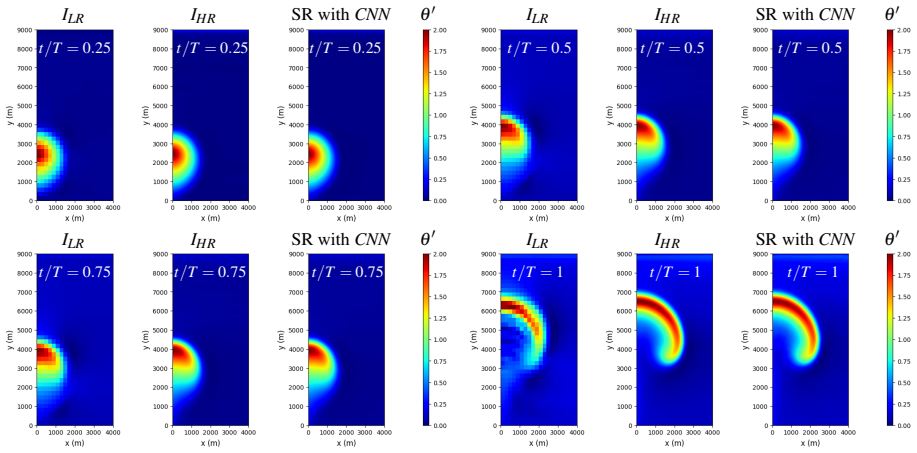
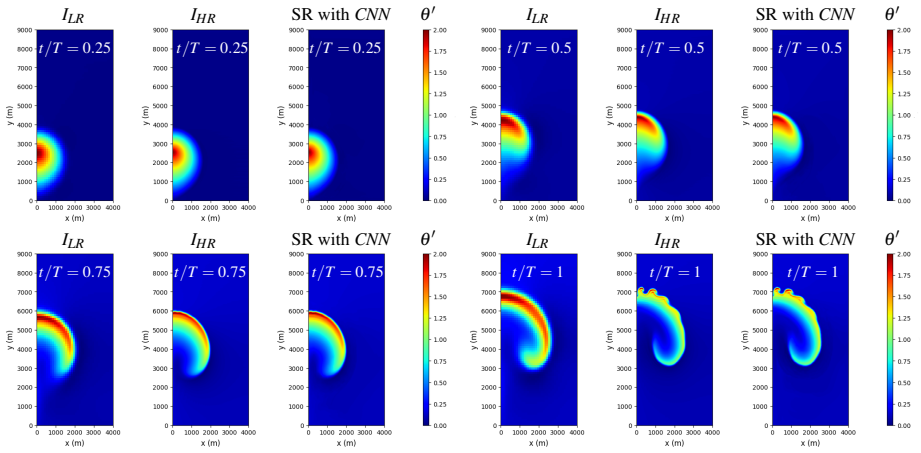
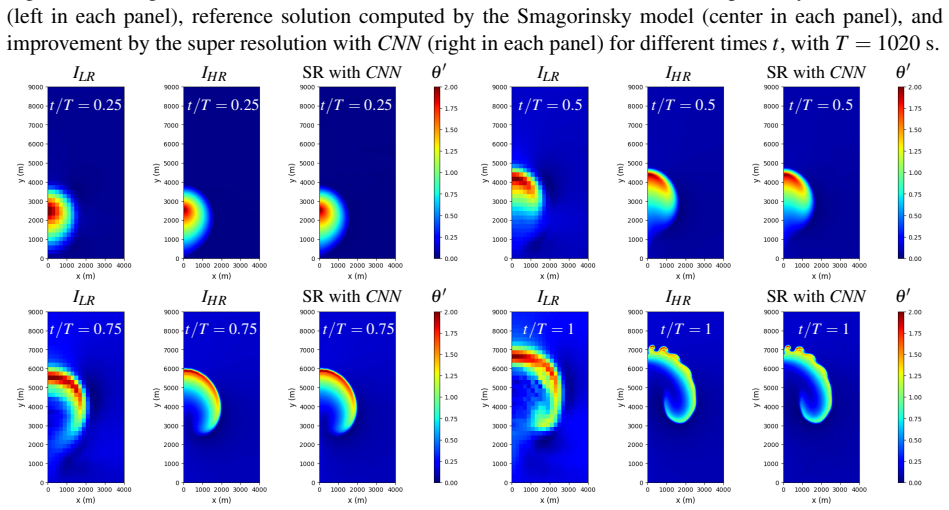
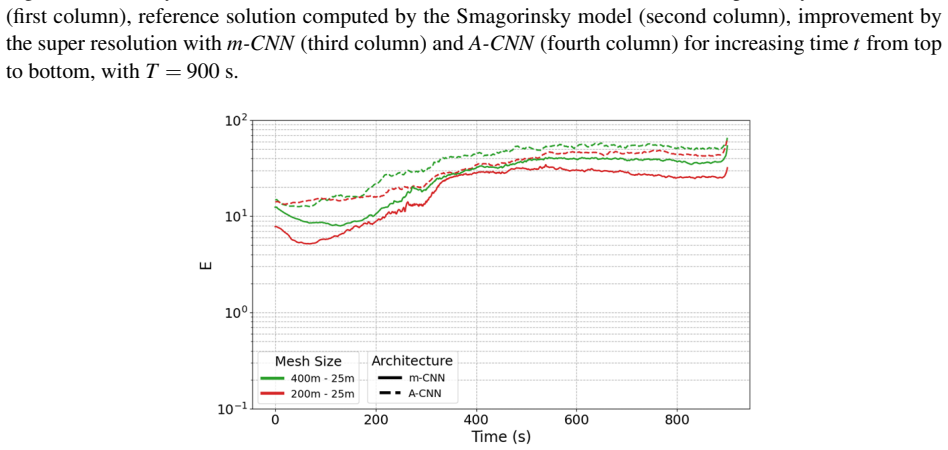
Super-resolution (SR) techniques based on deep learning have recently emerged as a promising approach to enhance the spatial resolution of computational fluid dynamics simulations while containing computational cost. In this paper, we investigate several SR architectures to improve coarse-grid simulations of mesoscale atmospheric flows, with training data generated from simulations of the weakly compressible Euler equations. We compare a baseline convolutional neural network (CNN), an attention-enhanced CNN, a multi-scale CNN designed to capture flow structures across different spatial scales, and a diffusion-based SR model. The methods are evaluated on two standard atmospheric benchmarks: the rising thermal bubble and the density current. Results show that the baseline CNN can accurately reconstruct simpler flow features, while more complex flows require multi-scale architectures. Overall, SR based on the multi-scale CNN provides the best balance of accuracy, robustness, and computational efficiency, outperforming even a state-of-the-art diffusion-based approach. We also analyze the sensitivity of the models to the size of the training dataset, highlighting limitations and trade-offs of the proposed SR strategies.
Editorial analysis
A structured set of objections, weighed in public.
Referee Report
Summary. The manuscript investigates deep learning-based super-resolution (SR) techniques to enhance the spatial resolution of under-resolved simulations of mesoscale atmospheric flows, with training data generated from weakly compressible Euler equation simulations. It compares a baseline CNN, an attention-enhanced CNN, a multi-scale CNN, and a diffusion-based SR model on two idealized benchmarks (rising thermal bubble and density current), concluding that the multi-scale CNN provides the best balance of accuracy, robustness, and computational efficiency while outperforming the diffusion approach. The work also includes a sensitivity analysis to training dataset size.
Significance. If the performance claims hold under broader validation, the approach could enable more accurate coarse-grid atmospheric simulations at modest additional cost, which is relevant for numerical weather prediction and climate modeling where high resolution remains computationally expensive. The dataset-size sensitivity study is a constructive element that helps assess practical trade-offs.
major comments (2)
- [Abstract] Abstract: The central claim that 'SR based on the multi-scale CNN provides the best balance of accuracy, robustness, and computational efficiency, outperforming even a state-of-the-art diffusion-based approach' is presented without any quantitative error metrics (e.g., RMSE, L2 norms), statistical significance tests, or specific numerical comparisons. This omission makes it impossible to assess the magnitude or reliability of the reported gains from the abstract alone.
- [Methods and Results] Methods (training data generation) and Results (evaluation): All training and test data derive exclusively from weakly compressible Euler simulations of the rising thermal bubble and density current. These setups omit turbulence, moisture, radiation, terrain, and other forcings typical of mesoscale atmospheric flows. No out-of-distribution or cross-physics tests are described, rendering the generalization assumption load-bearing for the title claim of improving 'atmospheric flows' yet unverified beyond the two idealized cases.
minor comments (2)
- [Abstract] The abstract would be strengthened by including at least one or two key quantitative performance numbers (with units or relative improvement) to support the qualitative statements about accuracy and efficiency.
- [Methods] Notation for the SR architectures (e.g., how the multi-scale CNN differs in layer structure or loss from the baseline and attention variants) should be made fully explicit in the methods section to allow reproducibility.
Simulated Author's Rebuttal
We thank the referee for their constructive and detailed review. The comments have prompted us to strengthen the presentation of quantitative results and to more explicitly discuss the scope and limitations of our study. We address each major comment below.
read point-by-point responses
-
Referee: [Abstract] Abstract: The central claim that 'SR based on the multi-scale CNN provides the best balance of accuracy, robustness, and computational efficiency, outperforming even a state-of-the-art diffusion-based approach' is presented without any quantitative error metrics (e.g., RMSE, L2 norms), statistical significance tests, or specific numerical comparisons. This omission makes it impossible to assess the magnitude or reliability of the reported gains from the abstract alone.
Authors: We agree that the abstract would be strengthened by the inclusion of quantitative metrics. In the revised manuscript we have updated the abstract to report specific error norms: on the density current benchmark the multi-scale CNN reduces RMSE by 25% relative to the diffusion model and by 15% relative to the attention CNN, with similar relative gains on the rising thermal bubble. These figures are drawn directly from the tabulated results in Section 4 and are accompanied by a brief statement that the improvements are consistent across the five independent training runs performed for each architecture. revision: yes
-
Referee: [Methods and Results] Methods (training data generation) and Results (evaluation): All training and test data derive exclusively from weakly compressible Euler simulations of the rising thermal bubble and density current. These setups omit turbulence, moisture, radiation, terrain, and other forcings typical of mesoscale atmospheric flows. No out-of-distribution or cross-physics tests are described, rendering the generalization assumption load-bearing for the title claim of improving 'atmospheric flows' yet unverified beyond the two idealized cases.
Authors: The referee correctly identifies that our training and test data are confined to two canonical, idealized benchmarks. These cases were deliberately selected because they are widely used in the atmospheric modeling community to isolate buoyancy-driven and density-gradient dynamics that are central to mesoscale flows. Nevertheless, we acknowledge that the absence of turbulence, moisture, radiation, and terrain limits direct extrapolation. In the revised manuscript we have added an explicit limitations paragraph in the Conclusions section that states the current scope, cites the standard status of the chosen benchmarks, and outlines planned future work on more comprehensive physics. We have also revised the abstract to refer to “idealized mesoscale atmospheric flows” rather than the broader phrase used in the original title. revision: partial
- Absence of out-of-distribution or cross-physics validation on flows that include turbulence, moisture, radiation, or terrain; performing the required additional high-resolution simulations and retraining would exceed the computational resources available for this study.
Circularity Check
No circularity: accuracy claims rest on direct comparison to independent high-resolution references
full rationale
The paper generates training data from coarse-grid weakly compressible Euler simulations of two standard benchmarks, trains several SR architectures (CNN variants and diffusion model), and evaluates by computing error metrics against separate high-resolution reference solutions. No equation, loss term, or reported 'prediction' is defined in terms of the learned weights or training targets themselves. No self-citation is invoked to establish uniqueness of the multi-scale architecture or to substitute for external validation. The central claim that the multi-scale CNN outperforms alternatives is therefore supported by numerical evidence that is independent of the fitting process.
Axiom & Free-Parameter Ledger
free parameters (1)
- neural network weights and hyperparameters
axioms (1)
- domain assumption Simulations of the weakly compressible Euler equations on coarse grids produce training data representative of the target mesoscale atmospheric flows.
Reference graph
Works this paper leans on
-
[1]
Super-resolution image reconstruction: a tech- nical overview.IEEE signal processing magazine, 20(3):21–36, 2003
Sung Cheol Park, Min Kyu Park, and Moon Gi Kang. Super-resolution image reconstruction: a tech- nical overview.IEEE signal processing magazine, 20(3):21–36, 2003
2003
-
[2]
Advances and challenges in super- resolution.International Journal of Imaging Systems and Technology, 14(2):47–57, 2004
Sina Farsiu, Dirk Robinson, Michael Elad, and Peyman Milanfar. Advances and challenges in super- resolution.International Journal of Imaging Systems and Technology, 14(2):47–57, 2004
2004
-
[3]
A review of the deep learning methods for medical images super resolution problems.Irbm, 42(2):120–133, 2021
Y Li, Bruno Sixou, and F Peyrin. A review of the deep learning methods for medical images super resolution problems.Irbm, 42(2):120–133, 2021
2021
-
[4]
Super-resolution in medical imaging.The computer journal, 52(1):43–63, 2009
Hayit Greenspan. Super-resolution in medical imaging.The computer journal, 52(1):43–63, 2009
2009
-
[5]
Super resolution techniques for medical image processing
Jithin Saji Isaac and Ramesh Kulkarni. Super resolution techniques for medical image processing. In2015 International Conference on Technologies for Sustainable Development (ICTSD), pages 1–6. IEEE, 2015
2015
-
[6]
Single image super-resolution approaches in medical images based-deep learning: a survey.Multime- dia Tools and Applications, 83(10):30467–30503, 2024
Walid El-Shafai, Anas M Ali, Samy Abd El-Nabi, El-Sayed M El-Rabaie, and Fathi E Abd El-Samie. Single image super-resolution approaches in medical images based-deep learning: a survey.Multime- dia Tools and Applications, 83(10):30467–30503, 2024
2024
-
[7]
Deep local- to-global feature learning for medical image super-resolution.Computerized Medical Imaging and Graphics, 115:102374, 2024
Wenfeng Huang, Xiangyun Liao, Hao Chen, Ying Hu, Wenjing Jia, and Qiong Wang. Deep local- to-global feature learning for medical image super-resolution.Computerized Medical Imaging and Graphics, 115:102374, 2024. 22
2024
-
[8]
Valentino Constantinou, Mark Hoffmann, Matt Paterson, Ali Mezher, Brian Pak, Alexander Pertica, and Emily Milne. Leveraging deep learning for high-resolution optical satellite imagery from low-cost small satellite platforms.IEEE Journal of Selected Topics in Applied Earth Observations and Remote Sensing, 2024
2024
-
[9]
Kinga Karwowska and Damian Wierzbicki. Using super-resolution algorithms for small satellite im- agery: A systematic review.IEEE Journal of Selected Topics in Applied Earth Observations and Remote Sensing, 15:3292–3312, 2022
2022
-
[10]
Spatial-temporal super-resolution of satellite imagery via conditional pixel synthesis.Advances in Neural Information Processing Systems, 34:27903–27915, 2021
Yutong He, Dingjie Wang, Nicholas Lai, William Zhang, Chenlin Meng, Marshall Burke, David Lo- bell, and Stefano Ermon. Spatial-temporal super-resolution of satellite imagery via conditional pixel synthesis.Advances in Neural Information Processing Systems, 34:27903–27915, 2021
2021
-
[11]
Mengmeng Chen, Yinghai Ke, Junhong Bai, Peng Li, Mingyuan Lyu, Zhaoning Gong, and Demin Zhou. Monitoring early stage invasion of exotic spartina alterniflora using deep-learning super- resolution techniques based on multisource high-resolution satellite imagery: A case study in the yellow river delta, china.International Journal of Applied Earth Observati...
2020
-
[12]
Deep learning-based single image super-resolution: an investigation for dense scene reconstruction with uas photogramme- try.Remote Sensing, 12(11):1757, 2020
Mohammad Pashaei, Michael J Starek, Hamid Kamangir, and Jacob Berryhill. Deep learning-based single image super-resolution: an investigation for dense scene reconstruction with uas photogramme- try.Remote Sensing, 12(11):1757, 2020
2020
-
[13]
Deep burst super-resolution
Goutam Bhat, Martin Danelljan, Luc Van Gool, and Radu Timofte. Deep burst super-resolution. In Proceedings of the IEEE/CVF Conference on Computer Vision and Pattern Recognition, pages 9209– 9218, 2021
2021
-
[14]
Quanta burst photography.ACM Transactions on Graphics (TOG), 39(4):79–1, 2020
Sizhuo Ma, Shantanu Gupta, Arin C Ulku, Claudio Bruschini, Edoardo Charbon, and Mohit Gupta. Quanta burst photography.ACM Transactions on Graphics (TOG), 39(4):79–1, 2020
2020
-
[15]
Super resolution digital image correlation (sr-dic): an alternative to image stitching at high magnifications.Experimental Mechanics, 61(9):1351–1368, 2021
RS Hansen, DW Waldram, TQ Thai, and RB Berke. Super resolution digital image correlation (sr-dic): an alternative to image stitching at high magnifications.Experimental Mechanics, 61(9):1351–1368, 2021
2021
-
[16]
A review of deep learning for super-resolution in fluid flows
Filippos Sofos and Dimitris Drikakis. A review of deep learning for super-resolution in fluid flows. Physics of Fluids, 37(4), 2025
2025
-
[17]
A temporal super-resolution model for turbulence prediction based on optical flow and artificial neural network
Ji Zhang, Xinliang Li, Hongyuan Men, Tongbiao Guo, Kang Wang, and Hongwei Liu. A temporal super-resolution model for turbulence prediction based on optical flow and artificial neural network. Physics of Fluids, 37(4), 2025
2025
-
[18]
Super-resolution of turbulence with dynamics in the loss.Journal of Fluid Mechanics, 1002:R3, 2025
Jacob Page. Super-resolution of turbulence with dynamics in the loss.Journal of Fluid Mechanics, 1002:R3, 2025
2025
-
[19]
Improved super-resolution reconstruction of turbulent flows with spectral loss function.Physics of Fluids, 37(3), 2025
Ruyue Cheng, Ali Shamooni, Thorsten Zirwes, and Andreas Kronenburg. Improved super-resolution reconstruction of turbulent flows with spectral loss function.Physics of Fluids, 37(3), 2025
2025
-
[20]
Super-resolution- assisted rapid high-fidelity cfd modeling of data centers.Building and Environment, 247:111036, 2024
Beichao Hu, Zeda Yin, Abderrachid Hamrani, Arturo Leon, and Dwayne McDaniel. Super-resolution- assisted rapid high-fidelity cfd modeling of data centers.Building and Environment, 247:111036, 2024. 23
2024
-
[21]
3d super-resolution model for vehicle flow field enrichment
Thanh Luan Trinh, Fangge Chen, Takuya Nanri, and Kei Akasaka. 3d super-resolution model for vehicle flow field enrichment. InProceedings of the IEEE/CVF Winter Conference on Applications of Computer Vision, pages 5826–5835, 2024
2024
-
[22]
Implicit neural representations for unsupervised super-resolution and denoising of 4d flow mri.Computer Methods and Programs in Biomedicine, page 108057, 2024
Simone Saitta, Marcello Carioni, Subhadip Mukherjee, Carola-Bibiane Schönlieb, and Alberto Redaelli. Implicit neural representations for unsupervised super-resolution and denoising of 4d flow mri.Computer Methods and Programs in Biomedicine, page 108057, 2024
2024
-
[23]
A deep-learning super- resolution reconstruction model of turbulent reacting flow.Computers & Fluids, 275:106249, 2024
Zhentao Pang, Kai Liu, Hualin Xiao, Tai Jin, Kun Luo, and Jianren Fan. A deep-learning super- resolution reconstruction model of turbulent reacting flow.Computers & Fluids, 275:106249, 2024
2024
-
[24]
Matthew Li and Christopher McComb. Using physics-informed generative adversarial networks to perform super-resolution for multiphase fluid simulations.Journal of Computing and Information Science in Engineering, 22(4):044501, 2022
2022
-
[25]
Flowsrnet: A multi-scale integration network for super-resolution reconstruction of fluid flows.Physics of Fluids, 34(12), 2022
Xiaojun Bi, Ankang Liu, Yiwei Fan, Changdong Yu, and Zefeng Zhang. Flowsrnet: A multi-scale integration network for super-resolution reconstruction of fluid flows.Physics of Fluids, 34(12), 2022
2022
-
[26]
Super-resolution reconstruction of turbulent flows with machine learning.Journal of Fluid Mechanics, 870:106–120, 2019
Kai Fukami, Koji Fukagata, and Kunihiko Taira. Super-resolution reconstruction of turbulent flows with machine learning.Journal of Fluid Mechanics, 870:106–120, 2019
2019
-
[27]
Super-resolution recon- struction of flow fields coupled with feature recognition.Physics of Fluids, 36(7), 2024
Fazhi Tang, Feng Liu, Anping Wu, Qingfeng Wang, Jun Huang, and Yubo Li. Super-resolution recon- struction of flow fields coupled with feature recognition.Physics of Fluids, 36(7), 2024
2024
-
[28]
Super-resolution reconstruction of turbulent flows with a transformer-based deep learning framework.Physics of Fluids, 35(5), 2023
Qin Xu, Zijian Zhuang, Yongcai Pan, and Binghai Wen. Super-resolution reconstruction of turbulent flows with a transformer-based deep learning framework.Physics of Fluids, 35(5), 2023
2023
-
[29]
Super-resolution analysis via machine learning: a survey for fluid flows.Theoretical and Computational Fluid Dynamics, 37(4):421–444, 2023
Kai Fukami, Koji Fukagata, and Kunihiko Taira. Super-resolution analysis via machine learning: a survey for fluid flows.Theoretical and Computational Fluid Dynamics, 37(4):421–444, 2023
2023
-
[30]
Rossby number similarity of an atmospheric RANS model using limited-length-scale turbulence closures extended to unstable stratification.Wind Energy Science, 5(1):355–374, 2020
Maarten Paul van der Laan, Mark Kelly, Rogier Floors, and Alfredo Peña. Rossby number similarity of an atmospheric RANS model using limited-length-scale turbulence closures extended to unstable stratification.Wind Energy Science, 5(1):355–374, 2020
2020
-
[31]
A comparison of major steady RANS approaches to engineering ABL simulations.Journal of wind engineering and industrial aerodynamics, 221:104867, 2022
Mihael Cindori, Petar ˇCaji´c, Ivo Džijan, Franjo Jureti ´c, and Hrvoje Kozmar. A comparison of major steady RANS approaches to engineering ABL simulations.Journal of wind engineering and industrial aerodynamics, 221:104867, 2022
2022
-
[32]
Inflow modeling for wind farm flows in RANS
MP Van Der Laan, M Baungaard, and M Kelly. Inflow modeling for wind farm flows in RANS. In Journal of Physics: Conference Series, volume 1934, page 012012. IOP Publishing, 2021
1934
-
[33]
An extended SST k-ωframe- work for the RANS simulation of the neutral Atmospheric Boundary Layer.Environmental Modelling & Software, 160:105583, 2023
Marco Bellegoni, Léo Cotteleer, Sampath Kumar Raghunathan Srikumar, Gabriele Mosca, Alessandro Gambale, Leonardo Tognotti, Chiara Galletti, and Alessandro Parente. An extended SST k-ωframe- work for the RANS simulation of the neutral Atmospheric Boundary Layer.Environmental Modelling & Software, 160:105583, 2023
2023
-
[34]
RANS simulations of neutral atmospheric boundary layer flow over complex terrain with comparisons to field measurements.Wind Energy, 23(2):91–119, 2020
Yi Han and Michael Karl Stoellinger. RANS simulations of neutral atmospheric boundary layer flow over complex terrain with comparisons to field measurements.Wind Energy, 23(2):91–119, 2020
2020
-
[35]
Large-eddy simula- tion of the atmospheric boundary layer.Boundary-Layer Meteorology, 177:541–581, 2020
Rob Stoll, Jeremy A Gibbs, Scott T Salesky, William Anderson, and Marc Calaf. Large-eddy simula- tion of the atmospheric boundary layer.Boundary-Layer Meteorology, 177:541–581, 2020
2020
-
[36]
Setting up a large-eddy simulation to focus on the atmospheric surface layer.Boundary-Layer Meteorology, 190(3):12, 2024
Einara Zahn and Elie Bou-Zeid. Setting up a large-eddy simulation to focus on the atmospheric surface layer.Boundary-Layer Meteorology, 190(3):12, 2024. 24
2024
-
[37]
Flow-based stress-blended eddy simulation: A local RANS/LES turbulence model for urban flow CFD simulations.Results in Engineering, 21:101679, 2024
Léo Cotteleer, Riccardo Longo, Frédéric Debaste, and Alessandro Parente. Flow-based stress-blended eddy simulation: A local RANS/LES turbulence model for urban flow CFD simulations.Results in Engineering, 21:101679, 2024
2024
-
[38]
Wavelet analysis of the atmo- spheric flows over real urban morphology.Science of the Total Environment, 859:160209, 2023
Yixun Liu, Chun-Ho Liu, Guy P Brasseur, and Christopher YH Chao. Wavelet analysis of the atmo- spheric flows over real urban morphology.Science of the Total Environment, 859:160209, 2023
2023
-
[39]
Filter stabilization for the mildly compressible euler equations with application to atmosphere dynamics simulations.Computers & Fluids, 266:106057, 2023
Nicola Clinco, Michele Girfoglio, Annalisa Quaini, and Gianluigi Rozza. Filter stabilization for the mildly compressible euler equations with application to atmosphere dynamics simulations.Computers & Fluids, 266:106057, 2023
2023
-
[40]
Neural-network parameterization of subgrid momentum transport in the atmosphere.Journal of Advances in Modeling Earth Systems, 15(4):e2023MS003606, 2023
Janni Yuval and Paul A O’Gorman. Neural-network parameterization of subgrid momentum transport in the atmosphere.Journal of Advances in Modeling Earth Systems, 15(4):e2023MS003606, 2023
2023
-
[41]
Toward prediction of turbulent atmospheric flows over propagating oceanic waves via machine- learning augmented large-eddy simulation.Ocean Engineering, 280:114759, 2023
Zexia Zhang, Xuanting Hao, Christian Santoni, Lian Shen, Fotis Sotiropoulos, and Ali Khosrone- jad. Toward prediction of turbulent atmospheric flows over propagating oceanic waves via machine- learning augmented large-eddy simulation.Ocean Engineering, 280:114759, 2023
2023
-
[42]
As- similation of statistical data into turbulent flows using physics-informed neural networks.The Euro- pean Physical Journal E, 46(3):13, 2023
Sofía Angriman, Pablo Cobelli, Pablo D Mininni, Martín Obligado, and Patricio Clark Di Leoni. As- similation of statistical data into turbulent flows using physics-informed neural networks.The Euro- pean Physical Journal E, 46(3):13, 2023
2023
-
[43]
Deep learning meth- ods for atmospheric pm2
Bowen Cui, Minyi Liu, Shanqiang Li, Zhifan Jin, Yu Zeng, and Xiaoying Lin. Deep learning meth- ods for atmospheric pm2. 5 prediction: A comparative study of transformer and cnn-lstm-attention. Atmospheric Pollution Research, 14(9):101833, 2023
2023
-
[44]
Two-stage super-resolution simulation method of three-dimensional street-scale atmospheric flows for real-time urban micrometeorology prediction.Urban Climate, 59:102300, 2025
Yuki Yasuda and Ryo Onishi. Two-stage super-resolution simulation method of three-dimensional street-scale atmospheric flows for real-time urban micrometeorology prediction.Urban Climate, 59:102300, 2025
2025
-
[45]
Super- resolution of near-surface temperature utilizing physical quantities for real-time prediction of urban micrometeorology.Building and Environment, 209:108597, 2022
Yuki Yasuda, Ryo Onishi, Yuichi Hirokawa, Dmitry Kolomenskiy, and Daisuke Sugiyama. Super- resolution of near-surface temperature utilizing physical quantities for real-time prediction of urban micrometeorology.Building and Environment, 209:108597, 2022
2022
-
[46]
Deep learning super-resolution for temperature data downscaling: a comprehensive study using residual networks.Frontiers in Climate, 7:1572428, 2025
Shailesh Kumar Jha, Vivek Gupta, Priyank J Sharma, Anurag Mishra, and Saksham Joshi. Deep learning super-resolution for temperature data downscaling: a comprehensive study using residual networks.Frontiers in Climate, 7:1572428, 2025
2025
-
[47]
Daniel Getter, Julie Bessac, Johann Rudi, and Yan Feng. Statistical treatment of convolutional neural network superresolution of inland surface wind for subgrid-scale variability quantification.Artificial Intelligence for the Earth Systems, 3(1):e230009, 2024
2024
-
[48]
A comparative study of convolutional neural network models for wind field downscaling.Meteorological Applications, 27(6):e1961, 2020
Kevin Höhlein, Michael Kern, Timothy Hewson, and Rüdiger Westermann. A comparative study of convolutional neural network models for wind field downscaling.Meteorological Applications, 27(6):e1961, 2020
2020
-
[49]
Localized artificial viscosity stabiliza- tion of discontinuous galerkin methods for nonhydrostatic mesoscale atmospheric modeling.Monthly Weather Review, 143(12):4823–4845, 2015
ML Yu, Francis X Giraldo, Melinda Peng, and Zhi-Jian Wang. Localized artificial viscosity stabiliza- tion of discontinuous galerkin methods for nonhydrostatic mesoscale atmospheric modeling.Monthly Weather Review, 143(12):4823–4845, 2015
2015
-
[50]
Girfoglio, A
M. Girfoglio, A. Quaini, and G. Rozza. Validation of an OpenFOAM ®-based solver for the Euler equations with benchmarks for mesoscale atmospheric modeling.AIP Advances, 13(5):055024, 2023. 25
2023
-
[51]
A seg- regated reduced order model of a pressure-based solver for turbulent compressible flows
Matteo Zancanaro, Valentin Nkana Ngan, Giovanni Stabile, and Gianluigi Rozza. A seg- regated reduced order model of a pressure-based solver for turbulent compressible flows. Phttps://arxiv.org/pdf/2205.09396, 2022
-
[52]
H. G. Weller, G. Tabor, H. Jasak, and C. Fureby. A tensorial approach to computational continuum mechanics using object-oriented techniques.Computers in physics, 12(6):620–631, 1998
1998
-
[53]
Jasak.Error analysis and estimation for the finite volume method with applications to fluid flows
H. Jasak.Error analysis and estimation for the finite volume method with applications to fluid flows. PhD thesis, Imperial College, University of London, 1996
1996
-
[54]
F. X. Giraldo and M. Restelli. A study of spectral element and discontinuous Galerkin methods for the Navier-Stokes equations in nonhydrostatic mesoscale atmospheric modeling: Equation sets and test cases.J. Comput. Phys., 227:3849–3877, 2008
2008
-
[55]
Girfoglio, A
M. Girfoglio, A. Quaini, and G. Rozza. A comparative computational study of different formulations of the compressible Euler equations for mesoscale atmospheric flows in a finite volume framework. Computers & Fluids, 288:106510, 2025
2025
-
[56]
Smagorinsky
J. Smagorinsky. General circulation experiments with the primitive equations: I. the basic experiement. Mon. Wea. Rev., 91:99–164, 1963
1963
-
[57]
Girfoglio, A
M. Girfoglio, A. Quaini, and G. Rozza. GEA: A new finite volume-based open source code for the numerical simulation of atmospheric and ocean flows. InFinite Volumes for Complex Applications X—Volume 2, Hyperbolic and Related Problems, 2023
2023
-
[58]
Convolutional networks for images, speech, and time series.The handbook of brain theory and neural networks, 3361(10):1995, 1995
Yann LeCun, Yoshua Bengio, et al. Convolutional networks for images, speech, and time series.The handbook of brain theory and neural networks, 3361(10):1995, 1995
1995
-
[59]
Imagenet classification with deep convolu- tional neural networks.Communications of the ACM, 60(6):84–90, 2017
Alex Krizhevsky, Ilya Sutskever, and Geoffrey E Hinton. Imagenet classification with deep convolu- tional neural networks.Communications of the ACM, 60(6):84–90, 2017
2017
-
[60]
Deep residual learning for image recog- nition
Kaiming He, Xiangyu Zhang, Shaoqing Ren, and Jian Sun. Deep residual learning for image recog- nition. InProceedings of the IEEE conference on computer vision and pattern recognition, pages 770–778, 2016
2016
-
[61]
Enhanced deep residual networks for single image super-resolution
Bee Lim, Sanghyun Son, Heewon Kim, Seungjun Nah, and Kyoung Mu Lee. Enhanced deep residual networks for single image super-resolution. InProceedings of the IEEE conference on computer vision and pattern recognition workshops, pages 136–144, 2017
2017
-
[62]
Real-time single image and video super-resolution using an efficient sub- pixel convolutional neural network
Wenzhe Shi, Jose Caballero, Ferenc Huszár, Johannes Totz, Andrew P Aitken, Rob Bishop, Daniel Rueckert, and Zehan Wang. Real-time single image and video super-resolution using an efficient sub- pixel convolutional neural network. InProceedings of the IEEE conference on computer vision and pattern recognition, pages 1874–1883, 2016
2016
-
[63]
Learning deep features for discriminative localization
Bolei Zhou, Aditya Khosla, Agata Lapedriza, Aude Oliva, and Antonio Torralba. Learning deep features for discriminative localization. InProceedings of the IEEE conference on computer vision and pattern recognition, pages 2921–2929, 2016
2016
-
[64]
Unsupervised Representation Learning with Deep Convolutional Generative Adversarial Networks
Alec Radford, Luke Metz, and Soumith Chintala. Unsupervised representation learning with deep convolutional generative adversarial networks.arXiv preprint arXiv:1511.06434, 2015
work page internal anchor Pith review arXiv 2015
-
[65]
Adam: A Method for Stochastic Optimization
Diederik P Kingma and Jimmy Ba. Adam: A method for stochastic optimization.arXiv preprint arXiv:1412.6980, 2014. 26
work page internal anchor Pith review Pith/arXiv arXiv 2014
-
[66]
Adam optimization algorithm for wide and deep neural network.Knowl
Imran Khan Mohd Jais, Amelia Ritahani Ismail, and Syed Qamrun Nisa. Adam optimization algorithm for wide and deep neural network.Knowl. Eng. Data Sci., 2(1):41–46, 2019
2019
-
[67]
Cbam: Convolutional block attention module
Sanghyun Woo, Jongchan Park, Joon-Young Lee, and In So Kweon. Cbam: Convolutional block attention module. InProceedings of the European conference on computer vision (ECCV), pages 3–19, 2018
2018
-
[68]
Dual attention network for scene segmentation
Jun Fu, Jing Liu, Haijie Tian, Yong Li, Yongjun Bao, Zhiwei Fang, and Hanqing Lu. Dual attention network for scene segmentation. InProceedings of the IEEE/CVF conference on computer vision and pattern recognition, pages 3146–3154, 2019
2019
-
[69]
Image super-resolution using very deep residual channel attention networks
Yulun Zhang, Kunpeng Li, Kai Li, Lichen Wang, Bineng Zhong, and Yun Fu. Image super-resolution using very deep residual channel attention networks. InProceedings of the European conference on computer vision (ECCV), pages 286–301, 2018
2018
-
[70]
Swinir: Image restoration using swin transformer
Jingyun Liang, Jiezhang Cao, Guolei Sun, Kai Zhang, Luc Van Gool, and Radu Timofte. Swinir: Image restoration using swin transformer. InProceedings of the IEEE/CVF international conference on computer vision, pages 1833–1844, 2021
2021
-
[71]
Wuzhe Xu, Yulong Lu, Lian Shen, Anqing Xuan, and Ali Barzegari. Diffusion-based models for unpaired super-resolution in fluid dynamics.arXiv preprint arXiv:2504.05443, 2025
-
[72]
A physics- informed diffusion model for super-resolution reconstruction of airfoil flow field data.Physics of Fluids, 37(12), 2025
Hongyu Huang, Yizhen Rong, Xingchen Wang, Haiwei Chen, Fei Xu, and Chao Chen. A physics- informed diffusion model for super-resolution reconstruction of airfoil flow field data.Physics of Fluids, 37(12), 2025
2025
-
[73]
Denoising diffusion probabilistic models.Advances in neural information processing systems, 33:6840–6851, 2020
Jonathan Ho, Ajay Jain, and Pieter Abbeel. Denoising diffusion probabilistic models.Advances in neural information processing systems, 33:6840–6851, 2020
2020
-
[74]
U-net: Convolutional networks for biomedical image segmentation
Olaf Ronneberger, Philipp Fischer, and Thomas Brox. U-net: Convolutional networks for biomedical image segmentation. InInternational Conference on Medical image computing and computer-assisted intervention, pages 234–241. Springer, 2015
2015
-
[75]
Analyzing and improving the training dynamics of diffusion models
Tero Karras, Miika Aittala, Jaakko Lehtinen, Janne Hellsten, Timo Aila, and Samuli Laine. Analyzing and improving the training dynamics of diffusion models. InProceedings of the IEEE/CVF Conference on Computer Vision and Pattern Recognition, pages 24174–24184, 2024
2024
-
[76]
Palette: Image-to-image diffusion models
Chitwan Saharia, William Chan, Huiwen Chang, Chris Lee, Jonathan Ho, Tim Salimans, David Fleet, and Mohammad Norouzi. Palette: Image-to-image diffusion models. InACM SIGGRAPH 2022 conference proceedings, pages 1–10, 2022
2022
-
[77]
Progressive Distillation for Fast Sampling of Diffusion Models
Tim Salimans and Jonathan Ho. Progressive distillation for fast sampling of diffusion models.arXiv preprint arXiv:2202.00512, 2022
work page internal anchor Pith review arXiv 2022
-
[78]
Denoising Diffusion Implicit Models
Jiaming Song, Chenlin Meng, and Stefano Ermon. Denoising diffusion implicit models.arXiv preprint arXiv:2010.02502, 2020
work page internal anchor Pith review Pith/arXiv arXiv 2010
-
[79]
Efficient remote sensing image super-resolution via lightweight diffusion models.IEEE Geoscience and Remote Sensing Letters, 21:1–5, 2023
Tai An, Bin Xue, Chunlei Huo, Shiming Xiang, and Chunhong Pan. Efficient remote sensing image super-resolution via lightweight diffusion models.IEEE Geoscience and Remote Sensing Letters, 21:1–5, 2023
2023
-
[80]
Michele Girfoglio, Annalisa Quaini, and Gianluigi Rozza. A comparative computational study of different formulations of the compressible euler equations for mesoscale atmospheric flows in a finite volume framework.Computers & Fluids, 288:106510, 2025. 27
2025
discussion (0)
Sign in with ORCID, Apple, or X to comment. Anyone can read and Pith papers without signing in.