Recognition: 2 theorem links
· Lean TheoremThe four-loop non-singlet splitting functions in QCD
Pith reviewed 2026-05-10 16:39 UTC · model grok-4.3
The pith
Analytic expressions for all four-loop non-singlet splitting functions in QCD are now available.
A machine-rendered reading of the paper's core claim, the machinery that carries it, and where it could break.
Core claim
We obtain, for the first time, fully analytic expressions for all non-singlet contributions at four-loop order. These confirm previous partial results and allow extraction of the analytic four-loop virtual and rapidity anomalous dimensions that enter logarithmic resummation. Precise numerical representations suitable for parton evolution are also provided.
What carries the argument
The four-loop non-singlet splitting functions in QCD, obtained via diagram reduction and integration methods.
If this is right
- Non-singlet parton distributions can now be evolved to four-loop accuracy in scale.
- Analytic four-loop virtual and rapidity anomalous dimensions become available for resummation calculations.
- Numerical implementations of these splitting functions can be inserted into existing parton-evolution programs.
Where Pith is reading between the lines
- Global fits of parton distributions could incorporate these higher-order effects to reduce theoretical uncertainty.
- Future precision measurements in deep-inelastic scattering might directly confront the four-loop predictions.
- The same computational approach could be applied to the still-missing four-loop singlet splitting functions.
Load-bearing premise
The perturbative expansion and the standard methods for reducing diagrams and evaluating integrals remain valid and controllable at four loops without unforeseen cancellations or divergences.
What would settle it
An independent numerical evaluation of any four-loop non-singlet splitting function that differs from these analytic expressions, or a mismatch with data on non-singlet evolution at very high scales, would settle the claim.
Figures


read the original abstract
The scale evolution of parton distributions is governed by splitting functions. We compute the four-loop splitting functions in perturbative QCD that control the evolution of quark non-singlet distributions. We confirm previous partial results and obtain, for the first time, fully analytic expressions for all non-singlet contributions at this order. These allow us to extract the analytic form of the four-loop virtual and rapidity anomalous dimensions entering logarithmic resummation. We provide precise numerical representations of the splitting functions suitable for parton evolution.
Editorial analysis
A structured set of objections, weighed in public.
Referee Report
Summary. The paper reports the calculation of the four-loop non-singlet splitting functions in QCD. It confirms all previously available partial results and provides the first complete analytic expressions for the non-singlet splitting functions at four-loop order. Additionally, the four-loop virtual and rapidity anomalous dimensions are extracted, and numerical representations of the splitting functions are given for practical use in parton distribution evolution.
Significance. This computation is of high significance for the QCD community. Completing the four-loop non-singlet splitting functions allows for more accurate evolution of parton distributions in global fits and for higher-order predictions in collider physics. The analytic nature of the results is particularly useful for understanding the structure of higher-order corrections and for applications in resummation. The confirmation of prior partial results provides an important consistency check.
minor comments (2)
- It would be helpful to specify the references for the 'previous partial results' that are confirmed in the abstract.
- The notation for the splitting functions and anomalous dimensions could be introduced more explicitly in the introductory sections to aid readers not familiar with the conventions.
Simulated Author's Rebuttal
We thank the referee for the positive assessment of our manuscript on the four-loop non-singlet splitting functions in QCD and for recommending minor revision. We appreciate the recognition of the work's significance for the QCD community, including its confirmation of prior partial results and provision of the first complete analytic expressions. No specific major comments were listed in the report.
Circularity Check
No significant circularity
full rationale
The paper's derivation is a direct perturbative computation of four-loop non-singlet splitting functions starting from Feynman diagrams, followed by diagram reduction, integration-by-parts identities, and master-integral evaluations to obtain analytic expressions. Prior partial results are confirmed as an internal consistency check rather than serving as load-bearing inputs, and the new fully analytic forms are extracted independently. No parameters are fitted in a manner that renders subsequent predictions tautological, no self-definitional relations equate outputs to inputs by construction, and self-citations (if present) support methodological details without reducing the central four-loop claim to an unverified prior assertion. The computation remains self-contained against external benchmarks at lower orders.
Axiom & Free-Parameter Ledger
Lean theorems connected to this paper
-
IndisputableMonolith/Foundation/ArithmeticFromLogic.leanLogicNat recovery unclear?
unclearRelation between the paper passage and the cited Recognition theorem.
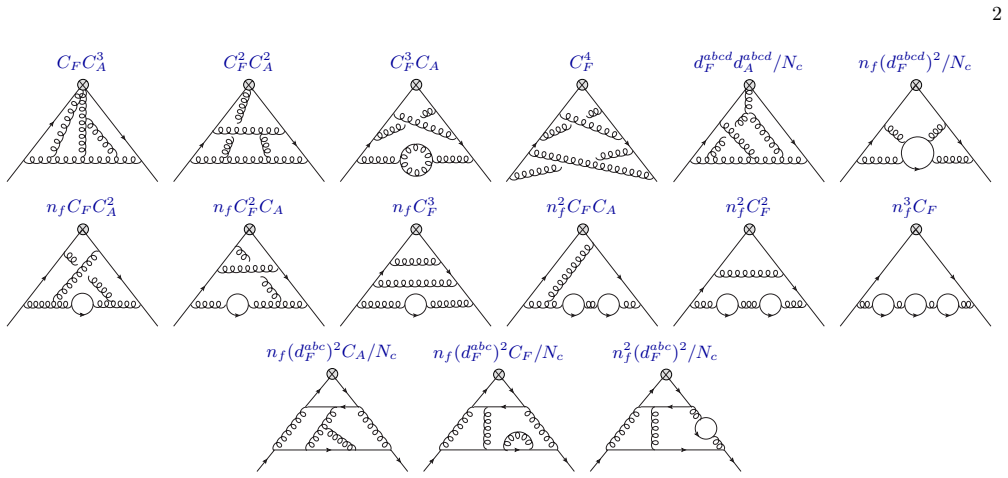
Our analytic results for γ_ns^(3) are expressed solely in terms of harmonic sums and decomposed into 15 color structures
What do these tags mean?
- matches
- The paper's claim is directly supported by a theorem in the formal canon.
- supports
- The theorem supports part of the paper's argument, but the paper may add assumptions or extra steps.
- extends
- The paper goes beyond the formal theorem; the theorem is a base layer rather than the whole result.
- uses
- The paper appears to rely on the theorem as machinery.
- contradicts
- The paper's claim conflicts with a theorem or certificate in the canon.
- unclear
- Pith found a possible connection, but the passage is too broad, indirect, or ambiguous to say the theorem truly supports the claim.
Forward citations
Cited by 3 Pith papers
-
Four-loop anomalous dimension of flavor non-singlet quark operator of twist two and Lorentz spin N for general gauge group: transcendental part
Closed-form expression for the ζ(3) term of the four-loop non-singlet twist-two quark anomalous dimension for arbitrary N, extracted via analytic reconstruction from Mellin moments.
-
Properties and implications of the four-loop non-singlet splitting functions in QCD
Four-loop non-singlet QCD splitting functions are verified for consistency and used to finalize analytical forms for the gluon virtual anomalous dimension and N^4LL threshold resummation coefficients, revealing a new ...
-
Four-Loop Gluon Anomalous Dimension of General Lorentz Spin: Transcendental Part
The zeta(3)-proportional contribution to the four-loop twist-two gluon anomalous dimension gamma_gg^(3)(N) is constructed in analytic form from low-N moments via the LLL algorithm together with reciprocity and supersy...
Reference graph
Works this paper leans on
-
[1]
J. D. Bjorken, Asymptotic Sum Rules at Infinite Momen- tum, Phys. Rev.179, 1547 (1969)
1969
-
[2]
J. D. Bjorken and E. A. Paschos, Inelastic Electron Pro- ton and gamma Proton Scattering, and the Structure of the Nucleon, Phys. Rev.185, 1975 (1969)
1975
-
[3]
G.AltarelliandG.Parisi,AsymptoticFreedominParton Language, Nucl. Phys. B126, 298 (1977)
1977
-
[4]
V. N. Gribov and L. N. Lipatov, Deep inelastic ep scat- tering in perturbation theory, Sov. J. Nucl. Phys.15, 438 (1972)
1972
-
[5]
Y. L. Dokshitzer, Calculation of the Structure Func- tionsforDeepInelasticScatteringande +e− Annihilation by Perturbation Theory in Quantum Chromodynamics., Sov. Phys. JETP46, 641 (1977)
1977
-
[6]
D. J. Gross and F. Wilczek, Asymptotically free gauge theories. 2., Phys. Rev. D9, 980 (1974)
1974
-
[7]
H. D. Politzer, Asymptotic Freedom: An Approach to Strong Interactions, Phys. Rept.14, 129 (1974)
1974
-
[8]
E. G. Floratos, D. A. Ross, and C. T. Sachrajda, Higher Order Effects in Asymptotically Free Gauge Theories: The Anomalous Dimensions of Wilson Operators, Nucl. Phys. B129, 66 (1977), [Erratum: Nucl.Phys.B 139, 545–546 (1978)]
1977
-
[9]
E. G. Floratos, D. A. Ross, and C. T. Sachrajda, Higher Order Effects in Asymptotically Free Gauge Theories. 2. Flavor Singlet Wilson Operators and Coefficient Func- tions, Nucl. Phys. B152, 493 (1979)
1979
-
[10]
Gonzalez-Arroyo, C
A. Gonzalez-Arroyo, C. Lopez, and F. J. Yndurain, Sec- ond Order Contributions to the Structure Functions in Deep Inelastic Scattering. 1. Theoretical Calculations, Nucl. Phys. B153, 161 (1979)
1979
-
[11]
Curci, W
G. Curci, W. Furmanski, and R. Petronzio, Evolution of Parton Densities Beyond Leading Order: The Nonsinglet Case, Nucl. Phys. B175, 27 (1980)
1980
-
[12]
Furmanski and R
W. Furmanski and R. Petronzio, Singlet Parton Densities Beyond Leading Order, Phys. Lett. B97, 437 (1980)
1980
-
[13]
Hamberg and W
R. Hamberg and W. L. van Neerven, The Correct renor- malization of the gluon operator in a covariant gauge, Nucl. Phys. B379, 143 (1992)
1992
- [14]
- [15]
-
[16]
J. Blümlein, P. Marquard, C. Schneider, and K. Schön- wald, The three-loop unpolarized and polarized non- singlet anomalous dimensions from off shell operator matrix elements, Nucl. Phys. B971, 115542 (2021), arXiv:2107.06267 [hep-ph]
-
[17]
J. Blümlein, P. Marquard, C. Schneider, and K. Schön- wald, The three-loop polarized singlet anomalous dimen- sions from off-shell operator matrix elements, JHEP01, 193, arXiv:2111.12401 [hep-ph]
-
[18]
T. Gehrmann, A. vonManteuffel,andT.-Z.Yang,Renor- malization of twist-two operators in covariant gauge to three loops in QCD, JHEP04, 041, arXiv:2302.00022 [hep-ph]
- [19]
- [20]
-
[21]
G. Falcioni, F. Herzog, S. Moch, and A. Vogt, Four-loop splittingfunctionsinQCD–Thequark-quarkcase,Phys. Lett. B842, 137944 (2023), arXiv:2302.07593 [hep-ph]
-
[22]
G. Falcioni, F. Herzog, S. Moch, and A. Vogt, Four-loop splitting functions in QCD – The gluon-to-quark case, Phys.Lett.B846,138215(2023),arXiv:2307.04158[hep- ph]
-
[23]
G. Falcioni, F. Herzog, S. Moch, A. Pelloni, and A. Vogt, Four-loop splitting functions in QCD – The quark-to-gluon case, Phys. Lett. B856, 138906 (2024), arXiv:2404.09701 [hep-ph]
-
[24]
G. Falcioni, F. Herzog, S. Moch, A. Pelloni, and A. Vogt, Four-loop splitting functions in QCD – the gluon-gluon case –, Phys. Lett. B860, 139194 (2025), arXiv:2410.08089 [hep-ph]
-
[25]
G. Falcioni, F. Herzog, S. Moch, A. Pelloni, and A. Vogt, Additional results on the four-loop flavour-singlet split- ting functions in QCD, Phys. Lett. B875, 140278 (2026), arXiv:2512.10783 [hep-ph]
- [26]
- [27]
-
[28]
T. Gehrmann, A. von Manteuffel, V. Sotnikov, and T.-Z. Yang, CompleteN 2 f contributions to four- loop pure-singlet splitting functions, JHEP01, 029, arXiv:2308.07958 [hep-ph]
-
[29]
T. Gehrmann, A. von Manteuffel, V. Sotnikov, and T.-Z. Yang,TheN f C 3 F contributiontothenon-singletsplitting function at four-loop order, Phys. Lett. B849, 138427 (2024), arXiv:2310.12240 [hep-ph]
-
[30]
G. Falcioni, F. Herzog, S. Moch, J. Vermaseren, and A. Vogt, The double fermionic contribution to the four- loopquark-to-gluonsplittingfunction,Phys.Lett.B848, 138351 (2024), arXiv:2310.01245 [hep-ph]
- [31]
- [32]
-
[33]
J. McGowan, T. Cridge, L. A. Harland-Lang, and R. S. Thorne, Approximate N3LO parton distribution func- tions with theoretical uncertainties: MSHT20aN 3LO PDFs, Eur. Phys. J. C83, 185 (2023), [Erratum: Eur.Phys.J.C 83, 302 (2023)], arXiv:2207.04739 [hep-ph]
-
[34]
A. Cooper-Sarkar, T. Cridge, F. Giuli, L. A. Harland- Lang, F. Hekhorn, J. Huston, G. Magni, S. Moch, and R. S. Thorne, A Benchmarking of QCD Evolution at Ap- proximateN 3LO, (2024), arXiv:2406.16188 [hep-ph]
- [35]
-
[36]
T. Cridgeet al., Combination of aN3LO PDFs and impli- cations for Higgs production cross-sections at the LHC, J. Phys. G52, 6 (2025), arXiv:2411.05373 [hep-ph]
-
[37]
C. Hampson and M. Guzzi, DGLAP evolution at N3LO with the candia algorithm, Phys. Rev. D113, 074008 (2026), arXiv:2512.22667 [hep-ph]
-
[38]
A. Karlberg, P. Nason, G. Salam, G. Zanderighi, and F. Dreyer, HOPPET v2.0.0 release note, Eur. Phys. J. C 86, 157 (2026), arXiv:2510.09310 [hep-ph]
- [39]
- [40]
-
[41]
B. Basso and G. P. Korchemsky, Anomalous dimensions of high-spin operators beyond the leading order, Nucl. Phys. B775, 1 (2007), arXiv:hep-th/0612247
-
[42]
J. A. Dixon and J. C. Taylor, Renormalization of Wilson operatorsingaugetheories,Nucl.Phys.B78,552(1974)
1974
-
[43]
G. Falcioni and F. Herzog, Renormalization of gluonic leading-twist operators in covariant gauges, JHEP05, 177, arXiv:2203.11181 [hep-ph]
-
[44]
G. Falcioni, F. Herzog, S. Moch, and S. Van Thurenhout, Constraints for twist-two alien operators in QCD, JHEP 11, 080, arXiv:2409.02870 [hep-ph]
-
[45]
T. Gehrmann, A. von Manteuffel, and T.-Z. Yang, Leading Twist-Two Gauge-Variant Counterterms, PoS LL2024, 087 (2024), arXiv:2409.10303 [hep-ph]
-
[46]
Nogueira, Automatic Feynman graph generation, J
P. Nogueira, Automatic Feynman graph generation, J. Comput. Phys.105, 279 (1993)
1993
- [47]
- [48]
-
[49]
T. van Ritbergen, A. N. Schellekens, and J. A. M. Vermaseren, Group theory factors for Feynman dia- grams, Int. J. Mod. Phys. A14, 41 (1999), arXiv:hep- ph/9802376
-
[50]
J. Ablinger, J. Blümlein, A. Hasselhuhn, S. Klein, C. Schneider, and F. Wissbrock, Massive 3-loop Lad- der Diagrams for Quarkonic Local Operator Matrix El- ements, Nucl. Phys. B864, 52 (2012), arXiv:1206.2252 [hep-ph]
-
[51]
J. Ablinger, A. Behring, J. Blümlein, A. De Freitas, A. von Manteuffel, and C. Schneider, The 3-loop pure singlet heavy flavor contributions to the structure func- tionF 2(x, Q2)and the anomalous dimension, Nucl. Phys. B890, 48 (2014), arXiv:1409.1135 [hep-ph]
-
[52]
K. G. Chetyrkin, A. L. Kataev, and F. V. Tkachov, New Approach to Evaluation of Multiloop Feynman Integrals: The Gegenbauer Polynomial x Space Technique, Nucl. Phys. B174, 345 (1980)
1980
-
[53]
High-precision calculation of multi-loop Feynman integrals by difference equations
S. Laporta, High precision calculation of multiloop Feyn- man integrals by difference equations, Int. J. Mod. Phys. A15, 5087 (2000), arXiv:hep-ph/0102033
work page Pith review arXiv 2000
-
[54]
Reduze 2 - Distributed Feynman Integral Reduction
A. von Manteuffel and C. Studerus, Reduze 2 - Distributed Feynman Integral Reduction, (2012), arXiv:1201.4330 [hep-ph]
work page Pith review arXiv 2012
-
[55]
A novel approach to integration by parts reduction
A. von Manteuffel and R. M. Schabinger, A novel ap- proach to integration by parts reduction, Phys. Lett. B 744, 101 (2015), arXiv:1406.4513 [hep-ph]
work page Pith review arXiv 2015
-
[56]
Scattering amplitudes over finite fields and multivariate functional reconstruction
T. Peraro, Scattering amplitudes over finite fields and multivariate functional reconstruction, JHEP12, 030, arXiv:1608.01902 [hep-ph]
-
[57]
M. Driesse, G. U. Jakobsen, G. Mogull, J. Plefka, B. Sauer, and J. Usovitsch, Conservative Black Hole Scattering at Fifth Post-Minkowskian and First Self- Force Order, Phys. Rev. Lett.132, 241402 (2024), arXiv:2403.07781 [hep-th]
- [58]
- [59]
-
[60]
M. von Hippel and M. Wilhelm, Refining Integration- by-Parts Reduction of Feynman Integrals with Machine Learning, JHEP05, 185, arXiv:2502.05121 [hep-th]
-
[61]
Z.-Y. Song, T.-Z. Yang, Q.-H. Cao, M.-x. Luo, and H. X. Zhu, Explainable AI-assisted Optimization for Feynman Integral Reduction, (2025), arXiv:2502.09544 [hep-ph]
- [62]
- [63]
- [64]
-
[65]
Usovitsch,Factorization of denominators in integration-by-parts reductions, 2002.08173
J. Usovitsch, Factorization of denominators in integration-by-parts reductions, (2020), arXiv:2002.08173 [hep-ph]
- [66]
-
[67]
M. Heller and A. von Manteuffel, MultivariateApart: Generalized partial fractions, Comput. Phys. Commun. 271, 108174 (2022), arXiv:2101.08283 [cs.SC]
-
[68]
T. Gehrmann and E. Remiddi, Differential equations for two loop four point functions, Nucl. Phys. B580, 485 (2000), arXiv:hep-ph/9912329
- [69]
-
[70]
J. Blümlein, M. Kauers, S. Klein, and C. Schneider, De- 8 termining the closed forms of the O(α3 s) anomalous di- mensions and Wilson coefficients from Mellin moments by means of computer algebra, Comput. Phys. Commun. 180, 2143 (2009), arXiv:0902.4091 [hep-ph]
-
[71]
J. Ablinger, A. Behring, J. Blümlein, A. De Freitas, A. von Manteuffel, and C. Schneider, Calculating Three Loop Ladder and V-Topologies for Massive Operator Matrix Elements by Computer Algebra, Comput. Phys. Commun.202, 33 (2016), arXiv:1509.08324 [hep-ph]
- [72]
- [73]
- [74]
-
[75]
A. von Manteuffel and R. M. Schabinger, Planar mas- ter integrals for four-loop form factors, JHEP05, 073, arXiv:1903.06171 [hep-ph]
- [76]
-
[77]
J. A. M. Vermaseren, Harmonic sums, Mellin transforms and integrals, Int. J. Mod. Phys. A14, 2037 (1999), arXiv:hep-ph/9806280
work page Pith review arXiv 2037
- [78]
- [79]
-
[80]
A Computer Algebra Toolbox for Harmonic Sums Related to Particle Physics
J. Ablinger,A Computer Algebra Toolbox for Harmonic Sums Related to Particle Physics, Master’s thesis, Linz U. (2009), arXiv:1011.1176 [math-ph]
work page Pith review arXiv 2009
discussion (0)
Sign in with ORCID, Apple, or X to comment. Anyone can read and Pith papers without signing in.