Recognition: no theorem link
ANTIC: Adaptive Neural Temporal In-situ Compressor
Pith reviewed 2026-05-14 21:43 UTC · model grok-4.3
The pith
ANTIC reduces storage for high-dimensional PDE simulations by orders of magnitude via adaptive snapshot selection and neural residual compression.
A machine-rendered reading of the paper's core claim, the machinery that carries it, and where it could break.
Core claim
ANTIC performs end-to-end in-situ compression for transient PDE fields by combining an adaptive temporal selector that identifies and filters informative snapshots at simulation time with a spatial neural compression module that uses continual fine-tuning of neural fields to learn residual updates between adjacent snapshots, enabling combined temporal and spatial reduction in one streaming pass and storage reductions of several orders of magnitude while preserving physics accuracy.
What carries the argument
The adaptive temporal selector for high-dimensional physics that filters snapshots during the run, paired with continual fine-tuning of neural fields to capture residual updates between kept snapshots.
If this is right
- Transient simulations of Navier-Stokes, magnetohydrodynamics or plasma physics no longer require explicit on-disk storage of entire time-evolved trajectories.
- The single-pass streaming design removes the need to buffer full spatiotemporal fields before compression.
- Storage reductions of several orders of magnitude become feasible while experimental results continue to link those reductions directly to maintained physics accuracy.
- High-performance computing infrastructures can support longer or higher-resolution runs without hitting current disk-capacity limits.
Where Pith is reading between the lines
- The same selector-plus-residual architecture could be tested on streaming data from other high-volume sources such as sensor arrays or climate ensembles.
- Direct integration of the compressed representation into existing analysis pipelines would allow queries without full decompression.
- Advances in neural-field hardware acceleration would further lower the runtime overhead of the continual fine-tuning step.
Load-bearing premise
The adaptive selector correctly identifies which snapshots can be omitted without changing downstream physics conclusions, and the neural fine-tuning preserves conservation properties and error bounds without extra post-hoc adjustments.
What would settle it
A controlled run in which the physics conclusions or conserved quantities derived from the compressed trajectory deviate measurably from those obtained from the full data set, for example total energy error exceeding a chosen threshold.
Figures


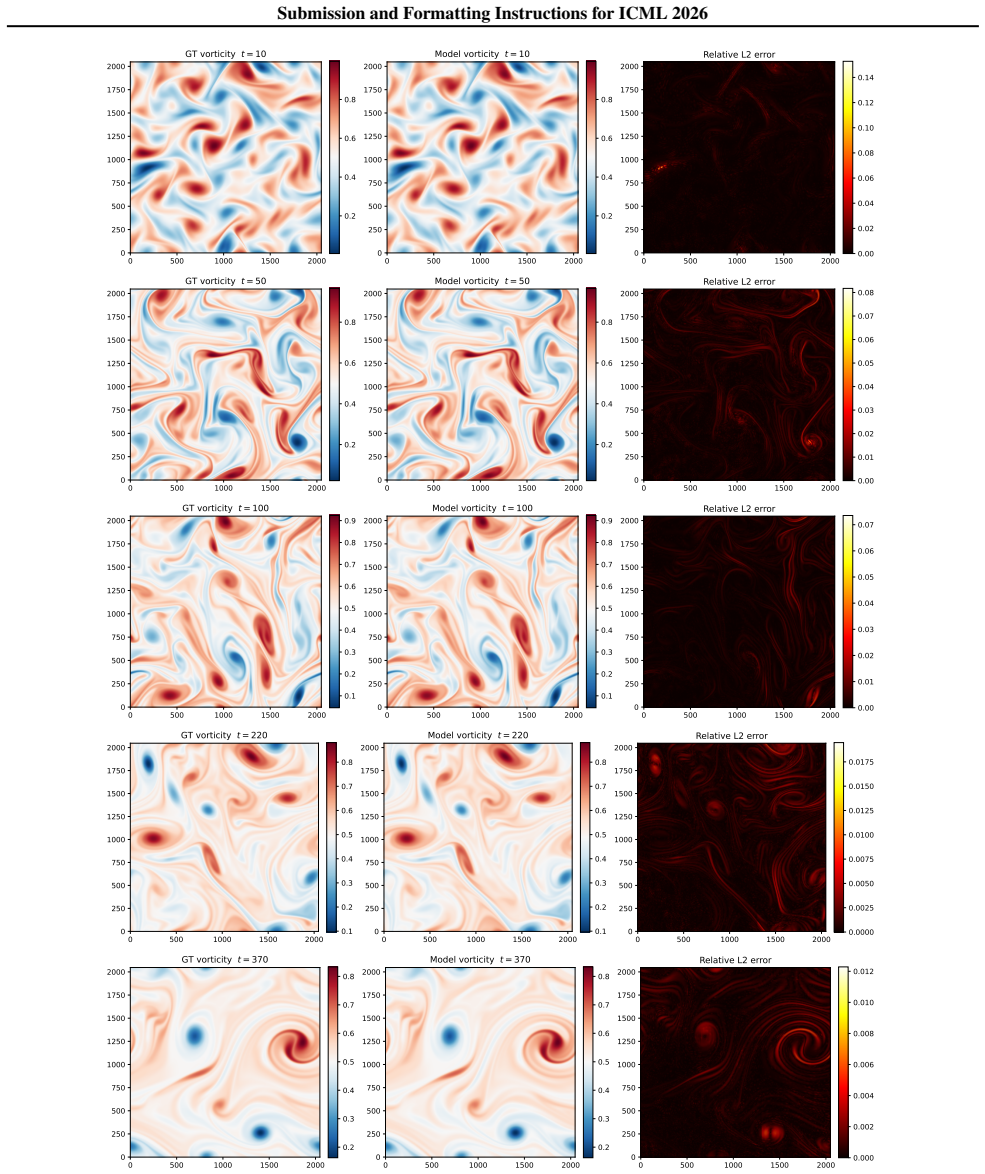
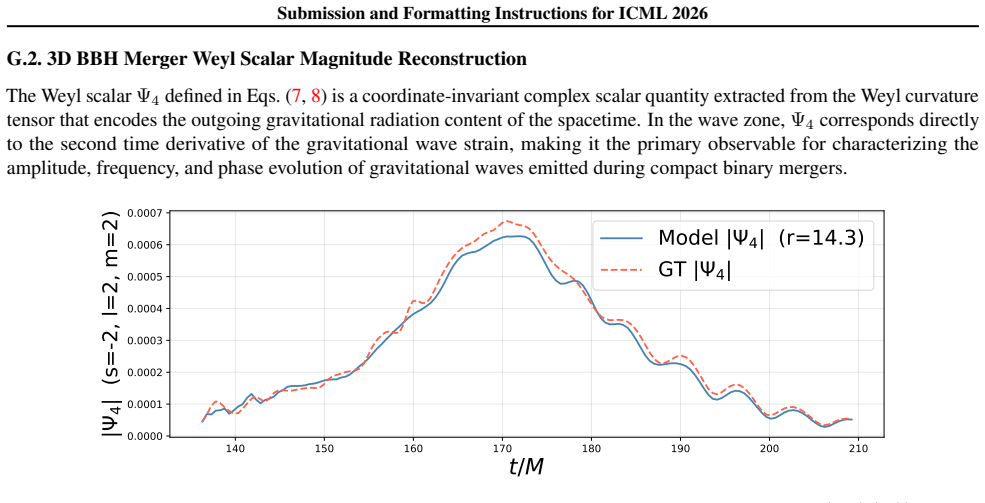
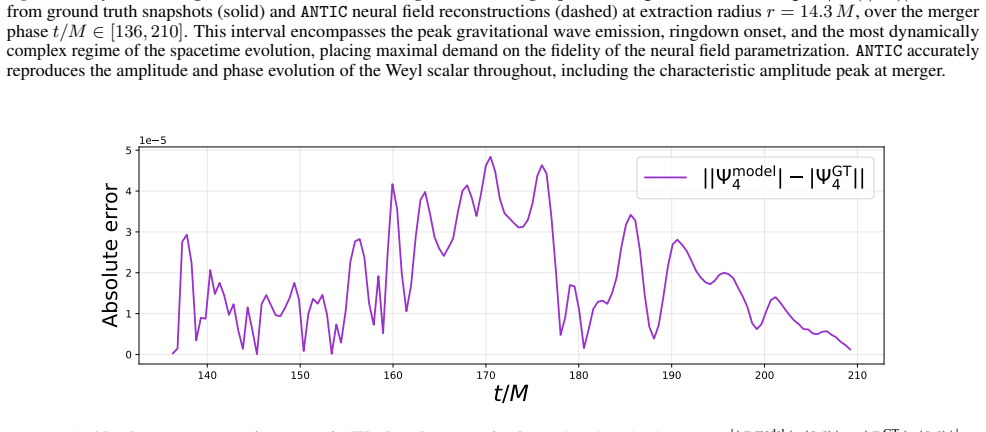
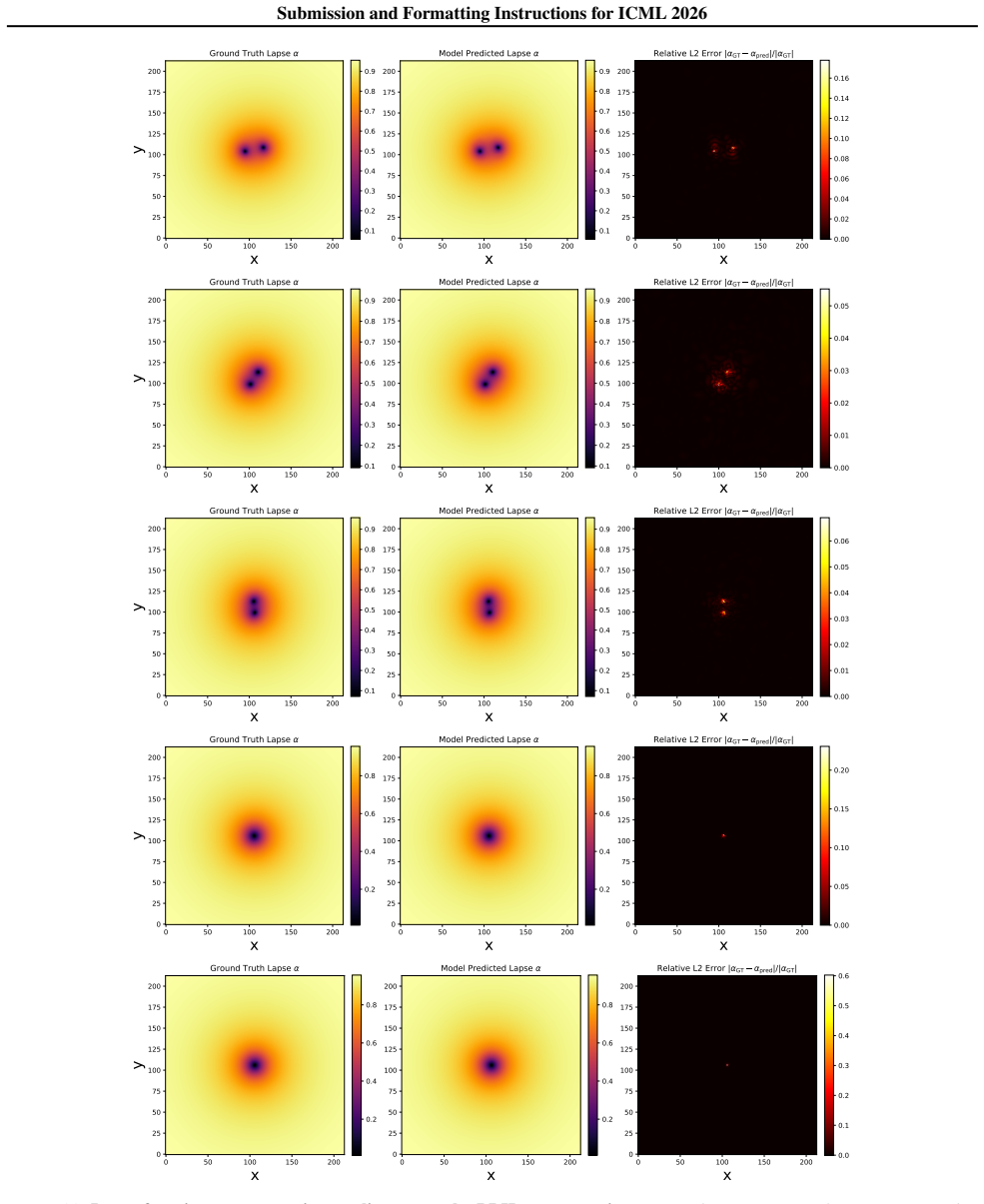
read the original abstract
The persistent storage requirements for high-resolution, spatiotemporally evolving fields governed by large-scale and high-dimensional partial differential equations (PDEs) have reached the petabyte-to-exabyte scale. Transient simulations modeling Navier-Stokes equations, magnetohydrodynamics, plasma physics, or binary black hole mergers generate data volumes that are prohibitive for modern high-performance computing (HPC) infrastructures. To address this bottleneck, we introduce ANTIC (Adaptive Neural Temporal in situ Compressor), an end-to-end in situ compression pipeline. ANTIC consists of an adaptive temporal selector tailored to high-dimensional physics that identifies and filters informative snapshots at simulation time, combined with a spatial neural compression module based on continual fine-tuning that learns residual updates between adjacent snapshots using neural fields. By operating in a single streaming pass, ANTIC enables a combined compression of temporal and spatial components and effectively alleviates the need for explicit on-disk storage of entire time-evolved trajectories. Experimental results demonstrate how storage reductions of several orders of magnitude relate to physics accuracy.
Editorial analysis
A structured set of objections, weighed in public.
Referee Report
Summary. The paper introduces ANTIC, an end-to-end in-situ compression pipeline for high-dimensional, time-evolving PDE fields (e.g., Navier-Stokes, MHD). It combines an adaptive temporal selector that filters informative snapshots during simulation with a spatial neural compression module that uses continual fine-tuning of neural fields to encode residual updates between snapshots. The method runs in a single streaming pass and claims to deliver several orders-of-magnitude storage reduction while preserving physics accuracy, as shown through experimental results.
Significance. If the empirical claims are substantiated with quantitative metrics and conservation checks, ANTIC could meaningfully alleviate petabyte-scale storage bottlenecks in HPC for transient physics simulations. The in-situ streaming design and joint temporal-spatial compression are practical strengths; however, the absence of reported baselines, error distributions, and invariant preservation tests in the provided description leaves the significance difficult to assess at present.
major comments (3)
- [§5] §5 (Experimental Results): The central claim that storage reductions of several orders of magnitude relate to preserved physics accuracy is not supported by any quantitative metrics, baselines, error distributions, or ablation studies in the reported text. Without these, the empirical demonstration cannot be evaluated.
- [§4.2, §4.3] §4.2 (Adaptive Temporal Selector) and §4.3 (Continual Neural Fine-Tuning): No explicit verification is described that skipped snapshots or residual neural-field updates preserve conserved quantities (total energy, momentum, divergence-free condition) or that downstream re-simulation from the compressed trajectory yields unchanged physics conclusions. L2 or visual fidelity alone is insufficient for the headline claim.
- [§5.3] §5.3 (Long-horizon evaluation): The paper asserts orders-of-magnitude compression across long time horizons, yet provides no measurement of accumulated drift in the continual fine-tuning process or re-execution accuracy of the original solver from the compressed data.
minor comments (2)
- [§4] Notation for the neural-field residual update and the temporal selection criterion should be defined explicitly with equations rather than prose descriptions.
- [Figures 3-5] Figure captions and axis labels in the experimental plots lack units and baseline comparisons, reducing clarity.
Simulated Author's Rebuttal
We thank the referee for their constructive and detailed review. The comments identify important gaps in the empirical validation that we will address in the revision. Below we respond point-by-point to the major comments.
read point-by-point responses
-
Referee: [§5] §5 (Experimental Results): The central claim that storage reductions of several orders of magnitude relate to preserved physics accuracy is not supported by any quantitative metrics, baselines, error distributions, or ablation studies in the reported text. Without these, the empirical demonstration cannot be evaluated.
Authors: The referee correctly notes that the current text does not present sufficient quantitative detail to substantiate the central claim. While the manuscript states that experimental results demonstrate the relation between storage reduction and physics accuracy, the provided description lacks explicit baselines, error distributions, and ablation studies. We will expand Section 5 with additional tables reporting storage ratios against SZ/ZFP baselines, relative L2 and physics-specific error metrics, and ablation results on the temporal selector. These additions will be included in the revised manuscript. revision: yes
-
Referee: [§4.2, §4.3] §4.2 (Adaptive Temporal Selector) and §4.3 (Continual Neural Fine-Tuning): No explicit verification is described that skipped snapshots or residual neural-field updates preserve conserved quantities (total energy, momentum, divergence-free condition) or that downstream re-simulation from the compressed trajectory yields unchanged physics conclusions. L2 or visual fidelity alone is insufficient for the headline claim.
Authors: We agree that L2 and visual fidelity alone are insufficient to support claims about preserved physics. The current manuscript does not describe explicit checks for conserved quantities or downstream re-simulation accuracy. We will add a dedicated subsection (new §4.4) that reports verification of total energy, momentum, and divergence-free conditions on skipped and reconstructed snapshots, together with results from re-running the original solver on the decompressed trajectories. These analyses will be included in the revision. revision: yes
-
Referee: [§5.3] §5.3 (Long-horizon evaluation): The paper asserts orders-of-magnitude compression across long time horizons, yet provides no measurement of accumulated drift in the continual fine-tuning process or re-execution accuracy of the original solver from the compressed data.
Authors: The referee is right that accumulated drift and re-execution accuracy are not quantified in the current long-horizon evaluation. We will extend §5.3 with plots and tables measuring residual drift over extended time horizons and direct comparisons of solver outputs (e.g., final state errors and integrated quantities) when the original PDE solver is re-executed from the compressed data. These measurements will be added to the revised manuscript. revision: yes
Circularity Check
No circularity: ANTIC relies on empirical validation of adaptive selector and neural compression rather than any self-referential derivation
full rationale
The paper describes an engineering pipeline (adaptive temporal selector + continual neural-field fine-tuning for residuals) whose central claims are supported solely by experimental storage-accuracy trade-offs. No equations, fitted parameters renamed as predictions, uniqueness theorems, or self-citation chains appear in the provided abstract or described method. The derivation chain is absent; results are presented as direct measurements on simulation trajectories, not as quantities forced by construction from the inputs themselves. This is the normal non-circular case for a methods paper whose correctness rests on external benchmarks rather than internal redefinition.
Axiom & Free-Parameter Ledger
Reference graph
Works this paper leans on
-
[1]
" write newline "" before.all 'output.state := FUNCTION n.dashify 't := "" t empty not t #1 #1 substring "-" = t #1 #2 substring "--" = not "--" * t #2 global.max substring 't := t #1 #1 substring "-" = "-" * t #2 global.max substring 't := while if t #1 #1 substring * t #2 global.max substring 't := if while FUNCTION format.date year duplicate empty "emp...
-
[2]
Abbott, B. P. et al. Observation of gravitational waves from a binary black hole merger. Phys. Rev. Lett., 116: 0 061102, Feb 2016 a . doi:10.1103/PhysRevLett.116.061102
-
[3]
Abbott, B. P. et al. Gw150914: The advanced ligo detectors in the era of first discoveries. Phys. Rev. Lett., 116: 0 131103, Mar 2016 b . doi:10.1103/PhysRevLett.116.131103
-
[4]
Intrinsic dimensionality explains the effectiveness of language model fine-tuning
Aghajanyan, A., Gupta, S., and Zettlemoyer, L. Intrinsic dimensionality explains the effectiveness of language model fine-tuning. In Zong, C., Xia, F., Li, W., and Navigli, R. (eds.), Proceedings of the 59th Annual Meeting of the Association for Computational Linguistics and the 11th International Joint Conference on Natural Language Processing, ACL/IJCNL...
-
[5]
Fluid intelligence: A forward look on ai foundation models in computational fluid dynamics, 2025
Ashton, N., Brandstetter, J., and Mishra, S. Fluid intelligence: A forward look on ai foundation models in computational fluid dynamics, 2025
work page 2025
-
[6]
Ba, L. J., Kiros, J. R., and Hinton, G. E. Layer normalization. CoRR, abs/1607.06450, 2016. URL http://arxiv.org/abs/1607.06450
work page internal anchor Pith review Pith/arXiv arXiv 2016
-
[7]
Balin, R., Simini, F., Simpson, C., Shao, A., Rigazzi, A., Ellis, M., Becker, S., Doostan, A., Evans, J. A., and Jansen, K. E. In situ framework for coupling simulation and machine learning with application to cfd, 2023
work page 2023
-
[8]
Tthresh: Tensor compression for multidimensional visual data
Ballester-Ripoll, R., Lindstrom, P., and Pajarola, R. Tthresh: Tensor compression for multidimensional visual data. IEEE Transactions on Visualization and Computer Graphics, 26 0 (9): 0 2891--2903, 2020. doi:10.1109/TVCG.2019.2904063
-
[9]
Baumgarte, T. W. and Shapiro, S. L. Numerical Relativity: Solving Einstein’s Equations on the Computer. Cambridge University Press, 2010
work page 2010
-
[10]
A fast, compressed and persistent data store library , 2009-2025
Blosc Development Team . A fast, compressed and persistent data store library , 2009-2025. https://blosc.org
work page 2009
-
[11]
Bodnar, A., Cranganore, S. S., and Brandstetter, J. JAX\_NR , 2025 a . GitHub repository
work page 2025
-
[12]
P., Lucic, A., Stanley, M., Allen, A., Brandstetter, J., Garvan, P., Riechert, M., Weyn, J
Bodnar, C., Bruinsma, W. P., Lucic, A., Stanley, M., Allen, A., Brandstetter, J., Garvan, P., Riechert, M., Weyn, J. A., Dong, H., et al. A foundation model for the earth system. Nature, pp.\ 1--8, 2025 b
work page 2025
-
[13]
Bradbury, J., Frostig, R., Hawkins, P., Johnson, M. J., Leary, C., Maclaurin, D., Necula, G., Paszke, A., Vander P las, J., Wanderman- M ilne, S., and Zhang, Q. JAX : composable transformations of P ython+ N um P y programs, 2018
work page 2018
-
[14]
Bross, B., Wang, Y.-K., Ye, Y., Liu, S., Chen, J., Sullivan, G. J., and Ohm, J.-R. Overview of the versatile video coding (vvc) standard and its applications. IEEE Transactions on Circuits and Systems for Video Technology, 31 0 (10): 0 3736--3764, 2021. doi:10.1109/TCSVT.2021.3101953
-
[15]
CERN hits one exabyte of stored experimental data from the LHC , dec 2025
CERN . CERN hits one exabyte of stored experimental data from the LHC , dec 2025. Accessed: 2026-01-06
work page 2025
-
[16]
S., Bodnar, A., Berzins, A., and Brandstetter, J
Cranganore, S. S., Bodnar, A., Berzins, A., and Brandstetter, J. Einstein fields: A neural perspective to computational general relativity, 2025
work page 2025
-
[17]
M., Osindero, S., Jaderberg, M., Swirszcz, G., and Pascanu, R
Czarnecki, W. M., Osindero, S., Jaderberg, M., Swirszcz, G., and Pascanu, R. Sobolev training for neural networks. In Guyon, I., von Luxburg, U., Bengio, S., Wallach, H. M., Fergus, R., Vishwanathan, S. V. N., and Garnett, R. (eds.), Advances in Neural Information Processing Systems 30: Annual Conference on Neural Information Processing Systems 2017, Dece...
work page 2017
-
[18]
Doering, C. R. and Gibbon, J. D. Applied Analysis of the Navier-Stokes Equations. Cambridge Texts in Applied Mathematics. Cambridge University Press, 1995
work page 1995
-
[19]
Dresdner, G., Kochkov, D., Norgaard, P., Zepeda-Núñez, L., Smith, J. A., Brenner, M. P., and Hoyer, S. Learning to correct spectral methods for simulating turbulent flows. 2022. doi:10.48550/ARXIV.2207.00556
-
[20]
Dupont, E., Goliński, A., Alizadeh, M., Teh, Y. W., and Doucet, A. Coin: Compression with implicit neural representations, 2021
work page 2021
-
[21]
Sigmoid-weighted linear units for neural network function approximation in reinforcement learning
Elfwing, S., Uchibe, E., and Doya, K. Sigmoid-weighted linear units for neural network function approximation in reinforcement learning. Neural Networks, 107: 0 3--11, 2018. doi:10.1016/J.NEUNET.2017.12.012
-
[22]
Fout, N. and Ma, K.-L. An adaptive prediction-based approach to lossless compression of floating-point volume data. IEEE Transactions on Visualization and Computer Graphics, 18 0 (12): 0 2295--2304, 2012. doi:10.1109/TVCG.2012.194
-
[23]
S., Hornsby, W., Carey, N., Zanisi, L., Pamela, S., and Brandstetter, J
Galletti, G., Gutenbrunner, G., Paischer, F., Cranganore, S. S., Hornsby, W., Carey, N., Zanisi, L., Pamela, S., and Brandstetter, J. Learning to compress plasma turbulence. In NeurIPS 2025 AI for Science Workshop, 2025
work page 2025
-
[24]
Deep learning for in situ data compression of large turbulent flow simulations
Glaws, A., King, R., and Sprague, M. Deep learning for in situ data compression of large turbulent flow simulations. Phys. Rev. Fluids, 5: 0 114602, Nov 2020. doi:10.1103/PhysRevFluids.5.114602
-
[25]
Mgard: A multigrid framework for high-performance, error-controlled data compression and refactoring
Gong, Q., Chen, J., Whitney, B., Liang, X., Reshniak, V., Banerjee, T., Lee, J., Rangarajan, A., Wan, L., Vidal, N., Liu, Q., Gainaru, A., Podhorszki, N., Archibald, R., Ranka, S., and Klasky, S. Mgard: A multigrid framework for high-performance, error-controlled data compression and refactoring. SoftwareX, 24: 0 101590, 2023 a . ISSN 2352-7110. doi:https...
-
[26]
Gong, Q., Zhang, C., Liang, X., Reshniak, V., Chen, J., Rangarajan, A., Ranka, S., Vidal, N., Wan, L., Ullrich, P., Podhorszki, N., Jacob, R., and Klasky, S. Spatiotemporally adaptive compression for scientific dataset with feature preservation – a case study on simulation data with extreme climate events analysis. In 2023 IEEE 19th International Conferen...
-
[27]
Gottlieb, S., Ketcheson, D. I., and Shu, C.-W. High order strong stability preserving time discretizations. Journal of Scientific Computing, 38 0 (3): 0 251--289, March 2009
work page 2009
-
[28]
Govett, M., Bah, B., Bauer, P., Berod, D., Bouchet, V., Corti, S., Davis, C., Duan, Y., Graham, T., Honda, Y., Hines, A., Jean, M., Ishida, J., Lawrence, B., Li, J., Luterbacher, J., Muroi, C., Rowe, K., Schultz, M., Visbeck, M., and Williams, K. Exascale computing and data handling: Challenges and opportunities for weather and climate prediction. Bulleti...
-
[29]
Hairer, E. and Wanner, G. Solving Ordinary Differential Equations II, volume 14 of Springer Series in Computational Mathematics. Springer-Verlag, Berlin, Heidelberg, 2 edition, 1996. ISBN 978-3-540-60452-5. doi:10.1007/978-3-642-05221-7
-
[30]
Solving Ordinary Differential Equations I: Nonstiff Problems
Hairer, E., N rsett, S., and Wanner, G. Solving Ordinary Differential Equations I: Nonstiff Problems. Springer Series in Computational Mathematics. Springer Berlin Heidelberg, 2008. ISBN 9783540566700
work page 2008
-
[31]
Jet from binary neutron star merger with prompt black hole formation
Hayashi, K., Kiuchi, K., Kyutoku, K., Sekiguchi, Y., and Shibata, M. Jet from binary neutron star merger with prompt black hole formation. Phys. Rev. Lett., 134: 0 211407, May 2025. doi:10.1103/PhysRevLett.134.211407
-
[32]
Lora+: Efficient low rank adaptation of large models
Hayou, S., Ghosh, N., and Yu, B. Lora+: Efficient low rank adaptation of large models. arXiv preprint arXiv:2402.12354, 2024
-
[33]
Falloff of the weyl scalars in binary black hole spacetimes
Hinder, I., Wardell, B., and Bentivegna, E. Falloff of the weyl scalars in binary black hole spacetimes. Phys. Rev. D, 84: 0 024036, Jul 2011. doi:10.1103/PhysRevD.84.024036
-
[34]
Future of storage: Hpc and ai storage by the numbers
HPCwire. Future of storage: Hpc and ai storage by the numbers. , October 2025. Accessed: YYYY-MM-DD
work page 2025
-
[35]
J., Shen, Y., Wallis, P., Allen-Zhu, Z., Li, Y., Wang, S., Wang, L., and Chen, W
Hu, E. J., Shen, Y., Wallis, P., Allen-Zhu, Z., Li, Y., Wang, S., Wang, L., and Chen, W. Lora: Low-rank adaptation of large language models, 2021
work page 2021
-
[36]
Huang, L. and Hoefler, T. Compressing multidimensional weather and climate data into neural networks, 2023
work page 2023
-
[37]
Iozzo, D. A. B., Boyle, M., Deppe, N., Moxon, J., Scheel, M. A., Kidder, L. E., Pfeiffer, H. P., and Teukolsky, S. A. Extending gravitational wave extraction using weyl characteristic fields. Phys. Rev. D, 103: 0 024039, Jan 2021. doi:10.1103/PhysRevD.103.024039
-
[38]
Information technology — jpeg 2000 image coding system part 1: Core coding system
ISO Central Secretary . Information technology — jpeg 2000 image coding system part 1: Core coding system. Standard ISO/IEC 15444-1:2024, International Organization for Standardization, Geneva, CH, 2024
work page 2000
-
[39]
Adaptive keyframe selection for scalable 3d scene reconstruction in dynamic environments, 2025
Jha, R., Zhou, Y., and Loianno, G. Adaptive keyframe selection for scalable 3d scene reconstruction in dynamic environments, 2025
work page 2025
-
[40]
Jia, R., Kamel, M. S., Wu, C., and Agrawal, B. Ansys Fluent HPC for Large-Scale CFD Simulations. doi:10.2514/6.2025-1950. URL https://arc.aiaa.org/doi/abs/10.2514/6.2025-1950
-
[41]
Neurlz: An online neural learning-based method to enhance scientific lossy compression
Jia, W., Hu, Z., Liu, Y., Zhang, B., Wang, J., Liu, J., Niu, W., Kalafatis, S., Huang, J., Jin, S., Wang, D., Tian, J., and Yin, M. Neurlz: An online neural learning-based method to enhance scientific lossy compression. In Proceedings of the 39th ACM International Conference on Supercomputing, ICS '25, pp.\ 26–42, New York, NY, USA, 2025. Association for ...
-
[42]
Codecnerf: Toward fast encoding and decoding, compact, and high-quality novel-view synthesis
Kang, G., Lee, Y., and Park, E. Codecnerf: Toward fast encoding and decoding, compact, and high-quality novel-view synthesis. CoRR, abs/2404.04913, 2024. doi:10.48550/ARXIV.2404.04913
-
[43]
Kolomenskiy, D., Onishi, R., and Uehara, H. Waverange: wavelet-based data compression for three-dimensional numerical simulations on regular grids. Journal of Visualization, 25 0 (3): 0 543--573, Jun 2022. ISSN 1875-8975. doi:10.1007/s12650-021-00813-8
-
[44]
Krommes, J. A. The gyrokinetic description of microturbulence in magnetized plasmas. Annual Review of Fluid Mechanics, 44 0 (Volume 44, 2012): 0 175--201, 2012. ISSN 1545-4479. doi:https://doi.org/10.1146/annurev-fluid-120710-101223
-
[45]
Kryder, M. H. and Kim, C. S. After hard drives—what comes next? IEEE Transactions on Magnetics, 45 0 (10): 0 3406--3413, 2009. doi:10.1109/TMAG.2009.2024163
-
[46]
Lakshminarasimhan, S., Shah, N., Ethier, S., Klasky, S., Latham, R., Ross, R., and Samatova, N. F. Compressing the incompressible with isabela: In-situ reduction of spatio-temporal data. In Jeannot, E., Namyst, R., and Roman, J. (eds.), Euro-Par 2011 Parallel Processing, pp.\ 366--379, Berlin, Heidelberg, 2011. Springer Berlin Heidelberg. ISBN 978-3-642-23400-2
work page 2011
-
[47]
Ascent: A Flyweight In Situ Library for Exascale Simulations
Larsen, M., Brugger, E., Childs, H., and Harrison, C. Ascent: A Flyweight In Situ Library for Exascale Simulations . In In Situ Visualization For Computational Science , pp.\ 255 -- 279. Mathematics and Visualization book series from Springer Publishing, Cham, Switzerland, May 2022
work page 2022
-
[48]
Le, H. and Tao, J. Hierarchical autoencoder-based lossy compression for large-scale high-resolution scientific data. Computing&AI Connect, 1 0 (1): 0 1, June 2024. ISSN 3104-4719. doi:10.69709/caic.2024.193132
-
[49]
M., Tian, J., Deng, J., Calhoun, J
Liang, X., Zhao, K., Di, S., Li, S., Underwood, R., Gok, A. M., Tian, J., Deng, J., Calhoun, J. C., Tao, D., Chen, Z., and Cappello, F. Sz3: A modular framework for composing prediction-based error-bounded lossy compressors, 2021. URL https://arxiv.org/abs/2111.02925
-
[50]
Fixed-rate compressed floating-point arrays
Lindstrom, P. Fixed-rate compressed floating-point arrays. IEEE Transactions on Visualization and Computer Graphics, 20 0 (12): 0 2674--2683, 2014. doi:10.1109/TVCG.2014.2346458
-
[51]
Lindstrom, P. and Isenburg, M. Fast and efficient compression of floating-point data. IEEE Transactions on Visualization and Computer Graphics, 12 0 (5): 0 1245--1250, 2006. doi:10.1109/TVCG.2006.143
-
[52]
Editing conditional radiance fields
Liu, S., Zhang, X., Zhang, Z., Zhang, R., Zhu, J.-Y., and Russell, B. Editing conditional radiance fields. In 2021 IEEE/CVF International Conference on Computer Vision (ICCV), pp.\ 5773--5783, Los Alamitos, CA, USA, October 2021. IEEE Computer Society. doi:10.1109/ICCV48922.2021.00572
-
[53]
Loshchilov, I. and Hutter, F. Sgdr: Stochastic gradient descent with warm restarts, 2017
work page 2017
-
[54]
Loshchilov, I. and Hutter, F. Decoupled weight decay regularization. In 7th International Conference on Learning Representations, ICLR 2019, New Orleans, LA, USA, May 6-9, 2019 . OpenReview.net, 2019. URL https://openreview.net/forum?id=Bkg6RiCqY7
work page 2019
-
[55]
Dvc: An end-to-end deep video compression framework
Lu, G., Ouyang, W., Xu, D., Zhang, X., Cai, C., and Gao, Z. Dvc: An end-to-end deep video compression framework. In 2019 IEEE/CVF Conference on Computer Vision and Pattern Recognition (CVPR), pp.\ 10998--11007, 2019. doi:10.1109/CVPR.2019.01126
-
[56]
Survey of storage systems for high-performance computing
Luttgau, J., Kuhn, M., Duwe, K., Alforov, Y., Betke, E., Kunkel, J., and Ludwig, T. Survey of storage systems for high-performance computing. Supercomput. Front. Innov.: Int. J., 5 0 (1): 0 31–58, March 2018. ISSN 2409-6008. doi:10.14529/jsfi180103
-
[57]
PEFT : State-of-the-art parameter-efficient fine-tuning methods, 2022
Mangrulkar, S., Gugger, S., Debut, L., Belkada, Y., Paul, S., Bossan, B., and Tietz, M. PEFT : State-of-the-art parameter-efficient fine-tuning methods, 2022
work page 2022
-
[58]
Occupancy networks: Learning 3d reconstruction in function space
Mescheder, L., Oechsle, M., Niemeyer, M., Nowozin, S., and Geiger, A. Occupancy networks: Learning 3d reconstruction in function space. In Proceedings of the IEEE/CVF conference on computer vision and pattern recognition, pp.\ 4455--4465, June 2019. doi:10.1109/CVPR.2019.00459
-
[59]
Mildenhall, B., Srinivasan, P. P., Tancik, M., Barron, J. T., Ramamoorthi, R., and Ng, R. Nerf: Representing scenes as neural radiance fields for view synthesis. Communications of the ACM, 65 0 (1): 0 99--106, 2021
work page 2021
-
[60]
Instant neural graphics primitives with a multiresolution hash encoding
Müller, T., Evans, A., Schied, C., and Keller, A. Instant neural graphics primitives with a multiresolution hash encoding. ACM Transactions on Graphics, 41 0 (4): 0 1–15, July 2022. ISSN 1557-7368. doi:10.1145/3528223.3530127
-
[61]
J., Walden, A., Nastac, G., Wang, L., Jones, W., Lohry, M., Anderson, W
Nielsen, E. J., Walden, A., Nastac, G., Wang, L., Jones, W., Lohry, M., Anderson, W. K., Diskin, B., Liu, Y., Rumsey, C. L., Iyer, P., Moran, P., and Zubair, M. Large-Scale Computational Fluid Dynamics Simulations of Aerospace Configurations on the Frontier Exascale System. doi:10.2514/6.2024-3866
-
[62]
Ohm, J.-R., Sullivan, G. J., Schwarz, H., Tan, T. K., and Wiegand, T. Comparison of the coding efficiency of video coding standards—including high efficiency video coding (hevc). IEEE Transactions on circuits and systems for video technology, 22 0 (12): 0 1669--1684, 2012
work page 2012
-
[63]
Gyroswin: 5d surrogates for gyrokinetic plasma turbulence simulations
Paischer, F., Galletti, G., Hornsby, W., Setinek, P., Zanisi, L., Carey, N., Pamela, S., and Brandstetter, J. Gyroswin: 5d surrogates for gyrokinetic plasma turbulence simulations. In The Thirty-ninth Annual Conference on Neural Information Processing Systems, 2025 a
work page 2025
-
[64]
Paischer, F., Hauzenberger, L., Schmied, T., Alkin, B., Deisenroth, M. P., and Hochreiter, S. One initialization to rule them all: Fine-tuning via explained variance adaptation, 2025 b
work page 2025
-
[65]
Evolution of binary black-hole spacetimes
Pretorius, F. Evolution of binary black-hole spacetimes. Phys. Rev. Lett., 95: 0 121101, Sep 2005. doi:10.1103/PhysRevLett.95.121101
-
[66]
Reed, D. A. and Dongarra, J. Exascale computing and big data. Commun. ACM, 58 0 (7): 0 56–68, June 2015. ISSN 0001-0782. doi:10.1145/2699414
-
[67]
Richardson, I. E. The H.264 Advanced Video Compression Standard. Wiley Publishing, 2nd edition, 2010. ISBN 0470516925
work page 2010
-
[68]
Rossinelli, D., Hejazialhosseini, B., Hadjidoukas, P., Bekas, C., Curioni, A., Bertsch, A., Futral, S., Schmidt, S. J., Adams, N. A., and Koumoutsakos, P. 11 pflop/s simulations of cloud cavitation collapse. In Proceedings of the International Conference on High Performance Computing, Networking, Storage and Analysis, SC '13, New York, NY, USA, 2013. Asso...
-
[69]
Shibata, M. and Nakamura, T. Evolution of three-dimensional gravitational waves: Harmonic slicing case. Phys. Rev. D, 52: 0 5428--5444, Nov 1995. doi:10.1103/PhysRevD.52.5428
-
[70]
Siena, A. D., Bourdelle, C., Navarro, A. B., Merlo, G., Görler, T., Fransson, E., Polevoi, A., Kim, S. H., Koechl, F., Loarte, A., Fable, E., Angioni, C., Mantica, P., and Jenko, F. First global gyrokinetic profile predictions of iter burning plasma, 2025
work page 2025
-
[71]
Neural fields for visual computing: Siggraph 2023 course
Takikawa, T., Saito, S., Tompkin, J., Sitzmann, V., Sridhar, S., Litany, O., and Yu, A. Neural fields for visual computing: Siggraph 2023 course. In ACM SIGGRAPH 2023 Courses, SIGGRAPH '23, New York, NY, USA, 2023. Association for Computing Machinery. ISBN 9798400701450. doi:10.1145/3587423.3595477
-
[72]
P., Mildenhall, B., Fridovich - Keil, S., Raghavan, N., Singhal, U., Ramamoorthi, R., Barron, J
Tancik, M., Srinivasan, P. P., Mildenhall, B., Fridovich - Keil, S., Raghavan, N., Singhal, U., Ramamoorthi, R., Barron, J. T., and Ng, R. Fourier features let networks learn high frequency functions in low dimensional domains. In Larochelle, H., Ranzato, M., Hadsell, R., Balcan, M., and Lin, H. (eds.), Advances in Neural Information Processing Systems 33...
work page 2020
-
[73]
Teukolsky , S. A. Perturbations of a Rotating Black Hole. I. Fundamental Equations for Gravitational, Electromagnetic, and Neutrino-Field Perturbations . Astrophysical Journal, 185: 0 635--648, October 1973. doi:10.1086/152444
-
[74]
Predicting file lifetimes for data placement in multi-tiered storage systems for hpc
Thomas, L., Gougeaud, S., Rubini, S., Deniel, P., and Boukhobza, J. Predicting file lifetimes for data placement in multi-tiered storage systems for hpc. In Proceedings of the Workshop on Challenges and Opportunities of Efficient and Performant Storage Systems, CHEOPS '21, New York, NY, USA, 2021. Association for Computing Machinery. ISBN 9781450383028. d...
-
[75]
Salient time steps selection from large scale time-varying data sets with dynamic time warping
Tong, X., Lee, T.-Y., and Shen, H.-W. Salient time steps selection from large scale time-varying data sets with dynamic time warping. In IEEE Symposium on Large Data Analysis and Visualization (LDAV), pp.\ 49--56, 2012. doi:10.1109/LDAV.2012.6378975
-
[76]
Truong, A., Mahmoud, A. H., Luković, M. K., and Solomon, J. Low-rank adaptation of neural fields, 2025
work page 2025
-
[77]
Neural discrete representation learning
van den Oord, A., Vinyals, O., and Kavukcuoglu, K. Neural discrete representation learning. In Advances in Neural Information Processing Systems (NeurIPS), volume 30, 2017
work page 2017
-
[78]
Soap: Improving and stabilizing shampoo using adam, 2025
Vyas, N., Morwani, D., Zhao, R., Kwun, M., Shapira, I., Brandfonbrener, D., Janson, L., and Kakade, S. Soap: Improving and stabilizing shampoo using adam, 2025
work page 2025
-
[79]
Importance-driven time-varying data visualization
Wang, C., Yu, H., and Ma, K.-L. Importance-driven time-varying data visualization. IEEE Transactions on Visualization and Computer Graphics, 14 0 (6): 0 1547--1554, 2008. doi:10.1109/TVCG.2008.140
-
[80]
Streaming approach to in situ selection of key time steps for time-varying volume data
Wu, M., Chiang, Y.-J., and Musco, C. Streaming approach to in situ selection of key time steps for time-varying volume data. Computer Graphics Forum, 41 0 (3): 0 309--320, 2022. doi:https://doi.org/10.1111/cgf.14542
discussion (0)
Sign in with ORCID, Apple, or X to comment. Anyone can read and Pith papers without signing in.