Recognition: unknown
Homothetic Killing horizons in generic Vaidya spacetimes
Pith reviewed 2026-05-10 17:07 UTC · model grok-4.3
The pith
Vaidya spacetimes admit unique homothetic Killing vectors when mass, charge or spin parameters vary linearly with advanced time.
A machine-rendered reading of the paper's core claim, the machinery that carries it, and where it could break.
Core claim
We show that these spacetimes admit a unique class of conformal Killing vectors that are homothetic for mass, charge, or rotation parameters being linear functions of the advanced null-time. For the Kerr-Vaidya metric, the solution to the conformal Killing equation exists iff both mass and rotation parameters become dynamic. The presence of a homothetic Killing vector for such a spacetime enables one to conformally map the original dynamical spacetime to a stationary spacetime, enabling access to the standard methods pertaining to a Killing horizon. The surface where an HKV becomes null is termed the homothetic Killing horizon.
What carries the argument
The homothetic Killing vector, a solution of the conformal Killing equation whose conformal factor is constant and that becomes null on the homothetic Killing horizon, thereby furnishing the conformal map to a stationary geometry.
If this is right
- The dynamical spacetime can be conformally transformed into a stationary spacetime possessing ordinary Killing horizons.
- A first-law or flux-balance relation holds for the homothetic Killing horizons of spherically symmetric Vaidya metrics.
- Both mass and angular-momentum parameters must vary with time for the homothetic vector to exist in the Kerr-Vaidya case.
- Maximal analytic extensions of the charged Vaidya metric can be constructed, opening a route to particle-creation calculations.
Where Pith is reading between the lines
- The same linear-parameter condition may allow similar mappings in other classes of dynamical black-hole solutions.
- Hawking-like radiation spectra could be computed by transporting the problem to the conformally related stationary geometry.
- The homothetic horizons might serve as a controlled testing ground for comparing different dynamical horizon notions such as apparent or trapping horizons.
Load-bearing premise
The mass, charge, or rotation parameters must be linear functions of the advanced null time.
What would settle it
Explicit integration of the conformal Killing equation for a Vaidya metric whose mass parameter grows quadratically with advanced time, followed by verification that no homothetic solution exists.
Figures
read the original abstract
We study the conformal Killing equation for generic Vaidya-like spacetimes, including those with rotation. We show that these spacetimes admit a unique class of conformal Killing vectors that are homothetic for mass, charge, or rotation parameters being linear functions of the advanced null-time. For the Kerr-Vaidya metric, the solution to the conformal Killing equation exists iff both mass and rotation parameters become dynamic. The presence of a homothetic Killing vector (HKV) for such a spacetime enables one to conformally map the original dynamical spacetime to a stationary spacetime, enabling access to the standard methods pertaining to a Killing horizon. The surface where an HKV becomes null is termed the homothetic Killing horizon. We discuss the thermodynamic properties of such homothetic Killing horizons and formulate a version of the first law (or flux balance law) for spherically symmetric Vaidya spacetimes. We further study the maximal analytic extension of a charged Vaidya metric and indicate its implications for studying particle creation in such backgrounds.
Editorial analysis
A structured set of objections, weighed in public.
Referee Report
Summary. The paper solves the conformal Killing equation in generic Vaidya spacetimes (including charged and rotating Kerr-Vaidya cases). It establishes that a unique class of homothetic conformal Killing vectors exists precisely when the mass, charge, and/or rotation parameters are linear functions of advanced time v. This permits a conformal map to a stationary spacetime, the definition of a homothetic Killing horizon (the surface where the HKV is null), a flux-balance law for spherically symmetric Vaidya, and an analysis of the maximal analytic extension of charged Vaidya with implications for particle creation.
Significance. If the derivations hold, the result supplies an explicit, checkable condition under which dynamical Vaidya-type spacetimes possess a homothetic symmetry that reduces thermodynamic questions to the stationary case. The extension to Kerr-Vaidya (requiring both M(v) and a(v) linear) and the concrete flux-balance law are useful for modeling accreting or evaporating black holes; the maximal-extension discussion adds relevance to semiclassical effects.
minor comments (3)
- The abstract states that the solution exists 'iff both mass and rotation parameters become dynamic' for Kerr-Vaidya, but does not indicate the explicit form of the HKV or the coordinate components; adding one sentence or an equation reference would improve readability.
- The term 'homothetic Killing horizon' is introduced without an immediate equation; a short definition such as 'the locus where the HKV becomes null' placed early in §3 would help.
- In the discussion of the flux-balance law, the relation between the conformal factor and the surface gravity should be written explicitly (e.g., as an equation) rather than left implicit.
Simulated Author's Rebuttal
We thank the referee for the careful reading of our manuscript and the positive assessment, including recognition of the utility of the homothetic Killing vector construction for dynamical Vaidya-type spacetimes and the extension to Kerr-Vaidya. The recommendation for minor revision is noted, but the report contains no specific major comments requiring point-by-point rebuttal.
Circularity Check
No significant circularity
full rationale
The derivation proceeds by directly solving the conformal Killing equation componentwise in the given Vaidya-type metric ansatz (including Kerr-Vaidya). The requirement that mass, charge, or rotation parameters be linear in advanced time v emerges as a necessary condition for the existence of a homothetic solution, rather than being inserted by definition or fitted to data. No load-bearing step reduces to a self-citation, an ansatz smuggled via prior work, or a renaming of a known result; the subsequent conformal mapping, horizon definition, and flux-balance law are standard consequences once the vector field is obtained. The paper is therefore self-contained against external benchmarks.
Axiom & Free-Parameter Ledger
axioms (2)
- domain assumption The spacetime metric is of Vaidya form or Kerr-Vaidya form
- domain assumption Conformal Killing equation admits analytic solutions under linear parameter evolution
invented entities (2)
-
Homothetic Killing vector (HKV)
no independent evidence
-
Homothetic Killing horizon
no independent evidence
Reference graph
Works this paper leans on
-
[1]
(97) As we see from above,m(v) andq(v) are linear functions ofvin 0≤v≤v 0
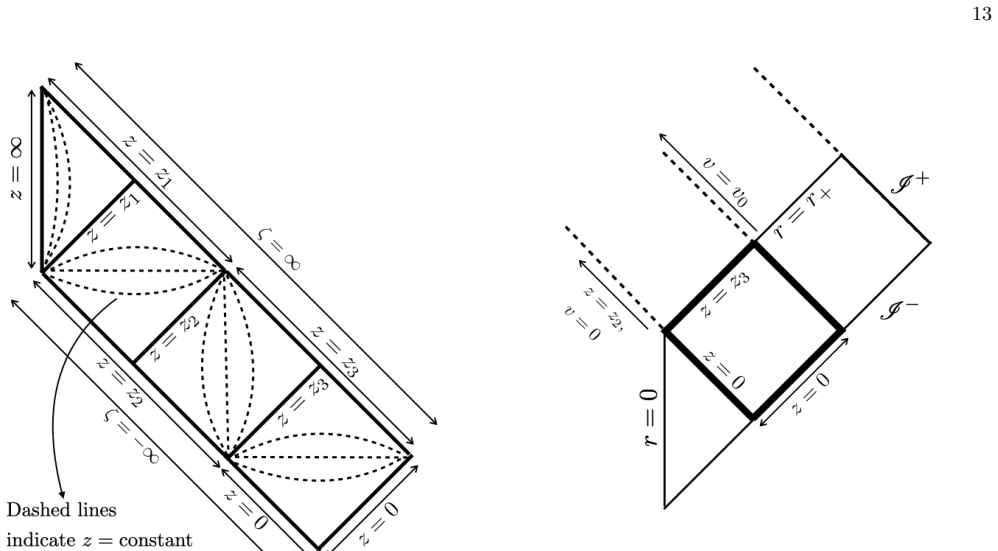
Reissner–Nordstr¨ om-Vaidya: Let us start by writing again the metric for the spher- ically symmetric charged Vaidya spacetime, ds2 =− 1− 2m(v) r + q2(v) r2 dv2 + 2dv dr(95) +r 2 dθ2 + sin2 θ dϕ 2 , with the mass and charge functions given by m(v) = 0 ifv≤0, µ vif 0≤v≤v 0 , Mifv≥v 0 , (96) and q(v) = 0 ifv≤0, q1 vif 0≤v≤v 0 , Qifv≥v 0 . (9...
2022
-
[2]
B. P. Abbott et al. (LIGO Scientific Collaboration and Virgo Collaboration), Phys. Rev. Lett.116, 061102 (2016), URLhttps://link.aps.org/doi/10. 1103/PhysRevLett.116.061102
2016
-
[3]
Abbott et al
R. Abbott et al. (LIGO Scientific Collaboration and Virgo Collaboration), Phys. Rev. Lett.125, 101102 (2020), URLhttps://link.aps.org/doi/10. 1103/PhysRevLett.125.101102
2020
-
[4]
T. E. H. T. Collaboration, K. Akiyama, A. Alberdi, W. Alef, K. Asada, R. Azulay, A.-K. Baczko, D. Ball, M. Balokovi´ c, J. Barrett, et al., The Astrophysical Jour- nal Letters875, L1 (2019), URLhttps://doi.org/10. 3847/2041-8213/ab0ec7
2019
-
[5]
J. M. Bardeen, B. Carter, and S. W. Hawking, Commu- nications in mathematical physics31, 161 (1973)
1973
-
[6]
J. D. Bekenstein, Physical Review D7, 2333 (1973)
1973
-
[7]
S. W. Hawking, Communications in mathematical physics43, 199 (1975)
1975
- [8]
-
[9]
Hawking and G
S. Hawking and G. Ellis, Cambridge Univ. Press (1973)
1973
- [11]
-
[12]
J. R. Oppenheimer and H. Snyder, Phys. Rev.56, 455 (1939), URLhttps://link.aps.org/doi/10.1103/ PhysRev.56.455
1939
-
[13]
Isolated and dynamical horizons and their applications
A. Ashtekar and B. Krishnan, Living Rev. Rel.7, 10 (2004), gr-qc/0407042
work page Pith review arXiv 2004
-
[15]
Booth and S
I. Booth and S. Fairhurst, Phys. Rev. Lett.92, 011102 (2004), URLhttps://link.aps.org/doi/10. 1103/PhysRevLett.92.011102
2004
-
[16]
Chunilal Vaidya, Current Science12, 183 (1943)
P. Chunilal Vaidya, Current Science12, 183 (1943)
1943
-
[17]
Chunilal Vaidya, Proc
P. Chunilal Vaidya, Proc. Indian Acad. Sci. (Math. Sci.) 33, 264 (1951)
1951
-
[18]
I. H. Dwivedi and P. S. Joshi, Classical and Quan- tum Gravity6, 1599 (1989), URLhttps://doi.org/10. 1088/0264-9381/6/11/013
1989
-
[20]
Dyer and E
C. Dyer and E. Honig, Journal of Mathematical Physics 20, 409 (1979)
1979
-
[21]
T. Jacobson and G. Kang, Class. Quant. Grav.10, L201 (1993), gr-qc/9307002
-
[22]
Sultana and C
J. Sultana and C. Dyer, Journal of Mathematical Physics 45, 4764 (2004)
2004
-
[23]
A. B. Nielsen, Galaxies2, 62 (2014), ISSN 2075-4434, URLhttps://www.mdpi.com/2075-4434/2/1/62
2014
- [24]
-
[25]
W. B. Bonnor and P. C. Vaidya, Gen. Rel. Grav.1, 127 (1970)
1970
-
[26]
A. Tarafdar and S. Bhattacharjee, Class. Quant. Grav. 40, 205017 (2023), 2210.15246
- [27]
-
[28]
P. C. Vaidya and L. K. Patel, Phys. Rev. D7, 3590 (1973)
1973
-
[29]
Husain, Exact solutions for null fluid collapse, Phys
V. Husain, Phys. Rev. D53, 1759 (1996), gr-qc/9511011
-
[30]
Creelman and I
B. Creelman and I. Booth, Phys. Rev. D95, 124033 (2017), URLhttps://link.aps.org/doi/10. 1103/PhysRevD.95.124033
2017
-
[31]
P. K. Dahal and D. R. Terno, Phys. Rev. D102, 124032 (2020), URLhttps://link.aps.org/doi/10. 1103/PhysRevD.102.124032
2020
-
[32]
Murenbeeld and J
M. Murenbeeld and J. R. Trollope, Phys. Rev. D 1, 3220 (1970), URLhttps://link.aps.org/doi/10. 1103/PhysRevD.1.3220
1970
-
[33]
F. Hammad, ´E. Mass´ e, and P. Labelle, Phys. Rev. D98, 104049 (2018), 1811.12201
-
[34]
Landsberg and G
P. Landsberg and G. Tonge, Journal of Applied Physics 51, R1 (1980)
1980
-
[35]
Casas-V´ azquez and D
J. Casas-V´ azquez and D. Jou, Reports on Progress in Physics66, 1937 (2003)
1937
-
[36]
H. Kodama, Progress of Theoretical Physics63, 1217 (1980), ISSN 0033- 068X, https://academic.oup.com/ptp/article- pdf/63/4/1217/5243205/63-4-1217.pdf, URL https://doi.org/10.1143/PTP.63.1217
-
[37]
C. W. Misner and D. H. Sharp, Phys. Rev.136, B571 (1964)
1964
-
[38]
S. A. Hayward, Phys. Rev. D53, 1938 (1996), URLhttps://link.aps.org/doi/10.1103/PhysRevD. 53.1938
- [39]
-
[40]
P. Dorau and R. Verch, Class. Quant. Grav.41, 145008 (2024), 2402.18993
-
[41]
A. Chatterjee and A. Ghosh, Phys. Rev. D91, 064054 (2015), 1412.5115
-
[42]
A. Chatterjee and A. Ghosh, Phys. Rev. D92, 044003 (2015), 1502.07128
-
[43]
W. A. Hiscock, L. G. Williams, and D. M. Eardley, Phys. Rev. D26, 751 (1982)
1982
- [44]
- [45]
-
[46]
L. Capuano, L. Santoni, and E. Barausse, Phys. Rev. D 110, 084081 (2024), 2407.06009
discussion (0)
Sign in with ORCID, Apple, or X to comment. Anyone can read and Pith papers without signing in.