Recognition: unknown
Observational and Dynamical Constraints on an Unseen Outer Perturber in the GJ 436 Hot Neptune System
Pith reviewed 2026-05-10 16:18 UTC · model grok-4.3
The pith
Dynamical modeling favors a sub-Jovian perturber beyond 6.8 AU in the GJ 436 system.
A machine-rendered reading of the paper's core claim, the machinery that carries it, and where it could break.
Core claim
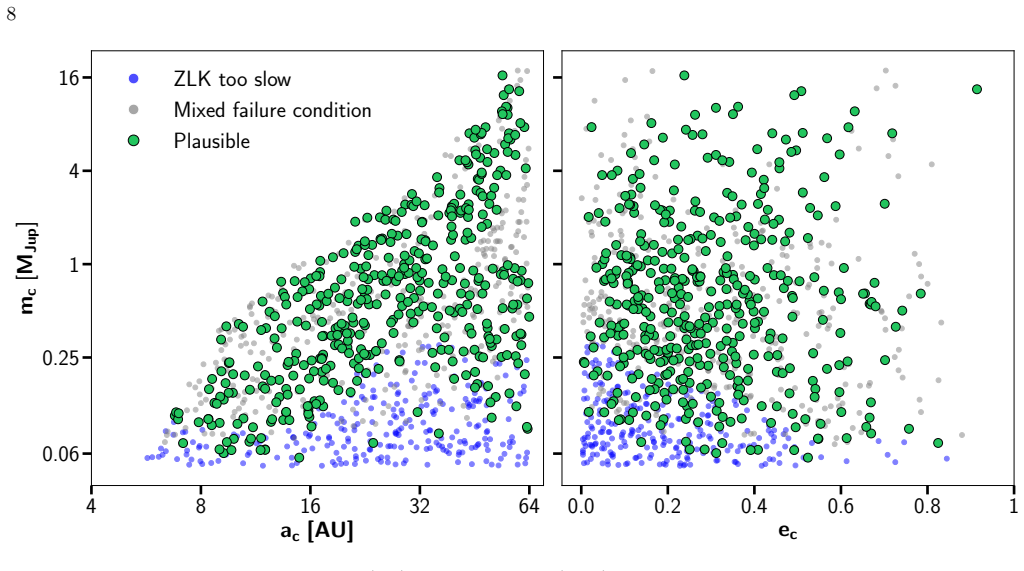
Archival radial velocity and astrometric data constrain potential companions to a_c less than 5.4 AU for masses above 0.05 Jupiter masses and to a_c less than 64 AU for masses above 24 Jupiter masses at 2 sigma. Three-body hierarchical secular simulations within these bounds show that sub-Jovian mass objects with a_c greater than or equal to 6.8 AU can reproduce the present-day polar and eccentric orbit of GJ 436 b, pointing to a substellar perturber as the likely explanation.
What carries the argument
Hierarchical secular simulations of the von Zeipel-Lidov-Kozai mechanism, where a distant outer companion induces oscillations in the inner planet's eccentricity and inclination.
Load-bearing premise
That the von Zeipel-Lidov-Kozai mechanism from a distant companion is the primary cause of GJ 436 b's polar eccentric orbit and that the simulations include all important dynamical effects without needing tides, relativity, or extra planets.
What would settle it
A direct detection of a companion more massive than 24 Jupiter masses inside 64 AU, or a failure to reproduce the observed orbit parameters in simulations using the favored mass and separation ranges.
Figures




read the original abstract
Hot Neptunes in the sub-Jovian desert offer unique insights into planetary system evolution, retaining signatures of dynamical processes that shaped their present-day architectures. Many of these planets exhibit polar orbits, yet the mechanisms responsible for these misalignments between the stellar spin axis and planet orbit normal remain under debate. GJ 436 b stands among the very few hot Neptunes with both a polar and an eccentric orbit, thereby preserving dynamical signatures that may have otherwise been erased by tidal circularization. We investigate the unusual orbital architecture of GJ 436, exploring von Zeipel-Lidov-Kozai migration induced by a distant companion as a mechanism to explain the present-day orbit of GJ 436 b. Using $\sim$20 years of archival radial velocity measurements and astrometric data from the Hipparcos-Gaia Catalog of Accelerations, we constrain a potential companion to $a_{c}<5.4$ AU for $m_{c}>0.05$ $M_{Jup}$ and $a_{c}<64$ AU for $m_{c}>24$ $M_{Jup}$ in the GJ 436 system at the $2\sigma$ confidence level, providing the most stringent constraints to date. We further perform three-body hierarchical secular simulations to determine which companion configurations could reproduce GJ 436 b's present-day orbit within the observationally constrained parameter space. Our dynamical modeling favors sub-Jovian masses on orbits with $a_\mathrm{c} \gtrsim 6.8$ AU, suggesting a substellar perturber. These observational and dynamical constraints can guide future companion searches and illuminate formation mechanisms for hot Neptune desert planets on polar orbits.
Editorial analysis
A structured set of objections, weighed in public.
Referee Report
Summary. The manuscript derives 2σ observational constraints on an unseen outer companion to GJ 436 from ~20 years of archival radial velocities combined with Hipparcos-Gaia Catalog of Accelerations astrometry, yielding a_c < 5.4 AU for m_c > 0.05 M_Jup and a_c < 64 AU for m_c > 24 M_Jup. It then performs three-body hierarchical secular simulations to test which companion configurations within this space can reproduce the present-day eccentric (e=0.16) and polar (i~80°) orbit of the hot Neptune GJ 436 b via the von Zeipel-Lidov-Kozai mechanism, concluding that sub-Jovian masses on orbits with a_c ≳ 6.8 AU are favored.
Significance. If the dynamical results hold after inclusion of additional physics, the work provides a concrete link between the unusual architecture of GJ 436 b and a possible substellar perturber, tightening limits on companions in the sub-Jovian desert and offering guidance for future direct imaging or RV searches. The use of combined archival datasets for stringent observational bounds and the explicit mapping of simulation outcomes onto the observed orbit are positive features that could be strengthened by addressing the completeness of the secular model.
major comments (2)
- [§4] §4 (dynamical modeling): The three-body hierarchical secular integrations omit general-relativistic apsidal precession and equilibrium tidal damping. For a planet at a_b ≈ 0.03 AU these terms produce precession rates of several degrees per year and eccentricity damping on Myr timescales at high e; their absence can artificially permit Kozai cycles that would otherwise be quenched, directly affecting the claimed lower bound a_c ≳ 6.8 AU and the preference for sub-Jovian masses.
- [§3] §3 (observational constraints): The 2σ limits on companion mass and semi-major axis are presented without explicit description of the covariance matrix treatment between RV and HGCA data, the precise data-reduction steps for the archival velocities, or any convergence diagnostics for the orbit fits. These details are required to evaluate whether the allowed region (a_c < 5.4 AU for m_c > 0.05 M_Jup) is robust before it is used to filter the simulation grid.
minor comments (2)
- Notation for the companion semi-major axis alternates between a_c and a_c in the text and figures; consistent use of a single symbol would improve readability.
- The abstract states that the simulations 'reproduce GJ 436 b's present-day orbit'; the manuscript should clarify whether this is a forward integration from initial conditions or a posterior check against the observed elements.
Simulated Author's Rebuttal
We thank the referee for their careful and constructive review of our manuscript. We address each of the major comments in turn below, indicating where revisions will be made to strengthen the paper.
read point-by-point responses
-
Referee: [§4] §4 (dynamical modeling): The three-body hierarchical secular integrations omit general-relativistic apsidal precession and equilibrium tidal damping. For a planet at a_b ≈ 0.03 AU these terms produce precession rates of several degrees per year and eccentricity damping on Myr timescales at high e; their absence can artificially permit Kozai cycles that would otherwise be quenched, directly affecting the claimed lower bound a_c ≳ 6.8 AU and the preference for sub-Jovian masses.
Authors: We agree that general-relativistic apsidal precession and equilibrium tidal damping are important effects omitted from the secular integrations. These processes can quench Kozai cycles for the close-in planet and may influence the derived lower bound on a_c as well as the preference for sub-Jovian masses. In the revised manuscript we will incorporate both terms into the three-body hierarchical secular model, re-run the simulation grid over the observationally allowed parameter space, and update the dynamical constraints and conclusions accordingly. revision: yes
-
Referee: [§3] §3 (observational constraints): The 2σ limits on companion mass and semi-major axis are presented without explicit description of the covariance matrix treatment between RV and HGCA data, the precise data-reduction steps for the archival velocities, or any convergence diagnostics for the orbit fits. These details are required to evaluate whether the allowed region (a_c < 5.4 AU for m_c > 0.05 M_Jup) is robust before it is used to filter the simulation grid.
Authors: We thank the referee for noting the missing methodological details in the observational analysis. In the revised manuscript we will add an expanded subsection in §3 that explicitly describes the covariance matrix treatment between the radial-velocity and Hipparcos-Gaia astrometric data, the precise reduction steps applied to the archival velocities, and the convergence diagnostics employed for the orbit fits. These additions will allow readers to assess the robustness of the reported 2σ limits. revision: yes
Circularity Check
No circularity: observational limits independent; simulations explore rather than tautologically reproduce inputs
full rationale
Observational upper limits on companion mass and separation are obtained directly from archival RV time series and Hipparcos-Gaia astrometric accelerations; these are external data products. The three-body secular integrations are forward explorations that test which (a_c, m_c) pairs can evolve the inner planet to the observed e ≈ 0.16 and i ≈ 80° under the vZLK mechanism. No parameter is fitted to the target orbit, no self-citation supplies a uniqueness theorem that forces the favored region, and no ansatz or renaming reduces the reported preference to an input by construction. The derivation chain therefore remains self-contained against external benchmarks.
Axiom & Free-Parameter Ledger
axioms (2)
- domain assumption The von Zeipel-Lidov-Kozai mechanism is the primary driver of the observed polar eccentric orbit
- domain assumption Hierarchical secular three-body integrations accurately reproduce the long-term evolution
Reference graph
Works this paper leans on
-
[1]
Albrecht, S. H., Marcussen, M. L., Winn, J. N., Dawson, R. I., & Knudstrup, E. 2021, ApJL, 916, L1, doi: 10.3847/2041-8213/ac0f03
-
[2]
1973, Astrophysics and Space Science, 23, 459
Alexander, M. 1973, Astrophysics and Space Science, 23, 459
1973
-
[3]
2008, A&A, 487, L5, doi: 10.1051/0004-6361:200810007
Alonso, R., Barbieri, M., Rabus, M., et al. 2008, A&A, 487, L5, doi: 10.1051/0004-6361:200810007
-
[4]
An, Q., Lu, T., Brandt, G. M., Brandt, T. D., & Li, G. 2025, AJ, 169, 22, doi: 10.3847/1538-3881/ad90b4
-
[5]
Anderson, K. R., Storch, N. I., & Lai, D. 2016, MNRAS, 456, 3671, doi: 10.1093/mnras/stv2906
-
[6]
Armstrong, D. J., Lopez, T. A., Adibekyan, V., et al. 2020, Nature, 583, 39, doi: 10.1038/s41586-020-2421-7
-
[7]
2025, A&A, 702, A132, doi: 10.1051/0004-6361/202555239
Attia, M., Bourrier, V., Bolmont, E., et al. 2025, A&A, 702, A132, doi: 10.1051/0004-6361/202555239
-
[8]
2021, A&A, 647, A40, doi: 10.1051/0004-6361/202039452
Attia, M., Bourrier, V., Eggenberger, P., et al. 2021, A&A, 647, A40, doi: 10.1051/0004-6361/202039452
-
[9]
Baldwin, J. E., Tubbs, R. N., Cox, G. C., et al. 2001, A&A, 368, L1, doi: 10.1051/0004-6361:20010118
-
[10]
2010, PASP, 122, 1341, doi: 10.1086/657159 Bardalez Gagliuffi, D
Ballard, S., Charbonneau, D., Deming, D., et al. 2010, PASP, 122, 1341, doi: 10.1086/657159 Bardalez Gagliuffi, D. C., Balmer, W. O., Pueyo, L., et al. 2025, ApJL, 988, L18, doi: 10.3847/2041-8213/ade30f
-
[11]
2009, ApJ, 699, 23, doi: 10.1088/0004-637X/699/1/23 Beaug´ e, C., & Nesvorn´ y, D
Batygin, K., Laughlin, G., Meschiari, S., et al. 2009, ApJ, 699, 23, doi: 10.1088/0004-637X/699/1/23 Beaug´ e, C., & Nesvorn´ y, D. 2012, ApJ, 751, 119, doi: 10.1088/0004-637X/751/2/119
-
[12]
2012, A&A, 545, A88, doi: 10.1051/0004-6361/201219183
Forveille, T. 2012, A&A, 545, A88, doi: 10.1051/0004-6361/201219183
-
[13]
Bodenheimer, P., Lin, D. N. C., & Mardling, R. A. 2001, ApJ, 548, 466, doi: 10.1086/318667
-
[14]
Nature553(7689), 477–480 (2018) https://doi.org/10.1038/nature24677 arXiv:1712.06638 [astro-ph.EP]
Bourrier, V., Lovis, C., Beust, H., et al. 2018, Nature, 553, 477, doi: 10.1038/nature24677
-
[15]
2021, A&A, 654, A152, doi: 10.1051/0004-6361/202141527
Bourrier, V., Lovis, C., Cretignier, M., et al. 2021, A&A, 654, A152, doi: 10.1051/0004-6361/202141527
-
[16]
Bourrier, V., Zapatero Osorio, M. R., Allart, R., et al. 2022, A&A, 663, A160, doi: 10.1051/0004-6361/202142559
-
[17]
1999, A&A, 349, 619
Bouvier, J., Chelli, A., Allain, S., et al. 1999, A&A, 349, 619
1999
-
[18]
Bowler, B. P., Blunt, S. C., & Nielsen, E. L. 2020, AJ, 159, 63, doi: 10.3847/1538-3881/ab5b11
-
[19]
Brandt, G. M., Michalik, D., Brandt, T. D., et al. 2021a, AJ, 162, 230, doi: 10.3847/1538-3881/ac12d0
-
[20]
Brandt, T. D. 2018, ApJS, 239, 31, doi: 10.3847/1538-4365/aaec06 —. 2021, ApJS, 254, 42, doi: 10.3847/1538-4365/abf93c
-
[21]
Brandt, T. D., Dupuy, T. J., Li, Y., et al. 2021b, AJ, 162, 186, doi: 10.3847/1538-3881/ac042e
-
[22]
Butler, R. P., Vogt, S. S., Marcy, G. W., et al. 2004, ApJ, 617, 580, doi: 10.1086/425173
-
[23]
Butler, R. P., Wright, J. T., Marcy, G. W., et al. 2006, ApJ, 646, 505, doi: 10.1086/504701
-
[24]
A., Gu` ardia, J., L´ opez del Fresno, M., et al
Caballero, J. A., Gu` ardia, J., L´ opez del Fresno, M., et al. 2016, in Society of Photo-Optical Instrumentation Engineers (SPIE) Conference Series, Vol. 9910, Observatory Operations: Strategies, Processes, and Systems VI, ed. A. B. Peck, R. L. Seaman, & C. R. Benn, 99100E, doi: 10.1117/12.2233574
-
[25]
N., & Davies, M
Carrera, D., Raymond, S. N., & Davies, M. B. 2019, Astronomy & Astrophysics, 629, L7
2019
-
[26]
Chambers, J. E., Wetherill, G. W., & Boss, A. P. 1996, Icarus, 119, 261, doi: 10.1006/icar.1996.0019
-
[27]
Chatterjee, S., Ford, E. B., Matsumura, S., & Rasio, F. A. 2008, ApJ, 686, 580, doi: 10.1086/590227
-
[28]
Cresswell, P., Dirksen, G., Kley, W., & Nelson, R. P. 2007, A&A, 473, 329, doi: 10.1051/0004-6361:20077666
-
[29]
Cumming, A., Butler, R. P., Marcy, G. W., et al. 2008, PASP, 120, 531, doi: 10.1086/588487
-
[30]
Dai, F., & Winn, J. N. 2017, AJ, 153, 205, doi: 10.3847/1538-3881/aa65d1
-
[31]
Dawson, R. I., & Johnson, J. A. 2018, ARA&A, 56, 175, doi: 10.1146/annurev-astro-081817-051853
work page Pith review doi:10.1146/annurev-astro-081817-051853 2018
-
[32]
Farr, W. M. 2019, MNRAS, 482, 4146, doi: 10.1093/mnras/sty2830
-
[33]
2023, AJ, 166, 112, doi: 10.3847/1538-3881/ace105
Dong, J., & Foreman-Mackey, D. 2023, AJ, 166, 112, doi: 10.3847/1538-3881/ace105
-
[34]
Dong, S., Katz, B., & Socrates, A. 2014, ApJL, 781, L5, doi: 10.1088/2041-8205/781/1/L5
-
[35]
Duffell, P. C., & Chiang, E. 2015, ApJ, 812, 94, doi: 10.1088/0004-637X/812/2/94
-
[36]
P., Kiseleva, L
Eggleton, P. P., Kiseleva, L. G., & Hut, P. 1998, The Astrophysical Journal, 499, 853
1998
-
[37]
Eggleton, P. P., & Kiseleva-Eggleton, L. 2001, ApJ, 562, 1012, doi: 10.1086/323843
-
[38]
2007, The Astrophysical Journal, 669, 1298 16
Fabrycky, D., & Tremaine, S. 2007, The Astrophysical Journal, 669, 1298 16
2007
-
[39]
Finnerty, L., Fitzgerald, M. P., Xuan, J. W., et al. 2026, arXiv e-prints, arXiv:2602.17777. https://arxiv.org/abs/2602.17777
-
[40]
The Journal of Open Source Software , keywords =
Foreman-Mackey, D., Farr, W., Sinha, M., et al. 2019, The Journal of Open Source Software, 4, 1864, doi: 10.21105/joss.01864
-
[41]
Fulton, B. J., Petigura, E. A., Blunt, S., & Sinukoff, E. 2018, PASP, 130, 044504, doi: 10.1088/1538-3873/aaaaa8 Gaia Collaboration, Vallenari, A., Brown, A. G. A., et al. 2023, A&A, 674, A1, doi: 10.1051/0004-6361/202243940
-
[42]
2024, ApJ, 972, 161, doi: 10.3847/1538-4357/ad5f2b
Vanderburg, A. 2024, ApJ, 972, 161, doi: 10.3847/1538-4357/ad5f2b
-
[43]
Gillon, M., Pont, F., Demory, B. O., et al. 2007, A&A, 472, L13, doi: 10.1051/0004-6361:20077799
-
[44]
2021, ApJL, 908, L25, doi: 10.3847/2041-8213/abdf57
Ginski, C., Facchini, S., Huang, J., et al. 2021, ApJL, 908, L25, doi: 10.3847/2041-8213/abdf57
-
[45]
1993, , 106, 247, 10.1006/icar.1993.1169
Gladman, B. 1993, Icarus, 106, 247, doi: 10.1006/icar.1993.1169
-
[46]
1966, Icarus, 5, 375, doi: https://doi.org/10.1016/0019-1035(66)90051-0
Goldreich, P., & Soter, S. 1966, Icarus, 5, 375, doi: 10.1016/0019-1035(66)90051-0
-
[47]
Grandjean, A., Lagrange, A. M., Meunier, N., et al. 2023, A&A, 669, A12, doi: 10.1051/0004-6361/202141235 Guzm´ an-Mesa, A., Kitzmann, D., Mordasini, C., & Heng, K. 2022, MNRAS, 513, 4015, doi: 10.1093/mnras/stac1066
-
[48]
2026a, ApJ, 997, 139, doi: 10.3847/1538-4357/adfb75 —
Hallatt, T., & Millholland, S. 2026a, ApJ, 997, 139, doi: 10.3847/1538-4357/adfb75 —. 2026b, ApJ, 997, 138, doi: 10.3847/1538-4357/ae129d
-
[49]
Harris, C. R., Millman, K. J., van der Walt, S. J., et al. 2020, Nature, 585, 357, doi: 10.1038/s41586-020-2649-2
-
[50]
Howard, A. W., Johnson, J. A., Marcy, G. W., et al. 2010, ApJ, 721, 1467, doi: 10.1088/0004-637X/721/2/1467
-
[51]
Hunter, J. D. 2007, Computing in Science & Engineering, 9, 90, doi: 10.1109/MCSE.2007.55
-
[52]
1981, Astronomy and Astrophysics, 99, 126
Hut, P. 1981, Astronomy and Astrophysics, 99, 126
1981
-
[53]
Jenkins, J. S., D´ ıaz, M. R., Kurtovic, N. T., et al. 2020, Nature Astronomy, 4, 1148, doi: 10.1038/s41550-020-1142-z Juri´ c, M., & Tremaine, S. 2008, ApJ, 686, 603, doi: 10.1086/590047
-
[54]
Kipping, D. M. 2013, MNRAS, 434, L51, doi: 10.1093/mnrasl/slt075
-
[55]
P., A’Hearn, M., Besse, S., et al
Klaasen, K. P., A’Hearn, M., Besse, S., et al. 2013, Icarus, 225, 643, doi: 10.1016/j.icarus.2013.03.024
-
[56]
1964, Reviews of Geophysics and Space Physics, 2, 625, doi: 10.1029/RG002i004p00625
Knopoff, L. 1964, Reviews of Geophysics and Space Physics, 2, 625, doi: 10.1029/RG002i004p00625
-
[57]
Knutson, H. A., Fulton, B. J., Montet, B. T., et al. 2014, ApJ, 785, 126, doi: 10.1088/0004-637X/785/2/126
-
[58]
2023, ApJS, 265, 4, doi: 10.3847/1538-4365/ac9da4
Kokori, A., Tsiaras, A., Edwards, B., et al. 2023, ApJS, 265, 4, doi: 10.3847/1538-4365/ac9da4
-
[59]
Kuffmeier, M., Dullemond, C. P., Reissl, S., & Goicovic, F. G. 2021, A&A, 656, A161, doi: 10.1051/0004-6361/202039614
-
[60]
Lai, D., Foucart, F., & Lin, D. N. C. 2011, MNRAS, 412, 2790, doi: 10.1111/j.1365-2966.2010.18127.x
-
[61]
2008, ApJ, 683, 949, doi: 10.1086/589822
Lai, D., & Zhang, H. 2008, ApJ, 683, 949, doi: 10.1086/589822
-
[62]
2024, ApJ, 972, 53, doi: 10.3847/1538-4357/ad5be6
Lammers, C., Hadden, S., & Murray, N. 2024, ApJ, 972, 53, doi: 10.3847/1538-4357/ad5be6
-
[63]
Lammers, C., & Winn, J. N. 2026, AJ, 171, 18, doi: 10.3847/1538-3881/ae21de
-
[64]
Lanotte, A. A., Gillon, M., Demory, B. O., et al. 2014, A&A, 572, A73, doi: 10.1051/0004-6361/201424373
-
[65]
A&A605, 7 (2017) https: //doi.org/10.1051/0004-6361/201731340 arXiv:1709.04686 [astro-ph.EP]
Lavie, B., Ehrenreich, D., Bourrier, V., et al. 2017, A&A, 605, L7, doi: 10.1051/0004-6361/201731340
-
[66]
2014a, ApJ, 791, 86, doi: 10.1088/0004-637X/791/2/86
Li, G., Naoz, S., Holman, M., & Loeb, A. 2014a, ApJ, 791, 86, doi: 10.1088/0004-637X/791/2/86
-
[67]
2014b, ApJ, 785, 116, doi: 10.1088/0004-637X/785/2/116
Li, G., Naoz, S., Kocsis, B., & Loeb, A. 2014b, ApJ, 785, 116, doi: 10.1088/0004-637X/785/2/116
-
[68]
E., Schutte, M., Hebb, L., et al
Libby-Roberts, J. E., Schutte, M., Hebb, L., et al. 2023, AJ, 165, 249, doi: 10.3847/1538-3881/accc2f
-
[69]
Lidov, M. L. 1962, Planetary and Space Science, 9, 719
1962
-
[70]
2018, A&A, 616, A2, doi: 10.1051/0004-6361/201832727
Lindegren, L., Hern´ andez, J., Bombrun, A., et al. 2018, A&A, 616, A2, doi: 10.1051/0004-6361/201832727
-
[71]
Lithwick, Y., & Naoz, S. 2011, ApJ, 742, 94, doi: 10.1088/0004-637X/742/2/94
-
[72]
2025, ApJ, 986, 103, doi: 10.3847/1538-4357/add405 —
Liu, Y., Lu, T., & Rice, M. 2025, ApJ, 986, 103, doi: 10.3847/1538-4357/add405 —. 2026, ApJL, 997, L41, doi: 10.3847/2041-8213/ae2fd8
-
[73]
AJ155(2), 66 (2018) https://doi.org/10.3847/1538-3881/aaa008 arXiv:1801.00412 [astro-ph.EP]
Lothringer, J. D., Benneke, B., Crossfield, I. J. M., et al. 2018, AJ, 155, 66, doi: 10.3847/1538-3881/aaa008
-
[74]
2025, ApJ, 979, 218, doi: 10.3847/1538-4357/ad9b79
Lu, T., An, Q., Li, G., et al. 2025, ApJ, 979, 218, doi: 10.3847/1538-4357/ad9b79
-
[75]
S., Kjeldsen, H., Albrecht, S., et al
Lundkvist, M. S., Kjeldsen, H., Albrecht, S., et al. 2016, Nature Communications, 7, 11201, doi: 10.1038/ncomms11201
-
[76]
2014, AcA, 64, 323, doi: 10.48550/arXiv.1501.02711
Maciejewski, G., Niedzielski, A., Nowak, G., et al. 2014, AcA, 64, 323, doi: 10.48550/arXiv.1501.02711
-
[77]
The Merger Rates and Mass Assembly Histories of Dark Matter Haloes in the Two
Malmberg, D., Davies, M. B., & Heggie, D. C. 2011, MNRAS, 411, 859, doi: 10.1111/j.1365-2966.2010.17730.x
-
[78]
Maness, H. L., Marcy, G. W., Ford, E. B., et al. 2007, PASP, 119, 90, doi: 10.1086/510689
-
[79]
Mardling, R. A. 2008, arXiv e-prints, arXiv:0805.1928, doi: 10.48550/arXiv.0805.1928
-
[80]
A., & Lin, D
Mardling, R. A., & Lin, D. N. 2002, The Astrophysical Journal, 573, 829 17
2002
discussion (0)
Sign in with ORCID, Apple, or X to comment. Anyone can read and Pith papers without signing in.