Recognition: unknown
Investigating the onset of deconfinement with NA61/SHINE
Pith reviewed 2026-05-10 16:50 UTC · model grok-4.3
The pith
Measurements of kaon-to-pion ratios in heavy-ion collisions map the onset of deconfinement.
A machine-rendered reading of the paper's core claim, the machinery that carries it, and where it could break.
Core claim
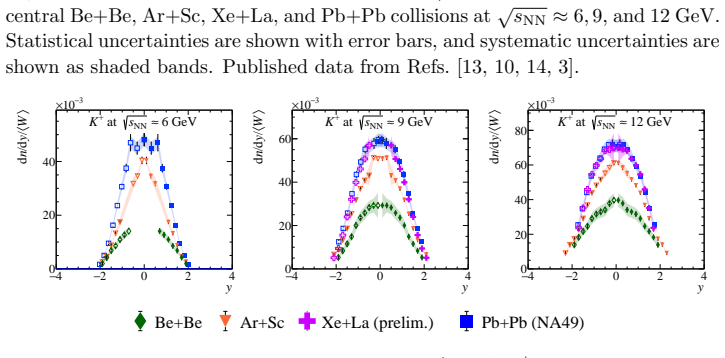
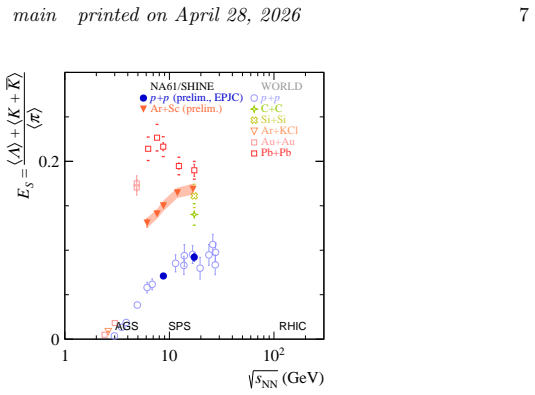
The obtained results, particularly the K+/π+ ratio, are crucial for understanding the phenomena of the onset of deconfinement. The kinematic distributions and the measured multiplicities of identified hadrons are compared across different systems and energies, while proton rapidity spectra provide a complete picture of the energy and system-size dependence of the mechanism of transport of baryon number.
What carries the argument
The K+/π+ ratio serving as an indicator for the onset of deconfinement within a two-dimensional scan over collision energy and system size.
If this is right
- The energy dependence of the K+/π+ ratio can mark the threshold for the onset of deconfinement.
- Proton rapidity spectra reveal the energy and system-size dependence of baryon number transport.
- Data across different collision systems allow mapping how the onset depends on nuclear size.
- Comparisons to earlier measurements confirm the consistency of the observed trends.
Where Pith is reading between the lines
- If the ratio exhibits non-monotonic behavior, models of the QCD phase diagram could be tested against it.
- Similar scans using other observables such as strange-particle yields might supply independent signals for the transition.
Load-bearing premise
The measured K+/π+ ratio and proton rapidity spectra are assumed to directly signal the onset of deconfinement rather than being shaped primarily by resonance decays or collective flow that change with system size.
What would settle it
A smooth monotonic trend in the K+/π+ ratio with no step or peak across the scanned energies and system sizes would weaken the claim that the ratio marks the onset of deconfinement.
Figures




read the original abstract
NA61/SHINE is a multipurpose fixed-target experiment located at the CERN SPS. One of its main goals is to study the onset of deconfinement and the properties of strongly interacting matter. For this purpose, a unique two-dimensional scan in collision energy ($\sqrt{s_\mathrm{NN}} = 5.12 - 16.8/17.3$~GeV) and system size (from $p$+$p$ to Pb+Pb) was performed. Results on hadron spectra produced in nucleus-nucleus collisions, including the recent data on charged hadrons produced in central Xe+La collisions and baryons in central Ar+Sc collisions, are presented. The kinematic distributions and the measured multiplicities of identified hadrons are compared with NA49 Pb+Pb results and with available world data. The obtained results, particularly the $K^+/\pi^+$ ratio, are crucial for understanding the phenomena of the onset of deconfinement, which is one of the main aims of the strong interaction program of the NA61/SHINE Collaboration. Additionally, a comparison of proton rapidity spectra in nucleus-nucleus collisions from NA61/SHINE and NA49 is presented, providing a complete picture of the energy and system-size dependence of the mechanism of transport of baryon number at SPS energies.
Editorial analysis
A structured set of objections, weighed in public.
Referee Report
Summary. The manuscript reports results from the NA61/SHINE experiment's two-dimensional scan in collision energy (5.12–16.8/17.3 GeV) and system size (p+p to Pb+Pb), including new data on charged hadrons in central Xe+La collisions and baryons in central Ar+Sc collisions. It presents kinematic distributions, multiplicities of identified hadrons, and comparisons to NA49 Pb+Pb results and world data, with emphasis on the K+/π+ ratio and proton rapidity spectra in the context of investigating the onset of deconfinement.
Significance. If the measurements and comparisons hold after full scrutiny of acceptances and systematics, the dataset completes the energy and system-size scan at SPS energies and supplies key reference points for models of hadron production. The inclusion of intermediate systems (Xe+La, Ar+Sc) strengthens the ability to map the evolution of observables such as the K+/π+ ratio across the transition from small to large systems.
major comments (1)
- [Abstract] Abstract: The statement that the obtained K+/π+ ratios 'are crucial for understanding the phenomena of the onset of deconfinement' is load-bearing for the paper's motivation, yet the manuscript provides no quantitative separation of the observed energy and system-size dependence from alternative hadronic contributions (resonance decays, collective flow, or baryon stopping) that are known to vary with system size. The comparisons to NA49 and world data alone do not isolate a model-independent signature of deconfinement.
minor comments (1)
- [Abstract] The abstract lists the energy range and systems but does not indicate the specific beam energies or centralities for the new Xe+La and Ar+Sc data points; adding these would improve clarity for readers.
Simulated Author's Rebuttal
We thank the referee for the careful review and for recognizing the value of the new Xe+La and Ar+Sc data in completing the NA61/SHINE two-dimensional scan. We address the single major comment below.
read point-by-point responses
-
Referee: [Abstract] Abstract: The statement that the obtained K+/π+ ratios 'are crucial for understanding the phenomena of the onset of deconfinement' is load-bearing for the paper's motivation, yet the manuscript provides no quantitative separation of the observed energy and system-size dependence from alternative hadronic contributions (resonance decays, collective flow, or baryon stopping) that are known to vary with system size. The comparisons to NA49 and world data alone do not isolate a model-independent signature of deconfinement.
Authors: This manuscript is an experimental data paper whose main purpose is to report the new measurements of charged-hadron spectra in central Xe+La collisions and baryon spectra in central Ar+Sc collisions, thereby completing the energy and system-size scan at SPS energies. The phrasing in the abstract follows the established context of the NA61/SHINE program, in which the K+/π+ ratio has been discussed as a potential probe of the onset of deconfinement on the basis of earlier NA49 Pb+Pb results. The new intermediate-mass systems provide essential additional points that allow the system-size evolution of the ratio to be mapped; such data are required inputs for any quantitative model study that aims to separate deconfinement signals from hadronic effects. The paper itself does not attempt a model-based decomposition, as that lies outside its scope. We are prepared to revise the abstract to state more precisely that the results complete the experimental dataset needed to investigate the onset of deconfinement, rather than asserting that they are crucial in isolation. revision: partial
Circularity Check
No circularity: pure experimental measurement paper with direct observables
full rationale
This paper presents measured hadron multiplicities, spectra, and ratios (including K+/π+ and proton rapidity distributions) from a 2D scan in energy and system size at the NA61/SHINE experiment. No derivation chain, theoretical prediction, or first-principles result is claimed that could reduce to fitted inputs, self-definitions, or self-citations. The central statements simply report experimental data and note their relevance to deconfinement studies via comparison to prior NA49 and world data. These comparisons are external benchmarks, not load-bearing justifications for any internal result. The analysis is self-contained as a data report.
Axiom & Free-Parameter Ledger
Reference graph
Works this paper leans on
-
[1]
Abgrallet al
N. Abgrallet al. JINST, vol. 9, P06005, 2014
2014
-
[2]
Antoniouet al.CERN-SPSC-2006-034, CERN-SPSC-P-330, 2006
N. Antoniouet al.CERN-SPSC-2006-034, CERN-SPSC-P-330, 2006
2006
-
[3]
Altet al
C. Altet al. PRC, vol. 77, 024903, 2008
2008
-
[4]
Ga´ zdzicki and M
M. Ga´ zdzicki and M. I. GorensteinAPP B, vol. 30, 2705, 1999
1999
-
[5]
Aduszkiewiczet al
A. Aduszkiewiczet al. EPJ C, vol. 77, no. 10, 671, 2017
2017
-
[7]
Adhikaryet al
H. Adhikaryet al. EPJ C, vol. 84, no. 4, 416, 2024
2024
-
[8]
Abgrallet al
N. Abgrallet al. EPJ C, vol. 74, no. 3, 2794, 2014
2014
-
[10]
Acharyaet al
A. Acharyaet al. EPJ C, vol. 81, no. 5, 397, 2021
2021
-
[11]
Aduszkiewiczet al
A. Aduszkiewiczet al. EPJ C, vol. 76, no. 4, 198, 2016
2016
-
[12]
Bia las, M
A. Bia las, M. Bleszy´ nski, and W. Czy˙ zNPB, vol. 111, no. 3, 461, 1976
1976
-
[13]
Acharyaet al
A. Acharyaet al. EPJ C, vol. 80, no. 10, 961, 2020
2020
-
[14]
S. V. Afanasievet al. PRC, vol. 66, 054902, 2002
2002
-
[15]
Acharyaet al
A. Acharyaet al. EPJ C, vol. 81, no. 1, 73, 2021
2021
-
[16]
Panova and M
O. Panova and M. LewickiEPJ Web Conf., vol. 274, 05004, 2022
2022
-
[17]
Anticicet al
T. Anticicet al. PRC, vol. 83, 014901, 2011
2011
-
[18]
B. B. Backet al. PRL, vol. 86, 1970, 2001
1970
-
[19]
Ablyazimovet al
T. Ablyazimovet al. EPJ A, vol. 53, no. 3, 2017
2017
-
[20]
Blume (NA49), private communication
C. Blume (NA49), private communication
-
[21]
Altet al
C. Altet al. PRC, vol. 78, 034918, 2008
2008
-
[22]
Altet al
C. Altet al. PRL, vol. 94, 052301, 2005
2005
-
[23]
B. I. Abelevet al. PRC, vol. 79, 034909, 2009
2009
-
[24]
Ahleet al
L. Ahleet al. PLB, vol. 476, 1, 2000
2000
-
[25]
J. L. Klayet al. PRC, vol. 68, 054905, 2003
2003
-
[26]
Adamczyket al
L. Adamczyket al. PRC, vol. 96, no. 4, 044904, 2017
2017
-
[27]
Adamet al
J. Adamet al. PRC, vol. 101, no. 2, 024905, 2020
2020
-
[28]
Acharyaet al
S. Acharyaet al. PRC, vol. 101, no. 4, 044907, 2020
2020
-
[29]
Abelevet al
B. Abelevet al. PRC, vol. 88, 044910, 2013
2013
-
[30]
Balkova indico.fais.uj.edu.pl/event/48/contributions/360, 2025
Y. Balkova indico.fais.uj.edu.pl/event/48/contributions/360, 2025
2025
-
[31]
Ahdidaet al.CERN-PBC Report-2025-002, 2025
C. Ahdidaet al.CERN-PBC Report-2025-002, 2025
2025
discussion (0)
Sign in with ORCID, Apple, or X to comment. Anyone can read and Pith papers without signing in.