Recognition: unknown
Cherenkov and scintillation light separation in BGO and BSO crystals coupled to SiPMs for dual-readout electromagnetic calorimetry at future colliders
Pith reviewed 2026-05-10 15:43 UTC · model grok-4.3
The pith
Cherenkov and scintillation light can be separated event-by-event in BGO and BSO crystals using SiPMs with optical filtering and waveform template fitting.
A machine-rendered reading of the paper's core claim, the machinery that carries it, and where it could break.
Core claim
The paper establishes that Cherenkov and scintillation light in BGO and BSO crystals coupled to SiPMs can be disentangled on an event-by-event basis by exploiting their distinct spectral and temporal characteristics through optical filtering and waveform template fitting. Beam measurements confirm Cherenkov yields of up to approximately 150 photoelectrons per GeV in electromagnetic showers. This constitutes the first demonstration of such separation with SiPM readout in these crystals and supports their application as building blocks for dual-readout electromagnetic calorimeters.
What carries the argument
The central mechanism is the dual approach of optical filtering to exploit spectral differences between Cherenkov and scintillation light combined with waveform template fitting to exploit their temporal differences, allowing event-by-event separation.
If this is right
- This technology can serve as a building block for dual-readout electromagnetic calorimeters.
- It enables precise measurement of both energy deposition and the electromagnetic component in showers.
- Yields of up to 150 photoelectrons per GeV for Cherenkov light are achievable in practice.
- The method integrates with SiPM readout for compact detector designs.
Where Pith is reading between the lines
- Similar separation techniques might be applicable to other scintillator materials used in high-energy physics.
- Implementation in a full calorimeter array could reveal additional challenges from light sharing between crystals.
- The demonstrated yields suggest potential for improved energy resolution in dual-readout systems compared to single-readout approaches.
- Further development could lead to applications beyond colliders, such as in medical imaging where fast timing is beneficial.
Load-bearing premise
That the waveform template fitting combined with optical filtering can reliably disentangle the Cherenkov and scintillation components on an event-by-event basis without significant bias or loss of efficiency when applied to realistic electromagnetic showers.
What would settle it
Observation of systematic discrepancies between the separated Cherenkov signal and independent expectations, or failure to achieve separation in a multi-crystal setup under beam conditions, would indicate the method does not work as claimed.
Figures




read the original abstract
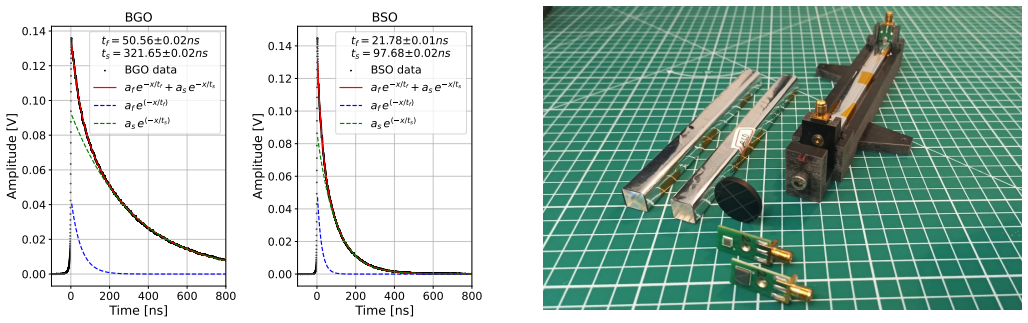
We report on the separation of Cherenkov and scintillation light in BGO and BSO crystals read out with silicon photomultipliers (SiPMs). The two light components are disentangled on an event-by-event basis by combining optical filtering with waveform template fitting, exploiting their distinct spectral and temporal characteristics. Measurements were carried out using high-energy muon and positron beams at the CERN SPS North Area, demonstrating Cherenkov yields of up to $\sim$150 ph.e./GeV in electromagnetic showers. This work provides the first demonstration of Cherenkov-scintillation separation in BGO and BSO crystals with SiPM readout, supporting the use of this technology as a building block for a dual-readout electromagnetic calorimeter, as foreseen in the IDEA detector concept for a future $e^+e^-$ Higgs factory.
Editorial analysis
A structured set of objections, weighed in public.
Referee Report
Summary. The manuscript reports beam-test measurements at the CERN SPS North Area using muon and positron beams to demonstrate event-by-event separation of Cherenkov and scintillation light in BGO and BSO crystals read out by SiPMs. Separation is performed by combining optical filtering (exploiting spectral differences) with waveform template fitting (exploiting temporal differences). The authors report Cherenkov yields reaching ~150 ph.e./GeV in electromagnetic showers and present this as the first such demonstration with SiPM readout, positioning the technique as a building block for dual-readout electromagnetic calorimetry in concepts such as the IDEA detector at future e+e- Higgs factories.
Significance. If the separation method maintains its reported performance under realistic shower conditions, the work provides a concrete experimental path toward dual-readout EM calorimeters that could improve energy resolution and particle identification at future colliders. The use of direct beam data rather than purely simulated waveforms strengthens the practical relevance of the result.
major comments (2)
- [Section 4] Section 4 (Results from positron beam data): While positron-induced electromagnetic showers are used to extract the ~150 ph.e./GeV Cherenkov yield, the analysis does not quantify fit bias, efficiency loss, or contamination as a function of shower depth, particle multiplicity, or energy deposition profile. This leaves open whether the fixed scintillation template remains unbiased when light from multiple particles with varying arrival times is superposed, which is central to the claim of reliable event-by-event separation in realistic EM showers.
- [Section 3.2] Section 3.2 (Waveform template fitting): The template-fitting procedure relies on a single fixed scintillation decay time constant extracted from muon data; no systematic variation of this parameter or alternative templates is explored for the positron-shower data set, where the effective waveform shape may differ due to the superposition of prompt and delayed components from particles produced at different depths.
minor comments (2)
- [Abstract] Abstract: The abstract states the separation method and the Cherenkov yield but does not include any numerical values for separation purity, efficiency, or total systematic uncertainty on the reported yield, which would allow immediate assessment of the result's robustness.
- [Figures] Figure captions and axis labels: Several waveform and charge-distribution figures would benefit from explicit annotation of the prompt Cherenkov peak versus the delayed scintillation tail to aid readers in following the template-fitting procedure.
Simulated Author's Rebuttal
We thank the referee for the careful reading and constructive comments on our manuscript. We address each major comment below and have revised the manuscript accordingly to strengthen the analysis of the template-fitting procedure.
read point-by-point responses
-
Referee: [Section 4] Section 4 (Results from positron beam data): While positron-induced electromagnetic showers are used to extract the ~150 ph.e./GeV Cherenkov yield, the analysis does not quantify fit bias, efficiency loss, or contamination as a function of shower depth, particle multiplicity, or energy deposition profile. This leaves open whether the fixed scintillation template remains unbiased when light from multiple particles with varying arrival times is superposed, which is central to the claim of reliable event-by-event separation in realistic EM showers.
Authors: We agree that a quantitative evaluation of potential biases arising from waveform superposition in electromagnetic showers would strengthen the robustness claim. In the revised manuscript we have added a dedicated study in Section 4 that uses GEANT4-simulated shower profiles to generate superposed waveforms with realistic depth-dependent arrival times and particle multiplicities. We then apply the fixed template fit and report the resulting bias, efficiency, and contamination as functions of shower depth and total energy deposit. The bias on the extracted Cherenkov yield remains below 5 % across the tested range, with efficiency loss below 2 % for showers above 10 GeV. These results are now presented in a new figure and accompanying text. revision: yes
-
Referee: [Section 3.2] Section 3.2 (Waveform template fitting): The template-fitting procedure relies on a single fixed scintillation decay time constant extracted from muon data; no systematic variation of this parameter or alternative templates is explored for the positron-shower data set, where the effective waveform shape may differ due to the superposition of prompt and delayed components from particles produced at different depths.
Authors: The muon-derived template was chosen to guarantee a pure scintillation reference free of Cherenkov contamination. To address the concern for positron data, the revised Section 3.2 now includes a systematic variation of the scintillation decay constant over the interval 200–400 ns (covering both our muon measurements and literature values for BGO/BSO). For each variation we re-fit the positron waveforms and quantify the change in the extracted Cherenkov yield; the variation is found to be < 3 % and is reported as a systematic uncertainty. In addition, we have tested an alternative two-component scintillation template and show that the Cherenkov component remains stable within the same bound. These studies are documented with a new table of systematic variations. revision: yes
Circularity Check
No circularity: experimental results from beam data with no self-referential derivation
full rationale
The paper reports direct experimental measurements of Cherenkov-scintillation separation in BGO/BSO crystals using muon and positron beams at CERN SPS. The method (optical filtering plus waveform template fitting) is applied to collected data to extract yields (~150 ph.e./GeV), with no equations, parameters, or predictions that reduce by construction to fitted inputs or prior self-citations. The central claim is an empirical demonstration supporting dual-readout calorimetry, not a mathematical derivation. No load-bearing self-citation chains, ansatz smuggling, or renaming of known results appear in the provided text. This is a standard non-circular experimental report.
Axiom & Free-Parameter Ledger
axioms (1)
- domain assumption Cherenkov and scintillation light in BGO/BSO have distinct spectral and temporal characteristics that can be exploited by filters and waveform fitting.
Reference graph
Works this paper leans on
-
[1]
Abada, et al., Fcc physics opportunities: Future cir- cular collider conceptual design report volume 1, The European Physical Journal C 79 (6) (Jun. 2019). doi:10.1140/epjc/s10052-019-6904-3. URLhttp://dx.doi.org/10.1140/epjc/s10052- 019-6904-3
-
[2]
doi:10.1140/epjst/e2019-900045-4
Abada, et al., Fcc-ee: The lepton collider: Future circular collider conceptual design report volume 2, The European Physical Journal Special Topics 228 (2) (2019) 261–623. doi:10.1140/epjst/e2019-900045-4. URLhttp://dx.doi.org/10.1140/epjst/e2019- 900045-4
- [3]
-
[4]
Ferrari, L
R. Ferrari, L. Pezzotti, M. Caccia, R. Santoro, M. An- tonello, Dual-readout calorimetry, Int. J. Mod. Phys. 11 A 34 (13n14) (2019) 1940019.doi:10.1142/ S0217751X19400190
2019
-
[5]
S. Lee, M. Livan, R. Wigmans, Dual-Readout Calorime- try, Rev. Mod. Phys. 90 (2) (2018) 025002.arXiv: 1712.05494,doi:10.1103/RevModPhys.90.025002
-
[6]
N. Akchurin, K. Carrell, H. Kim, R. Thomas, R. Wig- mans, J. Hauptman, H. P. Paar, A. Penzo, Electron detec- tion with a dual-readout calorimeter, Nucl. Instrum. Meth. A 536 (2005) 29–51.doi:10.1016/j.nima.2004.06. 178
-
[7]
N. Akchurin, K. Carrell, J. Hauptman, H. Kim, H. P. Paar, A. Penzo, R. Thomas, R. Wigmans, Hadron and jet detec- tion with a dual-readout calorimeter, Nucl. Instrum. Meth. A 537 (2005) 537–561.doi:10.1016/j.nima.2004. 07.285
-
[8]
N. Akchurin, K. Carrell, H. Kim, R. Thomas, R. Wig- mans, J. Hauptman, A. Penzo, Comparison of high-energy electromagnetic shower profiles measured with scintilla- tion and Cherenkov light, Nucl. Instrum. Meth. A 548 (2005) 336–354.doi:10.1016/j.nima.2005.03.169
-
[9]
N. Akchurin, F. Bedeschi, A. Cardini, M. Cascella, F. Cei, D. D. Pedis, S. Fracchia, S. Franchino, M. Fraternali, G. Gaudio, P. Genova, J. Hauptman, L. L. Rotonda, S. Lee, M. Livan, E. Meoni, A. Moggi, D. Pinci, A. Poli- cicchio, J. G. Saraiva, A. Sill, T. Venturelli, R. Wigmans, Dual-readout calorimetry (2013).arXiv:1307.5538. URLhttps://arxiv.org/abs/1307.5538
-
[10]
S. Lee, A. Cardini, M. Cascella, S. Choi, G. Ciapetti, R. Ferrari, S. Franchino, M. Fraternali, G. Gaudio, S. Ha, J. Hauptman, H. Kim, A. Lanza, F. Li, M. Li- van, E. Meoni, J. Park, F. Scuri, A. Sill, R. Wigmans, Hadron detection with a dual-readout fiber calorime- ter, Nuclear Instruments and Methods in Physics Research Section A: Accelerators, Spectrom...
-
[11]
Akchurin, et al., The electromagnetic performance of the RD52 fiber calorimeter, Nucl
N. Akchurin, et al., The electromagnetic performance of the RD52 fiber calorimeter, Nucl. Instrum. Meth. A 735 (2014) 130–144.doi:10.1016/j.nima.2013.09.033
-
[12]
A. Karadzhinova-Ferrer, et al., Novel prototype tower structure for the dual-readout fiber calorimeter, JINST 17 (09) (2022) T09007.doi:10.1088/1748-0221/17/ 09/T09007
-
[14]
S. Albergo, A. Braghieri, A. Burdyko, Y . Cai, L. Carmi- nati, E. Delfrate, D. Falchieri, R. Ferrari, G. Gaudio, P. Giacomelli, A. Loeschcke Centeno, E. Mazzeo, S. Millesoli, L. Nasella, A. Negri, A. Pareti, R. Per- siani, L. Pezzotti, G. Polesello, F. Salvatore, R. San- toro, L. Tacchini, R. Turra, N. Valle, I. Vivarelli, Energy response and resolution t...
- [15]
- [17]
-
[18]
M. T. Lucchini, Combining Dual-Readout Crystals and Fibers in a Hybrid Calorimeter for the IDEA Experiment, PoS EPS-HEP2021 (2022) 850.doi:10.22323/1.398. 0850
-
[19]
N. Akchurin, L. Berntzon, A. Cardini, R. Ferrari, G. Gau- dio, J. Hauptman, H. Kim, L. La Rotonda, M. Livan, E. Meoni, H. Paar, A. Penzo, D. Pinci, A. Policic- chio, S. Popescu, G. Susinno, Y . Roh, W. Vandelli, R. Wigmans, Contributions of cherenkov light to the signals from lead tungstate crystals, Nuclear Instru- ments and Methods in Physics Research S...
-
[20]
N. Akchurin, A. Astwood, A. Cardini, G. Ciapetti, R. Ferrari, S. Franchino, M. Fraternali, G. Gaudio, J. Hauptman, F. Lacava, L. La Rotonda, M. Livan, E. Meoni, H. Paar, D. Pinci, A. Policicchio, S. Popescu, G. Susinno, Y . Roh, W. Vandelli, T. Venturelli, C. V oena, I. V olobouev, R. Wigmans, Separation of crystal signals into scintillation and cherenkov...
-
[21]
N. Akchurin, M. Alwarawrah, A. Cardini, G. Ciapetti, R. Ferrari, S. Franchino, M. Fraternali, G. Gaudio, J. Hauptman, F. Lacava, L. La Rotonda, M. Li- van, E. Meoni, D. Pinci, A. Policicchio, S. Popescu, G. Susinno, Y . Roh, W. Vandelli, T. Venturelli, C. V oena, I. V olobouev, R. Wigmans, Dual-readout calorime- try with crystal calorimeters, Nuclear Inst...
-
[22]
N. Akchurin, F. Bedeschi, A. Cardini, M. Cascella, G. Ciapetti, D. De Pedis, M. Fasoli, R. Ferrari, S. Franchino, M. Fraternali, G. Gaudio, J. Haupt- man, M. Incagli, F. Lacava, L. La Rotonda, S. Lee, M. Livan, E. Meoni, A. Negri, D. Pinci, A. Polici- cchio, F. Scuri, A. Sill, G. Susinno, T. Venturelli, C. V oena, R. Wigmans, A comparison of bgo and bso c...
-
[23]
Adamson, et al., The NuMI Neutrino Beam, Nucl
M. Cascella, S. Franchino, Detection of electron show- ers in Dual-Readout crystal calorimeters, Nucl. Instrum. Meth. A 718 (2013) 72–74.doi:10.1016/j.nima. 2012.11.105
-
[24]
E. Garutti, Silicon Photomultipliers for High Energy Physics Detectors, JINST 6 (2011) C10003.arXiv: 1108.3166,doi:10.1088/1748-0221/6/10/C10003
-
[25]
R. Pestotnik, D. Consuegra, R. Dolenec, S. Korpar, P. Krizan, A. Seljak, Silicon photomultipliers for future HEP experiments, Nucl. Instrum. Meth. A 1068 (2024) 169776.doi:10.1016/j.nima.2024.169776
-
[26]
Hirosky, et al., Dual-readout calorimetry with homoge- neous crystals, EPJ Web Conf
R. Hirosky, et al., Dual-readout calorimetry with homoge- neous crystals, EPJ Web Conf. 320 (2025) 00021.arXiv: 2408.11973,doi:10.1051/epjconf/202532000021
-
[27]
R. Cala’, N. Kratochwil, L. Martinazzoli, M. Lucchini, S. Gundacker, E. Galenin, I. Gerasymov, O. Sidlet- skiy, M. Nikl, E. Auffray, Characterization of mixed bi4(gexsi1-x)3o12 for crystal calorimetry at future col- liders, Nuclear Instruments and Methods in Physics Re- search Section A: Accelerators, Spectrometers, Detectors and Associated Equipment 1032...
-
[28]
P. A. Cerenkov, Visible radiation produced by elec- trons moving in a medium with velocities exceed- ing that of light, Phys. Rev. 52 (1937) 378–379. doi:10.1103/PhysRev.52.378. URLhttps://link.aps.org/doi/10.1103/ PhysRev.52.378
-
[29]
W. Xiong, Y . Zhou, F. Guo, L. Chen, C. Luo, H. Yuan, A study on segregation layers of bi4si3o12 crys- tal grown by the bridgman method, Journal of Crystal Growth 377 (2013) 160–163.doi:https: //doi.org/10.1016/j.jcrysgro.2013.04.047. URLhttps://www.sciencedirect.com/science/ article/pii/S002202481300314X
-
[30]
P. A. Williams, et al., Optical, thermo-optic, electro- optic, and photoelastic properties of bismuth germanate (bi4ge3o12)., Appl. Opt. 35 (19) (1996) 3562–69.doi: https://doi.org/10.1364/AO.35.003562
-
[31]
D. P. Bortfeld, H. Meier., Refractive indices and electro-optic coefficients of the eulitities bi4ge3o12 and bi4si3o12., Journal of Applied Physics 43 (12) (1972) 5110–11.doi:https://doi.org/10.1063/1. 1661080
work page doi:10.1063/1 1972
-
[32]
Status and prospects of the PandaX-III experiment,
A. Benaglia, F. Cetorelli, M. T. Lucchini, E. Auf- fray, L. Roux, J. Delenne, Characterization of thin optical filters for high purity Cherenkov light read- out from scintillating crystals, JINST 21 (03) (2026) P03025.arXiv:2512.04965,doi:10.1088/1748- 0221/21/03/P03025
-
[33]
Shanghai institute of ceramics, chinese academy of sci- ences (siccas),http://www.siccas.com/index.html
-
[34]
Lambda 25/35/45 spectrophotometers,https: //resources.perkinelmer.com/corporate/ cmsresources/images/44-74448bro_lambda.pdf
-
[35]
Hamamatsu Photonics, MPPC S14160 Series,https: //www.hamamatsu.com/eu/en/product/optical- sensors/mppc/mppc_mppc-array/S14160- 6050HS.html, accessed: 2025-06-26 (2020)
2025
-
[36]
Hamamatsu Photonics, MPPC S14160-3010 Series Datasheet,https://www.hamamatsu.com/eu/en/ product/type/S14160-3010PS/index.html, ac- cessed: 2025-06-26 (2020)
2025
-
[37]
SCHOTT AG, UG11 Bandpass Filter Datasheet,https: //media.schott.com/api/public/content/ 84cc6e733284498b8fd901559a6f883b?v=3b93aa4e, accessed: June 2025
2025
-
[38]
caen.it/products/ndt1419/, accessed: 2024-05-22 (2024)
CAEN S.p.A., NDT1419 - 4 Ch Reversible 500 V/200µA NIM/Desktop HV Power Supply Module,https://www. caen.it/products/ndt1419/, accessed: 2024-05-22 (2024). 13
2024
-
[39]
CAEN S.p.A., A1423B - Fast Preamplifier,https:// www.caen.it/products/a1423b/, accessed: 2024-05- 22 (2024)
2024
-
[40]
google.com/url?q=https://eljentechnology
ELIJEN, EJ-550 silicon optical grease,https://www. google.com/url?q=https://eljentechnology. com/products/accessories/ej-550-ej-552&sa= D&source=editors&ust=1773440893171026&usg= AOvVaw004xRbatICfXaxm97jIBII, accessed: March 2026
2026
-
[41]
com/eu/en/product/lasers/laser-related- products/laser-diode-heads/M10306series
Hamamatsu Photonics, PLP-10 Series Compact Picosec- ond Laser Diode Module,https://www.hamamatsu. com/eu/en/product/lasers/laser-related- products/laser-diode-heads/M10306series. html, accessed: June 2025
2025
-
[42]
cern.ch/experimental-areas/north-area/h6, ac- cessed: March 2026
CERN, H6 beam line,https://be-dep-ea.web. cern.ch/experimental-areas/north-area/h6, ac- cessed: March 2026
2026
-
[43]
Tektronix, Inc., 4 Series B MSO Mixed Signal Os- cilloscope (MSO46B),https://www.tek.com/en/ products/oscilloscopes/4-series-mso/mso46b- oscilloscope-1-5-ghz-6-analog-48-digital- channels, accessed: 2024-05-22 (2024)
2024
-
[44]
Ritt, em et al., MIDAS - maximum integration data acquisition system,https://midas.triumf.ca, ac- cessed: 2025-06-15
S. Ritt, em et al., MIDAS - maximum integration data acquisition system,https://midas.triumf.ca, ac- cessed: 2025-06-15
2025
-
[45]
Agostinelli, et al., GEANT4 - A Simulation Toolkit, Nucl
S. Agostinelli, et al., GEANT4 - A Simulation Toolkit, Nucl. Instrum. Meth. A 506 (2003) 250–303.doi:10. 1016/S0168-9002(03)01368-8. 14
2003
discussion (0)
Sign in with ORCID, Apple, or X to comment. Anyone can read and Pith papers without signing in.