Recognition: unknown
Quantum Energy Teleportation Across Lattice and Continuum
Pith reviewed 2026-05-10 16:47 UTC · model grok-4.3
The pith
A neutral-current protocol on the lattice recovers the exact coarse-grained current correlator from continuum field theory in quantum energy teleportation.
A machine-rendered reading of the paper's core claim, the machinery that carries it, and where it could break.
Core claim
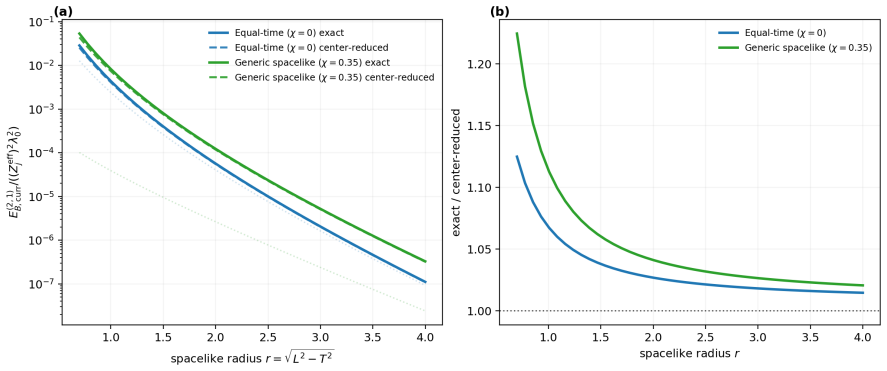
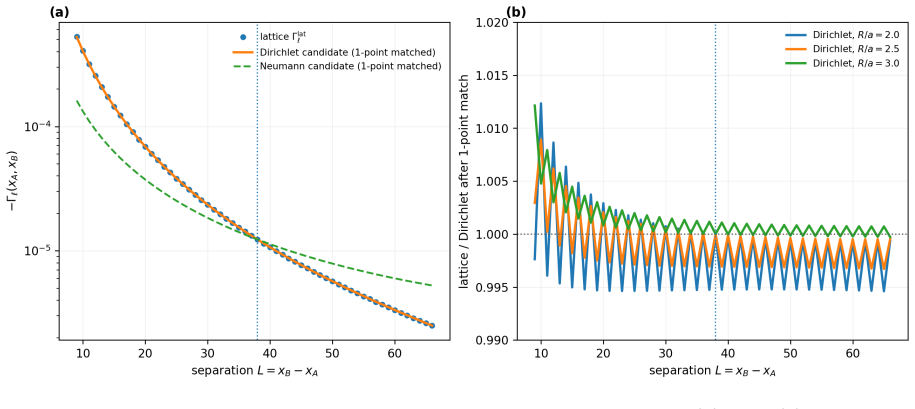
In the massive Thirring model the trigonometric measurement in the continuum is a weak binary POVM whose leading signal is set by a conserved-current correlator in the bosonized theory. On the lattice the conventional protocol is removed from this neutral current sector by a U(1) selection rule that routes the signal into charged sectors. On the same lattice Hamiltonian a newly constructed neutral current protocol produces a weak signal that is exactly the coarse-grained current correlator and an extracted energy that scales quadratically with the measurement strength, thereby identifying the neutral sector shared by the lattice and continuum descriptions.
What carries the argument
The neutral current protocol, a weak binary POVM constructed directly on the lattice Hamiltonian that isolates the neutral sector and reproduces the coarse-grained conserved-current correlator of the continuum bosonized theory.
If this is right
- The weak signal of the neutral current protocol equals the coarse-grained current correlator of the continuum theory.
- Extracted energy in the neutral protocol grows quadratically with measurement strength.
- Conventional qubit protocols remain confined to charged sectors and cannot access the neutral current contribution.
- The separation of neutral and charged sectors on the lattice Hamiltonian is exact and model-independent within the massive Thirring theory.
Where Pith is reading between the lines
- The protocol supplies a concrete route to import continuum QET predictions into lattice simulations or near-term quantum hardware without charged-sector contamination.
- Similar neutral-current constructions could be tested in other lattice-regularized field theories to check whether the shared neutral sector persists beyond the sine-Gordon case.
- The quadratic scaling suggests that arbitrarily weak measurements suffice to extract a controllable neutral-sector energy signal, opening a window to study the large-distance asymptotics of the current correlator on finite lattices.
Load-bearing premise
The newly constructed neutral current protocol isolates the neutral sector on the lattice Hamiltonian without introducing artifacts or charged-sector contamination that would prevent exact matching to the continuum current correlator.
What would settle it
Numerical evaluation of the extracted energy on the lattice using the new protocol showing that it fails to scale quadratically with measurement strength, or direct comparison of the measured signal to the continuum current correlator revealing a mismatch beyond lattice spacing effects.
Figures





read the original abstract
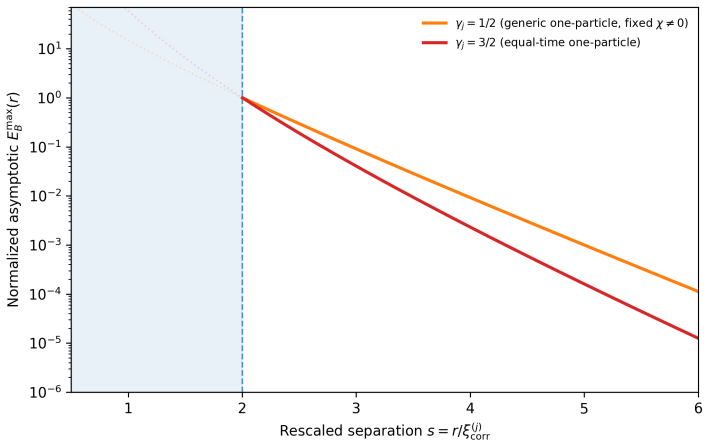
Quantum energy teleportation (QET) has been studied in continuum field theory and in lattice many-body systems, but the relation between the two within a single interacting model is still not well understood. To address this question, we consider the massive Thirring model, equivalently the sine--Gordon theory. In the continuum, the trigonometric measurement is a weak binary Positive Operator-Valued Measure (POVM), and its leading signal is set by a conserved-current correlator in the bosonized theory, with both gapless behavior and gapped large-distance asymptotics. On the lattice, the conventional protocol does not access this neutral current sector. For Alice's local measurement, a lattice $U(1)$ selection rule removes the neutral current contribution from Bob's subsystem, and the separated signal lies in charged sectors. On the same lattice Hamiltonian we construct a neutral current protocol whose weak signal is exactly a coarse-grained current correlator and whose extracted energy scales quadratically with the measurement strength. This identifies the neutral sector shared by the lattice and continuum descriptions, while separating it from the charged sector that governs the conventional qubit protocol.
Editorial analysis
A structured set of objections, weighed in public.
Referee Report
Summary. The manuscript examines quantum energy teleportation (QET) in the massive Thirring model (equivalent to sine-Gordon theory). In the continuum, a weak trigonometric binary POVM yields a leading signal set by a conserved-current correlator in the bosonized theory, exhibiting both gapless and gapped asymptotics. On the lattice, the conventional qubit protocol is blocked by a U(1) selection rule that removes the neutral current contribution from Bob's subsystem, confining the signal to charged sectors. The authors construct a neutral current protocol on the same lattice Hamiltonian whose weak signal is claimed to be exactly a coarse-grained current correlator, with extracted energy scaling quadratically in the measurement strength; this is presented as identifying the neutral sector shared by lattice and continuum while separating it from the charged sector of the conventional protocol.
Significance. If the exact matching and absence of contamination hold, the result bridges lattice many-body and continuum QFT descriptions of QET in an interacting model with U(1) symmetry. The explicit isolation of the neutral sector, quadratic scaling, and identification of a shared current correlator constitute a concrete advance that could inform lattice simulations of QET and related protocols in gauge theories or condensed-matter systems. The separation of sectors is conceptually useful and the quadratic dependence offers a falsifiable signature.
major comments (1)
- [Neutral current protocol construction] The load-bearing claim that the neutral current protocol yields a weak signal exactly equal to the coarse-grained current correlator (with no charged-sector leakage at O(ε²)) requires explicit verification. The abstract states that the conventional protocol is removed by the lattice U(1) selection rule, but the new protocol's construction must demonstrate that its local neutral operators evade this rule without reintroducing charged contributions or lattice artifacts that would spoil the exact leading-order match to the continuum bosonized correlator of the massive Thirring model.
Simulated Author's Rebuttal
We thank the referee for their careful reading of the manuscript, their recognition of the conceptual advance in isolating the neutral sector, and their recommendation for major revision. We address the major comment below and will revise the manuscript accordingly.
read point-by-point responses
-
Referee: [Neutral current protocol construction] The load-bearing claim that the neutral current protocol yields a weak signal exactly equal to the coarse-grained current correlator (with no charged-sector leakage at O(ε²)) requires explicit verification. The abstract states that the conventional protocol is removed by the lattice U(1) selection rule, but the new protocol's construction must demonstrate that its local neutral operators evade this rule without reintroducing charged contributions or lattice artifacts that would spoil the exact leading-order match to the continuum bosonized correlator of the massive Thirring model.
Authors: We appreciate the referee's emphasis on the need for explicit verification of the neutral current protocol. The protocol is constructed by defining local operators that are strictly neutral under the global U(1) symmetry of the lattice Thirring Hamiltonian (i.e., they commute with the total charge operator). This directly evades the selection rule that eliminates the neutral current contribution in the conventional qubit protocol. The weak-signal calculation proceeds via a perturbative expansion of the post-measurement state and Bob's energy extraction to O(ε²). Neutrality ensures that all matrix elements connecting to charged sectors vanish identically at this order by charge conservation, leaving precisely the two-point function of the coarse-grained lattice current operators. After identifying the lattice current with the bosonized continuum current, this reproduces the known correlator of the massive Thirring/sine-Gordon theory, including both gapless and gapped asymptotics. Lattice artifacts are controlled because the discretization preserves the U(1) symmetry and the leading O(ε²) term involves only the current, with higher-order lattice corrections appearing only at O(ε⁴) or higher. We agree that the manuscript would be strengthened by a fully expanded derivation. In the revised version we will add a dedicated appendix containing (i) the explicit definition of the neutral operators, (ii) the step-by-step O(ε²) expansion with symmetry arguments, and (iii) a short numerical check on small lattices confirming the absence of charged-sector leakage at the reported order. revision: yes
Circularity Check
No significant circularity; central claim follows from explicit protocol construction and lattice selection rules
full rationale
The paper defines a new neutral current protocol on the given lattice Hamiltonian and shows via direct calculation that its leading weak signal equals the coarse-grained current correlator (with quadratic energy scaling). This identification of the shared neutral sector is derived from the lattice U(1) selection rule blocking the conventional protocol and the explicit operator definitions in the new protocol; no step reduces by construction to a fitted parameter, self-referential definition, or load-bearing self-citation. The derivation remains independent of the target continuum matching result and does not invoke uniqueness theorems or ansatze from prior author work.
Axiom & Free-Parameter Ledger
axioms (1)
- domain assumption The massive Thirring model is equivalent to the sine-Gordon theory via bosonization.
Reference graph
Works this paper leans on
-
[1]
Quantum measurement information as a key to energy extraction from local vacuums,
M. Hotta, “Quantum measurement information as a key to energy extraction from local vacuums,”Physical Review D78(2008) 045006,arXiv:0803.2272 [quant-ph]
-
[2]
Quantum energy teleportation in spin chain systems,
M. Hotta, “Quantum energy teleportation in spin chain systems,”Journal of the Physical Society of Japan78(2009) 034001,arXiv:0803.0348 [quant-ph]
-
[3]
Quantum Energy Teleportation: An Introductory Review,
M. Hotta, “Quantum Energy Teleportation: An Introductory Review,”arXiv:1101.3954 [quant-ph]
-
[4]
Quantum energy in quantum computers: insights from quantum energy teleportation,
K. Ikeda, “Quantum energy in quantum computers: insights from quantum energy teleportation,”Canadian Journal of Physics103no. 10, (2025) 939–948
2025
-
[5]
A review of applications of quantum energy teleportation: from experimental tests to thermodynamics and spacetime engineering,
B. Ragula and E. Mart´ ın-Mart´ ınez, “A review of applications of quantum energy teleportation: from experimental tests to thermodynamics and spacetime engineering,”Canadian Journal of Physics103no. 11, (2025) 1094–1118
2025
-
[6]
Experimental activation of strong local passive states with quantum information,
N. A. Rodr´ ıguez-Briones, H. Katiyar, E. Mart´ ın-Mart´ ınez, and R. Laflamme, “Experimental activation of strong local passive states with quantum information,”Physical Review Letters 130no. 11, (2023) 110801. 29
2023
-
[7]
Demonstration of quantum energy teleportation on superconducting quantum hardware,
K. Ikeda, “Demonstration of quantum energy teleportation on superconducting quantum hardware,”Physical Review Applied20(2023) 024051,arXiv:2301.02666 [quant-ph]
-
[8]
Bell’s inequalities and quantum field theory. i. general setting,
S. J. Summers and R. F. Werner, “Bell’s inequalities and quantum field theory. i. general setting,”Journal of Mathematical Physics28no. 10, (1987) 2440–2447
1987
-
[9]
Bell’s inequalities and quantum field theory. ii. bell’s inequalities are maximally violated in the vacuum,
S. J. Summers and R. F. Werner, “Bell’s inequalities and quantum field theory. ii. bell’s inequalities are maximally violated in the vacuum,”Journal of Mathematical Physics28 no. 10, (1987) 2448–2456
1987
-
[10]
Passive states and KMS states for general quantum systems,
W. Pusz and S. L. Woronowicz, “Passive states and KMS states for general quantum systems,” Communications in Mathematical Physics58no. 3, (1978) 273–290
1978
-
[11]
Constraints on negative-energy fluxes,
L. H. Ford, “Constraints on negative-energy fluxes,”Physical Review D43no. 12, (1991) 3972–3978
1991
-
[12]
Bounds on negative energy densities in flat spacetime,
C. J. Fewster and S. P. Eveson, “Bounds on negative energy densities in flat spacetime,” Physical Review D58(1998) 084010,arXiv:gr-qc/9805024 [gr-qc]
-
[13]
P. Calabrese and J. Cardy, “Entanglement entropy and quantum field theory,”Journal of Statistical Mechanics: Theory and Experiment2004no. 06, (2004) P06002, arXiv:hep-th/0405152 [hep-th]
- [14]
-
[15]
H. Casini and M. Huerta, “Entanglement entropy in free quantum field theory,”Journal of Physics A: Mathematical and Theoretical42no. 50, (2009) 504007,arXiv:0905.2562 [hep-th]
-
[16]
Fundamental limitations to local energy extraction in quantum systems,
A. M. Alhambra, G. Styliaris, N. A. Rodr´ ıguez-Briones, J. Sikora, and E. Mart´ ın-Mart´ ınez, “Fundamental limitations to local energy extraction in quantum systems,”Physical Review Letters123no. 19, (2019) 190601
2019
-
[17]
Quantum energy teleportation with trapped ions,
M. Hotta, “Quantum energy teleportation with trapped ions,”Physical Review A80(2009) 042323,arXiv:0908.2824 [quant-ph]
-
[18]
Quantum energy teleportation with an electromagnetic field: Discrete versus continuous variables,
M. Hotta, “Quantum energy teleportation with an electromagnetic field: Discrete versus continuous variables,”Journal of Physics A: Mathematical and Theoretical43no. 10, (2010) 105305,arXiv:0908.2674 [quant-ph]
-
[19]
Quantum energy teleportation with a linear harmonic chain,
Y. Nambu and M. Hotta, “Quantum energy teleportation with a linear harmonic chain,” Physical Review A82(2010) 042329,arXiv:1007.2234 [quant-ph]
-
[20]
Quantum energy teleportation in a quantum Hall system,
G. Yusa, W. Izumida, and M. Hotta, “Quantum energy teleportation in a quantum Hall system,”Physical Review A84(2011) 032336,arXiv:1109.2203 [quant-ph]
-
[21]
Energy entanglement relation for quantum energy teleportation,
M. Hotta, “Energy entanglement relation for quantum energy teleportation,”Physics Letters A 374no. 34, (2010) 3416–3421,arXiv:1002.0200 [quant-ph]
-
[22]
Ground-state entanglement bound for quantum energy teleportation of general spin-chain models,
M. Hotta, “Ground-state entanglement bound for quantum energy teleportation of general spin-chain models,”Physical Review A87(2013) 032313,arXiv:1301.0485 [quant-ph]. 30
-
[23]
Quantum energy teleportation without a limit of distance,
M. Hotta, J. Matsumoto, and G. Yusa, “Quantum energy teleportation without a limit of distance,”Physical Review A89no. 1, (2014) 012311,arXiv:1305.3955 [quant-ph]
-
[24]
Asymptotically limitless quantum energy teleportation via qudit probes,
G. Verdon-Akzam, E. Mart´ ın-Mart´ ınez, and A. Kempf, “Asymptotically limitless quantum energy teleportation via qudit probes,”Physical Review A93no. 2, (2016) 022308
2016
-
[25]
Engineering negative stress-energy densities with quantum energy teleportation,
N. Funai and E. Mart´ ın-Mart´ ınez, “Engineering negative stress-energy densities with quantum energy teleportation,”Physical Review D96no. 2, (2017) 025014
2017
-
[26]
Quantum measurement in two-dimensional conformal field theories: Application to quantum energy teleportation,
W.-Z. Guo and F.-L. Lin, “Quantum measurement in two-dimensional conformal field theories: Application to quantum energy teleportation,”Physics Letters B782(2018) 61–68
2018
-
[27]
Strong local passive state in the minimal quantum energy teleportation model,
F.-L. Wu, H. Fan, L. Wang, S.-Q. Liu, S.-Y. Liu, and W.-L. Yang, “Strong local passive state in the minimal quantum energy teleportation model,”Physical Review A109no. 6, (2024) 062208
2024
-
[28]
Strong quantum energy teleportation,
H. Fan, F.-L. Wu, L. Wang, S.-Q. Liu, and S.-Y. Liu, “Strong quantum energy teleportation,” Physical Review A110no. 5, (2024) 052424
2024
-
[29]
The role of quantum resources in quantum energy teleportation,
H. Fan, F.-L. Wu, L. Wang, S.-Q. Liu, and S.-Y. Liu, “The role of quantum resources in quantum energy teleportation,”Quantum Information Processing23no. 11, (2024) 367
2024
-
[30]
Quantum energy teleportation versus information teleportation,
J. Wang and S. Yao, “Quantum energy teleportation versus information teleportation,” Quantum8(2024) 1564
2024
-
[31]
Quantum games and economics through teleportation,
K. Ikeda, “Quantum games and economics through teleportation,”Available at SSRN 5168193 (2025) .https://papers.ssrn.com/sol3/papers.cfm?abstract_id=5168193
2025
-
[32]
Beyond energy: Teleporting current, charge, and more,
K. Ikeda, “Beyond energy: Teleporting current, charge, and more,”Progress of Theoretical and Experimental Physics2025no. 1, (2025) 013B01,arXiv:2407.12359 [hep-th]
-
[33]
Upper bound on locally extractable energy from entangled pure state under feedback control,
K. Itoh, Y. Masaki, and H. Matsueda, “Upper bound on locally extractable energy from entangled pure state under feedback control,”Phys. Rev. E113(Feb, 2026) 024108. https://link.aps.org/doi/10.1103/2mkn-rjff
-
[34]
T. Haque, “Nontrivial bounds on extractable energy in quantum energy teleportation for gapped manybody systems with a unique ground state,”Phys. Lett. A584(2026) 131613, arXiv:2601.18718 [quant-ph]
-
[35]
Criticality of quantum energy teleportation at phase transition points in quantum field theory,
K. Ikeda, “Criticality of quantum energy teleportation at phase transition points in quantum field theory,”Physical Review D107(2023) L071502,arXiv:2301.11712 [hep-th]
-
[36]
K. Ikeda, “Investigating global and topological orders of states by local measurement and classical communication: Study on SPT phase diagrams by quantum energy teleportation,” A VS Quantum Science5no. 3, (2023) 035002,arXiv:2302.09630 [quant-ph]
-
[37]
Robustness of quantum correlation in quantum energy teleportation,
K. Ikeda and A. Lowe, “Robustness of quantum correlation in quantum energy teleportation,” Physical Review D110no. 9, (2024) 096010,arXiv:2402.00479 [hep-th]
-
[38]
Long-range quantum energy teleportation and distribution on a hyperbolic quantum network,
K. Ikeda, “Long-range quantum energy teleportation and distribution on a hyperbolic quantum network,”IET Quantum Communication5no. 4, (2024) 543–550, arXiv:2301.11884 [quant-ph]. 31
-
[39]
Quantum interactive proofs using quantum energy teleportation,
K. Ikeda and A. Lowe, “Quantum interactive proofs using quantum energy teleportation,” Quantum Information Processing23no. 6, (2024) 236,arXiv:2306.08242 [quant-ph]
-
[40]
Quantum key distribution via charge teleportation,
A. Yona and Y. Oz, “Quantum key distribution via charge teleportation,”Phys. Rev. A113 (Mar, 2026) 032402.https://link.aps.org/doi/10.1103/n7t7-2zvw
-
[41]
Quantum key distribution by quantum energy teleportation,
S. Dolev, K. Ikeda, and Y. Oz, “Quantum key distribution by quantum energy teleportation,” Phys. Rev. A113(Apr, 2026) 042402.https://link.aps.org/doi/10.1103/7s7y-7xcn
-
[42]
Exceeding the maximum classical energy density in fully charged quantum batteries,
M. Hotta and K. Ikeda, “Exceeding the maximum classical energy density in fully charged quantum batteries,”Quantum Information Processing24no. 6, (2025) 186, arXiv:2407.01832 [quant-ph]
-
[43]
Quantum Sine-Gordon equation as the massive Thirring model,
S. Coleman, “Quantum Sine-Gordon equation as the massive Thirring model,”Physical Review D11no. 8, (1975) 2088–2097
1975
-
[44]
Soliton operators for the quantized Sine-Gordon equation,
S. Mandelstam, “Soliton operators for the quantized Sine-Gordon equation,”Physical Review D11no. 10, (1975) 3026–3030
1975
-
[45]
A Soluble relativistic field theory,
W. E. Thirring, “A Soluble relativistic field theory,”Annals Phys.3(1958) 91–112
1958
-
[46]
V. E. Korepin, N. M. Bogoliubov, and A. G. Izergin,Quantum Inverse Scattering Method and Correlation Functions. Cambridge Monographs on Mathematical Physics. Cambridge University Press, 1993
1993
-
[47]
Long-distance asymptotics of spin–spin correlation functions for the XXZ spin chain,
S. Lukyanov and V. Terras, “Long-distance asymptotics of spin–spin correlation functions for the XXZ spin chain,”Nuclear Physics B654no. 3, (2003) 323–356,arXiv:hep-th/0206093 [hep-th]
-
[48]
Form factors of soliton-creating operators in the Sine-Gordon model,
S. Lukyanov and A. B. Zamolodchikov, “Form factors of soliton-creating operators in the Sine-Gordon model,”Nuclear Physics B607no. 3, (2001) 437–455,arXiv:hep-th/0102079 [hep-th]
-
[49]
Boundary S-Matrix and Boundary State in Two-Dimensional Integrable Quantum Field Theory
S. Ghoshal and A. B. Zamolodchikov, “Boundary S-matrix and boundary state in two-dimensional integrable quantum field theory,”International Journal of Modern Physics A 9no. 21, (1994) 3841–3885,arXiv:hep-th/9306002 [hep-th]. Erratum: Int. J. Mod. Phys. A 9, 4353 (1994)
work page Pith review arXiv 1994
-
[50]
The boundary Sine-Gordon theory: Classical and semi-classical analysis,
H. Saleur, S. Skorik, and N. P. Warner, “The boundary Sine-Gordon theory: Classical and semi-classical analysis,”Nuclear Physics B441no. 3, (1995) 421–436, arXiv:hep-th/9408004 [hep-th]
-
[51]
Conformal invariance and surface critical behavior,
J. L. Cardy, “Conformal invariance and surface critical behavior,”Nuclear Physics B240 no. 4, (1984) 514–532
1984
-
[52]
Expectation values of boundary fields in the boundary Sine-Gordon model,
V. Fateev, S. Lukyanov, A. B. Zamolodchikov, and A. B. Zamolodchikov, “Expectation values of boundary fields in the boundary Sine-Gordon model,”Physics Letters B406no. 1-2, (1997) 83–88,arXiv:hep-th/9702190 [hep-th]. 32
discussion (0)
Sign in with ORCID, Apple, or X to comment. Anyone can read and Pith papers without signing in.