Recognition: no theorem link
A parallel and distributed fixed-point quantum search algorithm for solving SAT problems
Pith reviewed 2026-05-10 16:51 UTC · model grok-4.3
The pith
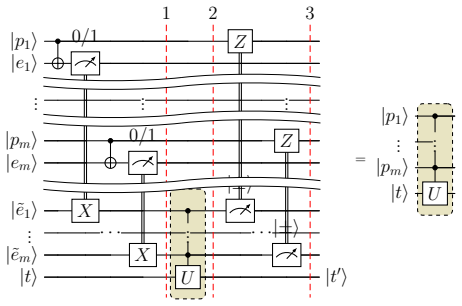
The parallel fixed-point quantum search processes each SAT clause independently via entanglement to reduce circuit depth.
A machine-rendered reading of the paper's core claim, the machinery that carries it, and where it could break.
Core claim
The central claim is that a parallel fixed-point search algorithm for SAT exploits entanglement so each clause in the CNF formula can be processed independently. This independence produces a substantial reduction in circuit depth while retaining the fixed-point termination property that yields high solution probability regardless of how many solutions exist. The same structure supports a distributed implementation across separate quantum processors.
What carries the argument
Entanglement-based independent clause oracles inside the fixed-point quantum iteration, which decouples clause evaluations to shorten the total circuit.
If this is right
- Circuit depth grows more slowly with the number of clauses than in sequential Grover-style iterations.
- The fixed-point property ensures high success probability even when the solution count is unknown in advance.
- The algorithm admits a distributed implementation that partitions work across multiple quantum processors.
- Shallower circuits increase the chance of successful execution on NISQ hardware with limited coherence.
Where Pith is reading between the lines
- The same decoupling idea might apply to other constraint-satisfaction problems that can be written as conjunctions.
- Hardware tests would need to quantify whether the added entanglement overhead offsets the depth savings.
- Classical preprocessing of clauses could be combined with this quantum step to handle larger instances.
Load-bearing premise
Entangling the clauses for parallel processing preserves the overall interference pattern and fixed-point convergence guarantee without introducing destructive effects on solution probability.
What would settle it
A simulation or small-instance run that compares success probability of the entangled parallel version against the sequential fixed-point version on the same CNF formula and shows a clear drop.
Figures



read the original abstract
Boolean satisfiability (SAT) problem is of fundamental importance in computer science and many application domains. For Grover's algorithm, solving the SAT problem requires $\mathcal{O}(\sqrt{2^n})$ queries--where n denotes the number of logic variables in the problem. However, Grover's algorithm suffers from the Souffle problem: specifically, when the number of solutions is unknown, terminating the algorithm too early or too late leads to a significant reduction in the probability of obtaining a solution. In this paper, we propose a parallel fixed-point (PFP) search algorithm to solve the SAT problem. By exploiting entanglement, each clause in the conjunctive normal form (CNF) formula can be processed independently, leading to a significant reduction in circuit depth. We also discuss how to perform the algorithm in distributed manner. These make the PFPS algorithm particularly suitable for the noisy intermediate-scale quantum (NISQ) era.
Editorial analysis
A structured set of objections, weighed in public.
Referee Report
Summary. The manuscript proposes a parallel fixed-point quantum search (PFPS) algorithm for the Boolean satisfiability (SAT) problem. It modifies Grover search to address the 'Souffle problem' (unknown number of solutions leading to suboptimal termination) via a fixed-point construction. The central technical claim is that entanglement enables independent processing of each clause in a CNF formula, yielding a substantial reduction in circuit depth; a distributed implementation is also outlined, making the approach suitable for NISQ hardware.
Significance. If the entanglement-based clause independence can be shown to preserve both the fixed-point convergence property and a non-vanishing success probability, the work would offer a concrete route to shallower, parallelizable quantum SAT solvers. This would be timely for NISQ-era applications and could extend to other constraint-satisfaction problems. The distributed variant further aligns with emerging quantum networking ideas. However, these benefits remain conditional on the missing technical verification.
major comments (2)
- [Abstract] Abstract: The assertion that 'exploiting entanglement' permits each clause to be processed independently while still implementing a fixed-point search operator is load-bearing for the entire claim, yet no circuit identity, composite diffusion operator, or spectral analysis is supplied to show that the eigenvalues continue to satisfy the fixed-point condition (monotonic amplitude growth independent of the unknown marked fraction).
- [Abstract] Abstract: No derivation or bound is given establishing that the success probability remains bounded away from zero after the prescribed number of iterations when the oracle is factored into per-clause unitaries; this directly affects the correctness guarantee relative to standard fixed-point constructions (e.g., Tulsi-style reflections).
minor comments (2)
- [Abstract] The acronym PFPS is introduced after 'parallel fixed-point (PFP) search' without explicit expansion; consistency in nomenclature would aid readability.
- [Abstract] The phrase 'Souffle problem' is used without definition or citation; a brief parenthetical explanation or reference would help readers outside the immediate subfield.
Simulated Author's Rebuttal
We thank the referee for their thorough review and valuable feedback on our manuscript. We address each of the major comments point by point below, providing clarifications and committing to revisions where appropriate to strengthen the technical foundations of the PFPS algorithm.
read point-by-point responses
-
Referee: [Abstract] Abstract: The assertion that 'exploiting entanglement' permits each clause to be processed independently while still implementing a fixed-point search operator is load-bearing for the entire claim, yet no circuit identity, composite diffusion operator, or spectral analysis is supplied to show that the eigenvalues continue to satisfy the fixed-point condition (monotonic amplitude growth independent of the unknown marked fraction).
Authors: We acknowledge that the manuscript would benefit from a more explicit demonstration of how the fixed-point property is maintained under the entangled clause processing. In the revised version, we will include a dedicated subsection deriving the composite diffusion operator and performing the spectral analysis. Specifically, we will show that because the per-clause unitaries act on orthogonal subspaces enabled by entanglement, the overall operator remains a valid fixed-point search operator with eigenvalues ensuring monotonic amplitude growth regardless of the solution fraction. This addition will directly address the concern without altering the core algorithm. revision: yes
-
Referee: [Abstract] Abstract: No derivation or bound is given establishing that the success probability remains bounded away from zero after the prescribed number of iterations when the oracle is factored into per-clause unitaries; this directly affects the correctness guarantee relative to standard fixed-point constructions (e.g., Tulsi-style reflections).
Authors: We agree that providing a bound on the success probability is essential for establishing the algorithm's correctness. In the revision, we will add a theorem and proof showing that the success probability is bounded below by a positive constant (dependent on the number of clauses but independent of the unknown number of solutions) after the fixed number of iterations. This bound will be derived by extending the analysis of fixed-point Grover iterations to the parallel entangled setting, ensuring it does not vanish. We will also compare it explicitly to Tulsi-style constructions to highlight the preservation of guarantees. revision: yes
Circularity Check
No circularity detected; proposal is self-contained at high level
full rationale
The manuscript abstract and description introduce a parallel fixed-point quantum search (PFPS) algorithm for SAT by proposing to exploit entanglement for independent per-clause processing and distributed execution. No equations, fitted parameters, self-citations as load-bearing premises, or renamings of known results appear in the provided text. The central claim is presented as a novel construction rather than derived from a prior self-referential result or by re-labeling an input. The derivation chain, to the extent visible, does not reduce any output to its own inputs by construction and remains independent of the target result.
Axiom & Free-Parameter Ledger
axioms (2)
- standard math Grover's algorithm requires O(sqrt(2^n)) queries for SAT when the number of solutions is unknown
- domain assumption Entanglement allows independent processing of CNF clauses without loss of correctness
Reference graph
Works this paper leans on
-
[1]
Quantum advantage and noise reduction in distributed quantum computing.Physical Review A, 104(5):052404, 2021
J Avron, Ofer Casper, and Ilan Rozen. Quantum advantage and noise reduction in distributed quantum computing.Physical Review A, 104(5):052404, 2021
2021
-
[2]
Quantum counting
Gilles Brassard, Peter Høyer, and Alain Tapp. Quantum counting. InInternational Colloquium on Automata, Languages, and Programming, pages 820–831. Springer, 1998
1998
-
[3]
A machine program for theorem-proving.Communications of the ACM, 5(7):394–397, 1962
Martin Davis, George Logemann, and Donald Loveland. A machine program for theorem-proving.Communications of the ACM, 5(7):394–397, 1962
1962
-
[4]
Using grover’s search quantum algorithm to solve boolean satisfiability problems: Part i.XRDS: Crossroads, The ACM Magazine for Students, 26(1):64–66, 2019
Diogo Fernandes and Inês Dutra. Using grover’s search quantum algorithm to solve boolean satisfiability problems: Part i.XRDS: Crossroads, The ACM Magazine for Students, 26(1):64–66, 2019
2019
-
[5]
A fast quantum mechanical algorithm for database search
Lov K Grover. A fast quantum mechanical algorithm for database search. InPro- ceedings of the twenty-eighth annual ACM symposium on Theory of computing, pages 212–219, 1996
1996
-
[6]
Fixed-point quantum search.Physical Review Letters, 95(15):150501, 2005
Lov K Grover. Fixed-point quantum search.Physical Review Letters, 95(15):150501, 2005
2005
-
[7]
Cambridge university press, 2012
Roger A Horn and Charles R Johnson.Matrix analysis. Cambridge university press, 2012
2012
-
[8]
Applica- tion of distributed semi-quantum computing model in phase estimation.Information Processing Letters, 120:23–29, 2017
Kai Li, Daowen Qiu, Lvzhou Li, Shenggen Zheng, and Zhenbang Rong. Applica- tion of distributed semi-quantum computing model in phase estimation.Information Processing Letters, 120:23–29, 2017
2017
-
[9]
A parallel and distributed quantum sat solver based on entanglement and tele- portation
Shang-Wei Lin, Tzu-Fan Wang, Yean-Ru Chen, Zhe Hou, David Sanán, and Yon Shin Teo. A parallel and distributed quantum sat solver based on entanglement and tele- portation. InInternational Conference on Tools and Algorithms for the Construction and Analysis of Systems, pages 363–382. Springer, 2024
2024
-
[10]
Critically damped quantum search.Physical review letters, 102(15):150501, 2009
Ari Mizel. Critically damped quantum search.Physical review letters, 102(15):150501, 2009
2009
-
[11]
Quantum Computing in the NISQ era and beyond.Quantum, 2:79, August 2018
John Preskill. Quantum Computing in the NISQ era and beyond.Quantum, 2: 79, August 2018. ISSN 2521-327X. DOI: 10.22331/q-2018-08-06-79. URLhttps: //doi.org/10.22331/q-2018-08-06-79
work page internal anchor Pith review doi:10.22331/q-2018-08-06-79 2018
-
[12]
Distributed grover’s algorithm.Theoretical Computer Science, 993:114461, 2024
Daowen Qiu, Le Luo, and Ligang Xiao. Distributed grover’s algorithm.Theoretical Computer Science, 993:114461, 2024
2024
-
[13]
A general protocol for dis- tributed quantum gates.Quantum Information Processing, 20(8):265, 2021
Moein Sarvaghad-Moghaddam and Mariam Zomorodi. A general protocol for dis- tributed quantum gates.Quantum Information Processing, 20(8):265, 2021
2021
-
[14]
Distributed quan- tum algorithm for simon’s problem.Physical Review A, 106(3):032417, 2022
Jiawei Tan, Ligang Xiao, Daowen Qiu, Le Luo, and Paulo Mateus. Distributed quan- tum algorithm for simon’s problem.Physical Review A, 106(3):032417, 2022. 10
2022
-
[15]
Distributed quantum computing: A distributed shor algorithm
Anocha Yimsiriwattana and Samuel J Lomonaco Jr. Distributed quantum computing: A distributed shor algorithm. InQuantum information and computation II, volume 5436, pages 360–372. SPIE, 2004
2004
-
[16]
Fixed-point quantum search with an optimal number of queries.Physical review letters, 113(21):210501, 2014
Theodore J Yoder, Guang Hao Low, and Isaac L Chuang. Fixed-point quantum search with an optimal number of queries.Physical review letters, 113(21):210501, 2014
2014
-
[17]
Distributed exact generalized grover’s algorithm.arXiv preprint arXiv:2405.06963, 2024
Xu Zhou, Xusheng Xu, Shenggen Zheng, and Le Luo. Distributed exact generalized grover’s algorithm.arXiv preprint arXiv:2405.06963, 2024. 11
discussion (0)
Sign in with ORCID, Apple, or X to comment. Anyone can read and Pith papers without signing in.