Recognition: unknown
Moral Hazard in Delegated Bayesian Persuasion
Pith reviewed 2026-05-10 16:19 UTC · model grok-4.3
The pith
Moral hazard in delegated Bayesian persuasion reduces to alignment conditions on payoff indices, or a single shadow price when those fail.
A machine-rendered reading of the paper's core claim, the machinery that carries it, and where it could break.
Core claim
We characterize first-best implementability through a pair of alignment conditions on the principal's and intermediary's payoff indices. A local condition on the support of the target experiment is necessary; a global affine alignment condition is sufficient. We show that the gap between them is non-empty and provide a partial characterization of the intermediate region. When the first-best is unattainable, the principal's problem admits a virtual Bayesian persuasion representation: the second-best experiment maximizes the same concavified objective as the first-best, with the principal's payoff index distorted by a single scalar shadow price that summarizes the entire agency friction. Under
What carries the argument
Pair of alignment conditions (local support necessity plus global affine sufficiency) on payoff indices, together with the virtual Bayesian persuasion representation that distorts the principal's objective by one scalar shadow price.
If this is right
- Whenever the local support and global affine alignments hold, the principal obtains the unconstrained optimal experiment.
- When alignment fails, the second-best solution is the Bayesian-persuasion optimum of the principal's objective after uniform scaling by the shadow price.
- Under entropy costs, moral hazard strictly reduces posterior dispersion if the intermediary's payoffs differ across recommended actions.
- Explicit closed-form posteriors, mixing probabilities, and transfer schedules are available for all binary environments.
Where Pith is reading between the lines
- The single-scalar reduction suggests that many delegation-of-information problems may admit low-dimensional contract solutions rather than fully flexible mechanisms.
- The same virtual-representation technique could be tested in dynamic or multi-intermediary versions of the model.
- Regulators or firms could estimate the shadow price from observed information choices to approximate optimal delegation rules without solving the full mechanism-design problem.
Load-bearing premise
The intermediary privately chooses the experiment subject to convex costs, and the principal can commit to outcome-contingent transfers without further restrictions on the contract space.
What would settle it
Compute the second-best experiment for a concrete binary-action environment with non-aligned payoffs and entropy costs, then check whether it exactly maximizes the concavified objective under the scalar shadow price derived from the incentive constraints.
Figures
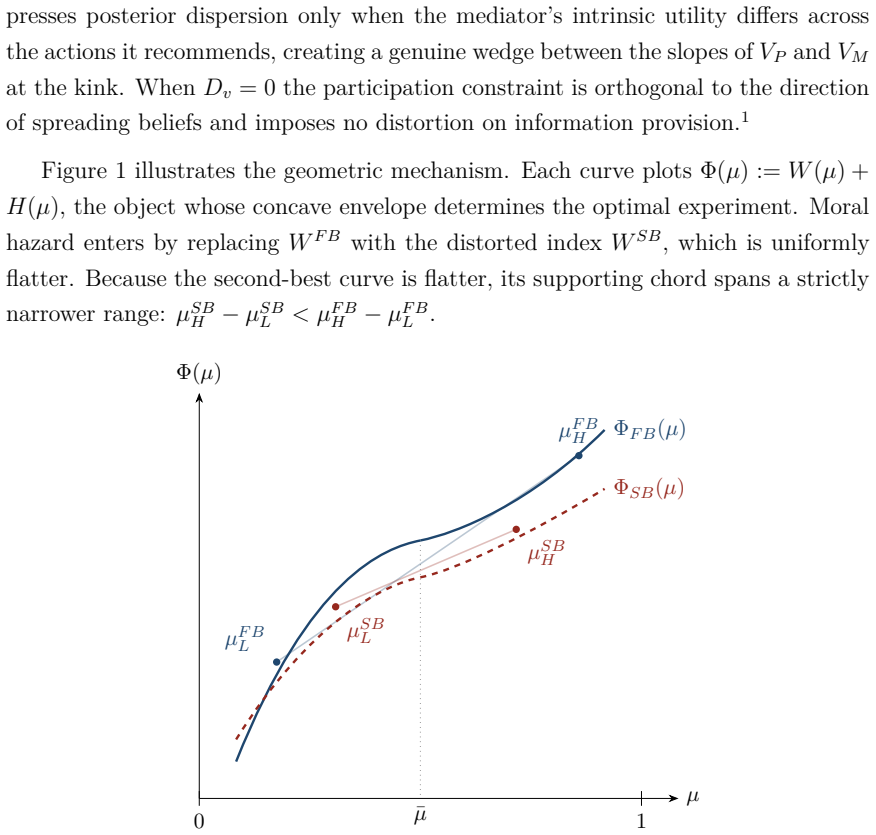


read the original abstract
We study delegated Bayesian persuasion: a principal incentivizes an intermediary to design information via outcome-contingent transfers, while the intermediary privately chooses the experiment subject to convex costs. We characterize first-best implementability through a pair of alignment conditions on the principal's and intermediary's payoff indices. A local condition on the support of the target experiment is necessary; a global affine alignment condition is sufficient. We show that the gap between them is non-empty and provide a partial characterization of the intermediate region. When the first-best is unattainable, the principal's problem admits a virtual Bayesian persuasion representation: the second-best experiment maximizes the same concavified objective as the first-best, with the principal's payoff index distorted by a single scalar shadow price that summarizes the entire agency friction. Under entropy costs, moral hazard compresses posterior dispersion whenever the intermediary's utility differs across the actions it recommends. Explicit closed-form solutions for posteriors, mixing weights, and the optimal transfer schedule are derived for binary environments.
Editorial analysis
A structured set of objections, weighed in public.
Referee Report
Summary. The paper studies moral hazard in delegated Bayesian persuasion, where a principal uses outcome-contingent transfers to incentivize an intermediary who privately chooses an experiment subject to convex costs. It characterizes first-best implementability via a necessary local alignment condition on the support of the target experiment and a sufficient global affine alignment condition on the payoff indices. The gap between these is shown to be non-empty with a partial characterization provided. When first-best is unattainable, the principal's problem reduces to a virtual Bayesian persuasion problem in which the second-best experiment maximizes the concavified objective with the principal's payoff index distorted by a single scalar shadow price summarizing the agency friction. Explicit closed-form solutions for posteriors, mixing weights, and transfers are derived for binary environments under entropy costs.
Significance. If the characterizations and virtual representation hold, this provides a clean and tractable framework for incorporating agency frictions into Bayesian persuasion models. The separation of local necessary and global sufficient conditions, combined with the single-shadow-price distortion for the second-best, offers a useful reduction that parallels standard mechanism-design techniques. The explicit solutions under entropy costs are a particular strength, as they deliver falsifiable predictions on posterior compression and could support applications in delegated information design.
minor comments (2)
- The abstract and introduction refer to a 'partial characterization of the intermediate region' between the local and global alignment conditions; the main text should include at least one concrete example or proposition that illustrates the boundary of this region.
- Notation for the principal's and intermediary's payoff indices (and their concavifications) should be introduced with a single consistent table or display early in the paper to aid readability across sections.
Simulated Author's Rebuttal
We thank the referee for the positive and insightful summary of our paper, as well as the recommendation for minor revision. The report raises no specific major comments or points requiring clarification, so we have no revisions to propose at this stage.
Circularity Check
Derivation is self-contained with no circular reductions
full rationale
The paper's core results—necessary local support condition and sufficient global affine alignment for first-best implementability, plus the virtual Bayesian persuasion reduction for the second-best via an endogenous scalar shadow price—are derived directly from the model primitives (principal's and intermediary's payoff indices, convex experiment costs, and unrestricted outcome-contingent transfers) without reducing to fitted inputs, self-definitional loops, or load-bearing self-citations. The shadow price emerges as the Lagrange multiplier enforcing the intermediary's incentive constraint in the principal's optimization program, preserving independence from the target experiment; explicit binary solutions under entropy costs follow by direct substitution into the concavified objective. No step equates a claimed prediction or first-principles result to its own inputs by construction.
Axiom & Free-Parameter Ledger
axioms (2)
- standard math Players are Bayesian rational with a common prior.
- domain assumption The intermediary's cost function for choosing an experiment is convex.
Reference graph
Works this paper leans on
-
[1]
Arieli, I., Babichenko, Y., and Smorodinsky, R. (2022). Mediators in persuasion problems.Theoretical Economics, 17(1):1–36. Bergemann, D. and Morris, S. (2016). Bayes correlated equilibrium and the compar- ison of information structures in games.Theoretical Economics, 11(2):487–522. Bharadwaj, A. and Iyer, G. (2025). Contracting for persuasion.Working pap...
2022
-
[2]
Doval, L. and Skreta, V. (2024). Optimal mechanism for the sale of a durable good. Theoretical Economics, 19(2):865–915. Dworczak, P. and Martini, G. (2019). The simple economics of optimal persuasion. Journal of Political Economy, 127:1993–2048. Gentzkow, M. and Kamenica, E. (2014). Costly persuasion.American Economic Review Papers and Proceedings, 104(5...
discussion (0)
Sign in with ORCID, Apple, or X to comment. Anyone can read and Pith papers without signing in.