Recognition: unknown
Understanding the structure of nucleon excitations from their wavefunctions
Pith reviewed 2026-05-10 16:08 UTC · model grok-4.3
The pith
Lattice wavefunctions of nucleon excitations display two node types, one built into single interpolating fields.
A machine-rendered reading of the paper's core claim, the machinery that carries it, and where it could break.
Core claim
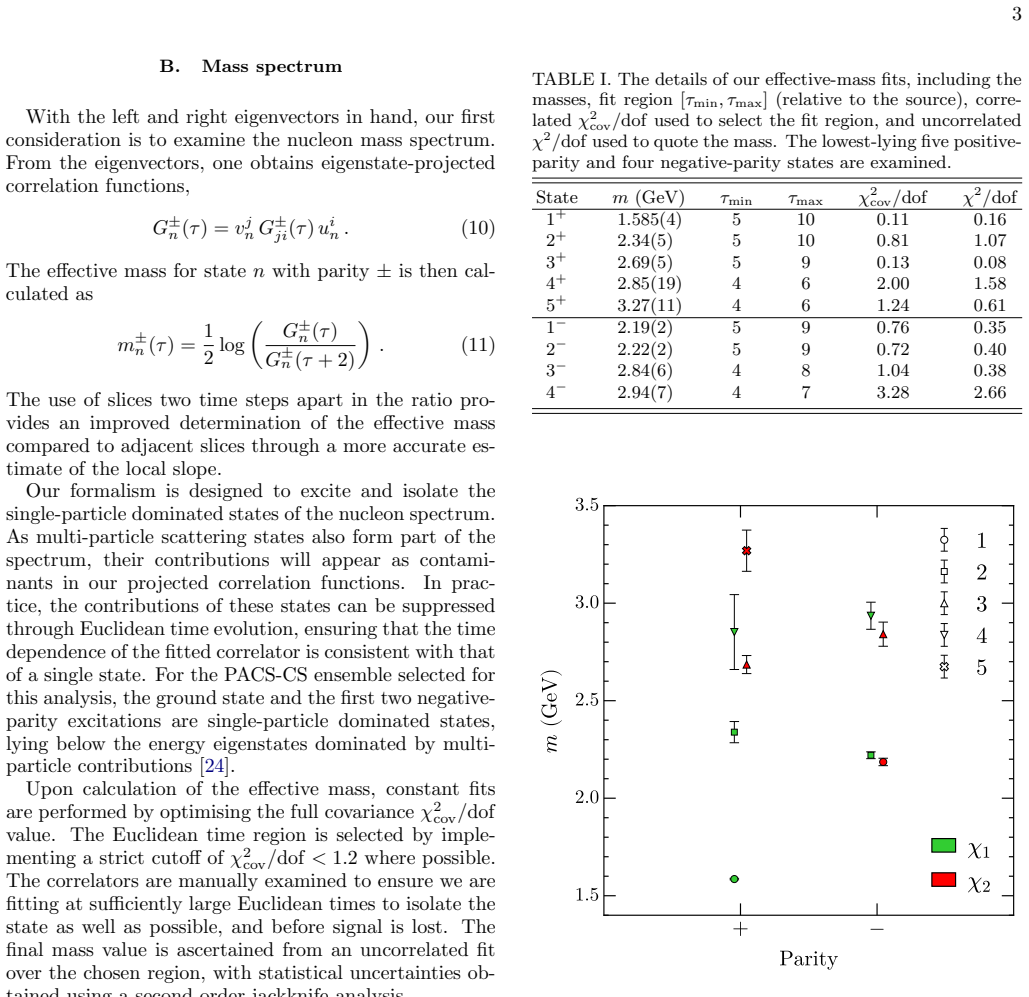
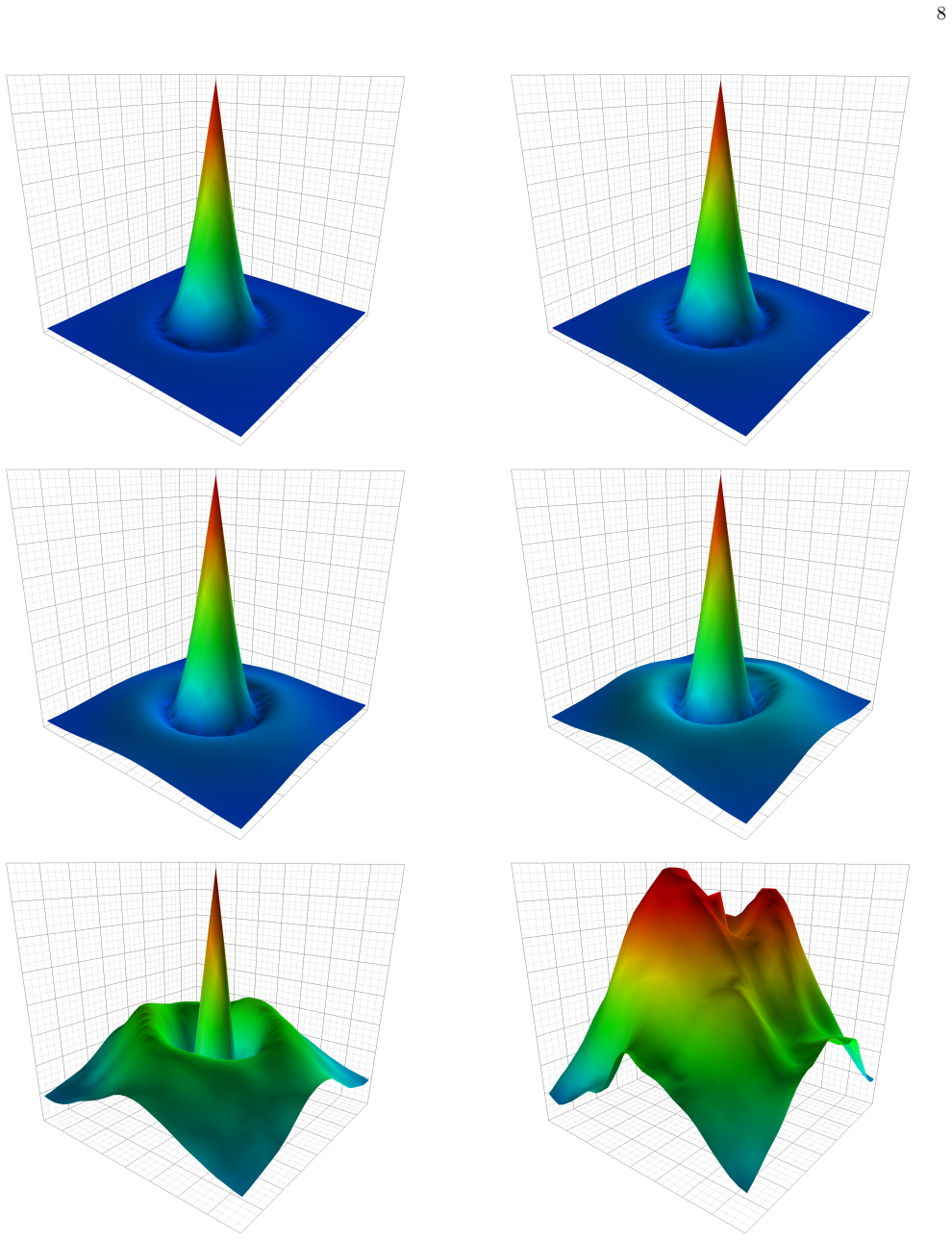
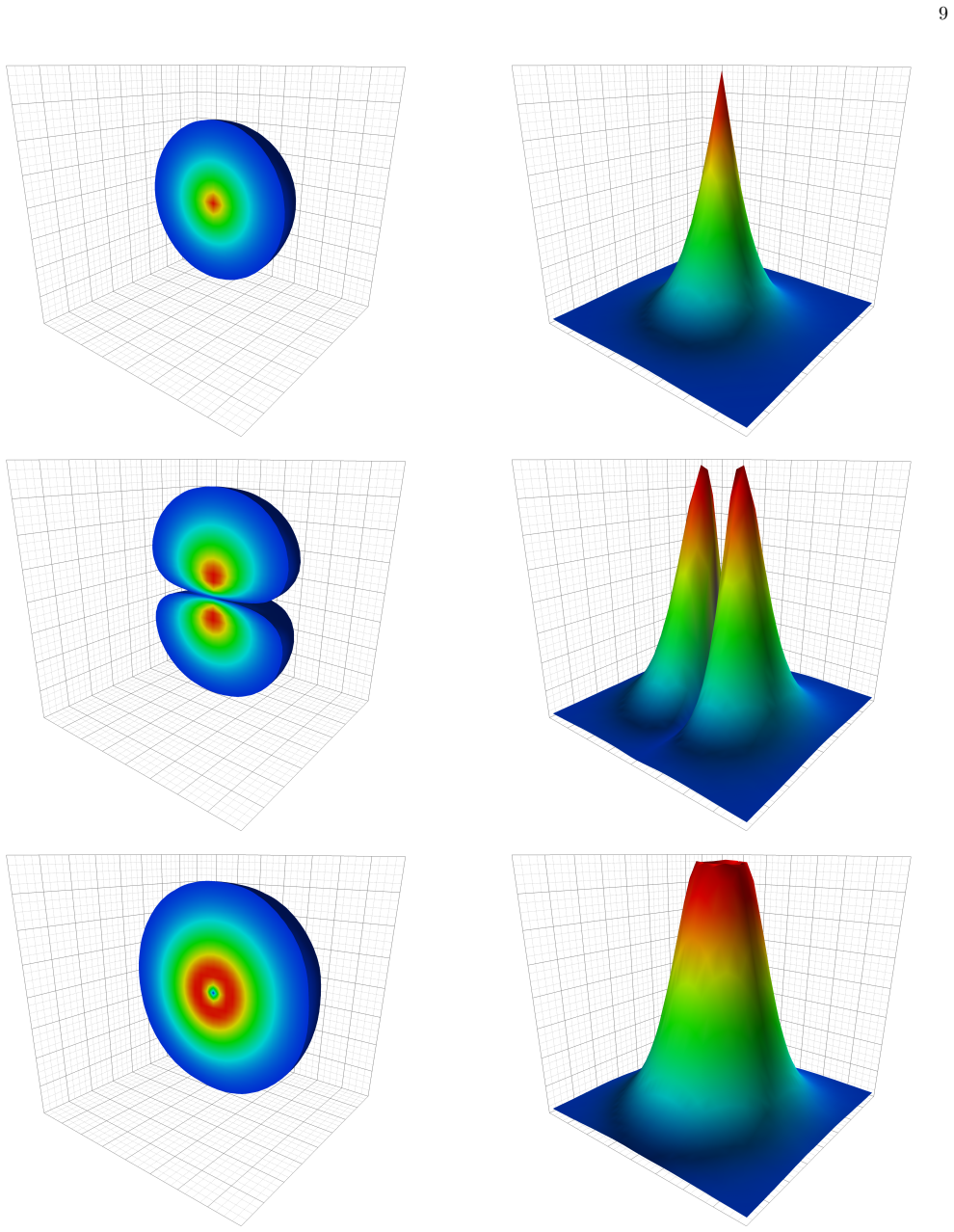
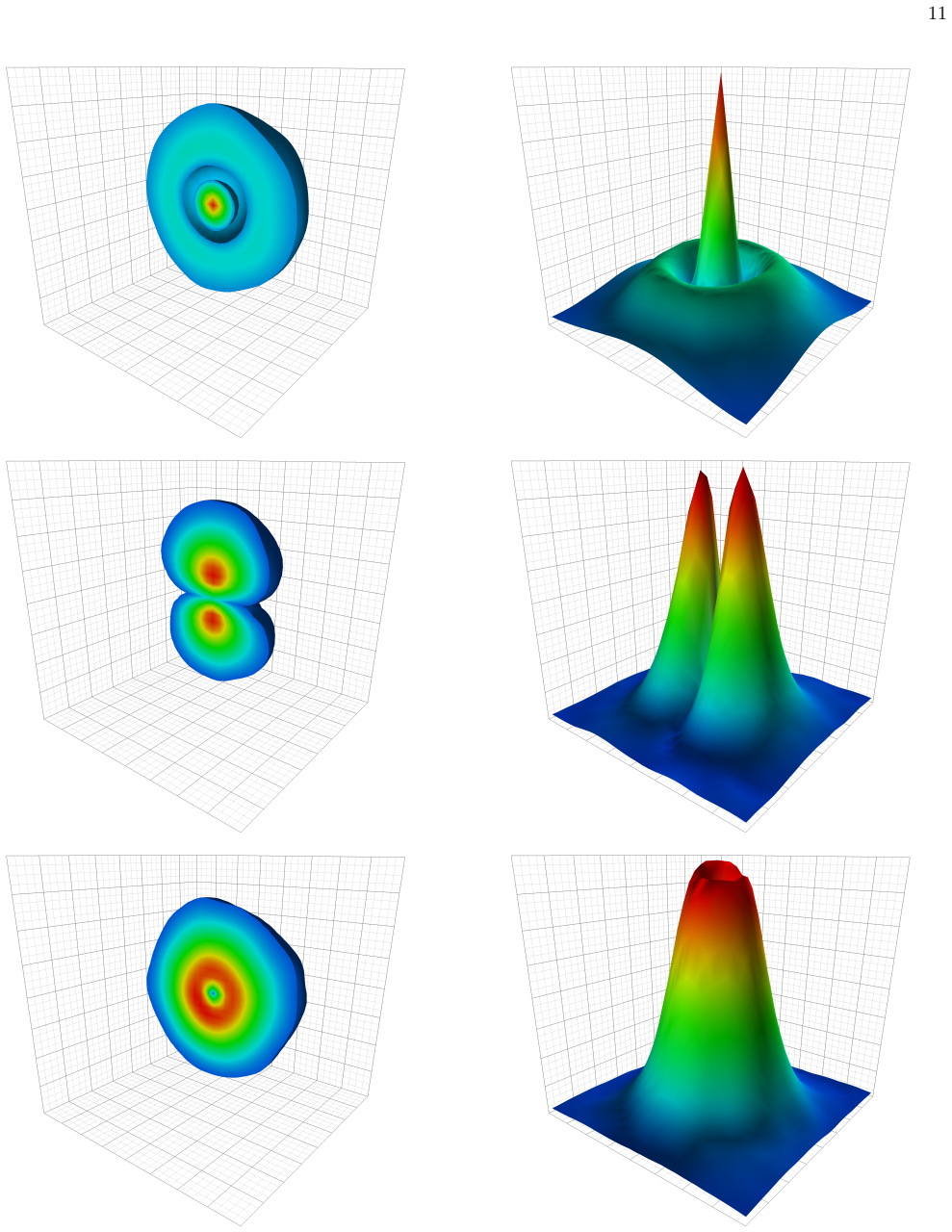
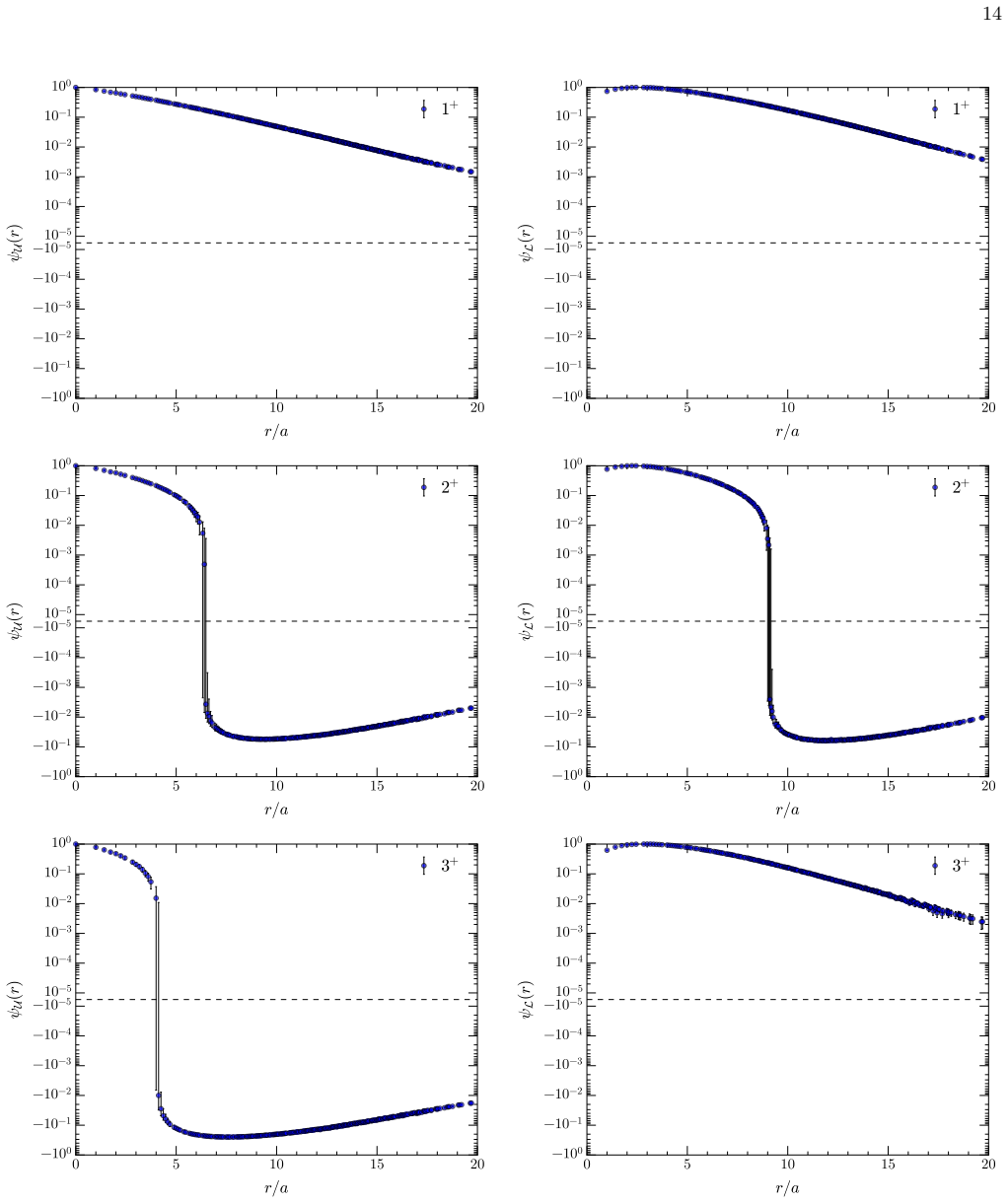
Relativistic wavefunctions of nucleon excitations are scrutinised to understand their node structure and the underlying role of local interpolating fields in generating the nucleon spectrum. Approximately 4000 propagators are employed on the heaviest PACS-CS ensemble at m_π ≃ 702 MeV. We examine the ground and four lowest-lying excited states at zero momentum for both positive- and negative-parity spectra, where the proton's d-quark wavefunction is calculated about the two u quarks at the origin. This is achieved using two local interpolating fields that each carry the quantum numbers of the nucleon but with differing spin-flavour structures, one of which vanishes in the nonrelativistic. We
What carries the argument
Local interpolating fields with differing spin-flavour structures that generate nucleon wavefunctions on the lattice, separating superposition nodes from built-in nodes inside s-wave Dirac components.
If this is right
- The single-particle nucleon spectrum can be decomposed into contributions traceable to individual lattice operators.
- Nodes observed in excited states arise either from linear combinations of interpolators or from intrinsic Dirac structure.
- Radial wavefunction profiles quantify the location and character of both node types across parity channels.
- Visual volume and surface renderings confirm the qualitative distinction between the two node classes.
- The approach supplies a concrete link between quark-model node expectations and the output of lattice operators.
Where Pith is reading between the lines
- The same distinction between built-in and superposition nodes could be tested in other baryons by applying analogous pairs of interpolators.
- If the built-in nodes survive at lighter pion masses, they may point to a feature of QCD bound states independent of the heavy-pion approximation.
- Improved interpolator design might exploit the built-in nodes to enhance overlap with specific radial excitations.
- The method offers a template for examining whether similar intrinsic nodes appear in meson wavefunctions under comparable lattice setups.
Load-bearing premise
The two chosen local interpolating fields have enough overlap with the physical eigenstates and the heavy-pion ensemble yields node structures representative of the physical world.
What would settle it
Recompute the same wavefunctions on an ensemble with physical or near-physical pion mass and check whether the built-in nodes in the s-wave components persist unchanged.
Figures







read the original abstract
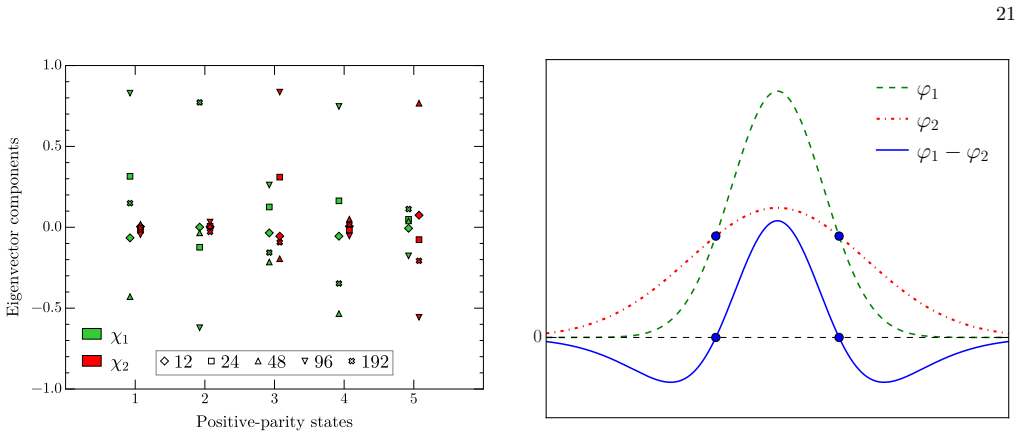
Relativistic wavefunctions of nucleon excitations are scrutinised to understand their node structure and the underlying role of local interpolating fields in generating the nucleon spectrum. In addressing quark model perspectives, approximately 4000 propagators are employed on the heaviest PACS-CS ensemble at $m_\pi \simeq$ 702 MeV. We examine the ground and four lowest-lying excited states at zero momentum for both positive- and negative-parity spectra, where the proton's d-quark wavefunction is calculated about the two u quarks at the origin. This is achieved using two local interpolating fields that each carry the quantum numbers of the nucleon but with differing spin-flavour structures, one of which vanishes in the nonrelativistic limit. We find that two distinct types of wavefunction nodes are manifest: "superposition nodes" formed through a linear combination of interpolating fields, and novel "built-in nodes" that are fundamentally built in to the s-wave Dirac components of an individual interpolating field. These are investigated qualitatively through visualisations in the form of both volume and surface renderings, and quantitatively by the calculation of radial wavefunctions. Combined, these findings build a comprehensive picture of the single-particle nucleon spectrum and how its properties derive from fundamental lattice operators.
Editorial analysis
A structured set of objections, weighed in public.
Referee Report
Summary. The manuscript presents a lattice QCD study on the PACS-CS ensemble (m_π ≃ 702 MeV) that computes relativistic wavefunctions of the nucleon ground state and its four lowest-lying excitations (zero momentum, both parities) using a 2×2 variational basis of two local interpolating fields. It identifies two classes of nodes in the d-quark wavefunction about the two u quarks at the origin—'superposition nodes' arising from linear combinations of the operators and 'built-in nodes' intrinsic to the s-wave Dirac components of a single operator—supported by volume/surface visualizations and radial profiles derived from approximately 4000 propagators.
Significance. If the extracted states are sufficiently close to the true eigenstates, the distinction between the two node types offers a concrete link between the choice of lattice interpolators and the nodal structure of the nucleon spectrum, complementing quark-model intuition with first-principles QCD information. The scale of the computation and the combination of qualitative renderings with quantitative radial wavefunctions constitute a clear technical strength.
major comments (2)
- [Abstract/Methods] Abstract and Methods: The central claim that the observed nodes reflect intrinsic properties of the nucleon excitations presupposes that the variational procedure with only two local interpolators isolates the ground and four excited states with acceptable purity. A 2×2 correlation matrix is minimal; without additional operators, explicit checks for excited-state contamination, or overlap factors with known physical states, the apparent node locations in the excited states could be shifted by mixing rather than representing true eigenstate structure.
- [Results] Results: The radial wavefunction profiles and node classifications are presented without error bars or any quantification of statistical or systematic uncertainties. In addition, the analysis is performed exclusively at m_π ≃ 702 MeV; no assessment is given of how the heavy-pion spectrum ordering or wavefunction overlaps might differ from the physical point, which directly affects the interpretation of the built-in versus superposition nodes.
minor comments (2)
- [Abstract] The abstract refers to 'approximately 4000 propagators' but provides no further details on the number of configurations, source-sink separations, or smearing parameters used to generate the wavefunctions.
- Figure captions and text should explicitly state the normalization convention for the radial profiles and the precise definition of the radial coordinate used in the surface renderings.
Simulated Author's Rebuttal
We thank the referee for their thorough review and constructive feedback on our manuscript. We address each major comment below, indicating planned revisions where appropriate while providing our honest assessment of the work's scope and limitations.
read point-by-point responses
-
Referee: [Abstract/Methods] The central claim that the observed nodes reflect intrinsic properties of the nucleon excitations presupposes that the variational procedure with only two local interpolators isolates the ground and four excited states with acceptable purity. A 2×2 correlation matrix is minimal; without additional operators, explicit checks for excited-state contamination, or overlap factors with known physical states, the apparent node locations in the excited states could be shifted by mixing rather than representing true eigenstate structure.
Authors: We agree that a 2×2 variational basis is minimal and that the purity of the extracted states is central to interpreting the nodes as intrinsic. The two local interpolators were selected for their complementary spin-flavour structures (one vanishing in the non-relativistic limit) to span the low-lying spectrum effectively. In the revised manuscript we will add effective-mass plots of the principal correlators, the eigenvalues of the 2×2 matrix, and a quantitative discussion of the overlap factors to demonstrate state isolation and address possible mixing. We maintain that the observed distinction between superposition and built-in nodes remains robust within this controlled setup, but we will qualify the claims accordingly. revision: partial
-
Referee: [Results] The radial wavefunction profiles and node classifications are presented without error bars or any quantification of statistical or systematic uncertainties. In addition, the analysis is performed exclusively at m_π ≃ 702 MeV; no assessment is given of how the heavy-pion spectrum ordering or wavefunction overlaps might differ from the physical point, which directly affects the interpretation of the built-in versus superposition nodes.
Authors: We accept that the radial profiles lack error bars and that the single heavy-pion ensemble limits the generality of the conclusions. In the revision we will include statistical uncertainties on the radial wavefunctions computed from the ~4000 propagators. We will also add an explicit discussion of the heavy-mass limitation, noting that the PACS-CS ensemble was chosen to maximise signal quality for these computationally demanding wavefunction measurements. A quantitative assessment at the physical point is not possible with the present data set. revision: yes
- Quantitative assessment of spectrum ordering and node structure at the physical pion mass, which would require additional ensembles beyond the single heavy-mass ensemble used here.
Circularity Check
No circularity: node classifications extracted directly from lattice wavefunction computations
full rationale
The paper performs a direct lattice QCD calculation of nucleon wavefunctions on a fixed ensemble using a 2x2 variational basis of local interpolators. The distinction between superposition nodes (arising from linear combinations in the eigenstate extraction) and built-in nodes (intrinsic to individual interpolator Dirac structures) is obtained by explicit computation of overlaps, radial profiles, and visualizations of the resulting states. No parameters are fitted to define or predict the node types, no self-citations load-bear the classification, and the results do not reduce to the inputs by construction. The derivation chain remains self-contained as empirical output from the correlator matrix diagonalization and wavefunction sampling.
Axiom & Free-Parameter Ledger
axioms (2)
- domain assumption Local interpolating fields with the correct quantum numbers have non-zero overlap with the physical nucleon eigenstates.
- domain assumption The heavy-pion ensemble at m_π ≃ 702 MeV yields node structures representative of the physical spectrum.
Reference graph
Works this paper leans on
-
[1]
interpolator wavefunctions
As such, these components can be appropriately combined to ob- tain an improved estimate without the need to explicitly calculate the wavefunctions forU ∗ configurations. In fu- ture work that considers nonzero momentum, computing wavefunctions for the{U ∗}ensemble will provide a gen- uine improvement. With this explained, we now present our plots of the ...
-
[2]
The lowest-lyingχ 1- andχ 2-dominated states both have zero superposition nodes
-
[3]
Separately add one node for eachχ1-dominated and χ2-dominated radial excitation
-
[4]
Add an extra node to thes-wave components ofχ 2- dominated positive-parity states andχ 1-dominated negative-parity states (the upper and lower compo- nents, respectively). C. MIT bag model Although which interpolating field carries the built-in node can be easily understood, we have yet to account for its presence in thes-wave components of the wavefunc- ...
-
[5]
E. E. Salpeter and H. A. Bethe, A Relativistic Equation for Bound-State Problems, Phys. Rev.84, 1232 (1951)
1951
- [6]
- [7]
-
[8]
Aokiet al.(PACS-CS), 2 + 1 flavor lattice QCD to- ward the physical point, Phys
S. Aokiet al.(PACS-CS), 2 + 1 flavor lattice QCD to- ward the physical point, Phys. Rev. D79, 034503 (2009), arXiv:0807.1661 [hep-lat]
- [9]
-
[10]
Y. Iwasaki, Renormalization Group Analysis of Lat- tice Theories and Improved Lattice Action. II. Four- dimensional non-Abelian SU(N) gauge model, (1983), arXiv:1111.7054 [hep-lat]
work page Pith review arXiv 1983
-
[11]
Y. Iwasaki, K. Kanaya, T. Kaneko, and T. Yoshie, Scal- ing in SU(3) pure gauge theory with a renormalization- group-improved action, Phys. Rev. D56, 151 (1997), arXiv:hep-lat/9610023
-
[12]
Sheikholeslami and R
B. Sheikholeslami and R. Wohlert, Improved continuum limit lattice action for QCD with wilson fermions, Nucl. Phys. B259, 572 (1985)
1985
- [13]
-
[14]
Chung, H
Y. Chung, H. G. Dosch, M. Kremer, and D. Schall, Baryon sum rules and chiral symmetry breaking, Nucl. Phys. B197, 55 (1982)
1982
-
[15]
D. Brommel, P. Crompton, C. Gattringer, L. Y. Gloz- man, C. B. Lang, S. Schaefer, and A. Schafer (Bern-Graz- Regensburg), Excited nucleons with chirally improved fermions, Phys. Rev. D69, 094513 (2004), arXiv:hep- ph/0307073
- [16]
- [17]
- [18]
- [19]
- [20]
- [21]
- [22]
-
[23]
Gusken, A study of smearing techniques for hadron correlation functions, Nucl
S. Gusken, A study of smearing techniques for hadron correlation functions, Nucl. Phys. B Proc. Suppl.17, 361 (1990)
1990
-
[24]
Michael, Adjoint sources in lattice gauge theory, Nucl
C. Michael, Adjoint sources in lattice gauge theory, Nucl. Phys. B259, 58 (1985)
1985
-
[25]
Luscher and U
M. Luscher and U. Wolff, How to calculate the elastic scattering matrix in two-dimensional quantum field the- ories by numerical simulation, Nucl. Phys. B339, 222 (1990)
1990
- [26]
-
[27]
Draper, R
T. Draper, R. M. Woloshyn, W. Wilcox, and K.-F. Liu, Electromagnetic form factors of hadrons, Nucl. Phys. B Proc. Suppl.9, 175 (1989)
1989
- [28]
- [29]
-
[30]
W. Melnitchouk, S. O. Bilson-Thompson, F. D. R. Bon- net, J. N. Hedditch, F. X. Lee, D. B. Leinweber, A. G. Williams, J. M. Zanotti, and J. B. Zhang, Excited baryons in lattice QCD, Phys. Rev. D67, 114506 (2003), arXiv:hep-lat/0202022
-
[31]
Chodos, R
A. Chodos, R. L. Jaffe, K. Johnson, C. B. Thorn, and V. F. Weisskopf, New extended model of hadrons, Phys. Rev. D9, 3471 (1974)
1974
-
[32]
Chodos, R
A. Chodos, R. L. Jaffe, K. Johnson, and C. B. Thorn, Baryon structure in the bag theory, Phys. Rev. D10, 2599 (1974)
1974
-
[33]
C. L. Critchfield, Scalar binding of quarks, Phys. Rev. D 12, 923 (1975)
1975
-
[34]
C. L. Critchfield, Scalar potentials in the Dirac equation, J. Math. Phys.17, 261 (1976)
1976
-
[35]
D. W. Rein, Low-energy properties of a relativistic quark model with linear scalar potential, Nuovo Cim. A38, 19 (1977)
1977
-
[36]
Ram and R
B. Ram and R. Halasa, Dirac equation with a quadratic scalar potential—are quarks confined?, Lett. Nuovo Cim. 26, 551 (1979)
1979
-
[37]
Ram, Comments on the Dirac equation with a quadratic scalar potential, Lett
B. Ram, Comments on the Dirac equation with a quadratic scalar potential, Lett. Nuovo Cim.28, 476 (1980)
1980
-
[38]
Ram and M
B. Ram and M. Arafah, Bound-state dirac eigenvalues for scalar potentials, Lett. Nuovo Cim.30, 5 (1981)
1981
-
[39]
V. P. Iyer and L. K. Sharma, Scalar potentials in the Dirac equation and quark confinement, Phys. Lett. B 102, 154 (1981)
1981
-
[40]
Ravndal, A harmonic quark bag model, Phys
F. Ravndal, A harmonic quark bag model, Phys. Lett. B 113, 57 (1982)
1982
-
[41]
Su and Z.-Q
R.-k. Su and Z.-Q. Ma, The Confinement Properties for Dirac Equation With the Scalar Like and Vector Like Potentials, J. Phys. A19, 1739 (1986)
1986
- [42]
-
[43]
’t Hooft, On the phase transition towards permanent quark confinement, Nucl
G. ’t Hooft, On the phase transition towards permanent quark confinement, Nucl. Phys. B138, 1 (1978)
1978
-
[44]
’t Hooft, A property of electric and magnetic flux in non-Abelian gauge theories, Nucl
G. ’t Hooft, A property of electric and magnetic flux in non-Abelian gauge theories, Nucl. Phys. B153, 141 (1979)
1979
-
[45]
H. B. Nielsen and P. Olesen, A quantum liquid model for the QCD vacuum: Gauge and rotational invariance of domained and quantized homogeneous color fields, Nucl. Phys. B160, 380 (1979)
1979
-
[46]
Greensite, The confinement problem in lattice gauge theory, Prog
J. Greensite, The confinement problem in lattice gauge theory, Prog. Part. Nucl. Phys.51, 1 (2003), arXiv:hep- lat/0301023
-
[47]
J. Greensite, Confinement from Center Vortices: A re- view of old and new results, EPJ Web Conf.137, 01009 (2017), arXiv:1610.06221 [hep-lat]
-
[48]
E.-A. O’Malley, W. Kamleh, D. Leinweber, and P. Moran,SU(3) centre vortices underpin confinement and dynamical chiral symmetry breaking, Phys. Rev. D 86, 054503 (2012), arXiv:1112.2490 [hep-lat]
-
[49]
A. Trewartha, W. Kamleh, and D. Leinweber, Evidence that centre vortices underpin dynamical chiral symmetry breaking in SU(3) gauge theory, Phys. Lett. B747, 373 (2015), arXiv:1502.06753 [hep-lat]
-
[50]
A. Trewartha, W. Kamleh, and D. Leinweber, Centre vortex removal restores chiral symmetry, J. Phys. G44, 125002 (2017), arXiv:1708.06789 [hep-lat]
-
[51]
Kamleh, Evolving the COLA software library, PoS LATTICE2022, 339 (2023), arXiv:2302.00850 [hep-lat]
W. Kamleh, Evolving the COLA software library, PoS LATTICE2022, 339 (2023), arXiv:2302.00850 [hep-lat]
discussion (0)
Sign in with ORCID, Apple, or X to comment. Anyone can read and Pith papers without signing in.