Recognition: no theorem link
Ion pickup and velocity space thermalization at outer planet moons
Pith reviewed 2026-05-10 15:57 UTC · model grok-4.3
The pith
Hybrid simulations show pickup ions at outer planet moons are scattered by self-excited waves to achieve rapid isotropization.
A machine-rendered reading of the paper's core claim, the machinery that carries it, and where it could break.
Core claim
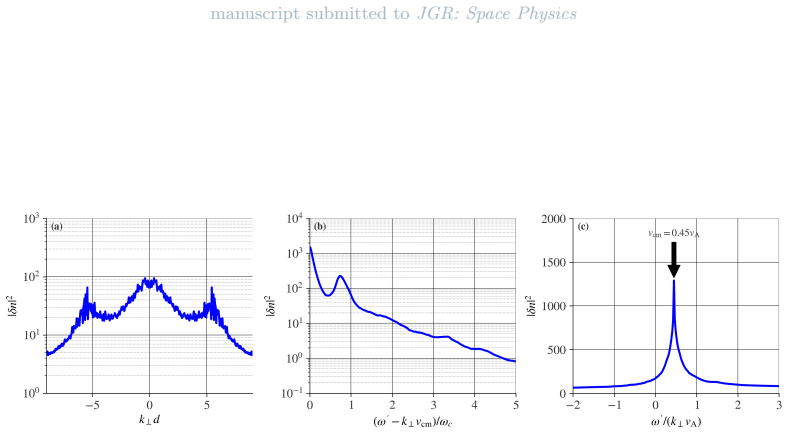
In the moon's rest frame, ambient ions initially stream perpendicular to the background magnetic field at the corotation velocity, forming a nongyrotropic velocity distribution with two ion populations clustered at opposite gyrophases. This configuration excites transverse magnetic perturbations associated with electromagnetic ion cyclotron waves and compressional perturbations associated with mirror-mode and ion Bernstein waves, reaching amplitudes of several percent of the background field strength. Field-particle correlation analysis quantifies the energy transfer between waves and particles and demonstrates how these perturbations scatter ions in velocity space, efficiently incorporating
What carries the argument
Field-particle correlation analysis applied to the wave-particle interactions that arise from the initial nongyrotropic two-population ion distribution in hybrid-kinetic simulations.
If this is right
- Pickup ions are incorporated into the background plasma within a few ion gyroperiods.
- The excited waves reach amplitudes of several percent of the background magnetic field.
- The scattering produces isotropization in both gyrophase and pitch angle.
- The results supply a kinetic framework for interpreting in situ measurements at active moons.
Where Pith is reading between the lines
- The same wave-driven incorporation mechanism may operate at other bodies that have exospheres and a flowing plasma.
- Instrument designs for future close encounters could target simultaneous detection of the waves and the evolving ion distributions.
- Full kinetic treatments that retain electron inertia might alter the growth rates or the final degree of isotropization.
Load-bearing premise
The hybrid-kinetic approximation with kinetic ions and massless fluid electrons, together with the specific initial nongyrotropic two-population distribution, accurately represents the real pickup process and wave excitation without missing electron-scale effects.
What would settle it
In situ measurements at an outer-planet moon that show no electromagnetic waves of the predicted amplitudes correlating with velocity-space scattering of pickup ions, or that show pickup ions remaining anisotropic in gyrophase and pitch angle.
Figures




read the original abstract
Ion pickup at the outer planets' active moons is a fundamental plasma process in which newly ionized particles from moon exospheres interact with the ambient corotating plasma and are accelerated to match the background flow. Spacecraft observations have revealed intense electromagnetic wave activity commonly attributed to this pickup process. Here we investigate ion pickup using hybrid-kinetic simulations in which ions are treated kinetically while electrons are modeled as a massless fluid. In the moon's rest frame, ambient ions initially stream perpendicular to the background magnetic field at the corotation velocity, creating a nongyrotropic velocity distribution with two ion populations clustered at opposite gyrophases. Within a few ion gyroperiods, this configuration simultaneously excites transverse magnetic perturbations associated with electromagnetic ion cyclotron waves and compressional perturbations associated with mirror-mode and ion Bernstein waves, reaching amplitudes of several percent of the background field strength. Using field-particle correlation analysis, we quantify the energy transfer between waves and particles and demonstrate how these perturbations scatter ions in velocity space, efficiently incorporating newly created ions into the background plasma and leading to isotropization in both gyrophase and pitch angle. These results provide a kinetic framework for understanding pickup-driven wave-particle interactions and offer guidance for interpreting in situ measurements at active moons throughout the outer solar system.
Editorial analysis
A structured set of objections, weighed in public.
Referee Report
Summary. The paper claims that hybrid-kinetic simulations of ion pickup at outer planet moons, initialized in the moon rest frame with a nongyrotropic two-population ion distribution (ambient corotating ions plus a second population at opposite gyrophase), rapidly excite transverse EMIC waves and compressional mirror-mode/ion Bernstein waves to amplitudes of several percent of the background field within a few gyroperiods. Field-particle correlation analysis is used to quantify wave-particle energy transfer, showing how the perturbations scatter ions in velocity space to achieve gyrophase and pitch-angle isotropization and incorporate the new ions into the background plasma.
Significance. If the results hold, the work supplies a kinetic framework for pickup-driven wave-particle interactions at active moons, with direct relevance to interpreting spacecraft observations throughout the outer solar system. The application of field-particle correlations to track energy transfer is a clear strength, as it provides a parameter-free diagnostic of the scattering mechanism without reliance on fitted models.
major comments (2)
- [Simulation setup] Simulation setup (abstract and methods): The initial-value problem starts from a static nongyrotropic distribution without source terms for ongoing ionization. Real pickup is continuous, with new cold ions injected at rest in the moon frame; the reported transient wave growth and isotropization within a few gyroperiods may therefore not represent the sustained scattering rates or incorporation efficiency under continuous injection. This assumption is load-bearing for the central claim that the perturbations 'efficiently incorporat[e] newly created ions'.
- [Numerical methods and results] Numerical methods and results: The manuscript provides no information on grid resolution, particles per cell, time step, or convergence tests for the reported wave amplitudes (several percent δB/B) and isotropization timescales. Without these, the quantitative outputs of the field-particle correlation analysis cannot be assessed for numerical robustness, undermining in the energy-transfer and scattering conclusions.
minor comments (1)
- [Abstract] Abstract: The description of wave types and amplitudes could cross-reference the specific figures or sections showing the field-particle correlation results to aid reader navigation.
Simulated Author's Rebuttal
We thank the referee for their constructive and insightful comments, which have helped us clarify the scope and strengthen the presentation of our results. We address each major comment in detail below.
read point-by-point responses
-
Referee: [Simulation setup] Simulation setup (abstract and methods): The initial-value problem starts from a static nongyrotropic distribution without source terms for ongoing ionization. Real pickup is continuous, with new cold ions injected at rest in the moon frame; the reported transient wave growth and isotropization within a few gyroperiods may therefore not represent the sustained scattering rates or incorporation efficiency under continuous injection. This assumption is load-bearing for the central claim that the perturbations 'efficiently incorporat[e] newly created ions'.
Authors: We agree that the simulation is formulated as an initial-value problem without continuous source terms for ongoing ionization. This setup is intentionally chosen to isolate and quantify the rapid wave excitation and the initial scattering/isotropization phase that occurs within a few gyroperiods after the creation of a nongyrotropic two-population distribution in the moon rest frame. The configuration directly models the immediate post-ionization state of newly created ions at rest relative to the corotating flow. While we recognize that sustained scattering rates under continuous injection could differ, the transient dynamics we report are physically relevant to the early incorporation of pickup ions and the onset of wave-particle interactions. We will revise the discussion section to explicitly acknowledge this limitation, clarify the scope of the 'efficient incorporation' claim, and outline how continuous injection might modify the long-term behavior. revision: partial
-
Referee: [Numerical methods and results] Numerical methods and results: The manuscript provides no information on grid resolution, particles per cell, time step, or convergence tests for the reported wave amplitudes (several percent δB/B) and isotropization timescales. Without these, the quantitative outputs of the field-particle correlation analysis cannot be assessed for numerical robustness, undermining in the energy-transfer and scattering conclusions.
Authors: We thank the referee for identifying this omission. The revised manuscript will include a new subsection in the Methods section that reports the grid resolution, particles per cell, time step, and results of convergence tests. These tests demonstrate that the reported wave amplitudes (several percent of the background field) and isotropization timescales are robust and insensitive to moderate variations in numerical parameters. The field-particle correlation diagnostics will be shown to remain consistent across the converged runs. revision: yes
Circularity Check
No significant circularity; results from forward simulation of initial conditions
full rationale
The paper reports outcomes of hybrid-kinetic simulations initialized with a fixed two-population nongyrotropic distribution (ambient corotating ions plus pickup ions at opposite gyrophase in the moon frame). Wave excitation, field-particle energy transfer, and velocity-space isotropization are computed directly from the time-dependent evolution under the hybrid approximation. No parameters are fitted to match observations within the paper, no derived quantities are renamed as predictions that reduce to the inputs by construction, and no self-citations are invoked to justify uniqueness or load-bearing steps. The field-particle correlation analysis is a post-processing diagnostic applied to the simulated fields and distributions. The modeling choice of an initial-value problem (rather than continuous source terms) is explicit and does not create a tautological chain; the reported amplitudes and timescales are numerical results, not definitional identities.
Axiom & Free-Parameter Ledger
axioms (2)
- domain assumption Ions are treated kinetically while electrons are modeled as a massless fluid.
- domain assumption Ambient ions initially stream perpendicular to the background magnetic field at the corotation velocity, creating a nongyrotropic distribution with two populations at opposite gyrophases.
Reference graph
Works this paper leans on
-
[1]
An2026ion APACrefauthors An, X. , Chang, M. , Cao, H. , Angelopoulos, V. \ Artemyev, A. APACrefauthors \ 2026 . Ion pickup and velocity space thermalization at outer planet moons. Ion pickup and velocity space thermalization at outer planet moons. Dryad . APACrefURL https://tinyurl.com/dryad-ion-pickup APACrefURL APACrefDOI doi:10.5061/dryad.hx3ffbgtw APACrefDOI
-
[2]
APACrefauthors \ 1994
bagenal1994empirical APACrefauthors Bagenal, F. APACrefauthors \ 1994 . Empirical model of the Io plasma torus: Voyager measurements Empirical model of the io plasma torus: Voyager measurements . Journal of Geophysical Research: Space Physics 99 A6 11043--11062
1994
-
[3]
\ Dols, V
bagenal2020space APACrefauthors Bagenal, F. \ Dols, V. APACrefauthors \ 2020 . The space environment of Io and Europa The space environment of io and europa . Journal of Geophysical Research: Space Physics 125 5 e2019JA027485
2020
-
[4]
Bale09 APACrefauthors Bale , S D. , Kasper , J C. , Howes , G G. , Quataert , E. , Salem , C. \ Sundkvist , D. APACrefauthors \ 2009 11 . Magnetic Fluctuation Power Near Proton Temperature Anisotropy Instability Thresholds in the Solar Wind Magnetic Fluctuation Power Near Proton Temperature Anisotropy Instability Thresholds in the Solar Wind . Physical Re...
-
[5]
, Roussel-Dupre, R
bernhardt1987observations APACrefauthors Bernhardt, P. , Roussel-Dupre, R. , Pongratz, M. , Haerendel, G. , Valenzuela, A. , Gurnett, D. \ Anderson, R. APACrefauthors \ 1987 . Observations and theory of the AMPTE magnetotail barium releases Observations and theory of the ampte magnetotail barium releases . Journal of Geophysical Research: Space Physics 92...
1987
-
[6]
, Russell, C
blanco2001galileo APACrefauthors Blanco-Cano, X. , Russell, C. , Strangeway, R. , Kivelson, M. \ Khurana, K. APACrefauthors \ 2001 . Galileo observations of ion cyclotron waves in the Io torus Galileo observations of ion cyclotron waves in the io torus . Advances in Space Research 28 10 1469--1474
2001
-
[7]
, Albright, B J
bowers2008ultrahigh APACrefauthors Bowers, K J. , Albright, B J. , Yin, L. , Bergen, B. \ Kwan, T J. APACrefauthors \ 2008 . Ultrahigh performance three-dimensional electromagnetic relativistic kinetic plasma simulation Ultrahigh performance three-dimensional electromagnetic relativistic kinetic plasma simulation . Physics of Plasmas 15 5
2008
-
[8]
\ Tsurutani, B
brinca1988unusual APACrefauthors Brinca, A. \ Tsurutani, B. APACrefauthors \ 1988 . Unusual characteristics of electromagnetic waves excited by cometary newborn ions with large perpendicular energies Unusual characteristics of electromagnetic waves excited by cometary newborn ions with large perpendicular energies . Exploration of Halley’s Comet Explorati...
1988
-
[9]
brinca1993on APACrefauthors Brinca , A L. , Borda de Agua , L. \ Winske , D. APACrefauthors \ 1993 05 . On the stability of nongyrotropic ion populations - A first (analytic and simulation) assessment On the stability of nongyrotropic ion populations - A first (analytic and simulation) assessment . 98 A5 7549-7560 . APACrefDOI doi:10.1029/92JA01874 APACrefDOI
-
[10]
\ Tsurutani, B T
brinca1989influence APACrefauthors Brinca, A L. \ Tsurutani, B T. APACrefauthors \ 1989 . Influence of multiple ion species on low-frequency electromagnetic wave instabilities Influence of multiple ion species on low-frequency electromagnetic wave instabilities . Journal of Geophysical Research: Space Physics 94 A10 13565--13569
1989
-
[11]
\ Grubits, K
cairns2001stochastic APACrefauthors Cairns, I H. \ Grubits, K. APACrefauthors \ 2001 . Stochastic growth of ion cyclotron and mirror waves in Earth’s magnetosheath Stochastic growth of ion cyclotron and mirror waves in earth’s magnetosheath . Physical Review E 64 5 056408
2001
-
[12]
cao1995nongyrotropy APACrefauthors Cao , J B. , Mazelle , C. , Belmont , G. \ R \`e me , H. APACrefauthors \ 1995 12 . Nongyrotropy of heavy newborn ions at comet Grigg-Skjellerup and corresponding instability Nongyrotropy of heavy newborn ions at comet Grigg-Skjellerup and corresponding instability . 100 A12 23379-23388 . APACrefDOI doi:10.1029/95JA01915...
-
[13]
chen2015wave APACrefauthors Chen , L. APACrefauthors \ 2015 06 . Wave normal angle and frequency characteristics of magnetosonic wave linear instability Wave normal angle and frequency characteristics of magnetosonic wave linear instability . 42 12 4709-4715 . APACrefDOI doi:10.1002/2015GL064237 APACrefDOI
-
[14]
APACrefauthors \ 2004
coates2004ion APACrefauthors Coates, A. APACrefauthors \ 2004 . Ion pickup at comets Ion pickup at comets . Advances in Space Research 33 11 1977--1988
2004
-
[15]
derecho APACrefauthors Computational and Information Systems Laboratory . APACrefauthors \ 2024 . Derecho: HPE C ray EX S ystem. Derecho: HPE C ray EX S ystem. Boulder, CO: National Center for Atmospheric Research . APACrefURL https://doi.org/10.5065/qx9a-pg09 APACrefURL
-
[16]
\ Gary, S
cowee2012electromagnetic APACrefauthors Cowee, M. \ Gary, S. APACrefauthors \ 2012 . Electromagnetic ion cyclotron wave generation by planetary pickup ions: One-dimensional hybrid simulations at sub-Alfv \'e nic pickup velocities Electromagnetic ion cyclotron wave generation by planetary pickup ions: One-dimensional hybrid simulations at sub-alfv \'e nic ...
2012
-
[17]
, Winske, D
cowee20071d APACrefauthors Cowee, M. , Winske, D. , Russell, C. \ Strangeway, R. APACrefauthors \ 2007 . 1D hybrid simulations of planetary ion-pickup: Energy partition 1d hybrid simulations of planetary ion-pickup: Energy partition . Geophysical research letters 34 2
2007
-
[18]
\ Bagenal, F
crary2000ion APACrefauthors Crary, F. \ Bagenal, F. APACrefauthors \ 2000 . Ion cyclotron waves, pickup ions, and Io's neutral exosphere Ion cyclotron waves, pickup ions, and io's neutral exosphere . Journal of Geophysical Research: Space Physics 105 A11 25379--25389
2000
-
[19]
\ Southwood, D J
fazakerley1992drift APACrefauthors Fazakerley, A N. \ Southwood, D J. APACrefauthors \ 1992 . Drift waves, magnetospheric interchange instability, and plasma transport in the magnetosphere of Jupiter Drift waves, magnetospheric interchange instability, and plasma transport in the magnetosphere of jupiter . Journal of Geophysical Research: Space Physics 97...
1992
-
[20]
, Paterson, W
frank1996plasma APACrefauthors Frank, L. , Paterson, W. , Ackerson, K. , Vasyliunas, V. , Coroniti, F. \ Bolton, S. APACrefauthors \ 1996 . Plasma observations at Io with the Galileo spacecraft Plasma observations at io with the galileo spacecraft . Science 274 5286 394--395
1996
-
[21]
, Arras, P
gronoff2020atmospheric APACrefauthors Gronoff, G. , Arras, P. , Baraka, S. , Bell, J M. , Cessateur, G. , Cohen, O. others APACrefauthors \ 2020 . Atmospheric escape processes and planetary atmospheric evolution Atmospheric escape processes and planetary atmospheric evolution . Journal of Geophysical Research: Space Physics 125 8 e2019JA027639
2020
-
[22]
, Poppe, A
halekas2012lunar APACrefauthors Halekas, J S. , Poppe, A. , Delory, G. , Sarantos, M. , Farrell, W. , Angelopoulos, V. \ McFadden, J. APACrefauthors \ 2012 . Lunar pickup ions observed by ARTEMIS: Spatial and temporal distribution and constraints on species and source locations Lunar pickup ions observed by artemis: Spatial and temporal distribution and c...
2012
-
[23]
, Esposito, L
hansen2006enceladus APACrefauthors Hansen, C J. , Esposito, L. , Stewart, A. , Colwell, J. , Hendrix, A. , Pryor, W. West, R. APACrefauthors \ 2006 . Enceladus' water vapor plume Enceladus' water vapor plume . Science 311 5766 1422--1425
2006
-
[24]
Hasegawa69 APACrefauthors Hasegawa , A. APACrefauthors \ 1969 . Drift mirror instability of the magnetosphere. Drift mirror instability of the magnetosphere. Physics of Fluids 12 2642-2650 . APACrefDOI doi:10.1063/1.1692407 APACrefDOI
-
[25]
Hellinger06 APACrefauthors Hellinger , P. , Tr \'a vn \' c ek , P. , Kasper , J C. \ Lazarus , A J. APACrefauthors \ 2006 05 . Solar wind proton temperature anisotropy: Linear theory and WIND/SWE observations Solar wind proton temperature anisotropy: Linear theory and WIND/SWE observations . 33 9101 . APACrefDOI doi:10.1029/2006GL025925 APACrefDOI
-
[26]
, Klein, K G
howes2017diagnosing APACrefauthors Howes, G G. , Klein, K G. \ Li, T C. APACrefauthors \ 2017 . Diagnosing collisionless energy transfer using field--particle correlations: Vlasov--Poisson plasmas Diagnosing collisionless energy transfer using field--particle correlations: Vlasov--poisson plasmas . Journal of Plasma Physics 83 1 705830102
2017
-
[27]
, Strangeway, R
huddleston1999mirror APACrefauthors Huddleston, D. , Strangeway, R. , Blanco-Cano, X. , Russell, C. , Kivelson, M. \ Khurana, K. APACrefauthors \ 1999 . Mirror-mode structures at the Galileo-Io flyby: Instability criterion and dispersion analysis Mirror-mode structures at the galileo-io flyby: Instability criterion and dispersion analysis . Journal of Geo...
1999
-
[28]
, Strangeway, R
huddleston2000io APACrefauthors Huddleston, D. , Strangeway, R. , Blanco-Cano, X. , Russell, C. , Kivelson, M. \ Khurana, K. APACrefauthors \ 2000 . IO-Jupiter interaction: Waves generated by pickup ions Io-jupiter interaction: Waves generated by pickup ions . Advances in Space Research 26 10 1513--1518
2000
-
[29]
, Strangeway, R
huddleston1997ion APACrefauthors Huddleston, D. , Strangeway, R. , Warnecke, J. , Russell, C. , Kivelson, M. \ Bagenal, F. APACrefauthors \ 1997 . Ion cyclotron waves in the Io torus during the Galileo encounter: Warm plasma dispersion analysis Ion cyclotron waves in the io torus during the galileo encounter: Warm plasma dispersion analysis . Geophysical ...
1997
-
[30]
, Cravens, T
kecskemety1989pickup APACrefauthors Kecskemety, K. , Cravens, T. , Afonin, V. , Erd \"o s, G. , Eroshenko, E. , Gan, L. others APACrefauthors \ 1989 . Pickup ions in the unshocked solar wind at comet Halley Pickup ions in the unshocked solar wind at comet halley . Journal of Geophysical Research: Space Physics 94 A1 185--196
1989
-
[31]
Kennel&Engelmann66 APACrefauthors Kennel , C F. \ Engelmann , F. APACrefauthors \ 1966 11 . Velocity Space Diffusion from Weak Plasma Turbulence in a Magnetic Field Velocity Space Diffusion from Weak Plasma Turbulence in a Magnetic Field . Physics of Fluids 9 2377-2388 . APACrefDOI doi:10.1063/1.1761629 APACrefDOI
-
[32]
, Bagenal, F
kivelson2004magnetospheric APACrefauthors Kivelson, M G. , Bagenal, F. , Kurth, W S. , Neubauer, F M. , Paranicas, C. \ Saur, J. APACrefauthors \ 2004 . Magnetospheric interactions with satellites Magnetospheric interactions with satellites . Jupiter: The planet, satellites and magnetosphere 1 513--536
2004
-
[33]
\ Verscharen, D
klein2025dielectric APACrefauthors Klein, K. \ Verscharen, D. APACrefauthors \ 2025 . The dielectric response of plasmas with arbitrary gyrotropic velocity distributions The dielectric response of plasmas with arbitrary gyrotropic velocity distributions . Physics of Plasmas 32 9
2025
-
[34]
\ Howes, G G
klein2016measuring APACrefauthors Klein, K G. \ Howes, G G. APACrefauthors \ 2016 . Measuring collisionless damping in heliospheric plasmas using field--particle correlations Measuring collisionless damping in heliospheric plasmas using field--particle correlations . The Astrophysical Journal Letters 826 2 L30
2016
-
[35]
, Howes, G G
klein2017diagnosing APACrefauthors Klein, K G. , Howes, G G. \ TenBarge, J M. APACrefauthors \ 2017 . Diagnosing collisionless energy transfer using field--particle correlations: gyrokinetic turbulence Diagnosing collisionless energy transfer using field--particle correlations: gyrokinetic turbulence . Journal of Plasma Physics 83 4 535830401
2017
-
[36]
, Hospodarsky, G
kurth2017juno APACrefauthors Kurth, W. , Hospodarsky, G. , Kirchner, D. , Mokrzycki, B. , Averkamp, T. , Robison, W. Zarka, P. APACrefauthors \ 2017 . The Juno waves investigation The juno waves investigation . Space Science Reviews 213 1 347--392
2017
-
[37]
, Wilkinson, D R
kurth2023juno APACrefauthors Kurth, W S. , Wilkinson, D R. , Hospodarsky, G B. , Santolik, O. , Averkamp, T F. , Sulaiman, A H. others APACrefauthors \ 2023 . Juno plasma wave observations at Europa Juno plasma wave observations at europa . Geophysical research letters 50 24 e2023GL105775
2023
-
[38]
, Stanier, A
le2023hybrid APACrefauthors Le, A. , Stanier, A. , Yin, L. , Wetherton, B. , Keenan, B. \ Albright, B. APACrefauthors \ 2023 . Hybrid-VPIC: An open-source kinetic/fluid hybrid particle-in-cell code Hybrid-vpic: An open-source kinetic/fluid hybrid particle-in-cell code . Physics of Plasmas 30 6
2023
-
[39]
, Poppe, A R
liuzzo2021investigating APACrefauthors Liuzzo, L. , Poppe, A R. , Halekas, J S. , Simon, S. \ Cao, X. APACrefauthors \ 2021 . Investigating the Moon's interaction with the terrestrial magnetotail lobe plasma Investigating the moon's interaction with the terrestrial magnetotail lobe plasma . Geophysical Research Letters 48 9 e2021GL093566
2021
-
[40]
, Cao, X
long2022statistics APACrefauthors Long, M. , Cao, X. , Gu, X. , Ni, B. , Qu, S. , Ye, S. Xu, Y. APACrefauthors \ 2022 . Statistics of water-group band ion cyclotron waves in Saturn's inner magnetosphere based on 13 yr of Cassini measurements Statistics of water-group band ion cyclotron waves in saturn's inner magnetosphere based on 13 yr of cassini measur...
2022
-
[41]
, Winske, D
mckean1992mirror APACrefauthors McKean, M. , Winske, D. \ Gary, S. APACrefauthors \ 1992 . Mirror and ion cyclotron anisotropy instabilities in the magnetosheath Mirror and ion cyclotron anisotropy instabilities in the magnetosheath . Journal of Geophysical Research: Space Physics 97 A12 19421--19432
1992
-
[42]
, Simon, S
meeks2016comprehensive APACrefauthors Meeks, Z. , Simon, S. \ Kabanovic, S. APACrefauthors \ 2016 . A comprehensive analysis of ion cyclotron waves in the equatorial magnetosphere of Saturn A comprehensive analysis of ion cyclotron waves in the equatorial magnetosphere of saturn . Planetary and Space Science 129 47--60
2016
-
[43]
, Goldstein, B
neugebauer1987pick APACrefauthors Neugebauer, M. , Goldstein, B. , Goldstein, R. , Lazarus, A. , Altwegg, K. \ Balsiger, H. APACrefauthors \ 1987 . The pick-up of cometary protons by the solar wind The pick-up of cometary protons by the solar wind . Astronomy and Astrophysics 187 1 21--24
1987
-
[44]
, Huba, J
papadopoulos1987collisionless APACrefauthors Papadopoulos, K. , Huba, J. \ Lui, A. APACrefauthors \ 1987 . Collisionless coupling in the AMPTE artificial comet Collisionless coupling in the ampte artificial comet . Journal of Geophysical Research: Space Physics 92 A1 47--54
1987
-
[45]
, Samad, R
poppe2012artemis APACrefauthors Poppe, A. , Samad, R. , Halekas, J. , Sarantos, M. , Delory, G. , Farrell, W. McFadden, J. APACrefauthors \ 2012 . ARTEMIS observations of lunar pick-up ions in the terrestrial magnetotail lobes Artemis observations of lunar pick-up ions in the terrestrial magnetotail lobes . Geophysical Research Letters 39 17
2012
-
[46]
, Coates, A J
radulescu2025pick APACrefauthors Radulescu, C R. , Coates, A J. , Simon, S. , Verscharen, D. \ Jones, G H. APACrefauthors \ 2025 . Pick-Up ion distributions in the inner and middle saturnian magnetosphere Pick-up ion distributions in the inner and middle saturnian magnetosphere . Journal of Geophysical Research: Space Physics 130 1 e2024JA033390
2025
-
[47]
, Bl \"o cker, A
roth2025mass APACrefauthors Roth, L. , Bl \"o cker, A. , de Kleer, K. , Goldstein, D. , Lellouch, E. , Saur, J. others APACrefauthors \ 2025 . Mass supply from Io to Jupiter’s magnetosphere Mass supply from io to jupiter’s magnetosphere . Space Science Reviews 221 1 13
2025
-
[48]
APACrefauthors \ 2001
russell2001dynamics APACrefauthors Russell, C. APACrefauthors \ 2001 . The dynamics of planetary magnetospheres The dynamics of planetary magnetospheres . Planetary and Space Science 49 10-11 1005--1030
2001
-
[49]
\ Huddleston, D
russell2000ion APACrefauthors Russell, C. \ Huddleston, D. APACrefauthors \ 2000 . Ion-cyclotron waves at Io Ion-cyclotron waves at io . Advances in Space Research 26 10 1505--1511
2000
-
[50]
, Kivelson, M
russell1998magnetic APACrefauthors Russell, C. , Kivelson, M. , Khurana, K. \ Huddleston, D. APACrefauthors \ 1998 . Magnetic fluctuations close to Io: Ion cyclotron and mirror mode wave properties Magnetic fluctuations close to io: Ion cyclotron and mirror mode wave properties . Planetary and space science 47 1-2 143--150
1998
-
[51]
, Mauk, B
rymer2009cassini APACrefauthors Rymer, A. , Mauk, B. , Hill, T. , Andr \'e , N. , Mitchell, D. , Paranicas, C. others APACrefauthors \ 2009 . Cassini evidence for rapid interchange transport at Saturn Cassini evidence for rapid interchange transport at saturn . Planetary and Space Science 57 14-15 1779--1784
2009
-
[52]
, Halekas, J S
shen2024dependence APACrefauthors Shen, H W. , Halekas, J S. \ Poppe, A R. APACrefauthors \ 2024 . Dependence of lunar pickup Ion flux on source location: ARTEMIS observations Dependence of lunar pickup ion flux on source location: Artemis observations . The Astrophysical Journal 967 2 84
2024
-
[53]
, Omura, Y
shoji2009mirror APACrefauthors Shoji, M. , Omura, Y. , Tsurutani, B T. , Verkhoglyadova, O P. \ Lembege, B. APACrefauthors \ 2009 . Mirror instability and L-mode electromagnetic ion cyclotron instability: Competition in the Earth's magnetosheath Mirror instability and l-mode electromagnetic ion cyclotron instability: Competition in the earth's magnetoshea...
2009
-
[54]
sudan1965growing APACrefauthors Sudan , R N. APACrefauthors \ 1965 10 . Growing Waves in a Nongyrotropic Plasma Growing Waves in a Nongyrotropic Plasma . Physics of Fluids 8 10 1915-1918 . APACrefDOI doi:10.1063/1.1761133 APACrefDOI
-
[55]
, Zhang, J
teng2025analysis APACrefauthors Teng, S. , Zhang, J. , Yao, Z. \ Xiao, P. APACrefauthors \ 2025 . Analysis of Ion Cyclotron Waves during Cassini’s Flybys of Enceladus Analysis of ion cyclotron waves during cassini’s flybys of enceladus . The Astrophysical Journal 989 1 45
2025
-
[56]
, Dols, V
volwerk2026pick APACrefauthors Volwerk, M. , Dols, V. , Kivelson, M G. , Jia, X. , Schmid, D. , Bagenal, F. others APACrefauthors \ 2026 . Pick-up-generated ion cyclotron waves around Io Pick-up-generated ion cyclotron waves around io . Astronomy & Astrophysics 708 A140
2026
-
[57]
, Combi, M R
waite2006cassini APACrefauthors Waite Jr, J H. , Combi, M R. , Ip, W H. , Cravens, T E. , McNutt Jr, R L. , Kasprzak, W. others APACrefauthors \ 2006 . Cassini ion and neutral mass spectrometer: Enceladus plume composition and structure Cassini ion and neutral mass spectrometer: Enceladus plume composition and structure . science 311 5766 1419--1422
2006
-
[58]
, Kivelson, M
warnecke1997ion APACrefauthors Warnecke, J. , Kivelson, M. , Khurana, K. , Huddleston, D. \ Russell, C. APACrefauthors \ 1997 . Ion cyclotron waves observed at Galileo's Io encounter: Implications for neutral cloud distribution and plasma composition Ion cyclotron waves observed at galileo's io encounter: Implications for neutral cloud distribution and pl...
1997
discussion (0)
Sign in with ORCID, Apple, or X to comment. Anyone can read and Pith papers without signing in.