Recognition: unknown
A Multi-modal Fusion Network for Star-Galaxy Classification from CSST Simulated Datasets
Pith reviewed 2026-05-10 15:52 UTC · model grok-4.3
The pith
A multi-modal network fuses CSST image and catalog data to classify stars and galaxies with recalls above 99.6 percent.
A machine-rendered reading of the paper's core claim, the machinery that carries it, and where it could break.
Core claim
The central claim is that a supervised network combining ResNet-50 image feature extraction with BiLSTM catalog feature processing, followed by multi-modal fusion, produces star-galaxy classifications with 99.81 percent galaxy recall and 99.66 percent star recall on a CSST simulation dataset of 32,371 stars and 93,525 galaxies.
What carries the argument
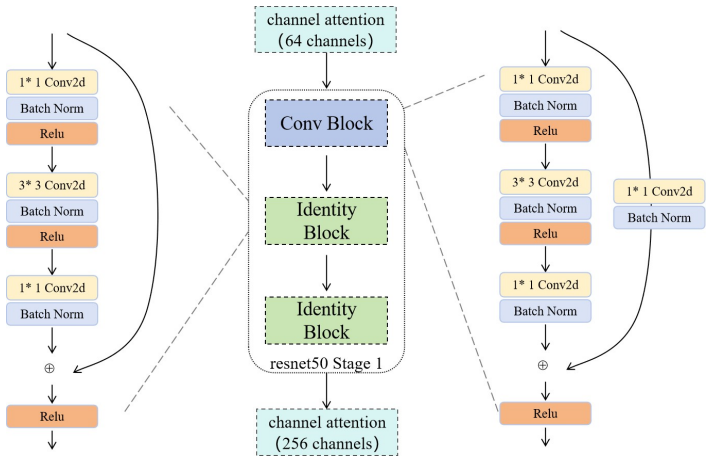
The ResNet-50 and BiLSTM fusion network that merges spatial image features with photometric catalog sequences for binary classification.
If this is right
- The model continues to deliver high accuracy on faint astronomical objects.
- Performance stays strong for high-redshift galaxies.
- Data augmentation and multi-modal fusion each improve results over single-modality baselines.
- The approach is positioned for direct use on the large volumes of data expected from the CSST survey.
Where Pith is reading between the lines
- If the simulation fidelity holds, the same architecture could be retrained or fine-tuned on early real CSST releases without major redesign.
- The fusion method may generalize to other multi-band surveys where both imaging and photometry are available.
- Direct head-to-head tests against purely image-based or purely catalog-based classifiers on identical CSST data would quantify the exact contribution of the fusion step.
Load-bearing premise
The CSST simulated images and catalogs accurately reproduce the noise, point-spread functions, and source distributions of actual telescope observations.
What would settle it
Apply the trained model to a sample of real CSST observations and measure whether recall for stars and galaxies remains above 99 percent or drops substantially.
Figures




read the original abstract
The distinction between stars and galaxies is a fundamental problem in the field of celestial classification. This issue has become challenging for these ongoing and upcoming digital surveys, which will produce terabytes and even petabytes of astronomical data. While deep learning offers a powerful solution for star-galaxy classification in large-scale datasets, most current approaches are limited by their reliance on catalog data alone, which consists primarily of multi-band magnitudes and imprecise morphological parameters. Therefore, we utilize China Space Station Telescope (CSST) simulation data to build a dataset with both image and photometric catalog, including 32,371 stars and 93,525 galaxies. A supervised deep learning network based on ResNet-50 and BiLSTM is proposed to improve the classification of two types of astronomical objects. The features of the catalog and image are integrated by the model, achieving 99.81% recall for galaxies and 99.66% recall for stars after training on GPU for 50 epochs. We evaluated the effects of data augmentation and multi-modal data fusion, which demonstrate that our model has commendable performance. Furthermore, our model also has a high accuracy rate for faint astronomical objects and high redshift galaxies, demonstrating its applicability to the upcoming CSST scientific data.
Editorial analysis
A structured set of objections, weighed in public.
Referee Report
Summary. The paper proposes a supervised multi-modal deep learning model that fuses ResNet-50 image features with BiLSTM catalog features for star-galaxy classification on CSST simulated data (32k stars, 93k galaxies). It reports recalls of 99.81% (galaxies) and 99.66% (stars) on a held-out test set after 50 GPU epochs, evaluates data augmentation and fusion, and asserts strong performance on faint objects and high-redshift galaxies with applicability to real CSST observations.
Significance. A working multi-modal fusion approach could aid efficient classification in petabyte-scale surveys by combining imaging and photometry; the reported recalls on simulated data are high, but the result's significance for real CSST data is constrained by the absence of any demonstrated fidelity between the simulations and actual telescope noise, PSF, or distributions.
major comments (4)
- [Abstract] Abstract and final paragraph: the claim that the model demonstrates 'applicability to the upcoming CSST scientific data' rests on the untested premise that the simulated catalog and images reproduce the joint distributions of magnitudes, colors, sizes, redshifts, noise, and PSF that real CSST observations will exhibit; no KS tests, moment matching, or residual comparisons to any real reference catalog or image set are supplied.
- [Results] Results section: the statements of 'high accuracy rate for faint astronomical objects and high redshift galaxies' are presented without supporting per-bin statistics, confusion matrices, or performance curves as a function of magnitude or redshift, leaving the claim without quantitative backing.
- [Methods/Results] Methods and Results: no baseline comparisons (traditional color-color or morphology cuts, single-modal ResNet or catalog-only networks) or ablation tables quantifying the gain from multi-modal fusion are reported, so the improvement attributable to the ResNet-50 + BiLSTM architecture cannot be assessed.
- [Abstract] Abstract and Methods: the headline recalls lack error bars, cross-validation details, or indications of whether the held-out test set was used in any hyperparameter selection, making it impossible to judge whether the 99.81 % / 99.66 % figures are robust or over-optimistic.
minor comments (2)
- [Methods] The training/validation/test split ratios and any class-balancing strategy are not stated, although the raw counts (32,371 stars, 93,525 galaxies) are given.
- Figure captions and axis labels should explicitly indicate whether the displayed metrics are on the training, validation, or test set.
Simulated Author's Rebuttal
We thank the referee for the constructive and detailed comments. We have addressed each major point below and revised the manuscript accordingly where feasible to improve clarity and rigor.
read point-by-point responses
-
Referee: [Abstract] Abstract and final paragraph: the claim that the model demonstrates 'applicability to the upcoming CSST scientific data' rests on the untested premise that the simulated catalog and images reproduce the joint distributions of magnitudes, colors, sizes, redshifts, noise, and PSF that real CSST observations will exhibit; no KS tests, moment matching, or residual comparisons to any real reference catalog or image set are supplied.
Authors: We agree that direct statistical comparisons to real CSST data are not possible, as the telescope has not yet begun operations. The simulations were constructed using CSST-specific instrument models for noise, PSF, and source distributions, but we acknowledge this leaves the real-world fidelity untested. In the revised manuscript we will tone down the applicability language in the abstract and conclusion to 'potential applicability to upcoming CSST data' and add an explicit limitations paragraph discussing simulation assumptions. revision: partial
-
Referee: [Results] Results section: the statements of 'high accuracy rate for faint astronomical objects and high redshift galaxies' are presented without supporting per-bin statistics, confusion matrices, or performance curves as a function of magnitude or redshift, leaving the claim without quantitative backing.
Authors: We accept that the current text lacks the requested quantitative support. The revised Results section will include new figures and tables reporting recall and precision binned by magnitude and redshift, together with confusion matrices for the faint and high-redshift subsets. revision: yes
-
Referee: [Methods/Results] Methods and Results: no baseline comparisons (traditional color-color or morphology cuts, single-modal ResNet or catalog-only networks) or ablation tables quantifying the gain from multi-modal fusion are reported, so the improvement attributable to the ResNet-50 + BiLSTM architecture cannot be assessed.
Authors: While the manuscript already evaluates the contribution of multi-modal fusion versus single-modality inputs, we agree that explicit baselines against classical methods are missing. We will add a dedicated comparison subsection that includes color-color and morphology-cut baselines as well as single-modal ResNet-50 and BiLSTM results, with an ablation table quantifying the fusion gain. revision: yes
-
Referee: [Abstract] Abstract and Methods: the headline recalls lack error bars, cross-validation details, or indications of whether the held-out test set was used in any hyperparameter selection, making it impossible to judge whether the 99.81 % / 99.66 % figures are robust or over-optimistic.
Authors: We will strengthen the statistical reporting. The revised abstract and Methods section will report error bars obtained from multiple independent training runs, describe the train/validation/test split, and clarify that hyperparameter choices were made on the validation set only. We will also add a brief k-fold cross-validation experiment if space permits. revision: yes
Circularity Check
No circularity; standard supervised training and held-out evaluation on simulated data
full rationale
The paper trains a ResNet-50 + BiLSTM fusion network on a fixed CSST simulation dataset (32k stars, 93k galaxies) and reports recall on a held-out test split after 50 epochs. No mathematical derivations, equations, or first-principles predictions appear in the provided text. Performance numbers are direct empirical measurements, not quantities that reduce to fitted parameters or self-citations by construction. The inference to real CSST observations rests on an untested simulation-fidelity assumption, but this is a correctness risk, not a circular reduction within the derivation chain. The work is self-contained as a standard ML classification experiment.
Axiom & Free-Parameter Ledger
free parameters (1)
- Training hyperparameters
axioms (1)
- domain assumption Simulated CSST data distribution matches real telescope observations
Reference graph
Works this paper leans on
-
[1]
write newline
" write newline "" before.all 'output.state := FUNCTION n.dashify 't := "" t empty not t #1 #1 substring "-" = t #1 #2 substring "--" = not "--" * t #2 global.max substring 't := t #1 #1 substring "-" = "-" * t #2 global.max substring 't := while if t #1 #1 substring * t #2 global.max substring 't := if while FUNCTION word.in bbl.in ":" * " " * FUNCTION f...
-
[2]
Dark Energy Survey Collaboration, The Dark Energy Survey: more than dark energy - an overview, Mon. Not. R. Astron. Soc., 460 (2) (2016), pp. 1270-1299, doi: 10.1093/mnras/stw641
-
[3]
Donald G. York, J. Adelman, John E. Anderson, et al., The Sloan Digital Sky Survey: Technical Summary, Astron. J., 120 (3) (2000), pp. 1579-1587, doi: 10.1086/301513
-
[4]
Wide-Field InfrarRed Survey Telescope-Astrophysics Focused Telescope Assets WFIRST-AFTA 2015 Report
D. Spergel, N. Gehrels, C. Baltay, et al., Wide-Field Infrared Survey Telescope-Astrophysics Focused Telescope Assets WFIRST-AFTA 2015 Report, (2015), doi: 10.48550/arXiv.1503.03757
work page internal anchor Pith review Pith/arXiv arXiv doi:10.48550/arxiv.1503.03757 2015
-
[5]
Euclid Collaboration, Euclid preparation. I. The Euclid Wide Survey, Astron. Astrophys., 662 (2022), p. A112, doi: 10.1051/0004-6361/202141938
-
[6]
Eric C. Bellm, The Zwicky Transient Facility, The Third Hot-wiring the Transient Universe Workshop, (2014), pp. 27-33, doi: 10.48550/arXiv.1410.8185
-
[7]
K. C. Chambers, E. A. Magnier, N. Metcalfe, et al., The Pan-STARRS1 Surveys, (2016), doi: 10.48550/arXiv.1612.05560
work page internal anchor Pith review Pith/arXiv arXiv doi:10.48550/arxiv.1612.05560 2016
-
[8]
Željko Ivezić, Steven M. Kahn, J. Anthony Tyson, et al., Lsst: from science drivers to reference design and anticipated data products, Astrophys. J., 873 (2) (2019), p. 111, doi: 10.3847/1538-4357/ab042c
-
[9]
2016 b , , 595, A2, 10.1051/0004-6361/201629512
Gaia Collaboration, Gaia Data Release 1. Summary of the astrometric, photometric, and survey properties, Astron. Astrophys., 595 (A2) (2016), p. 23, doi: 10.1051/0004-6361/201629512
-
[10]
E1.16-4-18
Zhan, Hu, An Overview of the Chinese Space Station Optical Survey, 42nd COSPAR Scientific Assembly, (2018), Abstract id. E1.16-4-18
2018
-
[11]
Fatemeh Zahra Zeraatgari, Fatemeh Hafezianzade, Yanxia Zhang, et al., Machine learning-based photometric classification of galaxies, quasars, emission-line galaxies, and stars, Mon. Not. R. Astron. Soc., 527 (3) (2024), pp. 4677–4689, doi: 10.1093/mnras/stad3436
-
[12]
R Moradi, F Rastegarnia, Y Wang, & M T Mirtorabi, FNet II: Spectral Classification of Quasars, Galaxies, Stars, and broad absorption line (BAL) Quasars, Mon. Not. R. Astron. Soc., 533 (2) (2024), pp. 1976–1985, doi: 10.1093/mnras/stae1878
-
[13]
Kron, R. G., Photometry of a complete sample of faint galaxies, Astrophys. J. Suppl. Ser., 43 (1980), pp. 305-325, doi: 10.1086/190669
-
[14]
S. C. Odewahn, R. R. de Carvalho, R. R. Gal, et al., The Digitized Second Palomar Observatory Sky Survey (DPOSS). III. Star-Galaxy Separation, Astron. J., 128 (6) (2004), pp. 3092-3107, doi: 10.1086/425525
-
[15]
E. C. Vasconcellos, R. R. de Carvalho, R. R. Gal, et al., Decision Tree Classifiers for Star/Galaxy Separation, Astron. J., 141 (6) (2011), p. 189, doi: 10.1088/0004-6256/141/6/189
-
[16]
Jeffrey A. Newman, Michael C. Cooper, Marc Davis, et al., The DEEP2 Galaxy Redshift Survey: Design, Observations, Data Reduction, and Redshifts, Astrophys. J. Suppl. Ser., 208 (1) (2013), p. 5, doi: 10.1088/0067-0049/208/1/5
-
[17]
J.-S. Huang, L. L. Cowie, J. P. Gardner, et al., The Hawaii K-Band Galaxy Survey. II. Bright K-Band Imaging, Astrophys. J., 476 (1) (1997), pp. 12-21, doi: 10.1086/303598
-
[18]
I. K. Baldry, A. S. G. Robotham, D. T. Hill, et al., Galaxy And Mass Assembly (GAMA): the input catalogue and star-galaxy separation, Mon. Not. R. Astron. Soc., 404 (1) (2010), pp. 86-100, doi: 10.1111/j.1365-2966.2010.16282.x
-
[19]
K. Małek, A. Solarz1, A. Pollo, et al., The VIMOS Public Extragalactic Redshift Survey (VIPERS). A support vector machine classification of galaxies, stars, and AGNs, Astron. Astrophys., 557 (2013), p. A16, doi: 10.1051/0004-6361/201321447
-
[20]
A. Molino, N. Benítez, M. Moles, et al., The ALHAMBRA Survey: Bayesian photometric redshifts with 23 bands for 3 deg, Mon. Not. R. Astron. Soc., 441 (4) (2014), pp. 2891–2922, doi: 10.1093/mnras/stu387
-
[21]
M. T. Soumagnac, F. B. Abdalla, O. Lahav, et al., Star/galaxy separation at faint magnitudes: application to a simulated Dark Energy Survey, Mon. Not. R. Astron. Soc., 450 (1) (2015), pp. 666–680, doi: 10.1093/mnras/stu1410
-
[22]
Edward J. Kim, & Robert J. Brunner, Star-galaxy classification using deep convolutional neural networks, Mon. Not. R. Astron. Soc., 464 (4) (2017), pp. 4463–4475, doi: 10.1093/mnras/stw2672
-
[23]
Shawhan, Patrick R
Peter S. Shawhan, Patrick R. Brady, Adam Brazier, et al., Data Analysis Challenges for Multi-Messenger Astrophysics, ASP Conf.Ser., 523 (2019), p. 705
2019
-
[24]
L. Nakazono, C. Mendes de Oliveira, N. S. T. Hirata, et al., On the discovery of stars, quasars, and galaxies in the Southern Hemisphere with S-PLUS DR2, Mon. Not. R. Astron. Soc., 507 (4) (2021), pp. 5847-5868, doi: 10.1093/mnras/stab1835
-
[25]
F. Stoppa, S. Bhattacharyya, R. Ruiz de Austri, et al., AutoSourceID-Classifier Star-Galaxy Classification using a Convolutional Neural Network with Spatial Information, Astron. Astrophys., 680 (2023), p. A109, doi: 10.1051/0004-6361/202347576
-
[26]
Srinadh Reddy Bhavanam, Sumohana S. Channappayya, P.K. Srijith, & Shantanu Desai, Enhanced Astronomical Source Classification with Integration of Attention Mechanisms and Vision Transformers, Astrophys Space Sci, 369 (8) (2024), p. 92, doi: 10.1007/s10509-024-04357-9
-
[27]
Shiliang Zhang, Guanwen Fang, Jie Song, et al., Preparation for CSST: Star-Galaxy Classification Using a Rotationally Invariant Supervised Machine Learning Method, Res. Astron. Astrophys., 24 (9) (2024), Article 095012, doi: 10.1088/1674-4527/ad6fe6
-
[28]
GuanWen Fang, Shuo Ba, Yizhou Gu, et al., Automatic Classification of Galaxy Morphology: A Rotationally-invariant Supervised Machine-learning Method Based on the Unsupervised Machine-learning Data Set, Astron. J, 165 (2) (2023), p. 35, doi: 10.3847/1538-3881/aca1a6
-
[29]
M. V. Costa-Duarte, L. Sampedro, A. Molino, et al., The S-PLUS: A Star/Galaxy Classification Based on a Machine Learning Approach, (2019), doi: 10.48550/arXiv.1909.08626
-
[30]
Cheng-Liang Wei, Guo-Liang Li, Yue-Dong Fang, et al., Mock Observations for the CSST Mission: Main Surveys-An Overview of Framework and Simulation Suite, Res. Astron. Astrophys., 26 (2) (2026), Article 024001, doi: 10.1088/1674-4527/ae20fe
-
[31]
Cheng-Liang Wei, Yu Luo, Hao Tian, et al., Mock Observations for the CSST Mission: Main Surveys–The Mock Catalog, Res. Astron. Astrophys., 26 (2) (2026), Article 024004, doi: 10.1088/1674-4527/ae20ff
-
[32]
Khoshgoftaar, A survey on Image Data Augmentation for Deep Learning, J Big Data, 6 (2019), pp
Connor Shorten, & T. Khoshgoftaar, A survey on Image Data Augmentation for Deep Learning, J Big Data, 6 (2019), pp. 1-48, doi: 10.1186/s40537-019-0197-0
-
[33]
391–405, doi: 10.1007/978-981-99-2100-3\_31
M Sharma, P Kushwaha, P Kumari, et al., Machine Learning Techniques in Data Fusion: A Review, International Conference on Communication and Intelligent Systems, 686 (2023), pp. 391–405, doi: 10.1007/978-981-99-2100-3\_31
-
[34]
Siddharth Chaini, Atharva Bagul, Anish Deshpande, et al., Photometric Identification of Compact Galaxies, Stars, and Quasars Using Multiple Neural Networks, Mon. Not. R. Astron. Soc., 518 (2) (2023), pp. 3123-3136, doi: 10.1093/mnras/stac3336
-
[35]
Hai-Cheng Feng, Rui Li, Nicola R. Napolitano, et al., Morpho-Photometric Classification of KiDS DR5 Sources Based on Neural Networks: A Comprehensive Star-Quasar-Galaxy Catalog, Astrophys. J. Suppl. Ser., 279 (1) (2025), doi: 10.3847/1538-4365/adde5a
-
[36]
Adam Paszke, Sam Gross, Francisco Massa, et al., PyTorch: An Imperative Style, High-Performance Deep Learning Library, NeurIPS, 32 (2019)
2019
-
[37]
Deep Residual Learning for Image Recognition , isbn =
Kaiming He, Xiangyu Zhang, Shaoqing Ren, & Jian Sun. Deep Residual Learning for Image Recognition, IEEE, CVPR, (2016), pp. 770-778, doi: 10.1109/CVPR.2016.90
-
[38]
arXiv preprint arXiv:1508.01991 (2015)
Zhiheng Huang, Wei Xu, & Kai Yu. Bidirectional LSTM-CRF Models for Sequence Tagging, (2015), doi: 10.48550/arXiv.1508.01991
-
[39]
Zhang Ban, Xiao-Bo Li, Xun Yang, et al., Mock Observations for the CSST Mission: End-to-end Performance Modeling of Optical System, Res. Astron. Astrophys., 26 (2) (2026), Article 024002, doi: 10.1088/1674-4527/ae20fb
-
[40]
M. Henrion, D. J. Mortlock, D. J. Hand, A. Gandy, A Bayesian approach to star–galaxy classification, Mon. Not. R. Astron. Soc., 412 (4) (2011), pp. 2286-2302, doi: 10.1111/j.1365-2966.2010.18055.x
-
[41]
Bertin, Automated Morphometry with SExtractor and PSFEx, ADASS XX, 442 (2011), p
E. Bertin, Automated Morphometry with SExtractor and PSFEx, ADASS XX, 442 (2011), p. 435
2011
-
[42]
Richard C Tolman, Effect of Inhomogeneity on Cosmological Models, Proc Natl Acad Sci U S A., 20 (3) (1934), pp. 169-176
1934
discussion (0)
Sign in with ORCID, Apple, or X to comment. Anyone can read and Pith papers without signing in.