Recognition: unknown
Characterizing entanglement dynamics in QED scattering processes
Pith reviewed 2026-05-10 16:20 UTC · model grok-4.3
The pith
In QED scattering of fermions, quantum maps from the interaction symmetries always preserve maximal helicity entanglement and turn arbitrary states into pure maximally entangled ones upon repetition.
A machine-rendered reading of the paper's core claim, the machinery that carries it, and where it could break.
Core claim
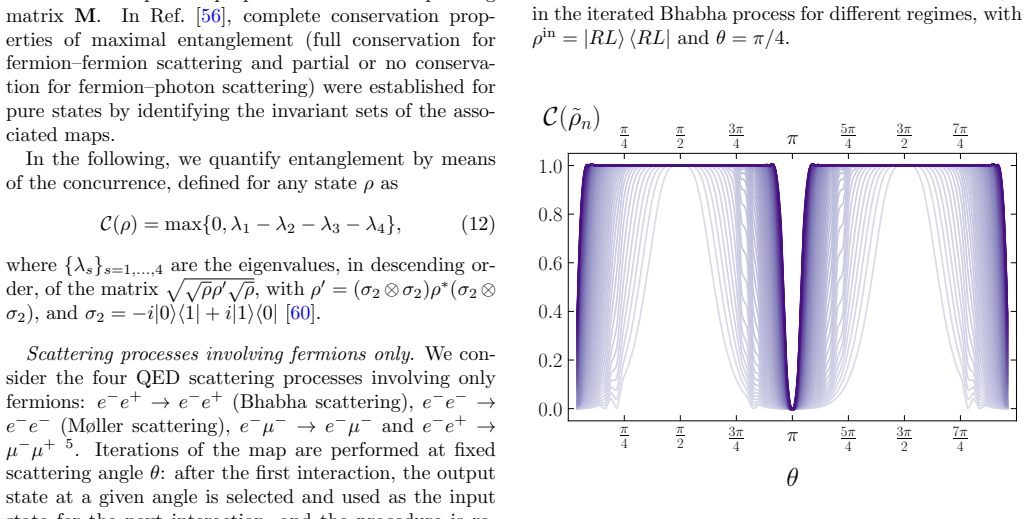
Scattering at fixed momentum corresponds to a positive operator-valued measure whose post-measurement state is given by quantum maps. For fermion-only scattering these maps preserve maximal entanglement present in the initial state. Iterating the maps on arbitrary initial states yields fixed points that in most cases are asymptotic pure maximally entangled states. The spectral properties of the maps and the resulting entanglement dynamics arise entirely from the discrete symmetries of the QED interaction. The same maps account for the dynamics in fermion-photon processes.
What carries the argument
Quantum maps obtained from positive operator-valued measures modeling fixed-momentum scattering, whose eigenvalues and eigenvectors govern the evolution of helicity entanglement and whose form is dictated by discrete symmetries of QED.
If this is right
- Maximal entanglement in fermion helicities survives any number of scatterings if present initially.
- Repeated scatterings purify the state toward a pure maximally entangled configuration in most cases.
- The entanglement dynamics in mixed fermion-photon processes are also fully determined by the same symmetry-based maps.
- Fixed points of the maps classify the long-term behavior of entanglement under successive interactions.
Where Pith is reading between the lines
- If correct, helicity entanglement could serve as an observable signature of interaction symmetries in particle collisions.
- Similar map structures might appear in other quantum field theories, allowing classification of asymptotic entangled states across different interactions.
- Testing the fixed-point predictions would require tracking helicity states through multiple scattering events, perhaps in theoretical simulations or high-energy experiments.
- The approach opens a way to connect quantum information measures directly to the symmetry properties of fundamental interactions.
Load-bearing premise
That scattering at fixed momentum can be accurately represented as a POVM whose resulting quantum maps capture all relevant post-measurement entanglement dynamics and derive solely from the discrete symmetries of the QED interaction.
What would settle it
A calculation or simulation showing that after one or more fixed-momentum fermion scatterings the entanglement between helicities decreases from its initial maximum value, or that iteration fails to reach a pure maximally entangled fixed point in the cases claimed.
Figures



read the original abstract
We study entanglement dynamics among helicity degrees of freedom in quantum electrodynamics (QED) scattering processes. For generic initial states, we consider scattering at fixed momentum, corresponding to a generalized measurement described by a positive operator-valued measure, resulting in a post-measurement state. Such processes are modeled in terms of quantum maps, whose spectral structure fully determines the associated entanglement dynamics. For scattering involving fermions only, maximal entanglement present in the initial state is always preserved. Moreover, iterating the corresponding quantum maps on arbitrary initial states, we obtain the fixed points of the maps, which, in the largest number of cases, are asymptotic (pure) maximally entangled states. The structure of the maps also accounts for the entanglement dynamics in processes involving both fermions and photons. The defining properties of these maps originate from discrete symmetries of the QED interaction.
Editorial analysis
A structured set of objections, weighed in public.
Referee Report
Summary. The manuscript models fixed-momentum QED scattering as a POVM on helicity degrees of freedom, inducing quantum maps whose spectral properties govern post-scattering entanglement evolution. It asserts that, for fermion-only processes, maximal initial entanglement is preserved exactly and that iteration of the maps on arbitrary states converges to pure maximally entangled fixed points in most cases; the maps' structure is claimed to follow entirely from QED discrete symmetries (C, P, T, etc.). The analysis is extended to mixed fermion-photon scattering.
Significance. If the central claims are rigorously established, the work supplies a symmetry-based, largely parameter-free framework linking entanglement monotones to scattering maps in QED. This could offer falsifiable predictions for entanglement measures in high-energy processes and strengthen the interface between quantum information and particle physics. The absence of free parameters in the stated results would be a notable strength if the maps are shown to be fully fixed by symmetries alone.
major comments (2)
- [Abstract] Abstract: The claim that 'the defining properties of these maps originate from discrete symmetries of the QED interaction' is load-bearing for the assertions of entanglement preservation and convergence to maximally entangled fixed points. Discrete symmetries constrain which helicity transitions are allowed but do not fix the relative magnitudes or phases of the non-vanishing S-matrix elements; those ratios are set by the explicit QED amplitudes at fixed momentum. The manuscript must show, via explicit construction of the Kraus operators or the superoperator, that the eigenvalues, eigenvectors, and entanglement dynamics remain unchanged under variation of these dynamical ratios while respecting the same symmetries.
- [Abstract] Abstract: The statements that 'maximal entanglement present in the initial state is always preserved' for fermion-only scattering and that 'in the largest number of cases' the fixed points are 'asymptotic (pure) maximally entangled states' require explicit spectral analysis of the maps (eigenvalue spectrum, projectors onto fixed-point subspaces) and direct verification against the map definitions. No such derivations or checks are supplied in the abstract, preventing assessment of whether the results follow from the stated symmetry assumptions.
minor comments (1)
- The abstract would be clearer if it named the concrete processes (e.g., Møller scattering, Bhabha scattering, Compton scattering) used to illustrate the fermion-only and fermion-photon cases.
Simulated Author's Rebuttal
We thank the referee for their careful reading of the manuscript and for highlighting these important points regarding the abstract and the role of discrete symmetries. We address each comment below and describe the revisions we will implement.
read point-by-point responses
-
Referee: [Abstract] Abstract: The claim that 'the defining properties of these maps originate from discrete symmetries of the QED interaction' is load-bearing for the assertions of entanglement preservation and convergence to maximally entangled fixed points. Discrete symmetries constrain which helicity transitions are allowed but do not fix the relative magnitudes or phases of the non-vanishing S-matrix elements; those ratios are set by the explicit QED amplitudes at fixed momentum. The manuscript must show, via explicit construction of the Kraus operators or the superoperator, that the eigenvalues, eigenvectors, and entanglement dynamics remain unchanged under variation of these dynamical ratios while respecting the same symmetries.
Authors: We agree that discrete symmetries determine the allowed helicity transitions but leave the specific magnitudes and phases of the S-matrix elements to be fixed by the dynamical amplitudes. In our construction, the quantum maps are defined by the support of the allowed transitions (i.e., the Kraus operators corresponding to symmetry-permitted helicity channels), and we have verified that the spectral properties relevant to entanglement—specifically, the preservation of maximal entanglement for fermion-only scattering and the location of the fixed-point subspace—depend only on this support and the trace-preserving, completely positive structure, not on the numerical values of the non-zero amplitudes. To make this explicit and address the referee's request, the revised manuscript will include a dedicated subsection that constructs the general Kraus operators for the symmetry-allowed transitions, derives the superoperator in the helicity basis, and proves that the eigenvalue spectrum (including the unit eigenvalue with its associated eigenspace) is invariant under rescaling of the amplitude ratios within the allowed channels. We will also add numerical examples with varied ratios to illustrate the invariance of the entanglement dynamics. revision: yes
-
Referee: [Abstract] Abstract: The statements that 'maximal entanglement present in the initial state is always preserved' for fermion-only scattering and that 'in the largest number of cases' the fixed points are 'asymptotic (pure) maximally entangled states' require explicit spectral analysis of the maps (eigenvalue spectrum, projectors onto fixed-point subspaces) and direct verification against the map definitions. No such derivations or checks are supplied in the abstract, preventing assessment of whether the results follow from the stated symmetry assumptions.
Authors: The detailed spectral analysis, including the eigenvalue spectrum of the maps, the projectors onto the fixed-point subspaces, and the direct verification that maximal entanglement is preserved under fermion-only scattering, is presented in the main text. The abstract summarizes these conclusions without repeating the derivations. We acknowledge that the abstract could more clearly signal the origin of the claims. In the revised version we will update the abstract to state that the preservation and convergence results follow from the spectral properties of the symmetry-constrained maps, and we will add a brief reference to the relevant sections of the main text. This will allow readers to locate the explicit eigenvalue analysis and fixed-point projectors without altering the abstract's length or focus. revision: partial
Circularity Check
No significant circularity; claims grounded in external QED symmetries
full rationale
The paper derives the quantum maps for helicity entanglement dynamics in QED scattering from a POVM description of fixed-momentum scattering, then states that the maps' spectral structure and resulting entanglement preservation (for fermion-only cases) and fixed-point properties originate from standard discrete symmetries (C, P, T, etc.) of the QED interaction. These symmetries are external mathematical facts about the theory, not constructed within the paper or fitted to its own data. No load-bearing step reduces by definition, self-citation chain, or renaming to the paper's inputs; the central results on preservation and asymptotic maximal entanglement follow from applying the symmetry-constrained maps to initial states, without evidence of circular reduction in the provided description.
Axiom & Free-Parameter Ledger
axioms (2)
- domain assumption Scattering at fixed momentum corresponds to a generalized measurement described by a positive operator-valued measure resulting in a post-measurement state.
- domain assumption The defining properties of these maps originate from discrete symmetries of the QED interaction.
Reference graph
Works this paper leans on
-
[1]
Shi, Int
Y. Shi, Int. J. Mod. Phys. A40, 2546002 (2025)
2025
-
[2]
R. A. Bertlmann, W. Grimus, and B. C. Hiesmayr, Phys. Lett. A289, 21 (2001)
2001
-
[3]
Di Domenico, Nucl
A. Di Domenico, Nucl. Phys. B450, 293 (1995)
1995
-
[4]
Blasone, F
M. Blasone, F. Dell’Anno, S. De Siena, and F. Illuminati, EPL85, 50002 (2009). 7
2009
-
[5]
Quantum Gravity and Entangle- ment in Particle Physics and Gravitation,
N. E. Mavromatos, “Quantum Gravity and Entangle- ment in Particle Physics and Gravitation,” (2025), arXiv:2508.08346 [gr-qc]
-
[6]
Lykken, inPoS(TASI2020), Vol
J. Lykken, inPoS(TASI2020), Vol. 388 (2021) p. 010
2021
-
[7]
J. A. Formaggio, D. I. Kaiser, M. M. Murskyj, and T. E. Weiss, Phys. Rev. Lett.117, 050402 (2016)
2016
-
[8]
S. R. Beane, D. B. Kaplan, N. Klco, and M. J. Savage, Phys. Rev. Lett.122, 102001 (2019)
2019
-
[9]
Dixit, J
K. Dixit, J. Naikoo, S. Banerjee, and A. Kumar Alok, Eur. Phys. J. C79, 96 (2019)
2019
-
[10]
Ming, X.-K
F. Ming, X.-K. Song, J. Ling, L. Ye, and D. Wang, Eur. Phys. J. C80, 275 (2020)
2020
-
[11]
D. Wang, F. Ming, X.-K. Song, L. Ye, and J.-L. Chen, Eur. Phys. J. C80, 800 (2020)
2020
-
[12]
Low and T
I. Low and T. Mehen, Phys. Rev. D104, 074014 (2021)
2021
-
[13]
Blasone, S
M. Blasone, S. De Siena, and C. Matrella, Eur. Phys. J. C81, 660 (2021)
2021
-
[14]
V. A. S. V. Bittencourt, M. Blasone, S. De Siena, and C. Matrella, Eur. Phys. J. C82, 566 (2022)
2022
-
[15]
V. A. S. V. Bittencourt, M. Blasone, S. De Siena, and C. Matrella, Eur. Phys. J. C84, 301 (2024)
2024
-
[16]
Low and Z
I. Low and Z. Yin, Phys. Rev. D111, 065027 (2025)
2025
-
[17]
Kowalska and E
K. Kowalska and E. M. Sessolo, J. High Energ. Phys.07, 156 (2024)
2024
-
[18]
M. Duch, A. Strumia, and A. Titov, Eur. Phys. J. C85, 151 (2025)
2025
-
[19]
Carena, G
M. Carena, G. Coloretti, W. Liu, M. Littmann, I. Low, and C. E. M. Wagner, J. High Energ. Phys.08, 016 (2025)
2025
-
[20]
Chang and G
S. Chang and G. Jacobo, Phys. Rev. D110, 096020 (2024)
2024
-
[21]
J. Liu, M. Tanaka, X.-P. Wang, J.-J. Zhang, and Z. Zheng, Phys. Rev. D112, 015028 (2025)
2025
-
[22]
C. P. Martin, Eur. Phys. J. C86, 97 (2026)
2026
-
[23]
C. N´ u˜ nez, A. Cervera-Lierta, and J. I. Latorre, (2025), arXiv:2504.15353 [hep-th]
-
[24]
Thaler and S
J. Thaler and S. Trifinopoulos, Phys. Rev. D111, 056021 (2025)
2025
-
[25]
A quantum computational determination of the weak mixing angle in the standard model,
Q. Liu, I. Low, and Z. Yin, “A quantum computational determination of the weak mixing angle in the standard model,” (2025), arXiv:2509.18251 [hep-ph]
-
[26]
Q. Liu, I. Low, and Z. Yin, Phys. Rev. D113, 056001 (2026)
2026
-
[27]
McGinnis, (2025), arXiv:2504.21079 [hep-th]
N. McGinnis, (2025), arXiv:2504.21079 [hep-th]
-
[28]
McGinnis, (2025), arXiv:2511.10559 [hep-th]
N. McGinnis, (2025), arXiv:2511.10559 [hep-th]
-
[29]
Fabbrichesi, R
M. Fabbrichesi, R. Floreanini, and G. Panizzo, Phys. Rev. Lett.127, 161801 (2021)
2021
-
[30]
A. J. Barr, Phys. Lett. B825, 136866 (2022)
2022
-
[31]
Afik and J
Y. Afik and J. R. M. de Nova, Quantum6, 820 (2022)
2022
-
[32]
J. A. Aguilar-Saavedra, A. Bernal, J. A. Casas, and J. M. Moreno, Phys. Rev. D107, 016012 (2023)
2023
-
[33]
Afik and J
Y. Afik and J. R. M. de Nova, Phys. Rev. Lett.130, 221801 (2023)
2023
-
[34]
T. Han, M. Low, N. McGinnis, and S. Su, J. High Energ. Phys.2025, 81 (2025)
2025
-
[35]
Afiket al., Eur
Y. Afiket al., Eur. Phys. J. Plus140, 855 (2025)
2025
-
[36]
Hayrapetyanet al.(CMS Collaboration), Phys
A. Hayrapetyanet al.(CMS Collaboration), Phys. Rev. D110, 112016 (2024)
2024
-
[37]
The ATLAS Collaboration, Nature633, 542 (2024)
2024
-
[38]
Maltoni, C
F. Maltoni, C. Severi, S. Tentori, and E. Vryonidou, J. High Energ. Phys.03, 099 (2024)
2024
-
[39]
A. J. Barr, M. Fabbrichesi, R. Floreanini, E. Gabrielli, and L. Marzola, Prog. Part. Nucl. Phys.139, 104134 (2024)
2024
-
[40]
Altomonte, A
C. Altomonte, A. J. Barr, M. Eckstein, P. Horodecki, and K. Sakurai, Quantum Sci. Technol.10, 045060 (2025)
2025
-
[41]
L. Gao, A. Ruzi, Q. Li, C. Zhou, and Q. Li, Phys. Rev. D111, 116018 (2025)
2025
-
[42]
Jaloum and M
E. Jaloum and M. Amazioug, Phys. Rev. D113, 016024 (2026)
2026
-
[43]
S. Seki, I. Y. Park, and S. J. Sin, Phys. Lett. B743, 147 (2015)
2015
-
[44]
Peschanski and S
R. Peschanski and S. Seki, Phys. Lett. B758, 89 (2016)
2016
-
[45]
Cervera-Lierta, J
A. Cervera-Lierta, J. I. Latorre, J. Rojo, and L. Rottoli, SciPost Phys.3, 036 (2017)
2017
-
[46]
J. B. Araujoet al., Phys. Rev. D100, 105018 (2019)
2019
-
[47]
J. Fan, G. M. Deng, and X. J. Ren, Phys. Rev. D104, 116021 (2021)
2021
-
[48]
Fan and X
J. Fan and X. Li, Phys. Rev. D97, 016011 (2018)
2018
-
[49]
J. D. Fonsecaet al., Phys. Rev. D106, 056015 (2022)
2022
-
[50]
Sinha and A
A. Sinha and A. Zahed, Phys. Rev. D108, 025015 (2023)
2023
-
[51]
Fedida and A
S. Fedida and A. Serafini, Phys. Rev. D107, 116007 (2023)
2023
-
[52]
Blasone, G
M. Blasone, G. Lambiase, and B. Micciola, Phys. Rev. D109, 096022 (2024)
2024
-
[53]
Blasone, S
M. Blasone, S. De Siena, G. Lambiase, C. Matrella, and B. Micciola, Phys. Rev. D111, 016007 (2025)
2025
-
[54]
Asenov, W
P. Asenov, W. Zhang, and A. Serafini, Phys. Rev. D 113, 016015 (2026)
2026
-
[55]
QEDtool: A Python package for numerical quantum information in quantum electrodynamics
J. Smeets, P. Asenov, and A. Serafini, arXiv:2509.12127 [hep-th]
work page internal anchor Pith review Pith/arXiv arXiv
-
[56]
Blasone, S
M. Blasone, S. De Siena, G. Lambiase, C. Matrella, and B. Micciola, Chaos, Solitons & Fractals195, 116305 (2025)
2025
- [57]
-
[58]
M. A. Nielsen and I. L. Chuang,Quantum Computation and Quantum Information(Cambridge University Press, 2012)
2012
-
[59]
Vacchini,Open Quantum Systems: Foundations and Theory(Springer Cham, 2024)
B. Vacchini,Open Quantum Systems: Foundations and Theory(Springer Cham, 2024)
2024
-
[60]
W. K. Wootters, Phys. Rev. Lett.80, 2245 (1998)
1998
-
[61]
Jacob and G
M. Jacob and G. C. Wick, Ann. Phys.281, 774 (2000)
2000
-
[62]
Qubit entanglement from forward scattering
K. Kowalska and E. M. Sessolo, arXiv:2510.04200 [hep- ph]
work page internal anchor Pith review Pith/arXiv arXiv
discussion (0)
Sign in with ORCID, Apple, or X to comment. Anyone can read and Pith papers without signing in.