Recognition: unknown
Structural Gating and Effect-aligned Lag-resolved Temporal Causal Discovery Framework with Application to Heat-Pollution Extremes
Pith reviewed 2026-05-10 15:22 UTC · model grok-4.3
The pith
A framework called SGED-TCD recovers lag-resolved causal networks in multivariate time series by combining structural gating, stability learning, and effect alignment.
A machine-rendered reading of the paper's core claim, the machinery that carries it, and where it could break.
Core claim
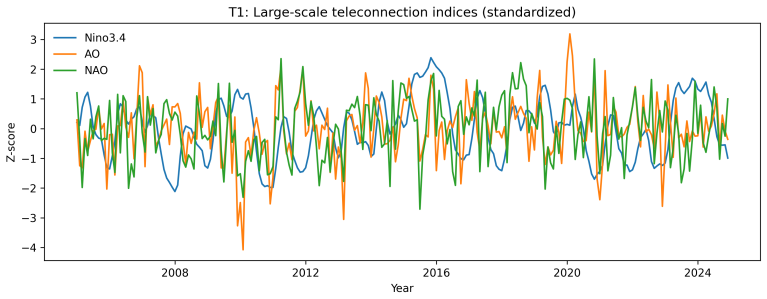
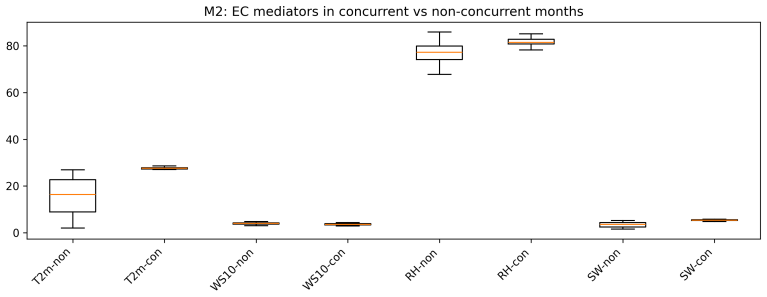
SGED-TCD reconstructs weighted causal networks with explicit dominant lags and relative causal importance from large-scale climate indices, regional circulation variables, and compound extreme indicators. The inferred networks show clear regional and seasonal heterogeneity: warm-season extremes in Eastern China are linked primarily to low-latitude oceanic variability through circulation, radiation, and ventilation pathways, whereas cold-season extremes in Northern China are governed more strongly by high-latitude circulation variability associated with boundary-layer suppression and persistent stagnation. The framework therefore recovers physically interpretable, hierarchical, and lag- and,
What carries the argument
The SGED-TCD framework, which integrates explicit structural gating, stability-oriented learning, perturbation-effect alignment, and unified graph extraction to infer lag-resolved causal graphs from multivariate time series.
If this is right
- The framework produces causal graphs that include both dominant lags and relative causal strengths for each link.
- Warm-season extremes in Eastern China are shown to be driven mainly by low-latitude oceanic variability acting through circulation and ventilation.
- Cold-season extremes in Northern China are shown to be driven more by high-latitude circulation and boundary-layer stagnation.
- The same structural components can be applied without change to other complex multivariate time series outside climate science.
Where Pith is reading between the lines
- The stability-oriented component may reduce sensitivity to spurious correlations that appear only in short windows of the record.
- Unified graph extraction could make it easier to compare causal hierarchies across different seasons or geographic domains in a single view.
- If the recovered pathways hold, they could be used to test whether intervening on one index would shift the probability of compound extremes in a predictable way.
Load-bearing premise
The combination of gating, stability learning, and effect alignment will recover physically meaningful causal pathways rather than artifacts arising from the chosen climate indices and extreme indicators.
What would settle it
If the inferred causal networks fail to match independent physical understanding of the same variables or cannot predict held-out extreme events better than standard methods on new data, the claim that the framework recovers meaningful pathways would be falsified.
Figures




read the original abstract
This study proposes Structural Gating and Effect-aligned Discovery for Temporal Causal Discovery (SGED-TCD), a novel and general framework for lag-resolved causal discovery in complex multivariate time series. SGED-TCD combines explicit structural gating, stability-oriented learning, perturbation-effect alignment, and unified graph extraction to improve the interpretability, robustness, and functional consistency of inferred causal graphs. To evaluate its effectiveness in a representative real-world setting, we apply SGED-TCD to teleconnection-driven compound heatwave--air-pollution extremes in eastern and northern China. Using large-scale climate indices, regional circulation and boundary-layer variables, and compound extreme indicators, the framework reconstructs weighted causal networks with explicit dominant lags and relative causal importance. The inferred networks reveal clear regional and seasonal heterogeneity: warm-season extremes in Eastern China are mainly linked to low-latitude oceanic variability through circulation, radiation, and ventilation pathways, whereas cold-season extremes in Northern China are more strongly governed by high-latitude circulation variability associated with boundary-layer suppression and persistent stagnation. These results show that SGED-TCD can recover physically interpretable, hierarchical, and lag-resolved causal pathways in a challenging climate--environment system. More broadly, the proposed framework is not restricted to the present application and provides a general basis for temporal causal discovery in other complex domains.
Editorial analysis
A structured set of objections, weighed in public.
Referee Report
Summary. The paper proposes SGED-TCD, a novel framework for lag-resolved temporal causal discovery in multivariate time series that integrates explicit structural gating, stability-oriented learning, perturbation-effect alignment, and unified graph extraction. Applied to teleconnection-driven compound heatwave-air-pollution extremes in eastern and northern China using climate indices, circulation variables, and extreme indicators, it reconstructs weighted causal networks revealing regional/seasonal heterogeneity (e.g., low-latitude oceanic influences in warm-season eastern China vs. high-latitude circulation in cold-season northern China). The central claim is that this combination yields more interpretable, robust, and functionally consistent causal graphs than prior methods.
Significance. If the framework's advantages hold under rigorous validation, it would offer a useful general-purpose tool for causal discovery in complex observational time series, particularly in climate-environment applications where physical interpretability matters. The explicit handling of lags and effect alignment addresses real challenges in teleconnection studies, and the application demonstrates potential for hierarchical pathway recovery.
major comments (2)
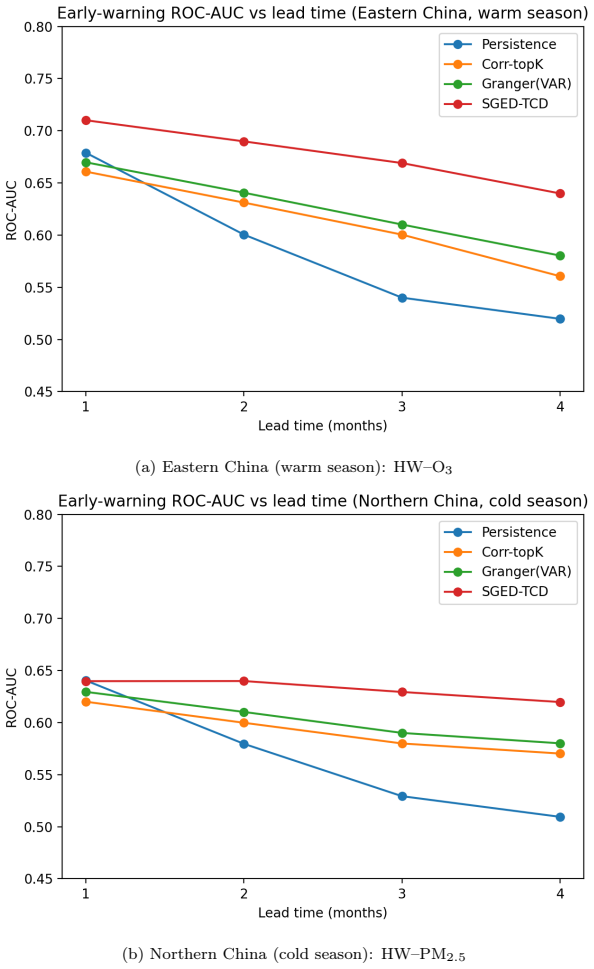
- [§4] §4 (Application and Results): The evaluation relies exclusively on observational climate indices and extreme indicators where the true causal structure is unknown. No synthetic ground-truth benchmarks (e.g., known SEMs with injected lags, edge strengths, and confounders) are reported to verify that SGED-TCD recovers true lag-resolved edges rather than data-driven artifacts or index-selection effects. This directly undermines the claim that the framework improves recovery of physically meaningful pathways over baselines.
- [§3] §3 (Framework Description): While structural gating, stability learning, perturbation-effect alignment, and unified extraction are combined, the manuscript provides no ablation studies or quantitative comparisons (e.g., edge recovery rates, lag accuracy, or robustness metrics) on controlled synthetic data. Without these, it is impossible to isolate the contribution of each component to the asserted gains in interpretability and robustness, leaving the central technical claim unverified.
minor comments (2)
- [Abstract and §1] The abstract and §1 state that the framework 'improves interpretability' and 'functional consistency' but do not define the quantitative metrics (e.g., graph edit distance, stability scores, or expert alignment scores) used to support these claims.
- [§3.4] Notation for the unified graph extraction step could be clarified with an explicit equation or pseudocode to show how weighted edges and dominant lags are aggregated from the gated and aligned components.
Simulated Author's Rebuttal
We thank the referee for the constructive and detailed comments. We address each major point below and outline revisions that will strengthen the validation of SGED-TCD while preserving the manuscript's focus on real-world climate applications.
read point-by-point responses
-
Referee: [§4] §4 (Application and Results): The evaluation relies exclusively on observational climate indices and extreme indicators where the true causal structure is unknown. No synthetic ground-truth benchmarks (e.g., known SEMs with injected lags, edge strengths, and confounders) are reported to verify that SGED-TCD recovers true lag-resolved edges rather than data-driven artifacts or index-selection effects. This directly undermines the claim that the framework improves recovery of physically meaningful pathways over baselines.
Authors: We agree that synthetic benchmarks with known ground truth would provide direct quantitative verification of causal recovery. The current evaluation emphasizes physical interpretability and consistency with domain knowledge in a complex observational setting, which is standard for climate teleconnection studies where true structures are unavailable. To address this, we will add synthetic experiments in the revision using structural equation models with injected lags, edge strengths, and confounders. These will report edge recovery rates, lag accuracy, and comparisons to baselines to demonstrate that SGED-TCD recovers true structures rather than artifacts. revision: yes
-
Referee: [§3] §3 (Framework Description): While structural gating, stability learning, perturbation-effect alignment, and unified extraction are combined, the manuscript provides no ablation studies or quantitative comparisons (e.g., edge recovery rates, lag accuracy, or robustness metrics) on controlled synthetic data. Without these, it is impossible to isolate the contribution of each component to the asserted gains in interpretability and robustness, leaving the central technical claim unverified.
Authors: We acknowledge that ablation studies on synthetic data are needed to isolate component contributions and verify the technical claims. The manuscript presents the integrated framework and its performance in the target application. In the revision, we will include controlled synthetic benchmarks with ablation variants, reporting quantitative metrics including edge recovery rates, lag accuracy, and robustness to noise or confounders. This will quantify the specific benefits of structural gating, perturbation-effect alignment, and the other elements. revision: yes
Circularity Check
No significant circularity; framework presented as independent construction
full rationale
The paper introduces SGED-TCD as a novel framework that combines structural gating, stability-oriented learning, perturbation-effect alignment, and unified graph extraction for lag-resolved causal discovery. No load-bearing steps in the abstract or described method reduce outputs to fitted parameters from the same data, self-definitional equations, or self-citation chains that import uniqueness or ansatzes. The application to climate indices and extremes is framed as an evaluation on observational data yielding interpretable networks, without any quoted derivations that equate predictions to inputs by construction. This is the expected non-circular outcome for a new methodological proposal evaluated externally.
Axiom & Free-Parameter Ledger
Reference graph
Works this paper leans on
-
[1]
X. Xiao, Y. Xu, X. Zhang, F. Wang, X. Lu, Z. Cai, G. Brasseur, M. Gao, Amplified upward trend of the joint occurrences of heat and ozone ex- tremes in china over 2013–20, Bulletin of the American Meteorological Society 103 (5) (2022) E1330–E1342. doi:10.1175/BAMS-D-21-0222.1
-
[2]
M. Cui, C. Hong, W. Liu, K. He, Q. Zhang, Future warming exacerbates heatwave-ozone compound extremes in china, npj Climate and Atmo- spheric Science 8 (1) (Oct. 2025). doi:10.1038/s41612-025-01218-2
-
[3]
X. Pu, T. Wang, X. Huang, D. Melas, P. Zanis, D. Papanastasiou, A. Poupkou, Enhanced surface ozone during the heat wave of 2013 in yangtze river delta region, china, Science of the Total Environment 603 (2017) 807–816. doi:10.1016/j.scitotenv.2017.03.056
-
[4]
L. Wu, C. Wang, Has the western pacific subtropical high extended westward since the late 1970s?, Journal of Climate 28 (13) (2015) 5406–
2015
-
[5]
doi:10.1175/JCLI-D-14-00618.1
-
[6]
Z. Jiang, J. Li, X. Lu, C. Gong, L. Zhang, H. Liao, Impact of western pa- cific subtropical high on ozone pollution over eastern china, Atmospheric Chemistry and Physics 21 (4) (2021) 2601–2613. doi:10.5194/acp-21- 2601-2021
-
[7]
Z. Zhang, D. Gong, R. Mao, L. Qiao, S.-J. Kim, S. Liu, Possible influ- ence of the antarctic oscillation on haze pollution in north china, Jour- nal of Geophysical Research: Atmospheres 124 (3) (2019) 1307–1321. doi:10.1029/2018JD029239
-
[8]
S. Lu, S. Gong, J. Chen, J. He, L. Zhang, J. Mo, Impact of arc- tic oscillation anomalies on winter pm2. 5 in china via a numeri- cal simulation, Science of the Total Environment 779 (2021) 146390. doi:10.1016/j.scitotenv.2021.146390. 30
-
[9]
G. Zhang, Y. Gao, W. Cai, L. R. Leung, S. Wang, B. Zhao, M. Wang, H. Shan, X. Yao, H. Gao, Seesaw haze pollution in north china modu- lated by the sub-seasonal variability of atmospheric circulation, Atmo- spheric Chemistry and Physics 19 (1) (2019) 565–576. doi:10.5194/acp- 19-565-2019
-
[10]
C. W. Granger, Investigating causal relations by econometric models and cross-spectral methods, Econometrica: journal of the Econometric Society (1969) 424–438doi:10.2307/1912791
-
[11]
Detecting and quantifying causal associations in large nonlinear time series datasets
J. Runge, P. Nowack, M. Kretschmer, S. Flaxman, D. Sejdi- novic, Detecting and quantifying causal associations in large nonlin- ear time series datasets, Science advances 5 (11) (2019) eaau4996. doi:10.1126/sciadv.aau4996
-
[12]
N. P. S. L. (PSL), Niño 3.4 index (monthly), Online. URLhttps://psl.noaa.gov/data/timeseries/month/DS/Nino34_ CPC/
-
[13]
N. C. P. C. (CPC), Teleconnections (aao, nao, pna ao) products and archives, Online. URLhttps://www.cpc.ncep.noaa.gov/products/precip/CWlink/ daily_ao_index/teleconnections.shtml
-
[14]
B. Huang, P. W. Thorne, V. F. Banzon, T. Boyer, G. Chepurin, J. H. Lawrimore, M. J. Menne, T. M. Smith, R. S. Vose, H.-M. Zhang, Ex- tended reconstructed sea surface temperature, version 5 (ersstv5): up- grades, validations, and intercomparisons, Journal of Climate 30 (20) (2017) 8179–8205. doi:10.1175/JCLI-D-16-0836.1
-
[15]
H. Hersbach, B. Bell, P. Berrisford, S. Hirahara, A. Horányi, J. Muñoz- Sabater, J. Nicolas, C. Peubey, R. Radu, D. Schepers, et al., The era5 global reanalysis, Quarterly journal of the royal meteorological society 146 (730) (2020) 1999–2049. doi:10.1002/qj.3803
-
[16]
N. P. Project, Api getting started, Online. URLhttps://power.larc.nasa.gov/docs/tutorials/ api-getting-started/
-
[17]
URL https://acp.copernicus.org/ articles/19/3515/2019/
A. Inness, M. Ades, A. Agustí-Panareda, J. Barré, A. Benedictow, A.- M. Blechschmidt, J. J. Dominguez, R. Engelen, H. Eskes, J. Flemming, 31 V. Huijnen, L. Jones, Z. Kipling, S. Massart, M. Parrington, V.-H. Peuch, M. Razinger, S. Remy, M. Schulz, M. Suttie, The cams reanalysis of atmospheric composition, Atmospheric Chemistry and Physics 19 (6) (2019) 35...
-
[18]
J. Runge, S. Bathiany, E. Bollt, G. Camps-Valls, D. Coumou, E. Deyle, C. Glymour, M. Kretschmer, M. D. Mahecha, J. Muñoz-Marí, et al., Inferring causation from time series in earth system sciences, Nature communications 10 (1) (2019) 2553. doi:10.1038/s41467-019-10105-3
-
[19]
Schreiber, Measuring information transfer, Physical review letters 85 (2) (2000) 461
T. Schreiber, Measuring information transfer, Physical review letters 85 (2) (2000) 461. doi:10.1103/PhysRevLett.85.461
-
[20]
S.-W. Yeh, W. Cai, S.-K. Min, M. J. McPhaden, D. Dommenget, B. De- witte, M. Collins, K. Ashok, S.-I. An, B.-Y. Yim, et al., Enso atmo- spheric teleconnections and their response to greenhouse gas forcing, Re- views of Geophysics 56 (1) (2018) 185–206. doi:10.1002/2017RG000568
-
[22]
Y. Yang, M. Li, H. Wang, H. Li, P. Wang, K. Li, M. Gao, H. Liao, Enso modulation of summertime tropospheric ozone over china, Envi- ronmental Research Letters 17 (3) (2022) 034020. doi:10.1088/1748- 9326/ac54cd
-
[23]
Z. Jiang, J. Li, Impact of eastern and central pacific el niño on lower tropospheric ozone in china, Atmospheric Chemistry and Physics 22 (11) (2022) 7273–7285. doi:10.5194/acp-22-7273-2022
-
[24]
X. Zhang, R. Zhugu, X. Jian, X. Liu, K. Chen, S. Tao, J. Liu, H. Gao, T. Huang, J. Ma, Associations of interannual variation in summer tro- pospheric ozone with the western pacific subtropical high in china from 1999 to 2017, Atmospheric Chemistry and Physics 23 (24) (2023) 15629– 15642. doi:10.5194/acp-23-15629-2023
-
[25]
H. Han, J. Liu, L. Shu, T. Wang, H. Yuan, Local and synoptic meteo- rological influences on daily variability in summertime surface ozone in 32 eastern china, Atmospheric Chemistry and Physics 20 (1) (2020) 203–
2020
-
[26]
doi:10.5194/acp-20-203-2020
-
[27]
P. Wang, Y. Yang, H. Li, L. Chen, R. Dang, D. Xue, B. Li, J. Tang, L. R. Leung, H. Liao, North china plain as a hot spot of ozone pollution exacerbated by extreme high temperatures, Atmospheric Chemistry and Physics 22 (7) (2022) 4705–4719. doi:10.5194/acp-22-4705-2022
-
[28]
L. Zong, Y. Yang, H. Xia, M. Gao, Z. Sun, Z. Zheng, X. Li, G. Ning, Y. Li, S. Lolli, Joint occurrence of heatwaves and ozone pollution and increased health risks in beijing, china: role of synoptic weather pattern and urbanization, Atmospheric Chemistry and Physics 22 (10) (2022) 6523–6538. doi:10.5194/acp-22-6523-2022
-
[29]
D. W. Thompson, J. M. Wallace, Annular modes in the ex- tratropical circulation. part i: Month-to-month variability, Jour- nal of climate 13 (5) (2000) 1000–1016. doi:10.1175/1520- 0442(2000)013<1000:AMITEC>2.0.CO;2
-
[30]
Z. Zhang, X. Zhang, D. Gong, S.-J. Kim, R. Mao, X. Zhao, Possi- ble influence of atmospheric circulations on winter haze pollution in the beijing–tianjin–hebei region, northern china, Atmospheric Chem- istry and Physics 16 (2) (2016) 561–571. doi:10.5194/acp-16-561-2016
-
[31]
M. Li, Y. Yao, I. Simmonds, D. Luo, L. Zhong, L. Pei, Linkages between the atmospheric transmission originating from the north atlantic oscilla- tion and persistent winter haze over beijing, Atmospheric Chemistry and Physics 21 (24) (2021) 18573–18588. doi:10.5194/acp-21-18573-2021
-
[32]
Zhong, Z
W. Zhong, Z. Yin, H. Wang, The relationship between anticyclonic anomalies in northeastern asia and severe haze in the beijing–tianjin– hebei region, Atmospheric Chemistry and Physics 19 (9) (2019) 5941–
2019
-
[33]
doi:10.5194/acp-19-5941-2019
-
[34]
Y. Zou, Y. Wang, Y. Zhang, J.-H. Koo, Arctic sea ice, eurasia snow, and extreme winter haze in china, Science Advances 3 (3) (2017) e1602751. doi:10.1126/sciadv.1602751
-
[35]
Y. Zou, Y. Wang, Z. Xie, H. Wang, P. J. Rasch, Atmospheric teleconnec- tion processes linking winter air stagnation and haze extremes in china 33 with regional arctic sea ice decline, Atmospheric Chemistry and Physics 20 (8) (2020) 4999–5017. doi:10.5194/acp-20-4999-2020
-
[36]
X. An, W. Chen, P. Hu, S. Chen, L. Sheng, Intraseasonal variation of the northeast asian anomalous anticyclone and its impacts on pm 2.5 pol- lution in the north china plain in early winter, Atmospheric Chemistry and Physics 22 (10) (2022) 6507–6521. doi:10.5194/acp-22-6507-2022
-
[37]
G.Sugihara, R.May, H.Ye, C.-h.Hsieh, E.Deyle, M.Fogarty, S.Munch, Detecting causality in complex ecosystems, science 338 (6106) (2012) 496–500. doi:10.1126/science.1227079. 34
discussion (0)
Sign in with ORCID, Apple, or X to comment. Anyone can read and Pith papers without signing in.