REVIEW 3 major objections 1 minor 9 references
Fate of Secondary Droplets Produced by High-speed Raindrops Interacting with a Liquid Pool
T0 review · 3 major / 1 minor · reviewed 2026-07-12 · grok-4.5
Pith's one-line read Secondary droplets from high-speed raindrop impacts follow a size distribution that scales as radius to the power −5/2 and collapses onto one curve once surface tension and drop diameter are scaled out.
desk verdict We only have the abstract for the raindrop DNS paper; the supplied full text is a different manuscript, so the −5/2 scaling claim is still un-auditable. read the letter →
The pith
A machine-rendered reading of the paper's core claim, the machinery that carries it, and where it could break.
The reading
What carries the argument
The secondary-droplet size distribution N_d(r_s) and its proposed scaling N_d(r_s) ∝ r_s^{−5/2} (plus surface-tension and diameter prefactors). Normalizing measured distributions by this law produces the reported collapse and is the central organizing result of the simulations.
What would settle it
A resolved laboratory measurement of secondary droplet sizes from millimetre raindrops at ~7 m/s (or a mesh-converged DNS outside the present surface-tension/diameter window) whose size histogram does not follow r^{−5/2} or fails to collapse after the proposed normalization would refute the central claim.
Extended reading notes
Core claim
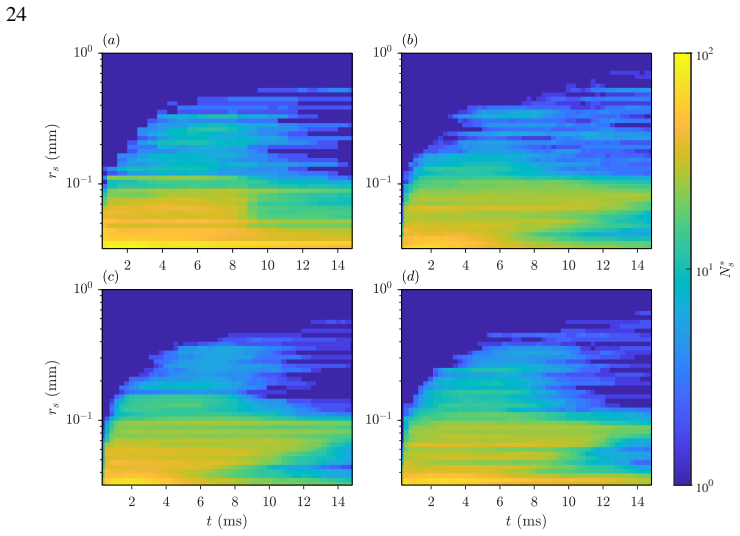
Direct numerical simulations of raindrop–pool impacts establish that the secondary-droplet size distribution obeys N_d(r_s) ∝ r_s^{−5/2}, with additional systematic dependence on surface tension and raindrop diameter; when the distributions are normalized by this law they collapse onto a single curve across the simulated parameter range. Interaction between nearby drops further modulates the fraction of secondaries recaptured by the cavity and the time window of re-merging, through staggered birth times and aerodynamic forcing from cavity airflow.
Load-bearing premise
The chosen set of impact speeds, diameters, surface tensions, and two-drop separations is assumed representative enough that the −5/2 exponent and the collapse are physical rather than artifacts of resolution, interface treatment, or the limited parameter box.
Editorial analysis
A structured set of objections, weighed in public.
Referee Report
Summary. The abstract claims that DNS of high-speed raindrop impacts (7 m/s, diameters 1–4 mm, surface tension 0.25–2× air–water) on a liquid pool produce secondary droplets whose size distribution obeys N_d(r_s) ∝ r_s^{-5/2}, with additional surface-tension and diameter dependence; after normalization the distributions collapse. Single- and two-drop (separations 2–4 D) configurations are considered. Morphology analysis identifies stages of interaction and central-film breakup; spatial/temporal statistics show that multi-drop interaction alters cavity capture fraction and re-merging duration via birth-time differences and cavity airflow. The supplied full-text block, however, is an unrelated manuscript (SWE-Shepherd, code-agent PRMs) and contains none of the fluid-dynamics content.
Significance. If the −5/2 scaling and collapse were rigorously established for realistic raindrop parameters, the result would be useful for spray, aerosol, and geophysical modeling of secondary-drop production. The abstract alone, however, supplies no mesh-convergence data, experimental comparison, raw histograms, or explicit prefactor form, so the claimed significance cannot be assessed from the material provided.
major comments (3)
- The CACHEABLE full manuscript text is an entirely different paper (SWE-Shepherd on process reward models for code agents, arXiv:2604.10493). No methods, mesh-resolution study, interface-capturing scheme, size histograms, fitting procedure for the −5/2 exponent, or functional form of the surface-tension/diameter prefactors appear for the raindrop DNS. The central claim is therefore un-auditable.
- Abstract only: the weakest assumption—that the limited parameter box (fixed 7 m/s, D = 1–4 mm, σ = 0.25–2×, two-drop separations 2–4 D) and numerical choices do not artifactually produce the reported power law—cannot be checked. Without convergence tests or experimental validation the scaling and collapse remain unsupported.
- Abstract: the statement that raindrop interaction influences cavity-capture percentage and re-merging duration is asserted without quantitative evidence (tables, figures, or error bars) that can be inspected in the supplied text.
minor comments (1)
- Because the full text is the wrong manuscript, ordinary presentation issues (notation, figure quality, reference completeness) for the raindrop study cannot be evaluated.
Circularity Check
No circularity found: abstract reports empirical DNS scaling; supplied full text is an unrelated paper, so no load-bearing reduction can be exhibited.
full rationale
The claimed result for arXiv:2604.10491 is that secondary-droplet size distributions from DNS scale as N_d(r_s) ∝ r_s^{-5/2} (with surface-tension and diameter prefactors) and collapse after normalization. That statement, as given in the abstract, is ordinary empirical scaling analysis: an exponent is read off simulation histograms and then used as a normalizing factor. It is not defined in terms of the collapse, is not a fitted free parameter later re-labeled a prediction, and is not justified by a self-citation uniqueness theorem. The CACHEABLE full-manuscript block is an entirely different work (SWE-Shepherd / arXiv:2604.10493, process reward models for code agents) and therefore contains no equations, mesh studies, fitting procedures, or self-citations that could create a circular reduction for the raindrop claim. Per the hard rules, circularity may be flagged only when a specific reduction can be quoted; none exists here, so the score is 0 and steps are empty.
Assumptions & free parameters
free parameters (1)
- surface-tension and diameter prefactors in the normalizing law
assumptions (3)
- domain assumption Continuum incompressible two-phase Navier–Stokes with surface tension adequately describes secondary-droplet generation at the stated We/Re for 1–4 mm drops at 7 m/s.
- domain assumption Impact speed fixed at a realistic 7 m/s and diameters 1–4 mm span the relevant raindrop regime for the claimed scaling.
- ad hoc to paper Two-drop separations of 2–4 diameters are representative of multi-drop interaction effects on cavity capture and re-merging.
Cite this review
Pith. "Pith review of Fate of Secondary Droplets Produced by High-speed Raindrops Interacting with a Liquid Pool." pith.science (2026). https://pith.science/paper/562XPFNR
@misc{pith2026260410491,
  author       = {Pith},
  title        = {Pith review of: Fate of Secondary Droplets Produced by High-speed Raindrops Interacting with a Liquid Pool},
  year         = {2026},
  howpublished = {\url{https://pith.science/paper/562XPFNR}},
  note         = {Machine review of arXiv:2604.10491}
}
abstract
Secondary droplets produced by interactions between falling fluid drops and a liquid pool play a significant role in engineering applications and geophysical processes in nature. This study uses direct numerical simulations to investigate the dynamics of secondary droplets generated by raindrop-liquid pool interactions. The raindrop parameters feature a realistic speed of 7 m/s, effective diameters of 1-4 mm, and surface tension values ranging from $25\%$ to twice the typical air-water interface value. The numerical configurations include both a single raindrop and two raindrops separated by distances between two and four times the raindrop diameter. The secondary droplet size distribution, $N_d$, is found to scale with the droplet radius, $r_s$, as $N_d(r_s)\propto r_s^{-5/2}$, with additional dependencies on surface tension and raindrop diameter. When normalized according to this new scaling law, the droplet size distribution obtained from simulations with different parameter values collapses onto a single curve. Analysis of the impact morphology reveals distinct stages of raindrop interactions and identifies the formation and breakup of a central liquid film. Spatial and temporal analyses of the secondary droplets show that raindrop interaction can influence both the percentage of droplets captured by the cavity and the duration over which they re-merge with the pool. These behaviors arise from the combined effects of differences in the birth times of secondary droplets of various sizes and aerodynamic forcing associated with the cavity airflow.
Figures


Figures from the paper (13 more)




Reference graph
Works this paper leans on
-
[1]
mini-SWE-agent: The 100 line AI agent
2026. mini-SWE-agent: The 100 line AI agent. https://mini-swe-agent.com/latest/. Accessed: 2026-02-20
2026
-
[2]
Antonis Antoniades, Albert Örwall, Kexun Zhang, Yuxi Xie, Anirudh Goyal, and William Yang Wang. [n. d.]. SWE-Search: Enhancing Software Agents with Monte Carlo Tree Search and Iterative Refinement. InThe Thirteenth International Con- ference on Learning Representations
-
[3]
Hyungjoo Chae, Sunghwan Kim, Junhee Cho, Seungone Kim, Seungjun Moon, Gyeom Hwangbo, Dongha Lim, Minjin Kim, Yeonjun Hwang, Minju Gwak, Dong- wook Choi, Minseok Kang, Gwanhoon Im, ByeongUng Cho, Hyojun Kim, Jun Hee Han, Taeyoon Kwon, Minju Kim, Beong woo Kwak, Dongjin Kang, and Jiny- oung Yeo. 2025. Web-Shepherd: Advancing PRMs for Reinforcing Web Agents....
2025
-
[4]
Jeff Da, Clinton Wang, Xiang Deng, Yuntao Ma, Nikhil Barhate, and Sean Hendryx
-
[5]
Agent-rlvr: Training software engineering agents via guidance and environ- ment rewards.arXiv preprint arXiv:2506.11425(2025)
arXiv 2025
-
[6]
Carlos E Jimenez, John Yang, Alexander Wettig, Shunyu Yao, Kexin Pei, Ofir Press, and Karthik R Narasimhan. [n. d.]. SWE-bench: Can Language Models Resolve Real-world Github Issues?. InThe Twelfth International Conference on Learning Representations
-
[7]
OpenAI. 2024. Introducing SWE -bench Verified. https://openai.com/index/ introducing-swe-bench-verified/. Updated February 24, 2025
2024
-
[8]
Minh VT Pham, Huy N Phan, Hoang N Phan, Cuong Le Chi, Tien N Nguyen, and Nghi DQ Bui. 2025. Swe-synth: Synthesizing verifiable bug-fix data to enable large language models in resolving real-world bugs.arXiv preprint arXiv:2504.14757 (2025)
arXiv 2025
Show all 9 references
-
[9]
Yuxiang Wei, Olivier Duchenne, Jade Copet, Quentin Carbonneaux, LINGMING ZHANG, Daniel Fried, Gabriel Synnaeve, Rishabh Singh, and Sida Wang. [n. d.]. SWE-RL: Advancing LLM Reasoning via Reinforcement Learning on Open Soft- ware Evolution. InThe Thirty-ninth Annual Conference ...
Reviewed July 12, 2026 · model on record in the stance chip above.
Discussion (0). Sign in to comment.