Recognition: unknown
Low-ionization Metal Absorption at 0.7 lesssim z lesssim 2 Confronting Cosmological Simulations with Observations
Pith reviewed 2026-05-10 15:53 UTC · model grok-4.3
The pith
IllustrisTNG reproduces low-ionization metal column density PDFs but underestimates strong MgII absorber incidence at higher redshifts.
A machine-rendered reading of the paper's core claim, the machinery that carries it, and where it could break.
Core claim
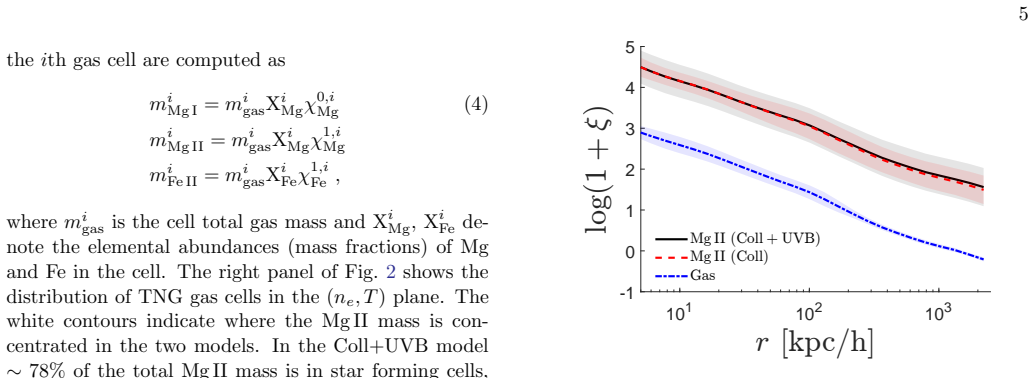
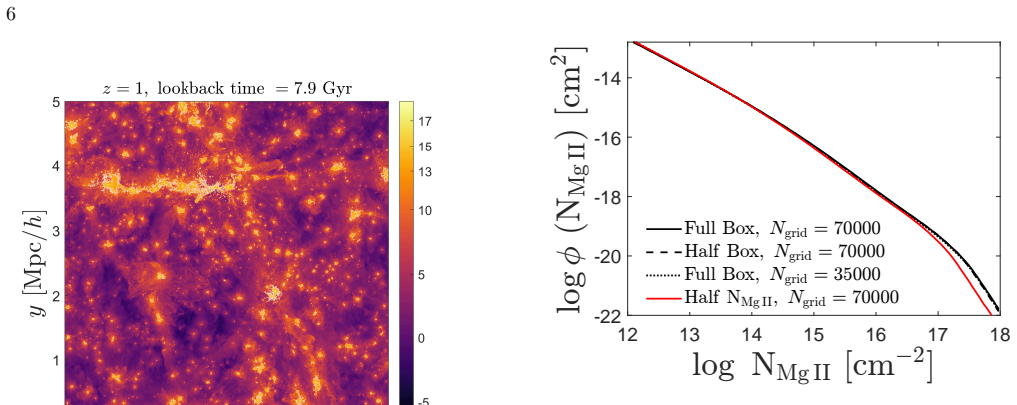
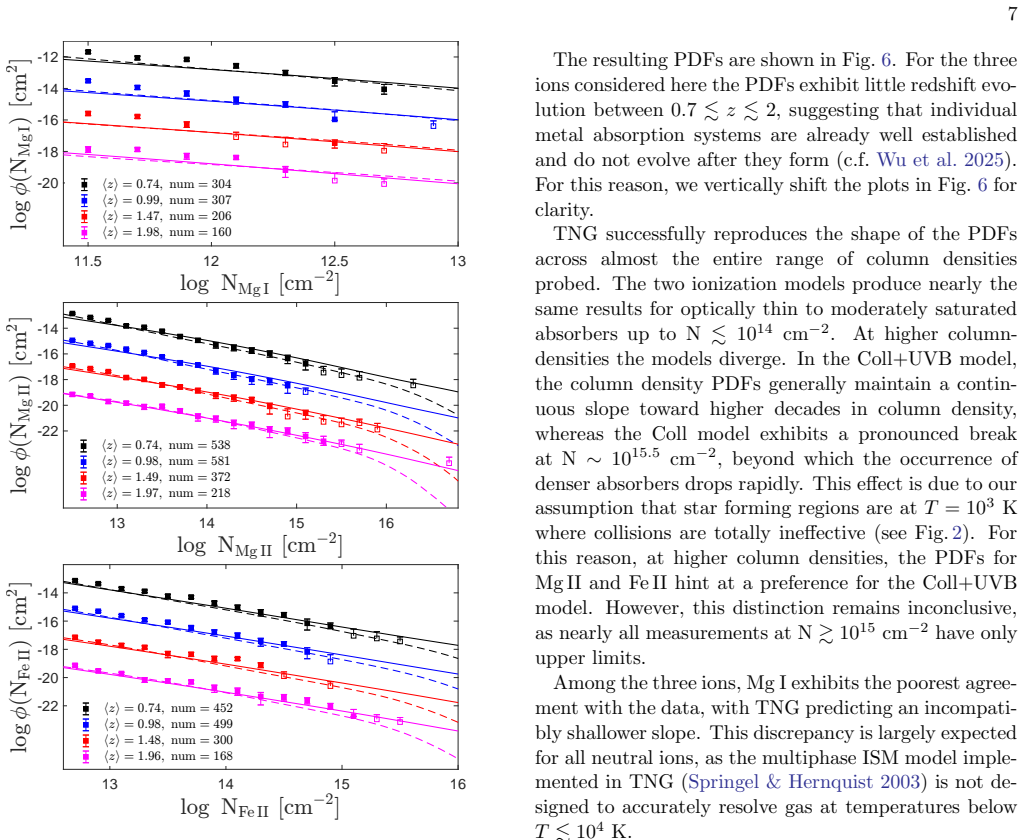
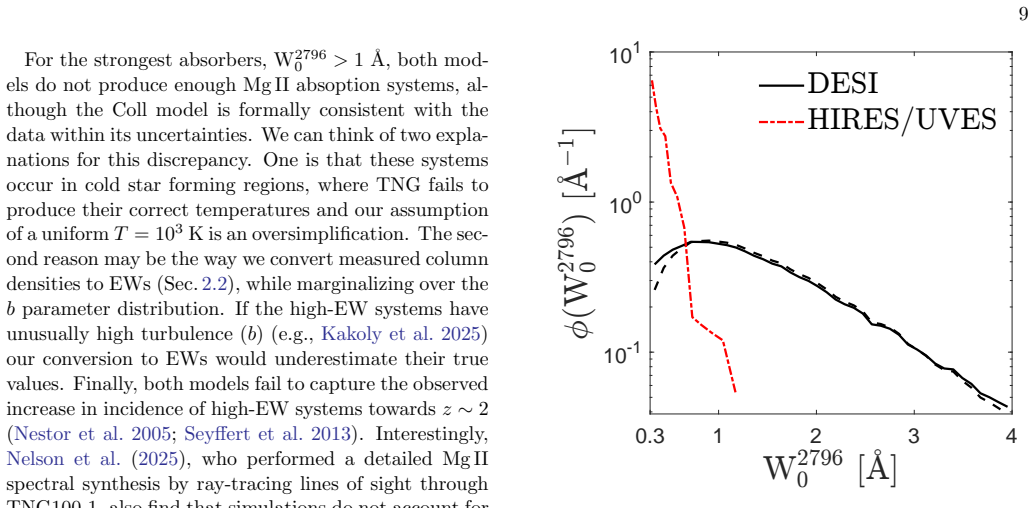
The authors compute MgI, MgII and FeII column densities from IllustrisTNG gas cells on a grid using both a purely collisional ionization model and one that includes photo-ionization by a uniform UVB. The resulting column density PDFs broadly reproduce the observed distributions from HIRES, UVES, SDSS and DESI samples across 10^11.4 ≲ N ≲ 10^16 cm^{-2}. The UVB model yields dN/dz values that match observations for MgII equivalent widths W0^2796 below 0.6 Å but underestimates the incidence at W0^2796 above 1 Å and fails to reproduce the observed rise in numbers toward z ∼ 2.
What carries the argument
Grid-based post-processing to derive ionic column densities from the simulation's gas distribution under uniform UVB photo-ionization plus collisional ionization equilibrium, followed by construction of PDFs and equivalent-width incidence statistics.
If this is right
- The simulation captures the dominant drivers of low-ionization absorption for column densities up to 10^16 cm^{-2}.
- Photo-ionized low-density gas in the outer CGM is adequately modeled for weak equivalent-width absorbers below 0.6 Å.
- High-EW MgII systems arise from denser gas whose abundance is underproduced in TNG, especially at z approaching 2.
- The mismatch at strong absorbers indicates that current galaxy-formation prescriptions miss some physics affecting cool dense gas.
Where Pith is reading between the lines
- The discrepancy points to a need for sub-grid treatments of cold gas clumps or local ionization sources to improve strong-absorber statistics.
- Comparing the same statistics across different simulations with varying feedback strengths could isolate which missing process drives the high-EW shortfall.
- The success for weak absorbers but failure for strong ones implies that outer CGM gas is better constrained than inner, denser regions.
Load-bearing premise
The IllustrisTNG gas distribution combined with a uniform UVB and standard collisional ionization prescriptions faithfully captures the physical conditions that produce the observed low-ionization absorption without needing local radiation fields or unresolved cold-gas structures.
What would settle it
Re-running the column-density and dN/dz analysis on a higher-resolution TNG variant or with added local stellar radiation that produces more high-column systems and an increase in strong MgII absorbers toward z=2.
Figures




read the original abstract
Low-ionization metal absorption lines provide a primary probe of cool gas in and around galaxies. We confront observations of metal-line absorption in quasar spectra with predictions from the IllustrisTNG cosmological simulation in order to benchmark how well current galaxy formation models reproduce the observed circumgalactic medium (CGM) and intergalactic medium (IGM) absorption signatures. We implement two ionization prescriptions: a purely collisional model and a model including photo-ionization by a uniform ultraviolet background (UVB). Using a grid-based framework, we compute MgI, MgII and FeII column densities and construct column density probability distribution functions (PDFs) and equivalent width (EW) statistics for comparison with observations. The observational samples considered here are based on the High Resolution Echelle Spectrometer (HIRES), the Ultraviolet and Visual Echelle Spectrograph (UVES), the Sloan Digital Sky Survey (SDSS) and the Dark Energy Spectroscopic Instrument (DESI). The computed PDFs broadly reproduce the observed ones across the sampled column density range of $10^{11.4}\lesssim \text{N}\lesssim 10^{16}\ \rm{cm^{-2}}$, indicating that the simulation captures the dominant physical drivers of low-ionization absorption. We then compute the cosmic incidence of MgII systems, namely the evolution of their number with redshift $d\mathcal{N}/{dz}$. The model that includes UVB accurately produces $d\mathcal{N}/{dz}$ up to equivalent widths (EW) of $\rm W_0^{2796} < 0.6\ \mathring{A}$, consistent with low-density photo-ionized gas in the outer CGM. At high EWs of $\rm W_0^{2796} > 1\ \mathring{A}$ TNG underestimates $d\mathcal{N}/{dz}$ and fails to capture its rise toward $z\sim2$.
Editorial analysis
A structured set of objections, weighed in public.
Referee Report
Summary. The paper compares low-ionization metal absorption (Mg I, Mg II, Fe II) column densities and equivalent widths from the IllustrisTNG simulation against HIRES, UVES, SDSS, and DESI observations. Using a grid-based approach with collisional ionization and a uniform UVB photo-ionization model, it reports that the simulated column-density PDFs broadly match observations over 10^{11.4} ≲ N ≲ 10^{16} cm^{-2}, while the UVB model reproduces dN/dz only for W_0^{2796} < 0.6 Å and underestimates the incidence and redshift evolution of stronger systems (W_0^{2796} > 1 Å) toward z ∼ 2.
Significance. If the reported PDF agreement and targeted dN/dz discrepancies hold after addressing numerical caveats, the work provides a useful benchmark for the cool-gas content of the CGM/IGM in state-of-the-art cosmological simulations. The identification of where TNG succeeds (low-density photo-ionized gas) versus fails (dense, high-EW absorbers) supplies concrete guidance for refining sub-grid physics or resolution requirements in future galaxy-formation models.
major comments (2)
- [§4] §4 (dN/dz and high-EW results): The claim that TNG underestimates dN/dz for W_0^{2796} > 1 Å and fails to capture the rise toward z ∼ 2 is load-bearing for the central conclusion. However, the TNG baryonic resolution (∼1.4 × 10^6 M_⊙, ∼0.7 kpc softening) is insufficient to resolve the sub-kpc, high-density cold clumps observationally linked to saturated Mg II. Without a resolution-convergence test or comparison to higher-resolution runs, the discrepancy cannot be cleanly attributed to galaxy-formation physics rather than numerical incompleteness in the cold-gas distribution.
- [Methods] Methods section (grid-based column-density calculation): The paper does not provide sufficient detail on sightline selection, the precise UVB spectrum and normalization, self-shielding treatment, or how unresolved dense structures are handled. These choices directly affect whether the reported PDF agreement is robust or sensitive to the adopted prescriptions.
minor comments (2)
- [Abstract and §4] Clarify in the abstract and §4 whether the dN/dz comparison uses the same redshift bins and EW thresholds as the observational catalogs.
- [Simulation setup] Add a short paragraph or table summarizing the exact simulation parameters (box size, resolution, UVB model reference) for reproducibility.
Simulated Author's Rebuttal
We thank the referee for their constructive and detailed comments, which have helped clarify several aspects of our analysis. We address each major comment below and describe the revisions we plan to implement.
read point-by-point responses
-
Referee: §4 (dN/dz and high-EW results): The claim that TNG underestimates dN/dz for W_0^{2796} > 1 Å and fails to capture the rise toward z ∼ 2 is load-bearing for the central conclusion. However, the TNG baryonic resolution (∼1.4 × 10^6 M_⊙, ∼0.7 kpc softening) is insufficient to resolve the sub-kpc, high-density cold clumps observationally linked to saturated Mg II. Without a resolution-convergence test or comparison to higher-resolution runs, the discrepancy cannot be cleanly attributed to galaxy-formation physics rather than numerical incompleteness in the cold-gas distribution.
Authors: We agree that the baryonic resolution of TNG limits the faithful representation of the smallest, densest cold clumps that dominate the strongest saturated Mg II systems. This is a substantive limitation of the current simulation suite. At the same time, the broad agreement we find in the column-density PDFs over 10^{11.4} ≲ N ≲ 10^{16} cm^{-2} indicates that the simulation captures the bulk of the photo-ionized cool gas responsible for weaker absorbers. The high-EW discrepancy is therefore likely a combination of numerical resolution and sub-grid physics. We will revise §4 to include an explicit discussion of these resolution caveats, reference prior work on CGM resolution requirements, and state that the reported underestimation of strong systems and their redshift evolution should be interpreted as a benchmark for future higher-resolution simulations rather than a definitive statement on galaxy-formation physics alone. revision: partial
-
Referee: Methods section (grid-based column-density calculation): The paper does not provide sufficient detail on sightline selection, the precise UVB spectrum and normalization, self-shielding treatment, or how unresolved dense structures are handled. These choices directly affect whether the reported PDF agreement is robust or sensitive to the adopted prescriptions.
Authors: We will expand the Methods section substantially. We will specify that sightlines are drawn randomly through the periodic simulation volume with a number chosen to ensure convergence of the PDFs and dN/dz statistics; that the UVB is the Haardt & Madau (2012) spectrum normalized at each redshift to the observed hydrogen photo-ionization rate; that self-shielding is implemented via a simple density-threshold prescription above which the UVB is attenuated; and that unresolved dense structures are handled by the native grid resolution of the simulation, with the caveat that sub-cell clumps are not captured. These additions will allow readers to evaluate the robustness of the reported PDF agreement. revision: yes
Circularity Check
No circularity: direct simulation-observation comparison using external data
full rationale
The paper extracts MgI, MgII and FeII column densities from the public IllustrisTNG simulation volume using two standard ionization prescriptions (collisional and UVB photo-ionization). It then constructs PDFs and dN/dz statistics and compares them to independent observational catalogs (HIRES, UVES, SDSS, DESI). No parameters are fitted to the target absorption statistics, no self-citation supplies a uniqueness theorem or ansatz that forces the result, and no reported quantity is defined in terms of itself. The noted under-prediction at high EW is an output of the comparison, not an input. This is a standard external-benchmark test and therefore self-contained.
Axiom & Free-Parameter Ledger
axioms (2)
- domain assumption IllustrisTNG provides a sufficiently accurate three-dimensional distribution of gas density, temperature and metallicity in the CGM and IGM.
- domain assumption A spatially uniform UVB is an adequate description of the photo-ionizing radiation field at these redshifts.
Reference graph
Works this paper leans on
-
[1]
Aghamousa, A., et al. 2016. https://arxiv.org/abs/1611.00036
work page internal anchor Pith review arXiv 2016
-
[2]
2025, The Astrophysical Journal, 990, 151, doi: 10.3847/1538-4357/adef3c
Anand, A., Aguilar, J., Ahlen, S., et al. 2025, The Astrophysical Journal, 990, 151, doi: 10.3847/1538-4357/adef3c
-
[3]
C., Haider, M., Montero-Dorta, A
Artale, M. C., Haider, M., Montero-Dorta, A. D., et al. 2021, Monthly Notices of the Royal Astronomical Society, 510, 399, doi: 10.1093/mnras/stab3281
-
[4]
Bahcall, J. N., & Salpeter, E. E. 1965, Astrophys. J., 142, 1677, doi: 10.1086/148460
-
[5]
J., Vogelsberger, M., Kannan, R., et al
Barnes, D. J., Vogelsberger, M., Kannan, R., et al. 2018, Monthly Notices of the Royal Astronomical Society, 481, 1809, doi: 10.1093/mnras/sty2078
-
[6]
1991, Astron
Bergeron, J., & Boiss´ e, P. 1991, Astron. Astrophys., 243, 344
1991
-
[7]
, archivePrefix = "arXiv", eprint =
Bergeron, J., & Stasi´ nska, G. 1986, Astron. Astrophys., 169, 1 Bouch´ e, N., Murphy, M. T., P´ eroux, C., et al. 2012, Mon. Not. R. Astron. Soc., 419, 2, doi: 10.1111/j.1365-2966.2011.19500.x 12
-
[8]
2023, ApJ, 944, 107, doi: 10.3847/1538-4357/acb3c2
Chaussidon, E., Y` eche, C., Palanque-Delabrouille, N., et al. 2023, Astrophys. J., 944, 107, doi: 10.3847/1538-4357/acb3c2
-
[9]
Chen, H.-W., Helsby, J. E., Gauthier, J.-R., et al. 2010, The Astrophysical Journal, 714, 1521, doi: 10.1088/0004-637X/714/2/1521
-
[10]
Chen, S.-F. S., Simcoe, R. A., Torrey, P., et al. 2017, The Astrophysical Journal, 850, 188, doi: 10.3847/1538-4357/aa9707
-
[11]
Churchill, C. W., Abbas, A., Kacprzak, G. G., & Nielsen, N. M. 2025, 13 Billion Years of MgII Absorber Evolution. https://arxiv.org/abs/2510.01430
-
[12]
Churchill, C. W., Evans, J. L., Stemock, B., et al. 2020, The Astrophysical Journal, 904, 28, doi: 10.3847/1538-4357/abbb34
-
[13]
Churchill, C. W., Mellon, R. R., Charlton, J. C., et al. 2000, The Astrophysical Journal Supplement Series, 130, 91–119, doi: 10.1086/317343
-
[14]
Churchill, C. W., Vogt, S. S., & Charlton, J. C. 2003, The Astronomical Journal, 125, 98, doi: 10.1086/345513
-
[15]
Dawson, K. S., Schlegel, D. J., Ahn, C. P., et al. 2013, Astron. J., 145, 10, doi: 10.1088/0004-6256/145/1/10 Del Zanna, G., Dere, K. P., Young, P. R., Landi, E., &
-
[16]
Mason, H. E. 2015, Astron. Astrophys., 582, A56, doi: 10.1051/0004-6361/201526827
-
[17]
Dere, K. P., Landi, E., Mason, H. E., Monsignori Fossi, B. C., & Young, P. R. 1997, A&AS, 125, 149, doi: 10.1051/aas:1997368 DESI Collaboration, Abdul-Karim, M., Adame, et al. 2025, arXiv e-prints, arXiv:2503.14745, doi: 10.48550/arXiv.2503.14745
-
[18]
Eisenstein, D. J., Weinberg, D. H., Agol, E., et al. 2011, Astron. J., 142, 72, doi: 10.1088/0004-6256/142/3/72 Euclid Collaboration, Jahnke, K., Gillard, W., et al. 2025, A&A, 697, A3, doi: 10.1051/0004-6361/202450786 Faucher-Gigu` ere, C.-A., Lidz, A., Zaldarriaga, M., &
-
[19]
Hernquist, L. 2009, Astrophys. J., 703, 1416, doi: 10.1088/0004-637X/703/2/1416
-
[20]
Gauthier, J.-R., Chen, H.-W., Cooksey, K. L., et al. 2014, Mon. Not. R. Astron. Soc., 439, 342, doi: 10.1093/mnras/stt2443
-
[21]
Grauer, M., & Behar, E. 2023, Astrophys. J., 953, 158, doi: 10.3847/1538-4357/ace1e8
-
[22]
Gunn, J. E., & Peterson, B. A. 1965, Astrophys. J., 142, 1633, doi: 10.1086/148444
-
[23]
2019, Monthly Notices of the Royal Astronomical Society, 488, 1248, doi: 10.1093/mnras/stz1773
Hafen, Z., Faucher-Gigu` ere, C.-A., Angl´ es-Alc´ azar, D., et al. 2019, Monthly Notices of the Royal Astronomical Society, 488, 1248, doi: 10.1093/mnras/stz1773
-
[24]
Hummels, C. B., Smith, B. D., Hopkins, P. F., et al. 2019, The Astrophysical Journal, 882, 156, doi: 10.3847/1538-4357/ab378f
-
[25]
Jannuzi, B. T., Bahcall, J. N., Bergeron, J., et al. 1998, The Astrophysical Journal Supplement Series, 118, 1–125, doi: 10.1086/313130
-
[26]
Murphy, M. T. 2008, The Astronomical Journal, 135, 922, doi: 10.1088/0004-6256/135/3/922
-
[27]
2025, Monthly Notices of the Royal Astronomical Society, 543, 3345, doi: 10.1093/mnras/staf1516
Kakoly, A., Stern, J., Faucher-Gigu` ere, C.-A., et al. 2025, Monthly Notices of the Royal Astronomical Society, 543, 3345, doi: 10.1093/mnras/staf1516
-
[28]
doi:10.1093/mnras/stad3374 , arxivId =
Khaire, V., Hu, T., Hennawi, J. F., Walther, M., & Davies, F. 2023, Monthly Notices of the Royal Astronomical Society, 527, 4545, doi: 10.1093/mnras/stad3374
-
[29]
Kim, T.-S., Partl, A. M., Carswell, R. F., & M¨ uller, V. 2013, Astron. Astrophys., 552, A77, doi: 10.1051/0004-6361/201220042
-
[30]
2017, ApJ, 850, 156, doi: 10.3847/1538-4357/aa93eb
Lan, T.-W., & Fukugita, M. 2017, The Astrophysical Journal, 850, 156, doi: 10.3847/1538-4357/aa93eb
-
[31]
Lan, T.-W., M´ enard, B., & Zhu, G. 2014, Astrophys. J., 795, 31, doi: 10.1088/0004-637X/795/1/31
-
[32]
URL http://arxiv.org/abs/2511.03195
Lan, T.-W., Prochaska, J. X., Aguilar, J., et al. 2025, The Multi-Phase Circumgalactic Medium of DESI Emission-Line Galaxies at z 1.5. https://arxiv.org/abs/2511.03195
-
[33]
Lucchini, S., Abramson, C., Hummels, C., et al. 2026, ENhanced Galactic Atmospheres With Arepo: Resolving the CGM at 200 pc with the ENGAWA Simulations. https://arxiv.org/abs/2603.05584
-
[34]
Lyke, B. W., Higley, A. N., McLane, J. N., et al. 2020, Astrophys. J. Supp., 250, 8, doi: 10.3847/1538-4365/aba623
-
[35]
2018, MNRAS, 480, 5113, doi: 10.1093/mnras/sty2206
Marinacci, F., Vogelsberger, M., Pakmor, R., et al. 2018, Monthly Notices of the Royal Astronomical Society, doi: 10.1093/mnras/sty2206
-
[36]
Matejek, M. S., & Simcoe, R. A. 2012, The Astrophysical Journal, 761, 112, doi: 10.1088/0004-637X/761/2/112
-
[37]
Mathes, N. L., Churchill, C. W., & Murphy, M. T. 2017, The Vulture Survey I: Analyzing the Evolution of Mg II Absorbers. https://arxiv.org/abs/1701.05624
-
[38]
Meiksin, A. A. 2009, Rev. Mod. Phys., 81, 1405, doi: 10.1103/RevModPhys.81.1405
-
[39]
Monaghan, J. J. 1992, Ann. Rev. Astron. Astrophys., 30, 543, doi: 10.1146/annurev.aa.30.090192.002551
-
[40]
P., Pillepich, A., Springel, V., et al
Naiman, J. P., Pillepich, A., Springel, V., et al. 2018, Monthly Notices of the Royal Astronomical Society, 477, 1206–1224, doi: 10.1093/mnras/sty618
-
[41]
Napolitano, L., Pandey, A., Myers, A. D., et al. 2023, Astron. J., 166, 99, doi: 10.3847/1538-3881/ace62c 13
-
[42]
Napolitano, L., Myers, A. D., Fawcett, V. A., et al. 2025, Astron. J., 170, 16, doi: 10.3847/1538-3881/adc389
-
[43]
Narayanan, A., Charlton, J. C., Masiero, J. R., & Lynch, R. 2005, The Astrophysical Journal, 632, 92, doi: 10.1086/432750
-
[44]
Narayanan, A., Misawa, T., Charlton, J. C., & Kim, T. 2007, The Astrophysical Journal, 660, 1093–1105, doi: 10.1086/512852
-
[45]
Burchett, J. N. 2021a, Monthly Notices of the Royal Astronomical Society, 507, 4445–4463, doi: 10.1093/mnras/stab2177
-
[46]
First results from the IllustrisTNG simulations: the galaxy color bimodality
Nelson, D., Pillepich, A., Springel, V., et al. 2017, Monthly Notices of the Royal Astronomical Society, 475, 624–647, doi: 10.1093/mnras/stx3040
work page internal anchor Pith review doi:10.1093/mnras/stx3040 2017
-
[47]
2018, Monthly Notices of the Royal Astronomical Society, 477, 450–479, doi: 10.1093/mnras/sty656
Nelson, D., Kauffmann, G., Pillepich, A., et al. 2018, Monthly Notices of the Royal Astronomical Society, 477, 450–479, doi: 10.1093/mnras/sty656
-
[48]
Nelson, D., Pillepich, A., Springel, V., et al. 2019, Monthly Notices of the Royal Astronomical Society, 490, 3234, doi: 10.1093/mnras/stz2306
-
[49]
2020, Monthly Notices of the Royal Astronomical Society, 498, 2391, doi: 10.1093/mnras/staa2419
Nelson, D., Sharma, P., Pillepich, A., et al. 2020, Monthly Notices of the Royal Astronomical Society, 498, 2391, doi: 10.1093/mnras/staa2419
- [50]
-
[51]
2025, The Synthetic Absorption Line Spectral Almanac (SALSA)
Nelson, D., Peroux, C., Richter, P., et al. 2025, The Synthetic Absorption Line Spectral Almanac (SALSA). https://arxiv.org/abs/2510.19904
-
[52]
Nestor, D. B., Turnshek, D. A., & Rao, S. M. 2005, The Astrophysical Journal, 628, 637, doi: 10.1086/427547
-
[53]
Noterdaeme, P., Petitjean, P., Carithers, W. C., et al. 2012, Astron. Astrophys., 547, L1, doi: 10.1051/0004-6361/201220259
-
[54]
D., Segers, M., Schaye, J., Richings, A
Oppenheimer, B. D., Segers, M., Schaye, J., Richings, A. J., & Crain, R. A. 2018, Mon. Not. R. Astron. Soc., 474, 4740, doi: 10.1093/mnras/stx2967
-
[55]
Pieri, M. M., Mortonson, M. J., Frank, S., et al. 2014, Monthly Notices of the Royal Astronomical Society, 441, 1718, doi: 10.1093/mnras/stu577
-
[56]
2018a, MNRAS, 475, 648, doi: 10.1093/mnras/stx3112
Pillepich, A., Nelson, D., Hernquist, L., et al. 2017a, Monthly Notices of the Royal Astronomical Society, 475, 648–675, doi: 10.1093/mnras/stx3112
-
[57]
2018b, MNRAS, 473, 4077, doi: 10.1093/mnras/stx2656
Pillepich, A., Springel, V., Nelson, D., et al. 2017b, Monthly Notices of the Royal Astronomical Society, 473, 4077–4106, doi: 10.1093/mnras/stx2656
work page internal anchor Pith review doi:10.1093/mnras/stx2656
-
[58]
2019, MNRAS, 490, 3196, doi: 10.1093/mnras/stz2338
Pillepich, A., Nelson, D., Springel, V., et al. 2019, Monthly Notices of the Royal Astronomical Society, 490, 3196, doi: 10.1093/mnras/stz2338
-
[59]
Press, W. H., Rybicki, G. B., & Schneider, D. P. 1993, Astrophys. J., 414, 64, doi: 10.1086/173057
-
[60]
Prochaska, J. X., Hennawi, J. F., & Herbert-Fort, S. 2008, The Astrophysical Journal, 675, 1002, doi: 10.1086/526508 P´ eroux, C., Nelson, D., van de Voort, F., et al. 2020, Monthly Notices of the Royal Astronomical Society, 499, 2462, doi: 10.1093/mnras/staa2888
-
[61]
Quider, A. M., Nestor, D. B., Turnshek, D. A., et al. 2011, The Astronomical Journal, 141, 137, doi: 10.1088/0004-6256/141/4/137
-
[62]
1998, Annual Review of Astronomy and Astrophysics, 36, 267–316, doi: 10.1146/annurev.astro.36.1.267
Rauch, M. 1998, Annual Review of Astronomy and Astrophysics, 36, 267–316, doi: 10.1146/annurev.astro.36.1.267
-
[63]
Rigby, J. R., Charlton, J. C., & Churchill, C. W. 2002, The Astrophysical Journal, 565, 743, doi: 10.1086/324723
-
[64]
Seyffert, E. N., Cooksey, K. L., Simcoe, R. A., et al. 2013, The Astrophysical Journal, 779, 161, doi: 10.1088/0004-637X/779/2/161
-
[65]
Springel, V., & Hernquist, L. 2003, Monthly Notices of the Royal Astronomical Society, 339, 289–311, doi: 10.1046/j.1365-8711.2003.06206.x
-
[66]
2018, MNRAS, 475, 676, doi: 10.1093/mnras/stx3304
Springel, V., Pakmor, R., Pillepich, A., et al. 2017, Monthly Notices of the Royal Astronomical Society, 475, 676–698, doi: 10.1093/mnras/stx3304
-
[67]
Steidel, C. C. 1992, PASP, 104, 843, doi: 10.1086/133065
-
[68]
Torrey, P., Vogelsberger, M., Marinacci, F., et al. 2019, Monthly Notices of the Royal Astronomical Society, 484, 5587, doi: 10.1093/mnras/stz243
-
[69]
2020, MNRAS, 494, 549, doi: 10.1093/mnras/staa685
Truong, N., Pillepich, A., Werner, N., et al. 2020, Monthly Notices of the Royal Astronomical Society, 494, 549, doi: 10.1093/mnras/staa685
-
[70]
Tumlinson, J., Peeples, M. S., & Werk, J. K. 2017, Annual Review of Astronomy and Astrophysics, 55, 389–432, doi: 10.1146/annurev-astro-091916-055240 van de Voort, F., Springel, V., Mandelker, N., van den Bosch, F. C., & Pakmor, R. 2019, Monthly Notices of the Royal Astronomical Society: Letters, 482, L85, doi: 10.1093/mnrasl/sly190
work page internal anchor Pith review doi:10.1146/annurev-astro-091916-055240 2017
-
[71]
Verner, D. A., Ferland, G. J., Korista, K. T., & Yakovlev, D. G. 1996, Astrophys. J., 465, 487, doi: 10.1086/177435
-
[72]
2017, MNRAS, 465, 3291, doi: 10.1093/mnras/stw2944
Weinberger, R., Springel, V., Hernquist, L., et al. 2016, Monthly Notices of the Royal Astronomical Society, 465, 3291–3308, doi: 10.1093/mnras/stw2944
work page internal anchor Pith review doi:10.1093/mnras/stw2944 2016
-
[73]
Weiner, B. J., Coil, A. L., Prochaska, J. X., et al. 2009, Astrophys. J., 692, 187, doi: 10.1088/0004-637X/692/1/187
-
[74]
Werk, J. K., Prochaska, J. X., Thom, C., et al. 2013, The Astrophysical Journal Supplement Series, 204, 17, doi: 10.1088/0067-0049/204/2/17 14
-
[75]
Turnshek, D. A. 1979, Astrophys. J., 234, 33, doi: 10.1086/157470
-
[76]
Wu, X., Cai, Z., Lan, T.-W., et al. 2025, Astrophys. J., 983, 186, doi: 10.3847/1538-4357/adb28a
-
[77]
G., Adelman, J., Anderson, Jr., J
York, D. G., Adelman, J., Anderson, Jr., J. E., et al. 2000, Astron. J., 120, 1579, doi: 10.1086/301513
-
[78]
Young, P., Sargent, W. L. W., & Boksenberg, A. 1982, Astrophys. J., 252, 10, doi: 10.1086/159529
-
[79]
2013, The Astrophysical Journal, 770, 130, doi: 10.1088/0004-637X/770/2/130
Zhu, G., & M´ enard, B. 2013, The Astrophysical Journal, 770, 130, doi: 10.1088/0004-637X/770/2/130
discussion (0)
Sign in with ORCID, Apple, or X to comment. Anyone can read and Pith papers without signing in.