Recognition: unknown
On stress-assisted boundary migration during recrystallization
Pith reviewed 2026-05-10 16:04 UTC · model grok-4.3
The pith
Recrystallization boundary migration aligns with local residual strain anisotropy in aluminum.
A machine-rendered reading of the paper's core claim, the machinery that carries it, and where it could break.
Core claim
Recrystallization boundary migration is modulated by the anisotropy of the local internal stress state, revealed by the direct correlation between principal residual strain components and observed migration directions, while stresses in recrystallizing grains respond passively to the surrounding deformed matrix and shear-coupled motion is absent despite applied shear stress.
What carries the argument
Correlation between principal residual strain components and boundary migration directions, which establishes modulation by local internal stress anisotropy.
If this is right
- Migration directions can be anticipated from measured principal strain fields in the deformed matrix.
- Stresses inside recrystallizing grains arise passively from constraints and dislocation structures in adjacent grains.
- Shear stress across the boundary does not produce detectable shear-coupled motion in this material system.
- Residual strains remain lower inside recrystallizing grains than in the deformed matrix by a factor of several.
Where Pith is reading between the lines
- If stress anisotropy dominates, controlled changes to dislocation boundary geometry could steer preferred migration paths in annealing.
- The passive stress response in new grains may appear in other annealing processes where deformed matrices impose local constraints.
- In situ strain mapping during annealing in other metals could test whether the same strain-migration correlation holds.
- Incorporating anisotropic stress tensors into recrystallization models would allow quantitative prediction of boundary paths.
Load-bearing premise
The correlation between residual strain patterns and boundary migration directions means anisotropy of the local stress state is the dominant mechanism rather than unmeasured variables such as local temperature or dislocation interactions.
What would settle it
A controlled experiment in which boundary migration directions remain uncorrelated with principal strain axes under uniform stress conditions would falsify the modulation claim.
Figures




read the original abstract
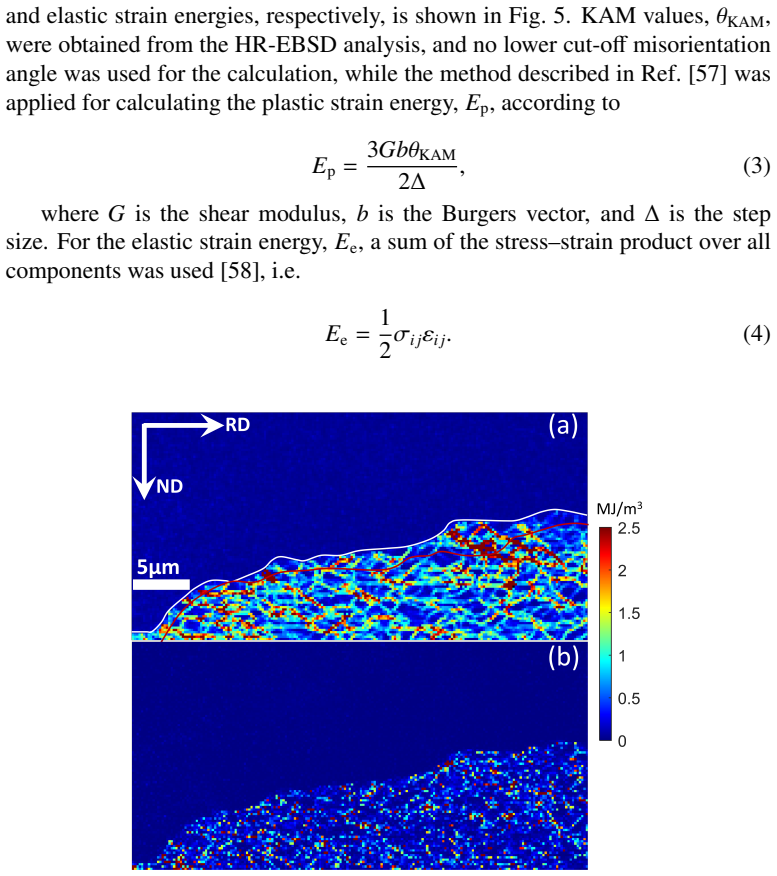
This study investigates the boundary migration mechanisms near the sample surface of recrystallizing grains in high-purity Al subjected to cryogenic rolling. Local strain and stress tensors were characterized during \textit{in situ} annealing by combining high-resolution electron backscatter diffraction with microstructure-based digital image correlation strain analysis. The results reveal local residual strains on the order of $10^{-3}$ within the recrystallizing grain, with values several times higher in the adjacent deformed matrix. The residual stresses in recrystallizing grains are a passive response to those developed within the surrounding deformed grains; the latter being strongly influenced by the local geometry and characteristics of dislocation boundaries, as well as by constraints imposed by neighboring grains. No evidence of shear-coupled motion was observed during the recrystallization boundary migration, despite the presence of shear stress across the boundary. In contrast, detailed analysis of the principal strain components reveals a clear correlation between residual strain patterns and boundary migration directions. These findings indicate that recrystallization boundary migration is modulated by the anisotropy of the local internal stress state.
Editorial analysis
A structured set of objections, weighed in public.
Referee Report
Summary. This experimental study examines recrystallization boundary migration near the surface in cryogenically rolled high-purity Al using in situ annealing combined with high-resolution EBSD and microstructure-based DIC. Local residual strains of order 10^{-3} are measured (higher in the deformed matrix), stresses in recrystallizing grains are characterized as a passive response to matrix stresses shaped by dislocation boundary geometry and grain constraints, no shear-coupled motion is observed despite shear stresses across boundaries, and a correlation is reported between principal residual strain components and observed migration directions, leading to the conclusion that migration is modulated by anisotropy of the local internal stress state.
Significance. If the reported correlation is shown to support a causal modulating role for stress anisotropy (rather than joint determination by unmeasured factors), the findings would advance mechanistic understanding of recrystallization in deformed metals by providing direct in situ evidence distinguishing stress effects from shear coupling. The combination of HR-EBSD with DIC for tensorial strain mapping during annealing and the explicit ruling out of shear coupling represent clear experimental strengths.
major comments (2)
- The central claim that the observed correlation indicates modulation by stress anisotropy (rather than both quantities being jointly determined by dislocation substructure) is load-bearing but rests on qualitative description of a 'clear correlation' without quantitative support such as a reported correlation coefficient, regression slope, or statistical test of significance between principal strain directions and migration vectors.
- No quantitative model is provided linking the measured principal strain directions (inferred from residual strains ~10^{-3}) to migration velocity or direction, nor are alternative drivers such as local stored-energy gradients or minor temperature inhomogeneities explicitly tested or controlled for in the analysis of migration paths.
minor comments (2)
- Expand the methods description to include explicit criteria for data exclusion, error propagation in the DIC strain analysis, and how migration directions were independently extracted from the time-lapse images.
- Figure captions and the results section should clarify the spatial registration between strain maps and boundary positions to allow readers to assess potential alignment artifacts.
Simulated Author's Rebuttal
We thank the referee for their careful review and constructive comments, which highlight both the strengths of the experimental approach and areas where the presentation can be strengthened. We address each major comment below and indicate the revisions planned for the manuscript.
read point-by-point responses
-
Referee: The central claim that the observed correlation indicates modulation by stress anisotropy (rather than both quantities being jointly determined by dislocation substructure) is load-bearing but rests on qualitative description of a 'clear correlation' without quantitative support such as a reported correlation coefficient, regression slope, or statistical test of significance between principal strain directions and migration vectors.
Authors: We agree that the correlation is presented qualitatively and that quantitative metrics would strengthen the central claim. In the revised manuscript we will add a quantitative analysis of the relationship between principal residual strain directions and migration vectors, including correlation coefficients, regression slopes where appropriate, and statistical significance tests. These additions will help distinguish modulation by stress anisotropy from joint determination by the dislocation substructure. The in situ observations already demonstrate consistent directional alignment across multiple boundaries, but the requested metrics will provide additional rigor. revision: yes
-
Referee: No quantitative model is provided linking the measured principal strain directions (inferred from residual strains ~10^{-3}) to migration velocity or direction, nor are alternative drivers such as local stored-energy gradients or minor temperature inhomogeneities explicitly tested or controlled for in the analysis of migration paths.
Authors: The study is observational and does not include a quantitative predictive model relating residual strains to migration velocity or direction; such modeling lies outside the scope of the present experimental work. We will revise the discussion to address alternative drivers more explicitly. Local stored-energy gradients are already contrasted via the measured strain magnitudes (higher in the deformed matrix) and the passive stress response in recrystallizing grains. Temperature inhomogeneities are minimized by the controlled in situ annealing conditions and high-purity material; we will add explicit statements clarifying why these alternatives are unlikely to dominate based on the observed lack of shear coupling and the correlation with principal strain components. revision: partial
- Development of a quantitative model that links the measured principal residual strains (~10^{-3}) to boundary migration velocity or direction.
Circularity Check
No circularity: purely observational experimental study with direct measurements
full rationale
The paper reports in-situ EBSD + DIC measurements of residual strains (~10^{-3}) and boundary migration directions during recrystallization annealing. No equations, derivations, fitted parameters, or self-citations appear in the provided text or abstract. The claimed correlation between principal strain patterns and migration directions is presented as an empirical observation, not derived from or equivalent to any input by construction. No load-bearing steps reduce to self-definition, fitted predictions, or author self-citations. This matches the default expectation for non-circular experimental work.
Axiom & Free-Parameter Ledger
axioms (1)
- domain assumption Measured local strains can be interpreted as residual stresses using the material's known elastic response without dominant plastic relaxation during the observed annealing stage.
Reference graph
Works this paper leans on
-
[1]
F. J. Humphreys, G. S. Rohrer, A. Rollett, Recrystallization and Related Annealing Phe- nomena, Elsevier, 2017.doi:10.1016/B978-008044164-1/50005-0
-
[2]
Y . Zhang, R. Barabash, High resolution mapping of orientation and strain gradients in metals by synchrotron 3d x-ray laue microdiffraction, Quantum Beam Science 3 (2019) 6. doi:10.3390/qubs3010006
-
[3]
A. Lindkvist, W. Liu, D. Juul Jensen, Y . Zhang, 3d mapping of residual stresses in growing grains of partially recrystallized gum metal, Materials Research Letters 11 (2023) 942–948. doi:10.1080/21663831.2023.2267094
-
[4]
S. Lee, T. D. Berman, C. Yildirim, C. Detlefs, J. E. Allison, A. Bucsek, Multi- scale in-situ characterization of static recrystallization using dark-field x-ray microscopy and high-resolution x-ray diffraction, Scientific Reports 14 (2024).doi:10.1038/ s41598-024-56546-9
2024
-
[5]
Y . Zhang, T. Yu, R. Xu, J. Thorborg, W. Liu, J. Tischler, A. Godfrey, D. Juul Jensen, Local residual stresses and microstructure within recrystallizing grains in iron, Materials Characterization 191 (2022) 112113.doi:10.1016/j.matchar.2022.112113
-
[6]
Y . Zhang, W. Ludwig, Selective growth of recrystallizing grains into well-characterized deformed aluminum at hardness indentation, Acta Materialia 270 (2024) 119862.doi: 10.1016/j.actamat.2024.119862
-
[8]
T. Q. Phan, I. F. Lee, L. E. Levine, J. Z. Tischler, Y . Huang, A. G. Fox, T. G. Langdon, M. E. Kassner, X-ray microbeam measurements of long-range internal stresses in commercial- purity aluminum processed by multiple passes of equal-channel angular pressing, Scripta Materialia 93 (2014) 48–51.doi:10.1016/j.scriptamat.2014.09.001
-
[10]
B. C. Larson, L. E. Levine, Submicrometre-resolution polychromatic three-dimensional x- ray microscopy, Journal of Applied Crystallography 46 (2013) 153–164.doi:10.1107/ S0021889812043737
2013
-
[11]
B. C. Larson, W. Yang, G. E. Ice, J. D. Budai, J. Z. Tischler, Three-dimensional x-ray structural microscopy with submicrometre resolution, Nature 415 (2002) 887–890.doi: 10.1038/415887a
-
[12]
Y . Hayashi, D. Setoyama, Y . Hirose, T. Yoshida, H. Kimura, Intragranular three- dimensional stress tensor fields in plastically deformed polycrystals, Science 366 (2019) 1492–1496.doi:10.1126/science.aax9167
-
[13]
N. A. Henningsson, S. A. Hall, P. Wright, Reconstructing intragranular strain fields in polycrystalline materials from scanning 3dxrd data, Journal of Applied Crystallography 53 (2020) 1–37.doi:10.1107/S1600576720001016
-
[14]
Henningsson, M
A. Henningsson, M. Kutsal, J. P. Wright, W. Ludwig, H. O. Sørensen, S. A. Hall, G. Winther, H. F. Poulsen, Microstructure and stress mapping in 3d at industrially rel- evant degrees of plastic deformation, Scientific Reports 14 (2024).doi:10.1038/ s41598-024-71006-0
2024
-
[15]
W. Li, H. Sharma, K. Peter, S. Ravi, H. Sehitoglu, A. Bucsek, Resolving intra- granular stress fields in plastically deformed titanium using point-focused high-energy diffraction microscopy, Journal of Materials Research 38 (2023).doi:10.1557/ s43578-022-00873-y
2023
-
[16]
J. Wright, C. Giacobbe, M. Majkut, New opportunities at the materials science beamline at esrf to exploit high energy nano-focus x-ray beams, Current Opinion in Solid State and Materials Science 24 (2020) 100818.doi:10.1016/j.cossms.2020.100818
-
[17]
L. E. Levine, C. Okoro, R. Xu, Full elastic strain and stress tensor measurements from individual dislocation cells in copper through-si vias, IUCrJ 2 (2015) 635–642.doi:10. 1107/S2052252515015031
2015
-
[18]
C. Ernould, B. Beausir, J. J. Fundenberger, V . Taupin, E. Bouzy, Measuring elastic strains and orientation gradients by scanning electron microscopy: Conventional and emerging methods, in: Advances in Imaging and Electron Physics, 2022.doi:10.1016/bs.aiep. 2022.07.001
-
[19]
T. B. Britton, A. J. Wilkinson, High resolution electron backscatter diffraction measure- ments of elastic strain variations in the presence of larger lattice rotations, Ultramicroscopy 114 (2012) 82–95.doi:10.1016/j.ultramic.2012.01.004
-
[20]
J. Jiang, T. B. Britton, A. J. Wilkinson, Mapping type iii intragranular residual stress distributions in deformed copper polycrystals, Acta Materialia 61 (2013) 5895–5904. doi:10.1016/j.actamat.2013.06.038
-
[22]
T. J. Ruggles, W. G. Gilliland, D. T. Fullwood, J. Kacher, An overview of hr-ebsd tech- niques for mapping local stress and dislocations in crystalline materials at sub-micron res- olution, Progress in Materials Science (2025) 101585doi:10.1016/j.pmatsci.2025. 101585
-
[23]
Q. Shi, S. Roux, F. Latourte, F. Hild, Estimation of elastic strain by integrated image correlation on electron diffraction patterns, Ultramicroscopy 199 (2019) 16–33.doi: 10.1016/j.ultramic.2019.02.001
-
[24]
T. Vermeij, J. P. M. Hoefnagels, A consistent full-field integrated dic framework for hr- ebsd, Ultramicroscopy 191 (2018) 44–50.doi:10.1016/j.ultramic.2018.05.001
-
[25]
T. J. Ruggles, G. F. Bomarito, R. L. Qiu, J. D. Hochhalter, New levels of high angular resolution ebsd performance via inverse compositional gauss–newton based digital image correlation, Ultramicroscopy 195 (2018) 85–92.doi:10.1016/j.ultramic.2018.08. 020
-
[26]
Q. Shi, H. Zhong, D. Loisnard, L. Wang, Z. Chen, H. Wang, S. Roux, Enhanced ebsd calibration accuracy based on gradients of diffraction patterns, Materials Characterization 202 (2023).doi:10.1016/j.matchar.2023.113022
-
[27]
Q. Shi, H. Zhong, D. Loisnard, M. Nowell, M. Mollens, Z. Chen, H. Wang, S. Roux, Towards measuring absolute residual stress by hr-ebsd with simulated reference patterns, Materials Characterization 218 (2024).doi:10.1016/j.matchar.2024.114508
-
[28]
Z. Chen, W. Lenthe, J. C. Stinville, M. Echlin, T. M. Pollock, S. Daly, High-resolution deformation mapping across large fields of view using scanning electron microscopy and digital image correlation, Experimental Mechanics 58 (2018) 1407–1421.doi:10.1007/ s11340-018-0419-y
2018
-
[29]
H. Schreier, J. J. Orteu, M. A. Sutton, Image Correlation for Shape, Motion and Defor- mation Measurements: Basic Concepts, Theory and Applications, Springer US, 2009. doi:10.1007/978-0-387-78747-3
-
[30]
T. C. Chu, W. F. Ranson, M. A. Sutton, W. H. Peters, Applications of digital-image- correlation techniques to experimental mechanics, Experimental Mechanics (1985) 232– 244doi:10.1007/BF02325092
-
[31]
Di Gioacchino, J
F. Di Gioacchino, J. Quinta da Fonseca, Plastic strain mapping with sub-micron resolution using digital image correlation, Experimental Mechanics 53 (2013) 743–754.doi:10. 1007/s11340-012-9685-2
2013
-
[32]
S. Zhang, A. Godfrey, C. Zhang, W. Liu, D. Juul Jensen, Surface patterning for combined digital image correlation and electron backscatter diffraction in-situ deformation experi- ments, Materials Characterization 164 (2020).doi:10.1016/j.matchar.2020.110332
-
[33]
G. Besnard, F. Hild, S. Roux, Finite-element displacement fields analysis from digital images: Application to portevin–le ch ˆatelier bands, Experimental Mechanics 46 (2006). doi:10.1007/s11340-006-9824-8
-
[34]
J. E. Brandenburg, D. A. Molodov, On shear coupled migration of low angle grain bound- aries, Scripta Materialia 163 (2019) 96–100.doi:10.1016/j.scriptamat.2019.01. 009
-
[36]
M. Winning, A. D. Rollett, G. Gottstein, D. J. Srolovitz, A. Lim, L. S. Shvindlerman, 23 Mobility of low-angle grain boundaries in pure metals, Philosophical Magazine 90 (2010) 3107–3128.doi:10.1080/14786435.2010.481272
-
[37]
M. Winning, Strain-induced migration of tilt grain boundaries, Scripta Materialia 58 (2008) 85–88.doi:10.1016/j.scriptamat.2007.09.034
-
[38]
F. Mompiou, D. Caillard, M. Legros, Grain boundary shear–migration coupling—i. in situ tem straining experiments in al polycrystals, Acta Materialia 57 (2009) 2198–2209.doi: 10.1016/j.actamat.2009.01.014
-
[39]
M. Legros, D. S. Gianola, K. J. Hemker, In situ tem observations of fast grain-boundary motion in stressed nanocrystalline aluminum films, Acta Materialia 56 (2008) 3380–3393. doi:10.1016/j.actamat.2008.03.032
-
[40]
E. R. Homer, S. M. Foiles, E. A. Holm, D. L. Olmsted, Phenomenology of shear-coupled grain boundary motion in symmetric tilt and general grain boundaries, Acta Materialia 61 (2013) 1048–1060.doi:10.1016/j.actamat.2012.10.005
-
[41]
S. L. Thomas, K. Chen, J. Han, P. K. Purohit, D. J. Srolovitz, Reconciling grain growth and shear-coupled grain boundary migration, Nature Communications 8 (2017) 1–12.doi: 10.1038/s41467-017-01889-3
-
[42]
T. J. Rupert, D. S. Gianola, Y . Gan, K. J. Hemker, Experimental observations of stress-driven grain boundary migration, Science 326 (2009) 1686–1690.doi:10.1126/ science.1178226
2009
-
[43]
A. Bhattacharya, Y . F. Shen, C. M. Hefferan, S. F. Li, J. Lind, R. M. Suter, C. E. Krill, G. S. Rohrer, Grain boundary velocity and curvature are not correlated in ni polycrystals, Science 374 (2021).doi:10.1126/science.abj3210
-
[44]
C. I. Qiu, D. J. Srolovitz, G. S. Rohrer, J. Han, M. Salvalaglio, Why grain growth is not curvature flow, Proceedings of the National Academy of Sciences 122 (2025) 2500707122. doi:10.1073/pnas.2500707122
-
[45]
J. Zhang, W. Ludwig, Y . Zhang, H. H. B. Soerensen, D. Rowenhorst, A. Yamanaka, P. W. V oorhees, H. F. Poulsen, Grain boundary mobilities in polycrystals, Acta Materialia 191 (2020).doi:10.1016/j.actamat.2020.03.044
-
[46]
D. A. Molodov, T. Gorkaya, G. Gottstein, Migration of theσ7 tilt grain boundary in al under an applied external stress, Scripta Materialia 65 (2011) 990–993.doi:10.1016/j. scriptamat.2011.08.030
work page doi:10.1016/j 2011
-
[47]
Y . Zhang, A. Godfrey, D. Juul Jensen, In-situ investigation of local boundary migration during recrystallization, Metallurgical and Materials Transactions A 45A (2014) 2899– 2905.doi:10.1007/s11661-014-2222-4
-
[48]
M. Berny, T. Archer, A. Mavel, P. Beauch ˆene, S. Roux, F. Hild, On the analysis of heat haze effects with spacetime dic, Optics and Lasers in Engineering 111 (2018) 135–153. doi:10.1016/j.optlaseng.2018.06.004
-
[49]
G. Besnard, H. Leclerc, F. Hild, S. Roux, N. Swiergiel, Analysis of image series through global digital image correlation, Journal of Strain Analysis for Engineering Design 47 (2012) 214–228.doi:10.1177/0309324712441435
-
[50]
M. Kobayashi, Y . Zhang, H. Ishikawa, J. Sun, J. Oddershede, D. Juul Jensen, H. Miura, Relationships between 3d grain structure and local inhomogeneous deformation: A laboratory-based multimodal x-ray tomography investigation, Acta Materialia 240 (2022) 118357.doi:10.2139/ssrn.3919740
-
[51]
Singh, F
S. Singh, F. Ram, M. De Graef, Emsoft: open source software for electron diffrac- tion/image simulations, Microscopy and Microanalysis 23 (2017).doi:10.1017/ 24 S143192761700174X
2017
-
[52]
A. G. Every, A. K. McCurdy, Second and higher order elastic constants, in: D. F. Nelson (Ed.), Landolt-B ¨ornstein: Numerical Data and Functional Relationships in Science and Technology, New Series, Group III, Springer Berlin Heidelberg, 1992.doi:10.1007/ b44185
1992
-
[53]
F. Bachmann, R. Hielscher, H. Schaeben, Texture analysis with mtex – free and open source software toolbox, Solid State Phenomena 160 (2010) 63–68.doi:10.4028/www. scientific.net/SSP.160.63
work page doi:10.4028/www 2010
-
[54]
D. A. Hughes, N. Hansen, High angle boundaries formed by grain subdivision mechanisms, Acta Materialia 45 (1997) 3871–3886.doi:10.1016/S1359-6454(97)00027-X
-
[55]
S. Kohara, M. N. Parthasarathi, P. A. Beck, Anisotropy of boundary mobility, Journal of Applied Physics 29 (1958) 1125–1126.doi:10.1063/1.1723374
-
[56]
G. H. Fan, Y . B. Zhang, J. H. Driver, D. Juul Jensen, Oriented growth during recrys- tallization revisited in three dimensions, Scripta Materialia 72–73 (2014) 9–12.doi: 10.1016/j.scriptamat.2013.09.031
-
[57]
A. Godfrey, O. V . Mishin, T. Yu, Characterization and influence of deformation microstruc- ture heterogeneity on recrystallization, IOP Conference Series: Materials Science and En- gineering 89 (2015) 012003.doi:10.1088/1757-899X/89/1/012003
-
[58]
Zhang, M
H. Zhang, M. I. Mendelev, D. J. Srolovitz, Computer simulation of the elastically driven migration of a flat grain boundary, Acta Materialia 52 (2004) 2569–2576.doi:10.1016/ j.actamat.2004.02.005
2004
-
[59]
E. F. F. Knipschildt-Okkels, Y . B. Zhang, X. Lei, T. Yu, W. Liu, S. Faester, R. E. Sanders, D. Juul Jensen, Multimodal 3d quantification of particle stimulated nucleation in industrially manufactured aluminium aa5182, Acta Materialia 282 (2025) 120446. doi:10.1016/j.actamat.2024.120446
-
[60]
N. Hansen, D. Kuhlmann-Wilsdorf, Low energy dislocation structures due to unidirectional deformation at low temperatures, Materials Science and Engineering 81 (1986) 141–161. doi:10.1016/0025-5416(86)90258-2
-
[61]
D. Kuhlmann-Wilsdorf, Theory of plastic deformation: properties of low energy disloca- tion structures, Materials Science and Engineering A 113 (1989) 1–41.doi:10.1016/ 0921-5093(89)90290-6
1989
-
[62]
Oberdorfer, B
B. Oberdorfer, B. Lorenzoni, K. Unger, W. Sprengel, M. Zehetbauer, R. Pippan, R. W ¨urschum, Absolute concentration of free volume-type defects in ultrafine-grained fe prepared by high-pressure torsion, Scripta Materialia 63 (2010) 452–455.doi:10.1016/ j.scriptamat.2010.05.007
2010
-
[63]
E. M. Steyskal, B. Oberdorfer, W. Sprengel, M. Zehetbauer, R. Pippan, R. W ¨urschum, Direct experimental determination of grain boundary excess volume in metals, Physical Review Letters 108 (2012) 1–5.doi:10.1103/PhysRevLett.108.055504
-
[64]
Y . Zhang, A. Godfrey, D. Juul Jensen, Kinetics of thermal grooving during low temperature recrystallization of pure aluminum, Materials Science Forum 753 (2013) 117–120.doi: 10.4028/www.scientific.net/MSF.753.117
-
[65]
Y . Huang, F. J. Humphreys, The effect of solutes on grain boundary mobility during recrys- tallization and grain growth in some single-phase aluminium alloys, Materials Chemistry and Physics 132 (2012) 166–174.doi:10.1016/j.matchemphys.2011.11.018
-
[66]
Y . B. Zhang, Quantification of local mobilities, Scripta Materialia 146 (2018) 286–289. doi:10.1016/j.scriptamat.2017.12.012. 25
-
[67]
J. Zhang, Y . Zhang, Local mobility variations along recrystallization boundaries, Materials & Design 258 (2025).doi:10.1016/j.matdes.2025.114618
-
[68]
V . Yadav, N. Moelans, Y . Zhang, D. Juul Jensen, Effects of dislocation boundary spacings and stored energy on boundary migration during recrystallization: A phase-field analysis, Acta Materialia 221 (2021).doi:10.1016/j.actamat.2021.117377
-
[69]
P. Kringhøj, A. N. Larsen, S. Y . Shirayev, Diffusion of sb in strained and relaxed si and sige, Physical Review Letters 76 (1996) 3372–3375.doi:10.1103/PhysRevLett.76.3372
-
[70]
S. S. Iyer, F. K. Legoues, Thermal relaxation of pseudomorphic si-ge superlattices by enhanced diffusion and dislocation multiplication, Journal of Applied Physics 65 (1989) 4693–4698.doi:10.1063/1.343245
-
[71]
M. J. Aziz, Thermodynamics of diffusion under pressure and stress: Relation to point defect mechanisms, Applied Physics Letters 70 (1997) 2810–2812.doi:10.1063/1.119066
-
[72]
N. E. B. Cowern, P. C. Zalm, P. van der Sluis, D. J. Gravesteijn, W. B. de Boer, Diffu- sion in strained si(ge), Physical Review Letters 72 (1994) 2585–2588.doi:10.1103/ PhysRevLett.72.2585
1994
-
[73]
A. J. Ardell, S. V . Prikhodko, Coarsening ofγ′ in ni-al alloys aged under uniaxial compres- sion: Ii. diffusion under stress and retardation of coarsening kinetics, Acta Materialia 51 (2003) 5013–5019.doi:10.1016/S1359-6454(03)00327-6. 26
discussion (0)
Sign in with ORCID, Apple, or X to comment. Anyone can read and Pith papers without signing in.