Recognition: unknown
Toward a Receiver-Induced Channel Shaping Paradigm: FRIS-Assisted Rydberg Atomic MIMO with Quadrature-Leakage-Aware Design
Pith reviewed 2026-05-10 15:50 UTC · model grok-4.3
The pith
In Rydberg atomic MIMO receivers, the optimal wireless channel is shaped around the receiver's nonlinear readout to cut quadrature leakage rather than by transmitter optimization alone.
A machine-rendered reading of the paper's core claim, the machinery that carries it, and where it could break.
Core claim
Under the strong-reference regime in magnitude-only heterodyne Rydberg atomic MIMO, symbol detection is limited by residual quadrature leakage after reference alignment; this leakage is minimized by a receiver-induced channel shaping approach that jointly optimizes the FRIS port set, finite-resolution phase shifts, and widely-linear transmit beamformer, leading to an alternating optimization solution with closed-form beamforming, combinatorial port selection, and coordinate-descent phase refinement.
What carries the argument
Receiver-induced channel shaping via quadrature-leakage minimization, implemented through alternating optimization of FRIS ports, phases, and widely-linear beamforming.
If this is right
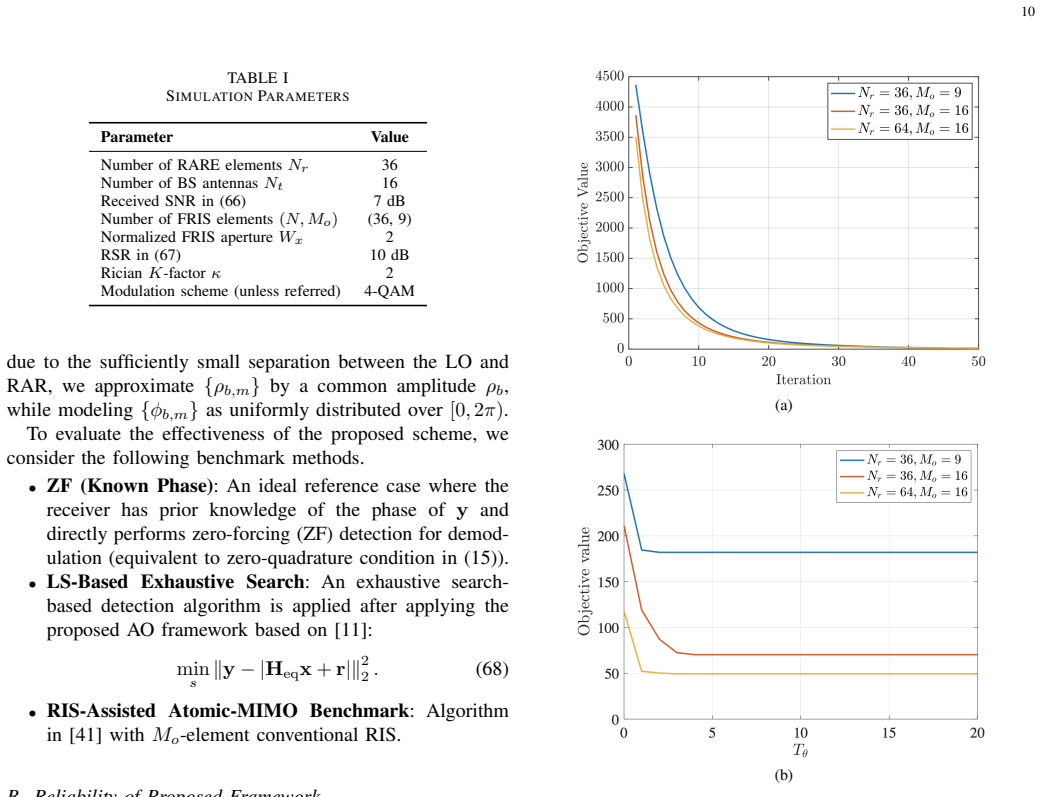
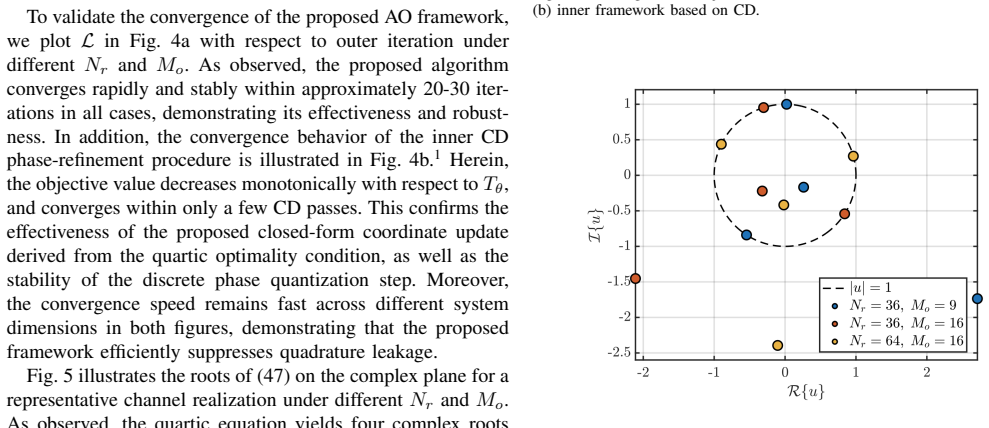
- The alternating-optimization framework converges quickly and achieves near-exhaustive-search performance at lower complexity.
- FRIS spatial reconfiguration supplies extra degrees of freedom that fixed-element RIS cannot match for leakage suppression.
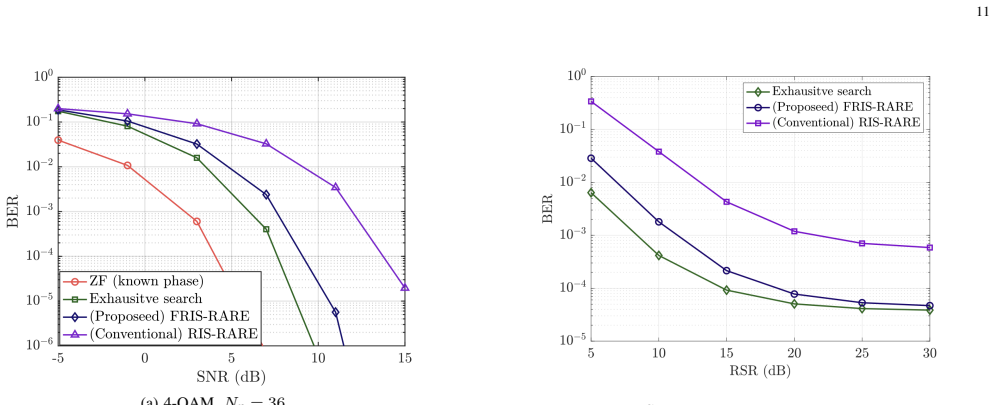
- Bit-error-rate gains hold across multiple modulation orders and receiver array dimensions.
- The design consistently beats conventional RIS-assisted schemes with static elements.
Where Pith is reading between the lines
- Similar receiver-centric shaping may apply to other nonlinear detectors such as those in optical or molecular communication.
- It suggests rethinking channel estimation to include the receiver's measurement nonlinearity as a design variable.
- The approach could extend to multi-user scenarios where leakage from one stream affects others.
Load-bearing premise
The system stays in the strong-reference regime where quadrature leakage dominates errors and FRIS reconfiguration can meaningfully suppress that leakage.
What would settle it
A prototype measurement showing no bit-error-rate reduction when FRIS port selection and phase shifts are optimized compared with fixed configurations under strong reference conditions.
Figures




read the original abstract
This paper investigates a fluid reconfigurable intelligent surface (FRIS)-assisted Rydberg Atomic REceiver (RARE) architecture under magnitude-only heterodyne readout. We show that, unlike conventional coherent systems, the optimal propagation environment is fundamentally governed by the receiver's nonlinear measurement structure. In particular, under the strong-reference regime, symbol detection is limited by residual quadrature leakage after reference alignment, motivating a receiver-induced channel shaping approach rather than conventional channel-centric optimization. Based on this insight, we formulate a signal-independent leakage minimization problem that jointly optimizes the FRIS port set, finite-resolution phase shifts, and the transmit beamformer, resulting in a nonconvex mixed discrete-continuous design. To address this, we develop an alternating-optimization (AO) framework comprising: (i) a closed-form eigenvector solution for widely-linear beamforming, (ii) cross-entropy method (CEM)-based combinatorial port selection, and (iii) coordinate-descent (CD) phase refinement with guaranteed monotonic descent. Simulation results demonstrate fast convergence and consistent bit-error-rate (BER) gains across various modulation orders and receiver dimensions. Moreover, the proposed FRIS-enabled design achieves near-exhaustive performance with significantly reduced complexity and consistently outperforms conventional RIS schemes with fixed elements, highlighting the effectiveness of spatial reconfiguration in suppressing quadrature leakage and the additional spatial degree-of-freedom (DoF) enabled by FRIS for reliable atomic-MIMO detection.
Editorial analysis
A structured set of objections, weighed in public.
Referee Report
Summary. The paper claims that for FRIS-assisted Rydberg atomic MIMO receivers using magnitude-only heterodyne readout, the optimal propagation environment is governed by the receiver's nonlinear measurement structure rather than conventional channel optimization. Under the strong-reference regime, symbol detection is limited by residual quadrature leakage after reference alignment; this motivates a signal-independent leakage-minimization problem jointly optimizing FRIS port selection, finite-resolution phases, and transmit beamformer. An alternating-optimization framework is proposed with closed-form widely-linear eigenvector beamforming, CEM-based combinatorial port selection, and coordinate-descent phase refinement, yielding BER gains over fixed RIS and near-exhaustive-search performance in simulations.
Significance. If the nonlinear model derivation holds and quadrature leakage indeed dominates the decision statistic, the work establishes a receiver-induced channel-shaping paradigm with potential impact on atomic receivers and nonlinear MIMO systems. The AO framework is practical (closed-form component plus monotonic CD), simulations report consistent gains across modulations and dimensions, and FRIS spatial DoF is shown to outperform fixed-element RIS. These elements would strengthen the contribution if the leakage-to-BER link is rigorously established.
major comments (2)
- [System Model and Strong-Reference Regime] The central claim and leakage-minimization objective rest on the assertion that, under strong-reference magnitude-only heterodyne readout, detection is limited by residual quadrature leakage after alignment (abstract and §II/III system model). The manuscript must explicitly derive the decision statistic or pairwise error probability from the nonlinear output (e.g., |r_I + j r_Q| or equivalent) to show that the in-phase term is canceled or negligible while quadrature leakage remains the dominant impairment; without this reduction, the subsequent AO framework optimizes a proxy that may not improve actual BER.
- [Simulation Results] Table/Figure results on BER gains (presumably §V) are reported for the proposed AO design versus conventional RIS, but the simulation setup must confirm that the BER metric is computed from the true nonlinear receiver output rather than the leakage objective alone; any mismatch would undermine the claim that FRIS reconfiguration suppresses the relevant impairment.
minor comments (2)
- [Abstract / System Model] Notation for the magnitude-only heterodyne output and reference alignment should be introduced with an explicit equation early in the system model to clarify the nonlinear structure for readers.
- [Optimization Framework] The complexity comparison with exhaustive search is useful but would benefit from explicit scaling expressions (e.g., CEM iterations, CD steps) to quantify the reduction.
Simulated Author's Rebuttal
We appreciate the referee's thorough review and constructive feedback on our manuscript. We address the major comments point by point below, providing clarifications and committing to revisions that strengthen the presentation of our results.
read point-by-point responses
-
Referee: [System Model and Strong-Reference Regime] The central claim and leakage-minimization objective rest on the assertion that, under strong-reference magnitude-only heterodyne readout, detection is limited by residual quadrature leakage after alignment (abstract and §II/III system model). The manuscript must explicitly derive the decision statistic or pairwise error probability from the nonlinear output (e.g., |r_I + j r_Q| or equivalent) to show that the in-phase term is canceled or negligible while quadrature leakage remains the dominant impairment; without this reduction, the subsequent AO framework optimizes a proxy that may not improve actual BER.
Authors: We thank the referee for highlighting this point. In the original manuscript, the system model in §II and §III describes the nonlinear magnitude-only heterodyne readout and motivates the leakage minimization under the strong-reference regime. However, to make the link to the decision statistic more explicit, we will add a dedicated subsection deriving the decision statistic from the nonlinear output |r_I + j r_Q|. This derivation will show that, after reference alignment, the in-phase component is effectively canceled or negligible, leaving the quadrature leakage as the dominant term affecting the error probability. We believe this addition will rigorously support the proposed optimization framework. revision: yes
-
Referee: [Simulation Results] Table/Figure results on BER gains (presumably §V) are reported for the proposed AO design versus conventional RIS, but the simulation setup must confirm that the BER metric is computed from the true nonlinear receiver output rather than the leakage objective alone; any mismatch would undermine the claim that FRIS reconfiguration suppresses the relevant impairment.
Authors: We confirm that the BER results in §V are computed using the true nonlinear receiver output. Specifically, the simulations implement the full magnitude-only heterodyne readout model, apply the detection rule based on the actual received signal magnitude, and evaluate the bit errors accordingly. The leakage objective is used only for optimization, while BER is evaluated end-to-end from the nonlinear model. To address the referee's concern, we will include an explicit statement in the simulation setup section clarifying this procedure and referencing the nonlinear model from §II. revision: yes
Circularity Check
No significant circularity; derivation remains self-contained
full rationale
The central claim—that optimal propagation is governed by the receiver nonlinear structure under strong-reference regime—is motivated directly from the stated magnitude-only heterodyne model and quadrature leakage limitation. No quoted equations reduce the leakage-minimization objective, AO framework (eigenvector beamforming, CEM port selection, CD phases), or BER gains to a fitted parameter, self-citation chain, or definitional tautology. The formulation treats the nonlinear readout as an external modeling assumption rather than deriving it from the optimization itself. This matches the reader's assessment of minor (non-load-bearing) self-reference risk at most.
Axiom & Free-Parameter Ledger
axioms (1)
- domain assumption Magnitude-only heterodyne readout in Rydberg receivers produces residual quadrature leakage after reference alignment that limits symbol detection in the strong-reference regime
Reference graph
Works this paper leans on
-
[1]
A speculative study on 6G,
F. Tariqet al., “A speculative study on 6G,”IEEE Wireless Commun., vol. 27, no. 4, pp. 118–125, Aug. 2020
2020
-
[2]
Toward 6G networks: Use cases and technologies,
M. Giordaniet al., “Toward 6G networks: Use cases and technologies,” IEEE Commun. Mag., vol. 58, no. 3, pp. 55–61, Mar. 2020
2020
-
[3]
6G: Opening new horizons for integration of comfort, security and intelligence,
G. Guiet al., “6G: Opening new horizons for integration of comfort, security and intelligence,”IEEE Wireless Commun., pp. 1–7, 2020
2020
-
[4]
Full-duplex wireless for 6G: Progress brings new opportunities and challenges,
B. Smidaet al., “Full-duplex wireless for 6G: Progress brings new opportunities and challenges,”IEEE J. Sel. Areas Commun., vol. 41, no. 9, pp. 2729–2750, Sep. 2023
2023
-
[5]
Beyond transmitting bits: Context, semantics, and task-oriented communications,
D. G ¨und¨uzet al., “Beyond transmitting bits: Context, semantics, and task-oriented communications,”IEEE J. Sel. Areas Commun., vol. 41, no. 1, pp. 5–41, Jan. 2023
2023
-
[6]
A state-of-the-art survey on full-duplex network design,
Y . Kimet al., “A state-of-the-art survey on full-duplex network design,” Proc. IEEE, vol. 112, no. 5, pp. 463–486, May 2024
2024
-
[7]
Massive access for future wireless communication systems,
Y . Wuet al., “Massive access for future wireless communication systems,”IEEE Wireless Commun., vol. 27, no. 4, pp. 148–156, Aug. 2020
2020
-
[8]
Cooperative ground-satellite scheduling and power allocation for urban air mobility networks,
H.-J. Moon and C.-B. Chae, “Cooperative ground-satellite scheduling and power allocation for urban air mobility networks,”IEEE J. Sel. Areas Commun., vol. 43, no. 1, pp. 218–233, Jan. 2025
2025
-
[9]
AI-based beam management for FR3 FDD MIMO via online channel synthesis,
H.-J. Moonet al., “AI-based beam management for FR3 FDD MIMO via online channel synthesis,”IEEE J. Sel. Areas Commun., vol. 44, pp. 3444–3458, 2026
2026
-
[10]
Rydberg atomic receiver: Next frontier of wireless communications,
M. Cuiet al., “Rydberg atomic receiver: Next frontier of wireless communications,”IEEE Commun. Mag., vol. 64, no. 1, pp. 146–152, Jan. 2026
2026
-
[11]
Towards atomic MIMO receivers,
——, “Towards atomic MIMO receivers,”IEEE J. Sel. Areas Commun., vol. 43, no. 3, pp. 659–673, Mar. 2025
2025
-
[12]
Rydberg states of alkali atoms in atomic vapour as SI-traceable field probes and communications receivers,
N. Schlossbergeret al., “Rydberg states of alkali atoms in atomic vapour as SI-traceable field probes and communications receivers,”Nat. Rev. Phys., vol. 6, pp. 606–620, Sep. 2024
2024
-
[13]
Rydberg atomic quantum receivers for classical wireless communication and sensing,
T. Gonget al., “Rydberg atomic quantum receivers for classical wireless communication and sensing,”IEEE Wireless Commun., vol. 32, no. 5, pp. 90–100, Oct. 2025. 13
2025
-
[14]
Rydberg atom electric field sensors for communi- cations and sensing,
C. T. Fancheret al., “Rydberg atom electric field sensors for communi- cations and sensing,”IEEE Trans. Quantum Eng., vol. 2, pp. 1–13, Mar. 2021
2021
-
[15]
Quantum-PROBE: Rydberg atomic receiver-based multi-AoA estimation with RF lens,
H.-B. Jeonet al., “Quantum-PROBE: Rydberg atomic receiver-based multi-AoA estimation with RF lens,”arXiv:2603.01855, 2026
-
[16]
A Rydberg atom-based receiver with amplitude modu- lation technique for the fifth-generation millimeter-wave wireless com- munication,
J. Yuanet al., “A Rydberg atom-based receiver with amplitude modu- lation technique for the fifth-generation millimeter-wave wireless com- munication,”IEEE Antennas Wirel. Propag. Lett., vol. 22, no. 10, pp. 2580–2584, Oct. 2023
2023
-
[17]
Calibration-free Rydberg atomic receiver for sub-MHz wireless communications and sensing,
M. Chenet al., “Calibration-free Rydberg atomic receiver for sub-MHz wireless communications and sensing,”IEEE Trans. Veh. Technol., pp. 1–6, 2026
2026
-
[18]
Microwave electrometry with Rydberg atoms in a vapour cell using bright atomic resonances,
J. A. Sedlaceket al., “Microwave electrometry with Rydberg atoms in a vapour cell using bright atomic resonances,”Nat. Phys., vol. 8, no. 11, pp. 819–824, Nov. 2012
2012
-
[19]
Detecting and receiving phase-modulated signals with a Rydberg atom-based receiver,
C. L. Hollowayet al., “Detecting and receiving phase-modulated signals with a Rydberg atom-based receiver,”IEEE Antennas Wireless Propag. Lett., vol. 18, no. 9, pp. 1853–1857, Sep. 2019
2019
-
[20]
PCB-based electrically tunable resonator for VHF band Rydberg atomic enhancement sensing,
K. Yanget al., “PCB-based electrically tunable resonator for VHF band Rydberg atomic enhancement sensing,”IEEE Trans. Antennas Propag., vol. 72, no. 7, pp. 6060–6068, Jul. 2024
2024
-
[21]
A Rydberg atom-based mixer measuring the phase of a radio frequency wave,
M. T. Simonset al., “A Rydberg atom-based mixer measuring the phase of a radio frequency wave,”Appl. Phys. Lett., vol. 114, no. 11, p. 114101, Mar. 2019
2019
-
[22]
Harnessing Rydberg atomic receivers: From quantum physics to wireless communications,
Y . Chenet al., “Harnessing Rydberg atomic receivers: From quantum physics to wireless communications,”arXiv:2501.11842v2, 2025
-
[23]
Quantum wireless sensing: Principle, design and implementation,
F. Zhanget al., “Quantum wireless sensing: Principle, design and implementation,” inProc. ACM MobiCom, Oct. 2023, pp. 1–15
2023
-
[24]
Atom based RF electric field sensing,
H. Fanet al., “Atom based RF electric field sensing,”J. Phys. B: At. Mol. Opt. Phys., vol. 48, no. 20, p. 202001, Sep. 2015
2015
-
[25]
Resonant structures for sensitivity enhancement of Rydberg-atom microwave receivers,
G. Sandidgeet al., “Resonant structures for sensitivity enhancement of Rydberg-atom microwave receivers,”IEEE Trans. Microw. Theory Techn., vol. 72, no. 4, pp. 2057–2066, Apr. 2024
2057
-
[26]
Continuous wideband microwave-to-optical con- verter based on room-temperature Rydberg atoms,,
S. Borowkaet al., “Continuous wideband microwave-to-optical con- verter based on room-temperature Rydberg atoms,,”Nat. Photon., vol. 18, no. 1, pp. 32–38, 2024
2024
-
[27]
Theoretical investigation on the mechanism and law of broadband terahertz wave detection using Rydberg quantum state,
Y . Zhouet al., “Theoretical investigation on the mechanism and law of broadband terahertz wave detection using Rydberg quantum state,” IEEE Photonics J., vol. 14, no. 3, pp. 1–8, Jun. 2022
2022
-
[28]
C. J. Foot,Atomic Physics. Oxford University Press, 2005
2005
-
[29]
Electric field measurement and application based on Rydberg atoms,
B. Liuet al., “Electric field measurement and application based on Rydberg atoms,”Electromagn. Sci., vol. 1, no. 2, pp. 1–16, Jun. 2023
2023
-
[30]
Atomic superheterodyne receiver based on microwave- dressed Rydberg spectroscopy,
M. Jinget al., “Atomic superheterodyne receiver based on microwave- dressed Rydberg spectroscopy,”Nat. Phys., vol. 1, pp. 911–915, Jun. 2020
2020
-
[31]
Shortwave ultrahigh-sensitivity Rydberg atomic electric field sensing based on a subminiature resonator,
R. Maoet al., “Shortwave ultrahigh-sensitivity Rydberg atomic electric field sensing based on a subminiature resonator,”IEEE Trans. Antennas Propag., vol. 72, no. 11, pp. 8165–8172, Nov. 2024
2024
-
[32]
Near space communications: A new regime in space-air- ground integrated networks,
Z. Xiaoet al., “Near space communications: A new regime in space-air- ground integrated networks,”IEEE Wireless Commun., vol. 29, no. 6, pp. 38–45, Dec. 2022
2022
-
[33]
Antenna array enabled space/air/ground communications and networking for 6G,
——, “Antenna array enabled space/air/ground communications and networking for 6G,”IEEE J. Sel. Areas Commun., vol. 40, no. 10, pp. 2773–2804, Oct. 2022
2022
-
[34]
MIMO precoding for Rydberg atomic receivers,
M. Cuiet al., “MIMO precoding for Rydberg atomic receivers,” arXiv:2408.14366v2, 2024
-
[35]
Quantum-MUSIC: Multiple signal classification for quantum wireless sensing,
H. Kimet al., “Quantum-MUSIC: Multiple signal classification for quantum wireless sensing,”IEEE Wireless Commun. Lett., vol. 14, no. 6, pp. 1623–1627, Jun. 2025
2025
-
[36]
Multi-band quantum wireless sensing for Rydberg atomic re- ceivers,
——, “Multi-band quantum wireless sensing for Rydberg atomic re- ceivers,”IEEE Commun. Lett., vol. 29, no. 6, pp. 1476–1480, Jun. 2025
2025
-
[37]
AoA detection using a single Rydberg atomic receiver: Leveraging inner-vapor interference,
Y . Guoet al., “AoA detection using a single Rydberg atomic receiver: Leveraging inner-vapor interference,”IEEE Trans. Commun., vol. 73, no. 12, pp. 14 828–14 844, Dec. 2025
2025
-
[38]
A theory of single-antenna atomic beamforming,
M. Cuiet al., “A theory of single-antenna atomic beamforming,” arXiv:2601.18426, 2026
-
[39]
Rydberg atomic quantum receivers for the multi-user MIMO uplink,
T. Gonget al., “Rydberg atomic quantum receivers for the multi-user MIMO uplink,” inProc. IEEE Int. Conf. on Commun. (ICC), Jun. 2025, pp. 4786–4791
2025
-
[40]
RAQ-MIMO: MIMO for multi-band Rydberg atomic quantum receiver,
J. Zhu and L. Dai, “RAQ-MIMO: MIMO for multi-band Rydberg atomic quantum receiver,”arXiv:2509.07832, 2025
-
[41]
RIS-assisted atomic MIMO receiver,
Q. Penget al., “RIS-assisted atomic MIMO receiver,”arXiv:2510.15763, 2025
-
[42]
RIS-enabled smart wireless environments: deployment scenarios, network architecture, bandwidth and area of influence,
G. Alexandropouloset al., “RIS-enabled smart wireless environments: deployment scenarios, network architecture, bandwidth and area of influence,”EURASIP Jour. Wireless Commun. and Netw., vol. 203, no. 1, p. 103, Oct. 2023
2023
-
[43]
Resource-efficient near-field misfocus mitigation in RIS- assisted wideband multi-user systems,
D. Junet al., “Resource-efficient near-field misfocus mitigation in RIS- assisted wideband multi-user systems,”IEEE Trans. Cogn. Commun. Netw., vol. 12, pp. 3148–3163, 2026
2026
-
[44]
Intelligent reflecting surface-aided wireless communica- tions: A tutorial,
Q. Wuet al., “Intelligent reflecting surface-aided wireless communica- tions: A tutorial,”IEEE Trans. Commun., vol. 69, no. 5, pp. 3313–3351, May 2021
2021
-
[45]
Present and future of reconfigurable intelli- gent surface-empowered communications [perspectives],
E. Basar and H. V . Poor, “Present and future of reconfigurable intelli- gent surface-empowered communications [perspectives],”IEEE Signal Process. Mag., vol. 38, no. 6, pp. 146–152, Nov. 2021
2021
-
[46]
Intelligent reflecting surface versus decode-and- forward: How large surfaces are needed to beat relaying?
E. Bj ¨ornsonet al., “Intelligent reflecting surface versus decode-and- forward: How large surfaces are needed to beat relaying?”IEEE Wireless Commun. Lett., vol. 9, no. 2, pp. 244–248, Feb. 2020
2020
-
[47]
An energy-efficient aerial backhaul system with reconfigurable intelligent surface,
H.-B. Jeonet al., “An energy-efficient aerial backhaul system with reconfigurable intelligent surface,”IEEE Trans. Wireless Commun., vol. 21, no. 8, pp. 6478–6494, Aug. 2022
2022
-
[48]
Ampli-flection for 6G: Active-RIS-aided aerial backhaul with full 3D coverage,
H.-B. Jeon and C.-B. Chae, “Ampli-flection for 6G: Active-RIS-aided aerial backhaul with full 3D coverage,”IEEE Trans. Wireless Commun., vol. 25, pp. 14 259–14 273, 2026
2026
-
[49]
Reconfigurable intelligent surfaces vs. relaying: Differences, similarities, and performance comparison,
M. Di Renzoet al., “Reconfigurable intelligent surfaces vs. relaying: Differences, similarities, and performance comparison,”IEEE Open J. Commun. Soc., vol. 1, pp. 798–807, Jun. 2020
2020
-
[50]
A first look at the performance enhancement potential of fluid reconfigurable intelligent surface,
A. Salemet al., “A first look at the performance enhancement potential of fluid reconfigurable intelligent surface,”arXiv:2502.17116v1, 2025
-
[51]
From fixed to fluid: Unlocking the new potential with fluid RIS (FRIS),
H. Xiaoet al., “From fixed to fluid: Unlocking the new potential with fluid RIS (FRIS),”arXiv:2509.18899, 2025
-
[52]
Fluid antenna systems,
K.-K. Wonget al., “Fluid antenna systems,”IEEE Trans. Wireless Commun., vol. 20, no. 3, pp. 1950–1962, Mar. 2021
1950
-
[53]
Fluid antenna systems: Redefining reconfigurable wireless communications,
W. K. Newet al., “Fluid antenna systems: Redefining reconfigurable wireless communications,”IEEE J. Sel. Areas Commun., vol. 44, pp. 1013–1044, 2026
2026
-
[54]
A tutorial on fluid antenna system for 6G networks: Encompass- ing communication theory, optimization methods and hardware designs,
——, “A tutorial on fluid antenna system for 6G networks: Encompass- ing communication theory, optimization methods and hardware designs,” IEEE Commun. Surveys Tuts., vol. 27, no. 4, pp. 2325–2377, Aug. 2025
2025
-
[55]
A contemporary survey on fluid antenna systems: Fundamentals and networking perspectives,
H. Honget al., “A contemporary survey on fluid antenna systems: Fundamentals and networking perspectives,”IEEE Trans. Netw. Sci. Eng., vol. 13, pp. 2305–2328, 2026
2026
-
[56]
Fluid antenna multiple access for 6G: A holistic review,
——, “Fluid antenna multiple access for 6G: A holistic review,”IEEE Open J. Commun. Soc., vol. 7, pp. 2607–2633, 2026
2026
-
[57]
Embracing reconfigurable antennas in the tri- hybrid MIMO architecture for 6G and beyond,
M. R. Castellanoset al., “Embracing reconfigurable antennas in the tri- hybrid MIMO architecture for 6G and beyond,”IEEE Trans. Commun., vol. 74, pp. 381–401, 2026
2026
-
[58]
The tri-hybrid MIMO architecture,
R. W. Heathet al., “The tri-hybrid MIMO architecture,”IEEE Wireless Commun., vol. 33, no. 1, pp. 199–206, Feb. 2026
2026
-
[59]
Performance analysis of wireless communication sys- tems assisted by fluid reconfigurable intelligent surfaces,
F. Ghadiet al., “Performance analysis of wireless communication sys- tems assisted by fluid reconfigurable intelligent surfaces,”IEEE Wireless Commun. Lett., vol. 14, no. 12, pp. 3922–3926, Dec. 2025
2025
-
[60]
Fluid reconfigurable intelligent surfaces: Joint on-off selection and beamforming with discrete phase shifts,
H. Xiaoet al., “Fluid reconfigurable intelligent surfaces: Joint on-off selection and beamforming with discrete phase shifts,”IEEE Wireless Commun. Lett., vol. 14, no. 10, pp. 3124–3128, Oct. 2025
2025
-
[61]
Ambient backscatter communication assisted by fluid reconfigurable intelligent surfaces,
M. Kavehet al., “Ambient backscatter communication assisted by fluid reconfigurable intelligent surfaces,”arXiv:2510.24725, 2026
-
[62]
Fluid reconfigurable intelligent surface (FRIS) enabling secure wireless com- munications,
X. Zhuet al., “Fluid reconfigurable intelligent surface (FRIS) enabling secure wireless communications,”arXiv:2511.15860, 2025
-
[63]
Physical layer security over fluid reconfigurable intelli- gent surface-assisted communication systems,
M. Kavehet al., “Physical layer security over fluid reconfigurable intelli- gent surface-assisted communication systems,”IEEE Wireless Commun. Letters, vol. 15, pp. 1697–1701, Jan. 2026
2026
-
[64]
Fluid reconfigurable intelligent surface with element- level pattern reconfigurability: Beamforming and pattern co-design,
H. Xiaoet al., “Fluid reconfigurable intelligent surface with element- level pattern reconfigurability: Beamforming and pattern co-design,” IEEE Trans. Wireless Commun., vol. 25, pp. 10 791–10 806, Jan. 2026
2026
-
[65]
Understanding the role of phase and position design in fluid reconfigurable intelligent surfaces,
J. D. Vega-S ´anchezet al., “Understanding the role of phase and position design in fluid reconfigurable intelligent surfaces,”IEEE Open J. Commun. Soc., vol. 7, pp. 1414–1425, 2026
2026
-
[66]
Sum-rate maximization for FRIS-enabled NOMA communications,
M. H. Naim Shaikhet al., “Sum-rate maximization for FRIS-enabled NOMA communications,”IEEE Wireless Commun. Lett., vol. 15, pp. 1995–1999, 2026
1995
-
[67]
H.-B. Jeon, “FARIS: Fluid-active-RIS,”arXiv:2512.22479, 2026
-
[68]
Fox,Quantum Optics: An Introduction
M. Fox,Quantum Optics: An Introduction. Oxford University Press, 2006
2006
-
[69]
Reconfigurable intelligent surfaces for energy effi- ciency in wireless communication,
C. Huanget al., “Reconfigurable intelligent surfaces for energy effi- ciency in wireless communication,”IEEE Trans. Wireless Commun., vol. 18, no. 8, pp. 4157–4170, Aug. 2019
2019
-
[70]
R. Y . Rubinstein and D. P. Kroese,The Cross-Entropy Method: A Unified Approach to Combinatorial Optimization, Monte-Carlo Simulation, and Machine Learning. Springer, 2004
2004
-
[71]
ARC 3.0: An expanded Python toolbox for atomic physics calculations,
E. Robertsonet al., “ARC 3.0: An expanded Python toolbox for atomic physics calculations,”Computer Physics Commun., vol. 261, p. 107814, Apr. 2021
2021
discussion (0)
Sign in with ORCID, Apple, or X to comment. Anyone can read and Pith papers without signing in.