Recognition: unknown
Search for a new heavy resonance decaying to a top quark and a neutral scalar boson in proton-proton collisions at sqrt{s} = 13 TeV
Pith reviewed 2026-05-10 15:37 UTC · model grok-4.3
The pith
No significant excess of events is observed in a search for a heavy resonance decaying to a top quark and a neutral scalar boson at the LHC.
A machine-rendered reading of the paper's core claim, the machinery that carries it, and where it could break.
Core claim
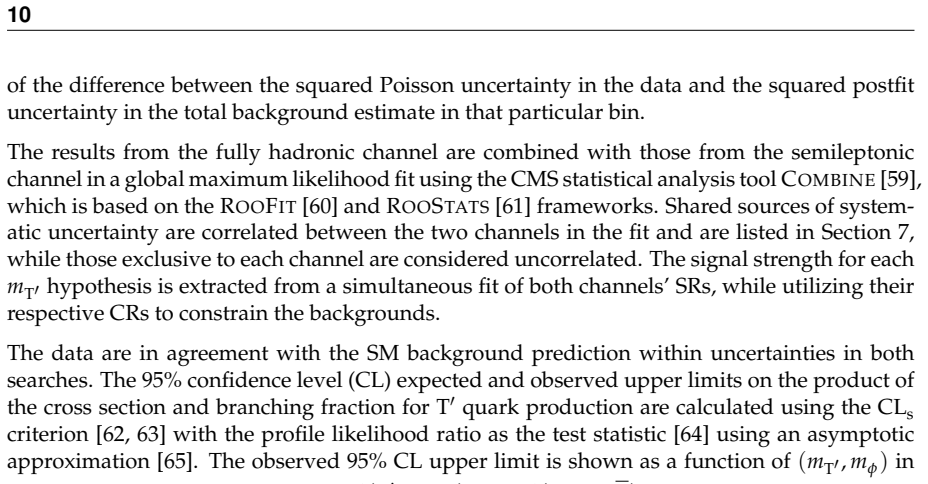
The analysis finds that the data in the signal region matches the expected background from simulation and control regions with no statistically significant excess. For the benchmark model of single production of a vector-like top quark T' decaying to a top quark and a neutral scalar phi (with phi decaying to a bottom quark pair), and where phi is the standard model Higgs boson with T' width equal to 5 percent of its mass, T' quark masses from 0.85 to 1.3 TeV are excluded at 95 percent confidence level. The most stringent limits to date are set for T' masses above 2 TeV. For other phi masses, the product of T' production cross section and branching fraction to top plus phi is constrained to 0
What carries the argument
Reconstruction of highly boosted top quark and phi boson decays as single large-radius jets identified by their substructure in the fully hadronic final state.
If this is right
- Vector-like top quarks with masses between 0.85 and 1.3 TeV are excluded at 95% CL when the scalar is the standard model Higgs and the width is 5% of the mass.
- The most stringent limits to date apply for vector-like top quark masses above 2 TeV.
- Upper limits as low as 0.1 fb are set on the product of production cross section and branching fraction for other scalar boson masses.
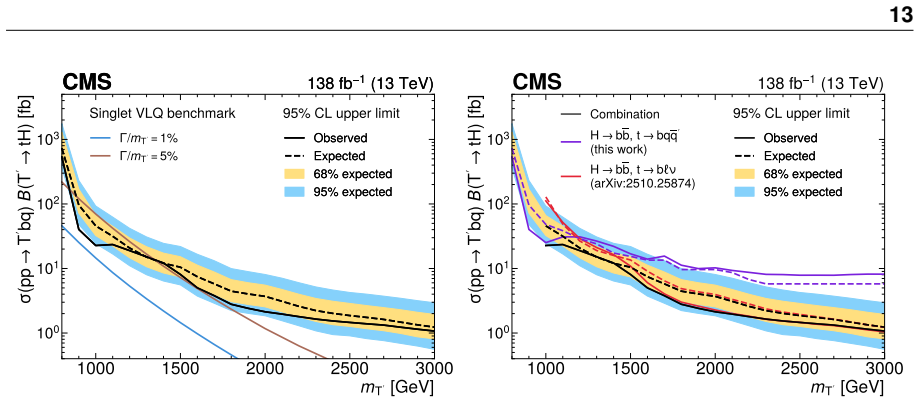
- Combining the fully hadronic results with a previous semileptonic search strengthens the overall constraints on the benchmark model.
Where Pith is reading between the lines
- These exclusions constrain models beyond the standard model that predict vector-like quarks coupling to Higgs-like scalars.
- The jet substructure techniques developed here could be adapted to searches for other heavy resonances in fully hadronic channels.
- Additional integrated luminosity from future LHC runs would extend the mass reach or tighten cross-section limits further.
Load-bearing premise
The background prediction from simulation and control regions accurately describes the data in the signal region, and the modeling of signal efficiency for boosted large-radius jets with substructure is correct.
What would settle it
A statistically significant excess of events in the signal region with jet substructure matching the expected top quark and bottom-quark pair signatures would indicate the presence of the new resonance.
Figures


read the original abstract
A first search at the LHC for a new heavy resonance decaying to a top quark and a neutral scalar boson $\phi$ in the fully hadronic final state is presented, where the $\phi$ boson is identified by its decay into a bottom quark-antiquark pair. The search is focused on final states in which the decay products of the highly Lorentz boosted top quark and $\phi$ boson are each reconstructed as a single, large-radius jet with distinct substructure. The analysis is performed using proton-proton collision data at a center-of-mass energy of 13 TeV, corresponding to an integrated luminosity of 138 fb$^{-1}$, recorded with the CMS detector at the LHC in 2016$-$2018. The single production of a vector-like top quark, $\mathrm{T}'$, is used as a benchmark model for the signal process. The results of this search are combined with those of a previous CMS search in which semileptonic decays of the top quark were used. No significant excess of data is observed with respect to the background prediction. For the case where the neutral scalar is a standard model Higgs boson and the $\mathrm{T}'$ quark width is 5% of its mass, $\mathrm{T}'$ quark masses between 0.85 and 1.3 TeV are excluded at 95% confidence level and the most stringent limits to date are set for masses above 2 TeV. For other $\phi$ boson masses, upper limits as low as 0.1 fb are set on the product of the $\mathrm{T}'$ quark production cross section and branching fraction for its decay to a top quark and a $\phi$ boson.
Editorial analysis
A structured set of objections, weighed in public.
Referee Report
Summary. The manuscript reports a search for a heavy vector-like top quark T' decaying to a top quark and a neutral scalar φ (with φ → bb) in the fully hadronic final state. It uses 138 fb^{-1} of 13 TeV CMS data, reconstructing the boosted decays as large-radius jets with substructure taggers. No significant excess over background is observed. For φ as the SM Higgs with T' width 5% of its mass, T' masses 0.85–1.3 TeV are excluded at 95% CL, with the strongest limits above 2 TeV; results are combined with a prior semileptonic search, and cross-section limits are set for other φ masses.
Significance. If the background modeling is accurate as validated in sidebands, this provides the first dedicated fully hadronic search for this topology and meaningfully strengthens high-mass constraints on vector-like top quarks by leveraging the larger hadronic branching fraction. The channel combination and boosted-jet techniques are effective for extending sensitivity above 2 TeV where prior limits were weaker.
major comments (1)
- [Section 5] Section 5 (Background estimation): The central no-excess and high-mass limit claims depend on the QCD multijet and ttbar background prediction matching data after all boosted-jet mass, top-tagger, and bb-tagger selections in the signal region. While sideband validation is referenced, the manuscript should include explicit quantitative agreement metrics or plots for the reconstructed resonance mass tail above 2 TeV in dedicated control regions (without full signal selection) to confirm the extrapolation does not bias the limit-setting procedure.
minor comments (3)
- [Abstract] Abstract: The statement that the most stringent limits are set above 2 TeV should briefly note the specific prior results (e.g., from ATLAS or earlier CMS) being surpassed for context.
- [Figure 5] Figure 5 (limit plot): Add the expected and observed limits from the semileptonic-only analysis as a separate curve or band for direct visual comparison of the combination improvement.
- [Section 4.1] Section 4.1 (Event selection): Specify the exact jet radius parameter (e.g., R=0.8) and the numerical working points for the top and bb substructure taggers used in the final selection.
Simulated Author's Rebuttal
We thank the referee for the careful reading of the manuscript and the positive overall assessment. We address the single major comment below.
read point-by-point responses
-
Referee: [Section 5] Section 5 (Background estimation): The central no-excess and high-mass limit claims depend on the QCD multijet and ttbar background prediction matching data after all boosted-jet mass, top-tagger, and bb-tagger selections in the signal region. While sideband validation is referenced, the manuscript should include explicit quantitative agreement metrics or plots for the reconstructed resonance mass tail above 2 TeV in dedicated control regions (without full signal selection) to confirm the extrapolation does not bias the limit-setting procedure.
Authors: We thank the referee for this constructive suggestion. While the current manuscript already references sideband validations, we agree that additional explicit documentation of the high-mass tail would further strengthen the presentation. In the revised manuscript we will add plots of the reconstructed resonance mass distribution above 2 TeV in dedicated control regions (defined by relaxing or removing the full signal-region selections on the top and bb taggers) together with quantitative agreement metrics, such as data-to-prediction ratios and associated uncertainties. These additions will explicitly demonstrate that the background extrapolation used for limit setting remains unbiased in the high-mass regime. revision: yes
Circularity Check
No circularity in data-driven limit extraction
full rationale
The paper's central results—no significant excess and 95% CL mass exclusions—are obtained by direct statistical comparison of observed data to background predictions in the signal region, with the background model constrained by simulation plus control-region data. This procedure contains no self-definitional steps, no fitted parameters renamed as predictions, and no load-bearing self-citation that reduces the claim to its own inputs. The combination with a prior CMS semileptonic search adds an independent channel rather than closing a loop. Background modeling accuracy is an external assumption subject to validation, not a circularity issue per the defined patterns.
Axiom & Free-Parameter Ledger
axioms (2)
- domain assumption Standard Model background processes are accurately modeled by simulation or estimated from data control regions.
- domain assumption Jet substructure algorithms correctly identify boosted top and phi decays with the stated efficiencies.
Reference graph
Works this paper leans on
-
[1]
N. Arkani-Hamed, S. Dimopoulos, and G. R. Dvali, “The Hierarchy problem and new dimensions at a millimeter”,Phys. Lett. B429(1998) 263, doi:10.1016/S0370-2693(98)00466-3,arXiv:hep-ph/9803315
-
[2]
LHC signatures of vector-like quarks
Y. Okada and L. Panizzi, “LHC signatures of vector-like quarks”,Adv. High Energy Phys. 2013(2013) 364936,doi:10.1155/2013/364936,arXiv:1207.5607
-
[3]
O. Eberhardt et al., “Joint analysis of Higgs boson decays and electroweak precision observables in the standard model with a sequential fourth generation”,Phys. Rev. D86 (2012) 013011,doi:10.1103/PhysRevD.86.013011,arXiv:1204.3872
-
[4]
A handbook of vector-like quarks: mixing and single production
J.-A. Aguilar-Saavedra, R. Benbrik, S. Heinemeyer, and M. P ´erez-Victoria, “A handbook of vector-like quarks: mixing and single production”,Phys. Rev. D88(2013) 094010, doi:10.1103/PhysRevD.88.094010,arXiv:1306.0572
-
[5]
ATLAS Collaboration, “Exploration at the high-energy frontier: ATLAS Run 2 searches investigating the exotic jungle beyond the Standard Model”,Phys. Rept.1116(2025) 301, doi:10.1016/j.physrep.2024.10.001,arXiv:2403.09292
-
[6]
CMS Collaboration, “Review of searches for vector-like quarks, vector-like leptons, and heavy neutral leptons in proton–proton collisions at √s= 13 TeV at the CMS experiment”,Phys. Rept.1115(2025) 570,doi:10.1016/j.physrep.2024.09.012, arXiv:2405.17605
-
[7]
Light Higgs and vector-like quarks without prejudice
S. Fajfer, A. Greljo, J. F. Kamenik, and I. Mustac, “Light Higgs and vector-like quarks without prejudice”,JHEP07(2013) 155,doi:10.1007/JHEP07(2013)155, arXiv:1304.4219
-
[8]
Exotic decays of top partners: mind the search gap
G. Cacciapaglia, T. Flacke, M. Park, and M. Zhang, “Exotic decays of top partners: mind the search gap”,Phys. Lett. B798(2019) 135015, doi:10.1016/j.physletb.2019.135015,arXiv:1908.07524
-
[9]
Signatures of vector-like top partners decaying into new neutral scalar or pseudoscalar bosons
R. Benbrik et al., “Signatures of vector-like top partners decaying into new neutral scalar or pseudoscalar bosons”,JHEP05(2020) 028,doi:10.1007/JHEP05(2020)028, arXiv:1907.05929
-
[10]
Exotic vectorlike quark phenomenology in the minimal linearσmodel
J. A. Aguilar-Saavedra, J. Alonso-Gonz ´alez, L. Merlo, and J. M. No, “Exotic vectorlike quark phenomenology in the minimal linearσmodel”,Phys. Rev. D101(2020) 035015, doi:10.1103/PhysRevD.101.035015,arXiv:1911.10202
-
[11]
Roadmap to explore vectorlike quarks decaying to a new scalar or pseudoscalar
A. Bhardwaj, T. Mandal, S. Mitra, and C. Neeraj, “Roadmap to explore vectorlike quarks decaying to a new scalar or pseudoscalar”,Phys. Rev. D106(2022) 095014, doi:10.1103/PhysRevD.106.095014,arXiv:2203.13753
-
[12]
Theory and phenomenology of two-Higgs-doublet models
G. C. Branco et al., “Theory and phenomenology of two-Higgs-doublet models”,Phys. Rept.516(2012) 1,doi:10.1016/j.physrep.2012.02.002,arXiv:1106.0034
-
[13]
Hayrapetyanet al.[CMS], [arXiv:2510.25874 [hep-ex]]
CMS Collaboration, “Search for single production of a vector-like T quark decaying to a top quark and a neutral scalar boson in the lepton+jets final state in proton-proton collisions at √s= 13 TeV”, 2025.arXiv:2510.25874. Submitted toJHEP. 16
-
[14]
Precision luminosity measurement in proton-proton collisions at√s=13 TeV in 2015 and 2016 at CMS
CMS Collaboration, “Precision luminosity measurement in proton-proton collisions at√s=13 TeV in 2015 and 2016 at CMS”,Eur. Phys. J. C81(2021) 800, doi:10.1140/epjc/s10052-021-09538-2,arXiv:2104.01927
-
[15]
Precision luminosity measurement in proton-proton collisions at√s=13 TeV with the CMS detector
CMS Collaboration, “Precision luminosity measurement in proton-proton collisions at√s=13 TeV with the CMS detector”, CMS Physics Analysis Summary CMS-PAS-LUM-20-001, 2025
2025
-
[16]
HEPData record for this analysis, 2026.doi:10.17182/hepdata.167416
-
[17]
The CMS experiment at the CERN LHC
CMS Collaboration, “The CMS experiment at the CERN LHC”,JINST3(2008) S08004, doi:10.1088/1748-0221/3/08/S08004
-
[18]
Development of the CMS detector for the CERN LHC Run 3
CMS Collaboration, “Development of the CMS detector for the CERN LHC Run 3”, JINST19(2024) P05064,doi:10.1088/1748-0221/19/05/P05064, arXiv:2309.05466
-
[19]
Performance of the CMS Level-1 trigger in proton-proton collisions at √s=13 TeV
CMS Collaboration, “Performance of the CMS Level-1 trigger in proton-proton collisions at √s=13 TeV”,JINST15(2020) P10017, doi:10.1088/1748-0221/15/10/P10017,arXiv:2006.10165
-
[20]
CMS Collaboration, “The CMS trigger system”,JINST12(2017) P01020, doi:10.1088/1748-0221/12/01/P01020,arXiv:1609.02366
-
[21]
Performance of the CMS high-level trigger during LHC Run 2
CMS Collaboration, “Performance of the CMS high-level trigger during LHC Run 2”, JINST19(2024) P11021,doi:10.1088/1748-0221/19/11/P11021, arXiv:2410.17038
-
[22]
Particle-flow reconstruction and global event description with the CMS detector
CMS Collaboration, “Particle-flow reconstruction and global event description with the CMS detector”,JINST12(2017) P10003,doi:10.1088/1748-0221/12/10/P10003, arXiv:1706.04965
work page internal anchor Pith review Pith/arXiv arXiv doi:10.1088/1748-0221/12/10/p10003 2017
-
[23]
M. Cacciari, G. P . Salam, and G. Soyez, “The anti-kT jet clustering algorithm”,JHEP04 (2008) 063,doi:10.1088/1126-6708/2008/04/063,arXiv:0802.1189
-
[24]
M. Cacciari, G. P . Salam, and G. Soyez, “FastJet user manual”,Eur. Phys. J. C72(2012) 1896,doi:10.1140/epjc/s10052-012-1896-2,arXiv:1111.6097
-
[25]
Pileup per particle identification
D. Bertolini, P . Harris, M. Low, and N. Tran, “Pileup per particle identification”,JHEP10 (2014) 059,doi:10.1007/JHEP10(2014)059,arXiv:1407.6013
-
[26]
Pileup mitigation at CMS in 13 TeV data
CMS Collaboration, “Pileup mitigation at CMS in 13 TeV data”,JINST15(2020) P09018, doi:10.1088/1748-0221/15/09/p09018,arXiv:2003.00503
-
[27]
Jet energy scale and resolution in the CMS experiment in pp collisions at 8 TeV
CMS Collaboration, “Jet energy scale and resolution in the CMS experiment in pp collisions at 8 TeV”,JINST12(2017) P02014, doi:10.1088/1748-0221/12/02/P02014,arXiv:1607.03663
-
[28]
CMS Collaboration, “Performance of missing transverse momentum reconstruction in proton-proton collisions at √s=13 TeV using the CMS detector”,JINST14(2019) P07004,doi:10.1088/1748-0221/14/07/P07004,arXiv:1903.06078
-
[29]
Jet substructure as a new Higgs search channel at the LHC
J. M. Butterworth, A. R. Davison, M. Rubin, and G. P . Salam, “Jet substructure as a new Higgs search channel at the LHC”,Phys. Rev. Lett.100(2008) 242001, doi:10.1103/PhysRevLett.100.242001,arXiv:0802.2470. References 17
-
[30]
Towards an understanding of jet substructure
M. Dasgupta, A. Fregoso, S. Marzani, and G. P . Salam, “Towards an understanding of jet substructure”,JHEP09(2013) 029,doi:10.1007/JHEP09(2013)029, arXiv:1307.0007
-
[31]
A. J. Larkoski, S. Marzani, G. Soyez, and J. Thaler, “Soft drop”,JHEP05(2014) 146, doi:10.1007/JHEP05(2014)146,arXiv:1402.2657
-
[32]
J. Alwall et al., “The automated computation of tree-level and next-to-leading order differential cross sections, and their matching to parton shower simulations”,JHEP07 (2014) 079,doi:10.1007/JHEP07(2014)079,arXiv:1405.0301
-
[33]
Model independent framework for searches of top partners
M. Buchkremer, G. Cacciapaglia, A. Deandrea, and L. Panizzi, “Model independent framework for searches of top partners”,Nucl. Phys. B876(2013) 376, doi:10.1016/j.nuclphysb.2013.08.010,arXiv:1305.4172
-
[34]
Single production of vectorlike quarks with large width at the Large Hadron Collider
A. Carvalho et al., “Single production of vectorlike quarks with large width at the Large Hadron Collider”,Phys. Rev. D98(2018)doi:10.1103/physrevd.98.015029, arXiv:1805.06402
-
[35]
Novel interpretation strategy for searches of singly produced vectorlike quarks at the LHC
A. Roy, N. Nikiforou, N. Castro, and T. Andeen, “Novel interpretation strategy for searches of singly produced vectorlike quarks at the LHC”,Phys. Rev. D101(2020) 115027,doi:10.1103/PhysRevD.101.115027,arXiv:2003.00640
-
[36]
A study of the reactionsψ ′ →γγψ
M. J. Oreglia, “A study of the reactionsψ ′ →γγψ”, other thesis, Stanford University,
-
[37]
SLAC Report SLAC-R-236
-
[38]
Charmonium Spectroscopy From Radiative Decays of theJ/ψandψ ′
J. E. Gaiser, “Charmonium Spectroscopy From Radiative Decays of theJ/ψandψ ′”, other thesis, Stanford University, 1982. SLAC Report SLAC-R-255
1982
-
[39]
Linear interpolation of histograms
A. L. Read, “Linear interpolation of histograms”,Nucl. Instrum. Meth. A425(1999) 357, doi:10.1016/S0168-9002(98)01347-3
-
[40]
A New Method for Combining NLO QCD with Shower Monte Carlo Algorithms
P . Nason, “A new method for combining NLO QCD with shower Monte Carlo algorithms”,JHEP11(2004) 040,doi:10.1088/1126-6708/2004/11/040, arXiv:hep-ph/0409146
work page internal anchor Pith review doi:10.1088/1126-6708/2004/11/040 2004
-
[41]
Matching NLO QCD computations with Parton Shower simulations: the POWHEG method
S. Frixione, P . Nason, and C. Oleari, “Matching NLO QCD computations with parton shower simulations: The POWHEG method”,JHEP11(2007) 070, doi:10.1088/1126-6708/2007/11/070,arXiv:0709.2092
work page internal anchor Pith review doi:10.1088/1126-6708/2007/11/070 2007
-
[42]
A Positive-Weight Next-to-Leading-Order Monte Carlo for Heavy Flavour Hadroproduction
S. Frixione, G. Ridolfi, and P . Nason, “A positive-weight next-to-leading-order Monte Carlo for heavy flavour hadroproduction”,JHEP09(2007) 126, doi:10.1088/1126-6708/2007/09/126,arXiv:0707.3088
work page Pith review doi:10.1088/1126-6708/2007/09/126 2007
-
[43]
A general framework for implementing NLO calculations in shower Monte Carlo programs: the POWHEG BOX
S. Alioli, P . Nason, C. Oleari, and E. Re, “A general framework for implementing NLO calculations in shower Monte Carlo programs: The POWHEG BOX”,JHEP06(2010) 043,doi:10.1007/JHEP06(2010)043,arXiv:1002.2581
work page internal anchor Pith review doi:10.1007/jhep06(2010)043 2010
-
[44]
Single-top Wt-channel production matched with parton showers using the POWHEG method
E. Re, “Single-top Wt-channel production matched with parton showers using the POWHEG method”,Eur. Phys. J. C71(2011) 1547, doi:10.1140/epjc/s10052-011-1547-z,arXiv:1009.2450
-
[45]
T. Sj ¨ostrand et al., “An introduction to PYTHIA 8.2”,Comput. Phys. Commun.191(2015) 159,doi:10.1016/j.cpc.2015.01.024,arXiv:1410.3012. 18
-
[46]
Parton distributions from high-precision collider data
NNPDF Collaboration, “Parton distributions from high-precision collider data”,Eur. Phys. J. C77(2017) 663,doi:10.1140/epjc/s10052-017-5199-5, arXiv:1706.00428
work page internal anchor Pith review Pith/arXiv arXiv doi:10.1140/epjc/s10052-017-5199-5 2017
-
[47]
Extraction and validation of a new set of CMS PYTHIA8 tunes from underlying-event measurements
CMS Collaboration, “Extraction and validation of a new set of CMS PYTHIA8 tunes from underlying-event measurements”,Eur. Phys. J. C80(2020) 4, doi:10.1140/epjc/s10052-019-7499-4,arXiv:1903.12179
-
[48]
GEANT4 Collaboration, “GEANT4—a simulation toolkit”,Nucl. Instrum. Meth. A506 (2003) 250,doi:10.1016/S0168-9002(03)01368-8
-
[49]
ATLAS Collaboration, “Measurement of the inelastic proton-proton cross section at√s=13 TeV with the ATLAS Detector at the LHC”,Phys. Rev. Lett.117(2016) 182002, doi:10.1103/PhysRevLett.117.182002,arXiv:1606.02625
-
[50]
Measurement of the inelastic proton-proton cross section at√s=13 TeV
CMS Collaboration, “Measurement of the inelastic proton-proton cross section at √s=13 TeV”,JHEP07(2018) 161,doi:10.1007/JHEP07(2018)161,arXiv:1802.02613
-
[51]
D. Krohn, J. Thaler, and L.-T. Wang, “Jet trimming”,JHEP02(2010) 084, doi:10.1007/JHEP02(2010)084,arXiv:0912.1342
-
[52]
Electron and photon reconstruction and identification with the CMS experiment at the CERN LHC
CMS Collaboration, “Electron and photon reconstruction and identification with the CMS experiment at the CERN LHC”,JINST16(2021) P05014, doi:10.1088/1748-0221/16/05/P05014,arXiv:2012.06888
-
[53]
CMS Collaboration, “Performance of the CMS muon detector and muon reconstruction with proton-proton collisions at √s=13 TeV”,JINST13(2018) P06015, doi:10.1088/1748-0221/13/06/p06015,arXiv:1804.04528
work page internal anchor Pith review Pith/arXiv arXiv doi:10.1088/1748-0221/13/06/p06015 2018
-
[54]
H. Qu and L. Gouskos, “Jet tagging via particle clouds”,Phys. Rev. D101(2020) 056019, doi:10.1103/PhysRevD.101.056019,arXiv:1902.08570
-
[55]
CMS Collaboration, “Performance of heavy-flavour jet identification in Lorentz-boosted topologies in proton-proton collisions at √s=13 TeV”,JINST20(2025) P11006, doi:10.1088/1748-0221/20/11/P11006,arXiv:2510.10228
-
[56]
CMS Collaboration, “Identification of heavy, energetic, hadronically decaying particles using machine-learning techniques”,JINST15(2020), no. 06, P06005, doi:10.1088/1748-0221/15/06/P06005,arXiv:2004.08262
-
[57]
On the interpretation ofχ 2 from contingency tables, and the calculation of p
R. A. Fisher, “On the Interpretation ofχ 2 from Contingency Tables, and the Calculation of P”,J. Royal Stat. Soc.85(1922) 87,doi:10.2307/2340521
-
[58]
Top-pair production at the LHC through NNLO QCD and NLO EW
M. Czakon et al., “Top-pair production at the LHC through NNLO QCD and NLO EW”, JHEP10(2017) 186,doi:10.1007/JHEP10(2017)186,arXiv:1705.04105
-
[59]
Measurement of the Inclusive W and Z Production Cross Sections in pp Collisions at √s=7 TeV
CMS Collaboration, “Measurement of the inclusive W and Z production cross sections in pp collisions at √s=7 TeV”,JHEP10(2011) 132,doi:10.1007/JHEP10(2011)132, arXiv:1107.4789
-
[60]
The CMS statistical analysis and combination tool:COMBINE
CMS Collaboration, “The CMS statistical analysis and combination tool: COMBINE”, Comput. Softw. Big Sci.8(2024) 19,doi:10.1007/s41781-024-00121-4, arXiv:2404.06614. References 19
-
[61]
The RooFit toolkit for data modeling
W. Verkerke and D. Kirkby, “The ROOFITtoolkit for data modeling”, inProc. 13th Int. Conf. on Computing in High Energy and Nuclear Physics (CHEP 2003): La Jolla CA, United States, March 24–28, 2003. 2003.arXiv:physics/0306116
work page Pith review arXiv 2003
-
[62]
L. Moneta et al., “The ROOSTATSproject”, inProc. 13th Int. Workshop on Advanced Computing and Analysis T echniques in Physics Research (ACAT 2010): Jaipur, India, February 22–27, 2010. 2010.arXiv:1009.1003.doi:10.22323/1.093.0057
-
[63]
Confidence Level Computation for Combining Searches with Small Statistics
T. Junk, “Confidence level computation for combining searches with small statistics”, Nucl. Instrum. Meth. A434(1999) 435,doi:10.1016/S0168-9002(99)00498-2, arXiv:hep-ex/9902006
work page Pith review doi:10.1016/s0168-9002(99)00498-2 1999
-
[64]
Presentation of search results: the CL s technique
A. L. Read, “Presentation of search results: The CL s technique”,J. Phys. G28(2002) 2693, doi:10.1088/0954-3899/28/10/313
-
[65]
Procedure for the LHC Higgs boson search combination in Summer 2011
ATLAS and CMS Collaborations, and LHC Higgs Combination Group, “Procedure for the LHC Higgs boson search combination in Summer 2011”, Technical Report CMS-NOTE-2011-005, ATL-PHYS-PUB-2011-11, 2011
2011
-
[66]
Asymptotic formulae for likelihood-based tests of new physics
G. Cowan, K. Cranmer, E. Gross, and O. Vitells, “Asymptotic formulae for likelihood-based tests of new physics”,Eur. Phys. J. C71(2011) 1554, doi:10.1140/epjc/s10052-011-1554-0,arXiv:1007.1727. [Erratum: doi:10.1140/epjc/s10052-013-2501-z]. 20 21 A The CMS Collaboration Yerevan Physics Institute, Yerevan, Armenia A. Hayrapetyan, V . Makarenko , A. Tumasya...
work page internal anchor Pith review doi:10.1140/epjc/s10052-011-1554-0 2011
discussion (0)
Sign in with ORCID, Apple, or X to comment. Anyone can read and Pith papers without signing in.