Half-quantized anomalous Hall conductance in topological insulator/ferromagnet van der Waals heterostructures
Pith reviewed 2026-05-10 15:37 UTC · model grok-4.3
The pith
Coupling a ferromagnet to one surface of a topological insulator slab opens a gap in the Dirac states that lets only one spin channel carry chiral current, producing half-quantized Hall conductance of e²/2h.
A machine-rendered reading of the paper's core claim, the machinery that carries it, and where it could break.
Core claim
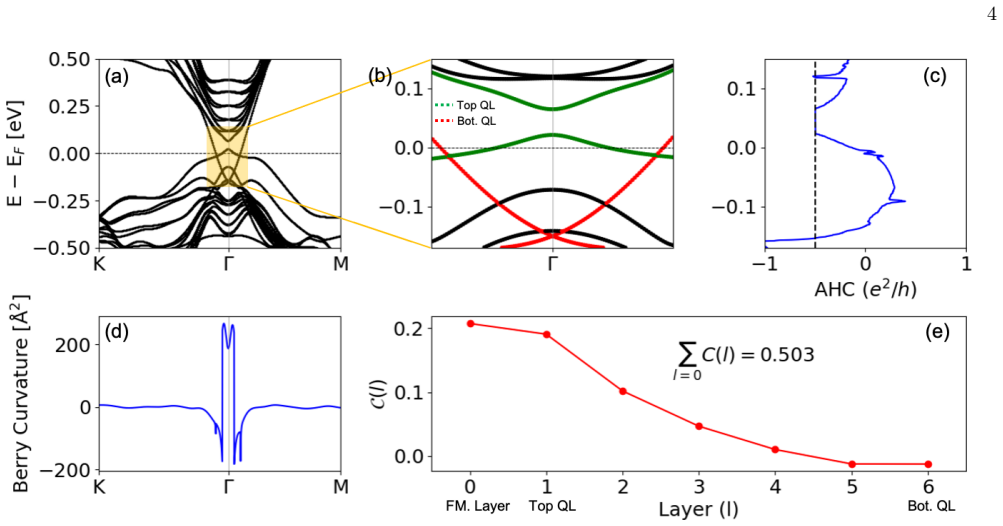
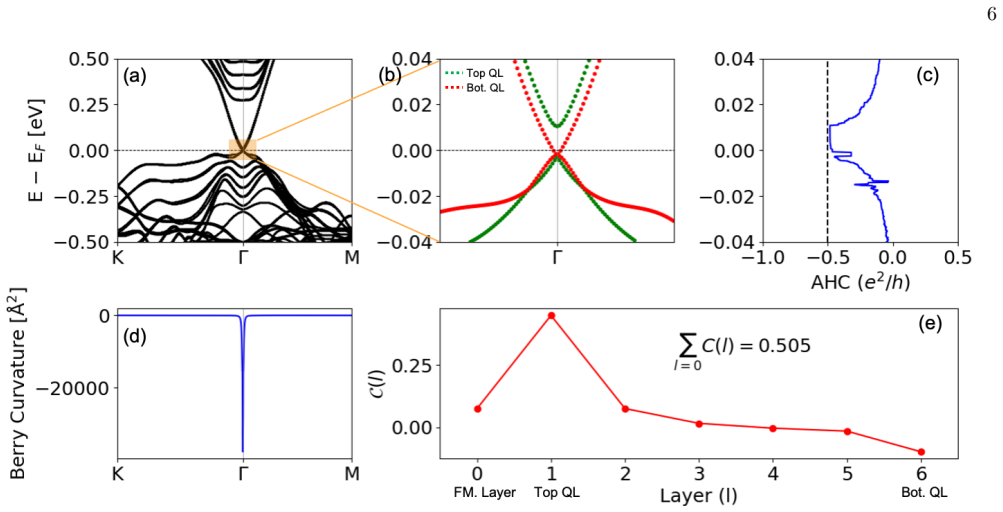
Placing a ferromagnetic insulator layer on one surface of a thin topological insulator slab induces an exchange field that gaps the Dirac cone of the top surface states while the bottom surface stays metallic. The resulting asymmetry supports chiral edge currents carried by only one spin channel. First-principles and tight-binding results show a half-quantized Hall conductance of e²/2h when the chemical potential lies inside the induced gap. The work also maps how sidewall states connect the surfaces and how realistic imperfections affect exact quantization.
What carries the argument
The magnetic proximity effect at the van der Waals ferromagnet-topological insulator interface, which generates an effective out-of-plane exchange field that selectively gaps one surface Dirac cone.
If this is right
- The heterostructure supports chiral currents carried exclusively by one spin species when the Fermi level is in the gap.
- Sidewall states appear at the slab edges and participate in the transport between top and bottom surfaces.
- The configuration provides a platform for the topological magnetoelectric effect without contributions from a second surface.
- Interface disorder or reconstruction can close the gap or mix spins, preventing exact half-quantization.
Where Pith is reading between the lines
- Adjusting the ferromagnet thickness or magnetization orientation could provide electrical control over the sign and magnitude of the Hall response.
- Stacking a superconductor on the same structure might create conditions for studying Majorana modes localized at the gapped surface.
- Minimizing the topological insulator thickness while preserving surface decoupling would be required to isolate the half-quantized signal cleanly.
Load-bearing premise
The van der Waals interface must remain atomically clean and free of reconstruction or disorder so that the proximity-induced gap stays open and spin channels do not mix.
What would settle it
A Hall conductance measurement that deviates from e²/2h by more than experimental error, or spectroscopic data showing the gap closed by interface states, would show that exact half-quantization is not realized.
Figures



read the original abstract
The half-quantized anomalous Hall conductance (AHC) in topological materials is a condensed matter physics realization of the parity anomaly of (2+1) quantum field theory and an important challenge for both theoretical and experimental research. A possible realization of this phenomenon may be achieved by interfacing a two-dimensional (2D) ferromagnetic (FM) layer with one surface of a thin slab of a topological insulator (TI), which breaks the otherwise conserved time-reversal symmetry, leading to a gap opening in the Dirac-like energy spectrum of the TI surface states. The resulting heterostructure can support chiral currents where only one spin channel contributes to transport, producing a half-quantized Hall conductance ($e^2/2h$). In this work, using first-principles methods together with tight-binding models, we investigate the magnetization-induced gap, the properties of the sidewalls states, and Hall conductance in three different FI/TI van der Waals heterostructures that are relevant for ongoing experiments. We also discuss the factors that can hinder the realization of exact half-quantization in a realistic system and their implication for the quantum anomalous Hall effect and the topological magnetoelectric effect.
Editorial analysis
A structured set of objections, weighed in public.
Referee Report
Summary. The manuscript claims that ferromagnetic insulator/topological insulator van der Waals heterostructures can realize half-quantized anomalous Hall conductance (e²/2h) by opening a magnetization-induced gap in the TI Dirac surface states, with only one spin channel contributing to chiral transport. First-principles DFT calculations are combined with tight-binding models to study the gap, sidewall states, and Hall conductance in three specific heterostructures, while listing factors that may prevent exact half-quantization in real devices.
Significance. If the central claim holds under realistic conditions, the work would provide a concrete theoretical route to the parity anomaly in condensed-matter systems and practical guidance for ongoing vdW heterostructure experiments targeting the quantum anomalous Hall effect and topological magnetoelectric effect. The use of DFT plus tight-binding for both gap and transport quantities is a methodological strength.
major comments (2)
- [Discussion of hindering factors] The central claim of exact half-quantization requires that the DFT-computed proximity gap remains clean and that the Fermi level lies inside it with no scattering channels from the second surface or interface disorder. The manuscript should add a quantitative robustness analysis (e.g., gap size versus small charge transfer or strain) in the section discussing hindering factors, because even modest reconstruction—common in vdW stacks—would move the system away from e²/2h.
- [Tight-binding transport results] The tight-binding Hall-conductance calculations rest on the assumption that the DFT-derived magnetic moments and gap are transferable without further renormalization. The paper should explicitly state the Fermi-level position relative to the gap edges and report the computed σ_xy value (including any deviation from e²/2h) for each of the three heterostructures.
minor comments (2)
- [Abstract] The abstract states the target quantities but does not report the key numerical outcomes (gap sizes, computed conductance values, or sidewall-state dispersion); adding one sentence summarizing the main computed results would improve readability.
- [Introduction and methods] Notation for the three heterostructures should be introduced once with chemical formulas and then used consistently; the current description leaves the specific materials ambiguous until later sections.
Simulated Author's Rebuttal
We thank the referee for the careful reading of our manuscript and the constructive comments. We address each major point below and have revised the manuscript to strengthen the presentation of our results.
read point-by-point responses
-
Referee: The central claim of exact half-quantization requires that the DFT-computed proximity gap remains clean and that the Fermi level lies inside it with no scattering channels from the second surface or interface disorder. The manuscript should add a quantitative robustness analysis (e.g., gap size versus small charge transfer or strain) in the section discussing hindering factors, because even modest reconstruction—common in vdW stacks—would move the system away from e²/2h.
Authors: We agree that quantitative robustness checks would improve the discussion of factors that may prevent exact half-quantization. In the revised manuscript we have added explicit calculations in the hindering-factors section showing the evolution of the proximity gap under small charge transfers (0–0.1 e per formula unit) and uniaxial strains (0–2 %). The gap remains open and larger than 10 meV for all three heterostructures within this range, with the Fermi level staying inside the gap. We also note that sidewall states are gapped by the same proximity effect and that high-quality vdW interfaces can minimize disorder scattering, consistent with recent experimental reports on similar stacks. revision: yes
-
Referee: The tight-binding Hall-conductance calculations rest on the assumption that the DFT-derived magnetic moments and gap are transferable without further renormalization. The paper should explicitly state the Fermi-level position relative to the gap edges and report the computed σ_xy value (including any deviation from e²/2h) for each of the three heterostructures.
Authors: The tight-binding parameters are taken directly from the DFT calculations for each heterostructure without additional renormalization, which is the standard procedure for such hybrid modeling. We have now added explicit statements that the Fermi level is placed at the mid-gap position for all three systems. The computed Hall conductance is e²/2h to within <1 % numerical accuracy (the small deviation arises from finite slab thickness in the transport geometry). A new table in the revised manuscript lists, for each heterostructure, the DFT gap, the TB gap, the Fermi-level position relative to the gap edges, and the resulting σ_xy value. revision: yes
Circularity Check
No circularity: first-principles DFT + tight-binding calculations are independent of the target half-quantized conductance value.
full rationale
The paper's central result is obtained by direct numerical computation of the magnetization-induced gap and Hall conductance in FI/TI heterostructures using standard external methods (DFT for electronic structure and proximity effect, tight-binding for transport). No parameters are fitted to the Hall conductance data itself, no self-definitional relations equate the output to the input, and no load-bearing uniqueness theorem or ansatz is imported from prior self-citations. The derivation chain therefore remains self-contained against external benchmarks.
Axiom & Free-Parameter Ledger
axioms (1)
- domain assumption Standard DFT exchange-correlation functionals and van der Waals corrections accurately describe the magnetic proximity effect at the interface
Reference graph
Works this paper leans on
-
[1]
to realize 1/2-QAHE, the TI/CGT heterostructure provides a natural starting point for our discussion. A key feature of this heterostructure is the vdW contact between the top chalcogen layer of the TI (Se) and the surface chalcogen layer of CGT (Te). In this setup, the spatially extended and highly polarizable Te-5pva- lence states, compared with the Se-4...
-
[2]
X.-L. Qi, T. L. Hughes, and S.-C. Zhang, Topological field theory of time-reversal invariant insulators, Physical Review B—Condensed Matter and Materials Physics78, 195424 (2008)
work page 2008
-
[3]
A. M. Essin, J. E. Moore, and D. Vanderbilt, Magneto- electric polarizability and axion electrodynamics in crys- talline insulators, Physical review letters102, 146805 (2009)
work page 2009
-
[4]
D. Vanderbilt,Berry phases in electronic structure the- ory: electric polarization, orbital magnetization and topo- logical insulators(Cambridge University Press, 2018)
work page 2018
-
[5]
A. N. Redlich, Parity violation and gauge noninvariance of the effective gauge field action in three dimensions, Phys. Rev. D29, 2366 (1984)
work page 1984
-
[6]
In (2 + 1)-dimension field theory, a gauge invariant reg- ularization process, necessary when a classical parity- symmetric theory for massless fermions is quantized, leads inevitably to the breaking of parity
-
[7]
R.-L. Chu, J. Shi, and S.-Q. Shen, Surface edge state and half-quantized hall conductance in topological insu- lators, Physical Review B—Condensed Matter and Ma- terials Physics84, 085312 (2011)
work page 2011
-
[8]
N. Varnava and D. Vanderbilt, Surfaces of axion insula- tors, Physical Review B98, 245117 (2018)
work page 2018
- [9]
-
[10]
H. Nielsen and M. Ninomiya, Absence of neutrinos on a lattice: (i). proof by homotopy theory, Nuclear Physics B185, 20 (1981)
work page 1981
-
[11]
J. Hu, B. Wang, H. Zhou, T. Jia, Z. Sun, C. Liu, B. Zhang, D. Qian, T. Li, X. Xie,et al., Half-quantized layer hall effect as a probe of quantized axion field, Na- ture Communications (2026)
work page 2026
-
[12]
M. Mogi, Y. Okamura, K. M., R. Yoshimi, Y. K., A. Tsukazaki, K. S. Takahashi, T. Morimoto, N. Na- gaosa, M. Kawasaki, Y. Takahashi, and Y. Tokura, Experimental signature of the parity anomaly in a semi-magnetic topological insulator, Nat. Phys.18, 390 (2022)
work page 2022
- [13]
-
[14]
R. Lu, H. Sun, S. Kumar, , Y. Wang, M. Gu, M. Zeng, Y.-J. Hao, J. Li, J. Shao, X.-M. Ma, Z. Hao, K. Zhang, W. Mansuer, J. Mei, Y. Zhao, C. Liu, K. Deng, W. Huang, B. Shen, K. Shimada, E. F. Schwier, C. Liu, Q. Liu, and C. Chen, Half-magnetic topological insula- tor with magnetization-induced dirac gap at a selected surface, Phys. Rev. X11, 011039 (2021)
work page 2021
-
[15]
M. Gu, J. Li, H. Sun, Y. Zhao, C. Liu, J. Liu, H. Lu, and Q. Liu, Spectral signatures of the surface anomalous hall effect in magnetic axion insulators, Nat. Comm.12, 3524 (2021)
work page 2021
- [16]
-
[17]
C. Gong, L. Li, Z. Li, H. Ji, A. Stern, Y. Xia, T. Cao, W. Bao, C. Wang, Y. Wang,et al., Discovery of intrinsic ferromagnetism in two-dimensional van der waals crys- tals, Nature546, 265 (2017)
work page 2017
- [18]
-
[19]
J. L. Lado and J. Fern´ andez-Rossier, On the origin of magnetic anisotropy in two dimensional cri3, 2D Materi- als4, 035002 (2017)
work page 2017
-
[20]
Y. Hou, J. Kim, and R. Wu, Magnetizing topological surface states of bi2se3 with a cri3 monolayer, Science advances5, eaaw1874 (2019)
work page 2019
-
[21]
X. Yao, B. Gao, M.-G. Han, D. Jain, J. Moon, J. W. Kim, Y. Zhu, S.-W. Cheong, and S. Oh, Record high- proximity-induced anomalous hall effect in (bi x sb1–x) 2te3 thin film grown on crgete3 substrate, Nano letters 19, 4567 (2019)
work page 2019
-
[22]
P. Li, Y. You, K. Huang, and W. Luo, Quantum anomalous hall effect in cr2ge2te6/bi2se3/cr2ge2te6 het- erostructures, Journal of Physics: Condensed Matter33, 465003 (2021)
work page 2021
-
[23]
A. E. Llacsahuanga Allcca, X.-C. Pan, I. Miotkowski, K. Tanigaki, and Y. P. Chen, Gate-tunable anoma- lous hall effect in stacked van der waals ferromagnetic insulator–topological insulator heterostructures, Nano Letters22, 8130 (2022)
work page 2022
- [24]
-
[25]
W. G. Vandenberghe and M. V. Fischetti, Imperfect two- dimensional topological insulator field-effect transistors, Nature communications8, 14184 (2017)
work page 2017
-
[26]
J.-Y. Zou, B. Fu, H.-W. Wang, Z.-A. Hu, and S.-Q. Shen, Half-quantized hall effect and power law decay of edge- current distribution, Phys. Rev. B105, L201106 (2022)
work page 2022
-
[27]
P. E. Bl¨ ochl, Projector augmented-wave method, Phys. Rev. B50, 17953 (1994)
work page 1994
-
[28]
G. Kresse and J. Furthm¨ uller, Efficient iterative schemes for ab initio total-energy calculations using a plane-wave basis set, Phys. Rev. B54, 11169 (1996)
work page 1996
-
[29]
G. Kresse and D. Joubert, From ultrasoft pseudopoten- tials to the projector augmented-wave method, Phys. Rev. B59, 1758 (1999)
work page 1999
- [30]
-
[31]
S. L. Dudarev, G. A. Botton, S. Y. Savrasov, C. Humphreys, and A. P. Sutton, Electron-energy-loss spectra and the structural stability of nickel oxide: An lsda+ u study, Phys. Rev. B57, 1505 (1998)
work page 1998
-
[32]
N. Marzari and D. Vanderbilt, Maximally localized gen- eralized wannier functions for composite energy bands, Phys. Rev. B56, 12847 (1997)
work page 1997
-
[33]
A. A. Mostofi, J. R. Yates, G. Pizzi, Y.-S. Lee, I. Souza, 9 D. Vanderbilt, and N. Marzari, An updated version of wannier90: A tool for obtaining maximally-localised wannier functions, Computer Physics Communications 185, 2309 (2014)
work page 2014
- [34]
-
[35]
S. S. Tsirkin, High performance wannier interpolation of berry curvature and related quantities with wannierberri code, npj Computational Materials7, 33 (2021)
work page 2021
-
[36]
Varnava, pcn,https://github.com/ nicodemosvarnava/pcn(2018)
N. Varnava, pcn,https://github.com/ nicodemosvarnava/pcn(2018)
work page 2018
-
[37]
T. K. Reid, S. P. Alpay, A. V. Balatsky, and S. K. Nayak, First-principles modeling of binary layered topo- logical insulators: Structural optimization and exchange- correlation functionals, Physical Review B101, 085140 (2020)
work page 2020
-
[38]
N. Nagaosa, J. Sinova, S. Onoda, A. H. MacDonald, and N. P. Ong, Anomalous hall effect, Reviews of modern physics82, 1539 (2010)
work page 2010
-
[39]
J.-Y. Zou, R. Chen, B. Fu, H.-W. Wang, Z.-A. Hu, and S.-Q. Shen, Half-quantized hall effect at the parity- invariant fermi surface, Physical Review B107, 125153 (2023)
work page 2023
discussion (0)
Sign in with ORCID, Apple, or X to comment. Anyone can read and Pith papers without signing in.