Recognition: 2 theorem links
· Lean TheoremA Lightweight Universal Machine-Learning Interatomic Potential via Knowledge Distillation for Scalable Atomistic Simulations
Pith reviewed 2026-05-10 16:39 UTC · model grok-4.3
The pith
Knowledge distillation from a large multi-task model yields a compact interatomic potential that preserves accuracy and enables large-scale simulations across materials.
A machine-rendered reading of the paper's core claim, the machinery that carries it, and where it could break.
Core claim
SevenNet-Nano inherits the generalization of SevenNet-Omni by training on its inference data generated within a unified framework. Despite its small size, the compact graph neural network achieves high accuracy and transferability while capturing diverse interatomic interactions. It supports reliable simulations of equilibrium properties as well as extreme cases such as plasma etching of SiO2. Benchmarks on quantities including Li-ion diffusion and liquid densities confirm broad applicability with only minimal fine-tuning, and the model runs over an order of magnitude faster than its teacher.
What carries the argument
Knowledge distillation from the multi-task foundation model SevenNet-Omni to the compact SevenNet-Nano graph neural network, using its unified inference data to transfer broad generalization.
Load-bearing premise
High-quality inference data generated by the teacher model inside a single unified computational framework will let the compact student model inherit wide generalization without meaningful loss of fidelity or new systematic biases.
What would settle it
A test on a fresh material system or extreme condition outside the distillation data where SevenNet-Nano predictions deviate substantially from both experimental measurements and the teacher model SevenNet-Omni would falsify the claim of retained accuracy and transferability.
Figures



read the original abstract
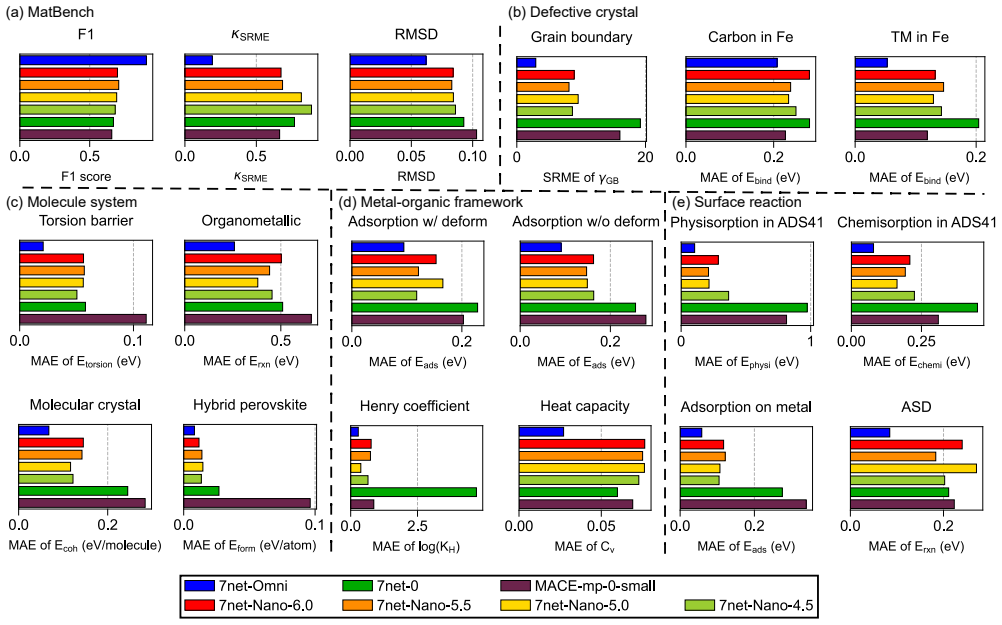
We introduce a lightweight universal machine-learning interatomic potential (uMLIP), SevenNet-Nano, based on the graph neural network architecture SevenNet and enabled by a knowledge-distillation framework. The model inherits the broad generalization capability of a large multi-task foundation model, SevenNet-Omni, trained on diverse materials datasets across chemical, configurational, and computational spaces. By learning chemical representations from high-quality inference data generated by the teacher model within a unified computational framework, SevenNet-Nano achieves high accuracy and strong transferability despite its compact architecture. The model also accurately captures a wide range of interatomic interactions, enabling reliable simulations under both equilibrium and extreme conditions, including plasma etching of SiO$_2$. Comprehensive benchmarks on static and dynamical properties--such as Li-ion diffusion and liquid densities--demonstrate its broad applicability with minimal fine-tuning. Importantly, SevenNet-Nano significantly reduces computational cost, achieving over an order-of-magnitude speedup and enabling large-scale atomistic simulations involving thousands of atoms.
Editorial analysis
A structured set of objections, weighed in public.
Referee Report
Summary. The manuscript introduces SevenNet-Nano, a compact graph neural network-based universal machine-learning interatomic potential obtained via knowledge distillation from the larger SevenNet-Omni teacher model. It claims that training on high-quality inference outputs from the teacher within a unified framework allows the student to inherit broad generalization across chemical, configurational, and computational spaces, achieving high accuracy and transferability with minimal fine-tuning. The work further asserts that the model reliably captures interatomic interactions for both equilibrium (e.g., Li-ion diffusion, liquid densities) and extreme-condition simulations (e.g., plasma etching of SiO2), while delivering over an order-of-magnitude computational speedup to enable large-scale atomistic simulations with thousands of atoms.
Significance. If the central claims hold, the work would deliver a practical, lightweight universal MLIP that preserves much of the teacher's broad applicability while substantially lowering inference cost. This could meaningfully expand the feasible system sizes and timescales for atomistic modeling in materials science. The distillation strategy itself is a clear strength, as it leverages existing high-quality teacher data without requiring new large-scale DFT datasets.
major comments (2)
- [Abstract and Results (extreme-condition benchmarks)] The central claim that SevenNet-Nano inherits reliable performance on extreme-condition dynamics (plasma etching of SiO2, Li-ion diffusion) from teacher inference data alone is load-bearing, yet the provided abstract supplies no numerical error metrics, error bars, or direct student-vs-teacher comparisons in those regimes. Without explicit validation protocols and quantitative fidelity checks against the teacher or experiment in §Results (extreme conditions subsection), the transferability assertion cannot be assessed.
- [Abstract and Results (benchmarks and performance)] The assertion of 'over an order-of-magnitude speedup' and 'comprehensive benchmarks on static and dynamical properties' is presented without baseline comparisons, timing details on equivalent hardware, or tabulated error statistics (e.g., force MAE, energy MAE, diffusion coefficients). This undermines evaluation of the claimed scalability advantage.
minor comments (2)
- [Methods] Notation for the student architecture size (number of parameters, layers, or message-passing steps) should be stated explicitly in the Methods section for reproducibility.
- [Abstract and Results] The phrase 'minimal fine-tuning' is used without quantifying the amount of additional data or epochs required; a short table or sentence clarifying this would improve clarity.
Simulated Author's Rebuttal
We thank the referee for the constructive and detailed feedback on our manuscript. The comments have helped us identify areas where the presentation of quantitative results and benchmarks can be strengthened. We address each major comment point-by-point below and will revise the manuscript accordingly to improve clarity and accessibility of the key claims.
read point-by-point responses
-
Referee: [Abstract and Results (extreme-condition benchmarks)] The central claim that SevenNet-Nano inherits reliable performance on extreme-condition dynamics (plasma etching of SiO2, Li-ion diffusion) from teacher inference data alone is load-bearing, yet the provided abstract supplies no numerical error metrics, error bars, or direct student-vs-teacher comparisons in those regimes. Without explicit validation protocols and quantitative fidelity checks against the teacher or experiment in §Results (extreme conditions subsection), the transferability assertion cannot be assessed.
Authors: We agree that explicit quantitative metrics and direct comparisons are necessary to substantiate the transferability claims for extreme conditions. The full manuscript's Results section (and associated figures/tables) does contain student-vs-teacher comparisons for dynamical properties including Li-ion diffusion coefficients and SiO2 plasma etching outcomes, along with fidelity to experimental references where available. However, we acknowledge that these are not summarized in the abstract and that the extreme-conditions subsection would benefit from more explicit protocols and error bars. In the revised manuscript we will (i) incorporate representative numerical error metrics and student-teacher comparisons into the abstract and (ii) expand the extreme-conditions subsection to include tabulated validation protocols, error bars, and direct fidelity checks. These revisions will be made. revision: yes
-
Referee: [Abstract and Results (benchmarks and performance)] The assertion of 'over an order-of-magnitude speedup' and 'comprehensive benchmarks on static and dynamical properties' is presented without baseline comparisons, timing details on equivalent hardware, or tabulated error statistics (e.g., force MAE, energy MAE, diffusion coefficients). This undermines evaluation of the claimed scalability advantage.
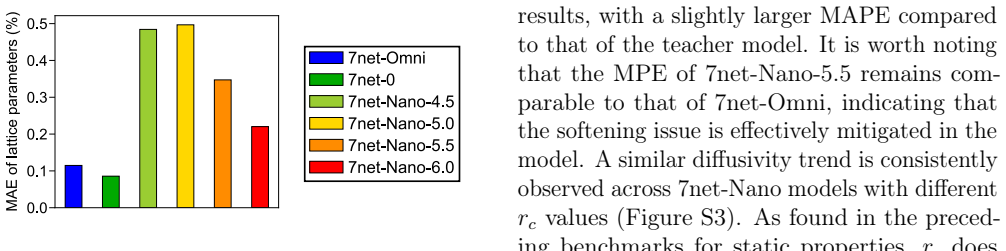
Authors: We thank the referee for this observation. The manuscript reports comprehensive benchmarks on both static (energies, forces, lattice parameters) and dynamical (diffusion coefficients, liquid densities) properties, with the >10x speedup quantified via inference timings; however, we agree that a consolidated table with baseline comparisons and hardware-specific timing details would improve evaluability. In the revised version we will add a summary table in the main text (or a new subsection) that tabulates force/energy MAEs for SevenNet-Nano versus the teacher model and other relevant baselines, together with explicit wall-clock timings on equivalent hardware for systems of varying size. This will directly support the scalability claims. revision: yes
Circularity Check
No significant circularity in derivation chain
full rationale
The paper's central procedure is standard knowledge distillation: the student SevenNet-Nano is trained on inference outputs generated by the external teacher SevenNet-Omni. Performance claims are supported by separate static and dynamical benchmarks (Li-ion diffusion, liquid densities, plasma etching simulations) rather than by re-deriving the training targets. No equation or claim reduces by construction to a fitted parameter or self-referential definition; the transferability argument rests on empirical validation outside the distillation step itself. Self-citations to prior SevenNet work are present but not load-bearing for the reported speedup or accuracy figures.
Axiom & Free-Parameter Ledger
free parameters (1)
- Neural network weights of SevenNet-Nano
axioms (1)
- domain assumption The teacher model SevenNet-Omni produces high-quality inference data that faithfully represent interatomic interactions across diverse materials and conditions
Lean theorems connected to this paper
-
IndisputableMonolith/Foundation/RealityFromDistinction.leanreality_from_one_distinction unclear?
unclearRelation between the paper passage and the cited Recognition theorem.
The model inherits the broad generalization capability of a large multi-task foundation model, SevenNet-Omni, trained on diverse materials datasets across chemical, configurational, and computational spaces.
What do these tags mean?
- matches
- The paper's claim is directly supported by a theorem in the formal canon.
- supports
- The theorem supports part of the paper's argument, but the paper may add assumptions or extra steps.
- extends
- The paper goes beyond the formal theorem; the theorem is a base layer rather than the whole result.
- uses
- The paper appears to rely on the theorem as machinery.
- contradicts
- The paper's claim conflicts with a theorem or certificate in the canon.
- unclear
- Pith found a possible connection, but the passage is too broad, indirect, or ambiguous to say the theorem truly supports the claim.
Reference graph
Works this paper leans on
-
[1]
arXiv preprint arXiv:2504.06231 , year=
(1) Behler, J. Perspective: Machine learning potentials for atomistic simulations.The Journal of Chemical Physics2016,145. (2) Deringer, V. L.; Caro, M. A.; Csányi, G. Machine learning interatomic potentials as emerging tools for materials science. Advanced Materials2019,31, 1902765. (3) Behler, J.; Parrinello, M. Generalized neural-network representation...
-
[2]
(12) Yang, H. et al. MatterSim: A Deep Learning Atomistic Model Across Ele- ments, Temperatures and Pressures. 2024; https://arxiv.org/abs/2405.04967. (13) Batatia, I.; Lin, C.; Hart, J.; Kasoar, E.; Elena, A. M.; Norwood, S. W.; Wolf, T.; Csányi, G. Cross Learning between Elec- tronic Structure Theories for Unifying Molecular, Surface, and Inorganic Crys...
-
[3]
arXiv preprint arXiv:2501.09009 , year=
(19) Kong, L.; Shim, J.; Hu, G.; Fung, V. Scal- able foundation interatomic potentials via message-passing pruning and graph par- titioning. 2026; https://doi.org/10.1 038/s41524-026-02001-4. (20) Taniguchi, T. Knowledge distillation of neural network potential for molecular crystals.Faraday Discussions2025,256, 139–155. (21) Jung, G. S. Atomic Energy Acc...
-
[4]
Decoupled Weight Decay Regularization
(27) Loshchilov, I.; Hutter, F. Decoupled Weight Decay Regularization. 2019;ht tps://arxiv.org/abs/1711.05101. (28) Deng, B.; Zhong, P.; Jun, K.; Riebesell, J.; Han, K.; Bartel, C. J.; Ceder, G. CHGNet as a pretrained universal neural network potential for charge-informed atomistic modelling.Nature Machine Intelligence 2023,5, 1031–1041. (29) Kingsbury, R...
work page internal anchor Pith review Pith/arXiv arXiv 2019
-
[5]
Open catalyst 2020 (OC20) dataset and community challenges.Acs Catalysis2021,11, 6059–6072
(38) Chanussot, L.; Das, A.; Goyal, S.; Lavril, T.; Shuaibi, M.; Riviere, M.; Tran, K.; Heras-Domingo, J.; Ho, C.; Hu, W.; et al. Open catalyst 2020 (OC20) dataset and community challenges.Acs Catalysis2021,11, 6059–6072. (39) Tran, R.; Lan, J.; Shuaibi, M.; Wood, B. M.; Goyal, S.; Das, A.; Heras- Domingo, J.; Kolluru, A.; Rizvi, A.; Shoghi, N.; et al. Th...
2020
-
[6]
L.; Woolf, L
(56) Hurle, R. L.; Woolf, L. A. Self-diffusion in liquid acetonitrile under pressure.Journal of the Chemical Society, Faraday Transac- tions 1: Physical Chemistry in Condensed Phases1982,78, 2233–2238. (57) Šimurka, L.; Čtvrtlík, R.; Tomaštík, J.; Bektaş, G.; Svoboda, J.; Bange, K. Me- chanical and optical properties of SiO2 thin films deposited on glass....
2021
-
[7]
P.; Richards, W
(66) Ong, S. P.; Richards, W. D.; Jain, A.; Hautier, G.; Kocher, M.; Cholia, S.; Gunter, D.; Chevrier, V. L.; Pers- son, K. A.; Ceder, G. Python Materials Genomics (pymatgen): A robust, open- source python library for materials anal- ysis.Computational Materials Science 2013,68, 314–319. (67) Batatia, I.; Benner, P.; Chiang, Y.; Elena, A. M.; Kovács, D. P...
2013
-
[8]
(83) Moosavi, S. M.; Novotny, B. Á.; On- gari, D.; Moubarak, E.; Asgari, M.; Ka- dioglu, Ö.; Charalambous, C.; Ortega- Guerrero, A.; Farmahini, A. H.; Sark- isov, L.; et al. A data-science approach to predict the heat capacity of nanoporous materials.Nature Materials2022,21, 1419–1425. (84) Sriram, A.; Brabson, L. M.; Yu, X.; Choi, S.; Abdelmaqsoud, K.; M...
-
[9]
(96) Deng, B.; Choi, Y.; Zhong, P.; Riebe- sell, J.; Anand, S.; Li, Z.; Jun, K.; Pers- son,K.A.; Ceder,G.Systematicsoftening in universal machine learning interatomic potentials.npj Computational Materials 2025,11,
2025
-
[10]
N.; Dreßler, C
(97) Hänseroth, J.; Flötotto, A.; Qais- rani, M. N.; Dreßler, C. Fine-Tuning Uni- fies Foundational Machine-Learned Inter- atomic Potential Architectures at ab ini- tio Accuracy.The Journal of Physical Chemistry Letters2026,17, 3152–3162. (98) Kaur, H.; Della Pia, F.; Batatia, I.; Advin- cula, X. R.; Shi, B. X.; Lan, J.; Csányi, G.; Michaelides, A.; Kapil...
1911
-
[11]
L.; Joseph, E
(110) Lin, K.-Y.; Li, C.; Engelmann, S.; Bruce, R. L.; Joseph, E. A.; Metzler, D.; Oehrlein, G. S. Achieving ultrahigh etch- ing selectivity of SiO2 over Si3N4 and Si in atomic layer etching by exploiting chemistry of complex hydrofluorocarbon precursors.Journal of Vacuum Science & Technology A2018,36. (111) Lee, S.; Oh, J.; Lee, K.; Sohn, H. Ultra- high ...
1960
-
[12]
(115) Shibano, T.; Fujiwara, N.; Hirayama, M.; Nagata, H.; Demizu, K
ion with energies from 250 to 2000 eV.Journal of Vacuum Sci- ence & Technology A: Vacuum, Surfaces, and Films2004,22, 1166–1168. (115) Shibano, T.; Fujiwara, N.; Hirayama, M.; Nagata, H.; Demizu, K. Etching yields of SiO2 by low energy CF+ x and F+ ions. Applied Physics Letters1993,63, 2336–
2000
-
[13]
Accelerate drug and material discovery with new math library NVIDIA cuEquivariance
(117) Geiger, M.; Kucukbenli, E.; Zandstein, B.; Tretina, K. Accelerate drug and material discovery with new math library NVIDIA cuEquivariance. 2024; https://develo per.nvidia.com/blog/accelerate-d rug-and-material-discovery-with-n ew-math-library-nvidia-cuequivar iance/. 26
2024
discussion (0)
Sign in with ORCID, Apple, or X to comment. Anyone can read and Pith papers without signing in.