Recognition: unknown
Heavy-quark transport across the QCD crossover driven by a lattice-constrained in-medium potential
Pith reviewed 2026-05-10 16:41 UTC · model grok-4.3
The pith
Lattice-constrained potential yields heavy-quark diffusion coefficient of 2π T D_s ≈ 0.5-1.7 across QCD crossover
A machine-rendered reading of the paper's core claim, the machinery that carries it, and where it could break.
Core claim
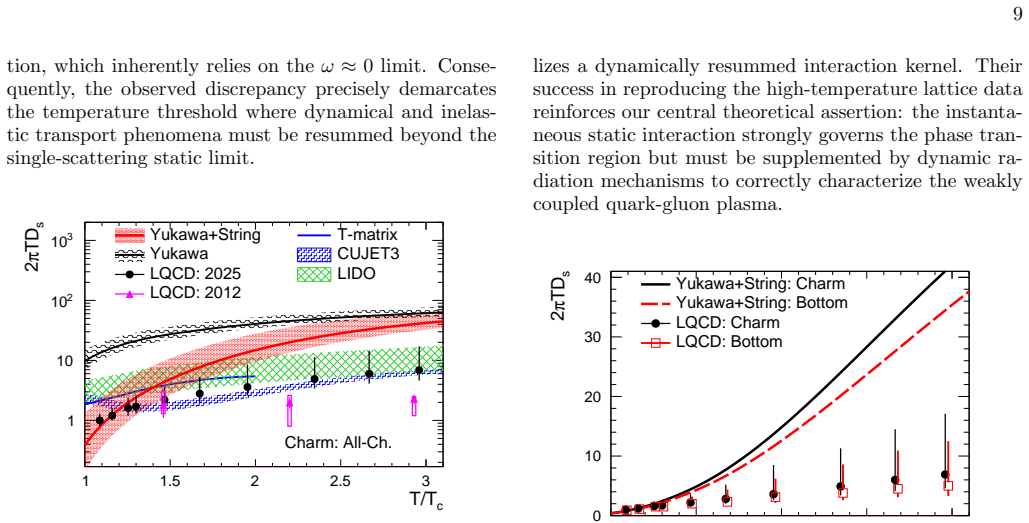
By employing an in-medium effective potential that incorporates both short-range Yukawa screening and long-range string tension, both fitted to lattice QCD data, the authors compute the heavy-quark spatial diffusion coefficient across the crossover region. Their calculation yields 2π T D_s between 0.5 and 1.7, in agreement with lattice extractions, and demonstrates that the confining term is essential near T_c.
What carries the argument
The lattice-constrained in-medium effective potential, combining Yukawa and confining string contributions, used as the interaction kernel for transport.
If this is right
- The non-perturbative string tension is required to reproduce the strong coupling near T_c.
- The spatial diffusion coefficient remains small throughout the crossover, indicating persistent strong interactions.
- This framework eliminates the need for arbitrary soft-hard separation scales in transport calculations.
- Results offer a dynamical explanation for heavy-quark behavior in hot QCD matter.
Where Pith is reading between the lines
- This method could be extended to calculate other transport coefficients like drag or momentum diffusion for heavy quarks.
- Phenomenological models of heavy-ion collisions might benefit from incorporating this temperature-dependent potential directly.
- Similar lattice-constrained potentials could be tested for light quark or gluon transport properties.
Load-bearing premise
The static in-medium potential extracted from lattice QCD can be directly inserted into the dynamic transport equations without accounting for additional medium effects or scale-dependent adjustments.
What would settle it
A lattice QCD calculation of the heavy-quark spatial diffusion coefficient near the crossover temperature that falls significantly outside the range 0.5 to 1.7 for 2π T D_s would contradict the model's predictions.
Figures


read the original abstract
We present a self-consistent framework for heavy-quark transport in the quark-gluon plasma across the QCD crossover region. By synthesizing perturbative and non-perturbative interactions into a unified interaction kernel, we circumvent the traditional reliance on arbitrary soft-hard momentum separation scales. The interaction is governed by an in-medium effective potential, incorporating short-range Yukawa screening and long-range confining string contributions, both rigorously constrained by the latest lattice QCD data. Our results reveal that the non-perturbative string tension is indispensable for capturing the extreme opacity of the medium near the critical temperature $T_c$. Specifically, our model predicts a spatial diffusion coefficient of $2\pi T D_s \approx 0.5 \sim 1.7$, demonstrating a striking quantitative agreement with the recent lattice QCD extractions. Ultimately, our results provide a robust dynamical interpretation of the strong heavy-quark coupling near the QCD crossover and offer a unified framework for describing heavy-flavor transport in hot and dense QCD matter.
Editorial analysis
A structured set of objections, weighed in public.
Referee Report
Summary. The manuscript presents a self-consistent framework for heavy-quark transport in the QGP across the QCD crossover. It employs an in-medium effective potential with short-range Yukawa screening and long-range confining string tension, both constrained solely by lattice QCD static correlators, to construct a unified interaction kernel without arbitrary soft-hard momentum separation scales. The resulting spatial diffusion coefficient is reported as 2π T D_s ≈ 0.5–1.7, claimed to agree quantitatively with recent lattice extractions, with the non-perturbative string term identified as essential for the medium opacity near T_c.
Significance. If the central mapping from static lattice data to dynamical transport holds, the result would be significant: it supplies a parameter-light, unified description that bridges perturbative and non-perturbative regimes, demonstrates the necessity of the string contribution near the crossover, and furnishes a dynamical interpretation of strong heavy-quark coupling consistent with lattice diffusion coefficients. Such a framework could reduce reliance on ad-hoc scales in heavy-flavor phenomenology.
major comments (1)
- [Interaction kernel and transport equation] The transport calculation inserts the static lattice-constrained potential V(r,T) directly into the interaction kernel of the dynamical transport equation. No auxiliary calculation (finite-velocity Wilson loops, real-time correlators, or velocity-dependent checks) is presented to verify that this quasi-static identification remains accurate for moving heavy quarks near T_c, where the string tension is stated to dominate the opacity. This assumption is load-bearing for the quantitative agreement claim with lattice D_s values.
minor comments (2)
- [Model implementation] Clarify the precise numerical implementation of the string tension term in the transport kernel and its temperature dependence across the crossover; a dedicated equation or table would improve reproducibility.
- [Results] The abstract and results section use the range 0.5 ∼ 1.7; ensure the exact bounds are consistently defined and referenced to specific temperature intervals or parameter choices.
Simulated Author's Rebuttal
We thank the referee for the detailed and constructive report. We address the single major comment below regarding the quasi-static use of the lattice potential.
read point-by-point responses
-
Referee: [Interaction kernel and transport equation] The transport calculation inserts the static lattice-constrained potential V(r,T) directly into the interaction kernel of the dynamical transport equation. No auxiliary calculation (finite-velocity Wilson loops, real-time correlators, or velocity-dependent checks) is presented to verify that this quasi-static identification remains accurate for moving heavy quarks near T_c, where the string tension is stated to dominate the opacity. This assumption is load-bearing for the quantitative agreement claim with lattice D_s values.
Authors: We agree that the framework directly inserts the static lattice-constrained V(r,T) into the interaction kernel without presenting finite-velocity Wilson loops, real-time correlators, or explicit velocity-dependent checks. This quasi-static identification is a standard approximation in heavy-quark transport models, justified by the large heavy-quark mass that keeps velocities non-relativistic and suppresses leading velocity corrections. The potential, including the string term, is Fourier-transformed to obtain the momentum-space kernel for scattering rates in the Born approximation. While no dedicated auxiliary calculations are included, the resulting 2πT Ds values show quantitative agreement with independent lattice extractions, and the necessity of the string contribution is demonstrated by explicit on/off comparisons. We view this as sufficient for the present scope and do not plan changes to the manuscript. revision: no
Circularity Check
No significant circularity: static lattice constraints on potential are independent of computed diffusion coefficient.
full rationale
The derivation constrains an in-medium potential V(r,T) solely from lattice QCD static quark-antiquark correlators (Yukawa screening plus string tension), then inserts this fixed V(r,T) into the interaction kernel of a transport equation to obtain the spatial diffusion coefficient 2π T D_s. The reported range 0.5–1.7 is presented as a prediction and compared to separate lattice extractions of D_s. Because the input lattice data (static correlators) and the target observable (dynamic diffusion) are distinct, and no parameter is adjusted to the D_s data itself, the agreement does not reduce to a tautology or fitted-input prediction. No self-citation chain, uniqueness theorem, or ansatz smuggling is invoked to force the central result. The framework therefore remains self-contained against external benchmarks.
Axiom & Free-Parameter Ledger
free parameters (2)
- Yukawa screening mass
- string tension
axioms (2)
- domain assumption The effective interaction kernel is the sum of perturbative Yukawa and non-perturbative string terms
- ad hoc to paper No arbitrary soft-hard momentum separation is needed in the unified framework
Reference graph
Works this paper leans on
-
[1]
A detailed comparison with the JETSCAPE results reveals crucial dynamic nuances regarding the interac- tion kernel
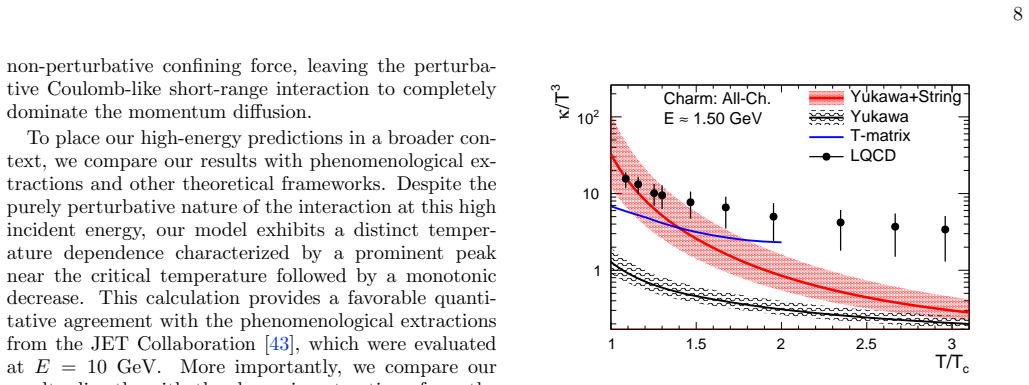
Our static potential model successfully captures the qualita- tive temperature evolution exhibited by the JETSCAPE results. A detailed comparison with the JETSCAPE results reveals crucial dynamic nuances regarding the interac- tion kernel. In the immediate vicinity ofT c, our model yields a slightly larger ˆq/T3 value than JETSCAPE. This enhancement sugge...
2025
- [2]
-
[3]
L. Apolin´ ario, Y.-J. Lee, and M. Winn, Prog. Part. Nucl. Phys.127, 103990 (2022), arXiv:2203.16352 [hep-ph]
- [4]
- [5]
-
[6]
S. Cao and X.-N. Wang, Rept. Prog. Phys.84, 024301 (2021), arXiv:2002.04028 [hep-ph]
-
[7]
Prino and R
F. Prino and R. Rapp, J. Phys. G43, 093002 (2016)
2016
- [8]
- [9]
- [10]
- [11]
-
[12]
J. Liao and E. Shuryak, Phys. Rev. C75, 054907 (2007), arXiv:hep-ph/0611131
-
[13]
J. Liao and E. Shuryak, Phys. Rev. Lett.101, 162302 (2008), arXiv:0804.0255 [hep-ph]
-
[14]
J. Liao and E. Shuryak, Phys. Rev. Lett.102, 202302 (2009), arXiv:0810.4116 [nucl-th]
-
[15]
Peshier, B
A. Peshier, B. K¨ ampfer, O. P. Pavlenko, and G. Soff, Phys. Rev. D54, 2399 (1996)
1996
-
[16]
A. Peshier, B. Kampfer, and G. Soff, Phys. Rev. D66, 094003 (2002), arXiv:hep-ph/0206229. 11
-
[17]
S. Plumari, W. M. Alberico, V. Greco, and C. Ratti, Phys. Rev. D84, 094004 (2011), arXiv:1103.5611 [hep- ph]
- [18]
- [19]
-
[20]
Nonperturbative Heavy-Quark Diffusion in the Quark-Gluon Plasma
H. van Hees, M. Mannarelli, V. Greco, and R. Rapp, Phys. Rev. Lett.100, 192301 (2008), arXiv:0709.2884 [hep-ph]
work page Pith review arXiv 2008
- [21]
-
[22]
Eichten, K
E. Eichten, K. Gottfried, T. Kinoshita, K. D. Lane, and T.-M. Yan, Phys. Rev. D17, 3090 (1978), [Erratum: Phys.Rev.D 21, 313 (1980)]
1978
-
[23]
Eichten, K
E. Eichten, K. Gottfried, T. Kinoshita, K. D. Lane, and T.-M. Yan, Phys. Rev. D21, 203 (1980)
1980
-
[24]
A. Rothkopf, Phys. Rept.858, 1 (2020), arXiv:1912.02253 [hep-ph]
-
[25]
V. V. DIXIT, Modern Physics Letters A05, 227 (1990), https://doi.org/10.1142/S0217732390000275
-
[26]
D. Lafferty and A. Rothkopf, Phys. Rev. D101, 056010 (2020), arXiv:1906.00035 [hep-ph]
-
[27]
Y. Burnier, O. Kaczmarek, and A. Rothkopf, Phys. Rev. Lett.114, 082001 (2015), arXiv:1410.2546 [hep-lat]
-
[28]
A. Bazavov, D. Hoying, R. N. Larsen, S. Mukherjee, P. Petreczky, A. Rothkopf, and J. H. Weber (HotQCD), Phys. Rev. D109, 074504 (2024), arXiv:2308.16587 [hep- lat]
-
[29]
Y. Burnier and A. Rothkopf, Phys. Lett. B753, 232 (2016), arXiv:1506.08684 [hep-ph]
-
[30]
K. Kajantie, M. Laine, J. Peisa, A. Rajantie, K. Rum- mukainen, and M. E. Shaposhnikov, Phys. Rev. Lett. 79, 3130 (1997), arXiv:hep-ph/9708207
- [31]
- [32]
-
[33]
The four-loop beta-function in Quantum Chromodynamics
T. van Ritbergen, J. A. M. Vermaseren, and S. A. Larin, Phys. Lett. B400, 379 (1997), arXiv:hep-ph/9701390
work page Pith review arXiv 1997
- [34]
- [35]
-
[36]
K. G. Chetyrkin, B. A. Kniehl, and M. Steinhauser, Nucl. Phys. B510, 61 (1998), arXiv:hep-ph/9708255
work page Pith review arXiv 1998
-
[37]
F. Riek and R. Rapp, Phys. Rev. C82, 035201 (2010), arXiv:1005.0769 [hep-ph]
-
[38]
W.-J. Xing, G.-Y. Qin, and S. Cao, Phys. Lett. B838, 137733 (2023), arXiv:2112.15062 [hep-ph]
-
[39]
N. Brambilla, A. Pineda, J. Soto, and A. Vairo, Nucl. Phys. B566, 275 (2000), arXiv:hep-ph/9907240
-
[40]
Gromes, Z
D. Gromes, Z. Phys. C26, 401 (1984)
1984
-
[41]
Lucha, F
W. Lucha, F. F. Schoberl, and D. Gromes, Phys. Rept. 200, 127 (1991)
1991
-
[42]
H. van Hees and R. Rapp, Phys. Rev. C71, 034907 (2005), arXiv:nucl-th/0412015
-
[43]
G. D. Moore and D. Teaney, Phys. Rev. C71, 064904 (2005), arXiv:hep-ph/0412346
work page Pith review arXiv 2005
-
[44]
K. M. Burkeet al.(JET), Phys. Rev. C90, 014909 (2014), arXiv:1312.5003 [nucl-th]
work page Pith review arXiv 2014
-
[45]
R. Ehlerset al., Phys. Rev. C111, 054913 (2025), arXiv:2408.08247 [hep-ph]
-
[46]
D. Bollweg, J. L. Dasilva Gol´ an, O. Kaczmarek, R. N. Larsen, G. D. Moore, S. Mukherjee, P. Petreczky, H.-T. Shu, S. Stendebach, and J. H. Weber (HotQCD), JHEP 09, 180 (2025), arXiv:2506.11958 [hep-lat]
- [47]
- [48]
- [49]
- [50]
- [51]
- [52]
- [53]
- [54]
- [55]
- [56]
- [57]
discussion (0)
Sign in with ORCID, Apple, or X to comment. Anyone can read and Pith papers without signing in.