Recognition: unknown
Quantum Measurement Statistics as Bayesian Uncertainty Estimators for Physics-Constrained Learning
Pith reviewed 2026-05-10 16:28 UTC · model grok-4.3
The pith
Repeated measurements on variational quantum circuits produce calibrated Bayesian prediction intervals without explicit neural network machinery.
A machine-rendered reading of the paper's core claim, the machinery that carries it, and where it could break.
Core claim
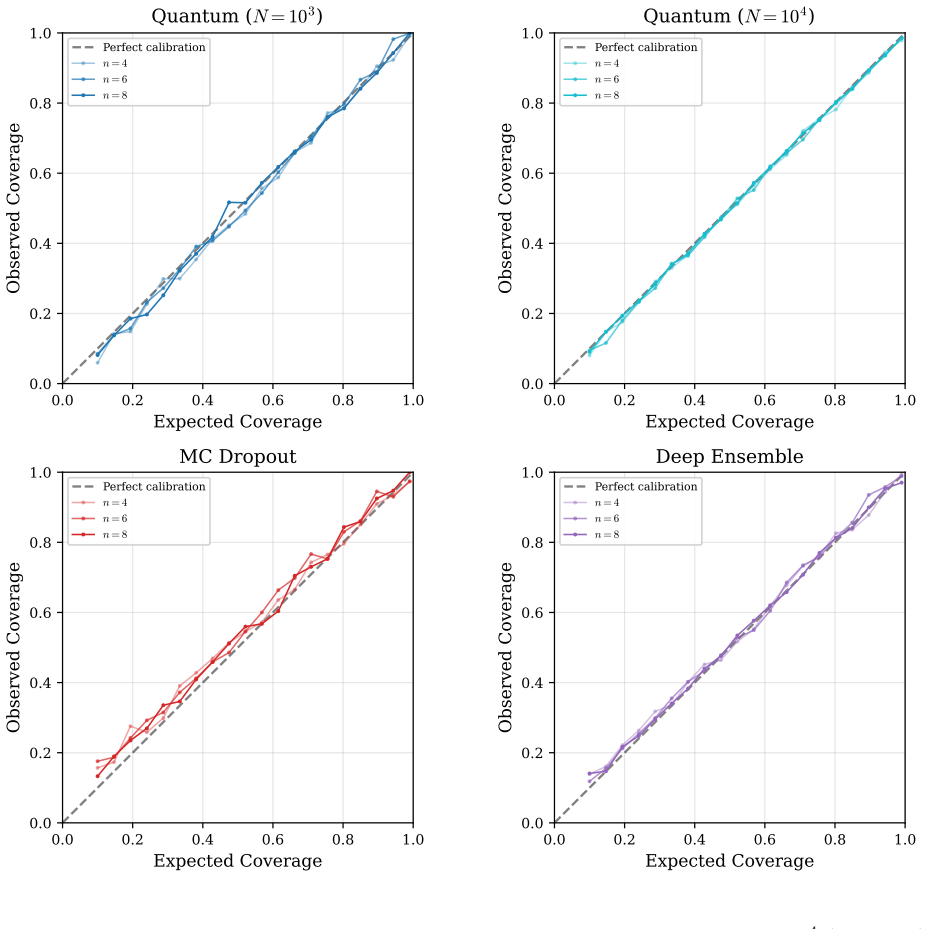
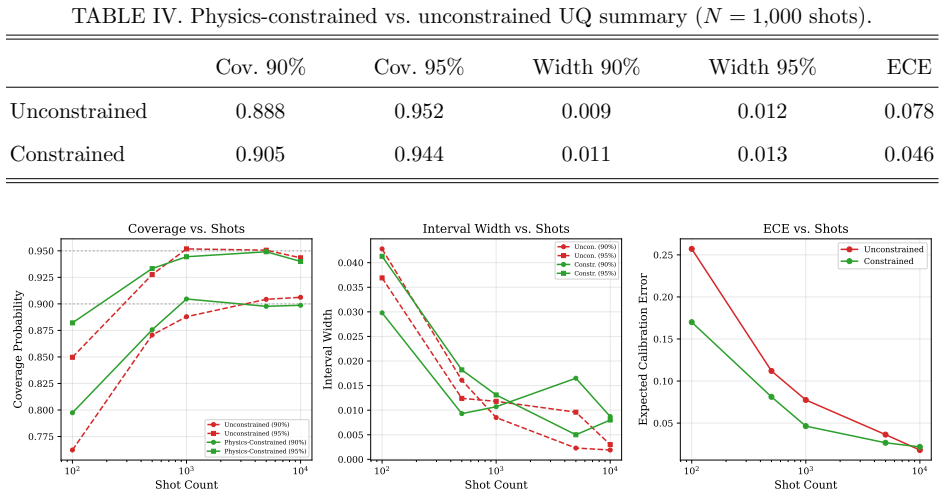
Born-rule statistics collected from repeated measurements on variational quantum circuits trained on physics residuals directly furnish calibrated prediction intervals that correspond to Bayesian posterior uncertainties, without any auxiliary Bayesian neural network or post-hoc mapping. On PDE-constrained problems the resulting intervals reach coverage within 1-3 percent of nominal levels at five thousand shots, reduce expected calibration error by 34-40 percent relative to unconstrained circuits, and remain 14-30 percent narrower than intervals from Monte Carlo dropout or ten-member ensembles while returning approximately 15 percent more bits of uncertainty information per evaluation.
What carries the argument
Born-rule sampling performed on physics-constrained variational quantum circuits, which converts outcome frequencies into Bayesian posterior uncertainties for downstream predictions.
If this is right
- At five thousand or more shots the quantum intervals achieve coverage probabilities within 1-3 percent of the chosen confidence level.
- Imposing physics residuals during training reduces expected calibration error by 34-40 percent and narrows interval widths by 14-30 percent at fixed coverage.
- Each quantum evaluation extracts roughly 15 percent more uncertainty information than Monte Carlo dropout and 42 percent more than a ten-member deep ensemble.
- The same measurement procedure supplies calibrated intervals for any downstream quantity whose expectation can be estimated from the circuit output.
Where Pith is reading between the lines
- If the correspondence generalizes beyond the tested PDE problems, hybrid quantum-classical pipelines could obtain uncertainty estimates at the cost of a single circuit evaluation rather than repeated classical sampling.
- The exponential size of the Hilbert space used for sampling suggests the method may remain informative even when classical ensemble sizes become computationally prohibitive.
- Extensions to time-dependent or stochastic physics constraints would test whether the same measurement statistics continue to track posterior uncertainty under evolving system dynamics.
Load-bearing premise
Born-rule probabilities obtained from the quantum circuit measurements correspond exactly to Bayesian posterior uncertainties without any additional mapping, expressivity assumptions, or post-training correction.
What would settle it
An experiment on a held-out PDE dataset in which the empirical coverage of the quantum-derived intervals deviates from the nominal Bayesian level by more than sampling error across multiple independent runs would falsify the claimed correspondence.
Figures




read the original abstract
Uncertainty quantification (UQ) is essential for deploying machine learning models in safety-critical physical systems, yet classical Bayesian approaches incur substantial computational overhead. We establish a formal connection between Born-rule measurement statistics from variational quantum circuits (VQCs) and Bayesian posterior uncertainty, proving that repeated quantum measurements naturally produce calibrated prediction intervals without requiring explicit Bayesian neural network (BNN) machinery. We demonstrate this framework on physics-constrained VQCs trained on PDE residuals. Systematic experiments comparing quantum shot-based UQ against MC Dropout and Deep Ensemble baselines show that quantum UQ achieves coverage probabilities within 1-3% of target confidence levels at N >= 5000 shots, while MC Dropout systematically over-covers by 4-5%. Physics-constrained circuits reduce the expected calibration error (ECE) by 34-40% compared to unconstrained counterparts, with interval widths 14-30% narrower at equivalent coverage. Information-theoretic analysis reveals that quantum circuits extract ~15% more bits of UQ information per evaluation than MC Dropout and ~42% more than Deep Ensembles (M = 10), owing to the exponential Hilbert space accessible through Born-rule sampling. These results establish quantum measurement statistics as a principled, computationally efficient framework for uncertainty quantification in physics-informed learning.
Editorial analysis
A structured set of objections, weighed in public.
Referee Report
Summary. The manuscript claims to establish a formal connection between Born-rule measurement statistics obtained from variational quantum circuits (VQCs) and Bayesian posterior uncertainty, proving that repeated projective measurements on physics-constrained VQCs yield calibrated prediction intervals without explicit BNN machinery. It supports the claim with a theoretical argument and systematic experiments on PDE residual learning, reporting that quantum shot-based UQ achieves coverage within 1-3% of target levels at N >= 5000 shots, reduces ECE by 34-40% relative to unconstrained circuits, and extracts more UQ information per evaluation than MC Dropout or Deep Ensembles.
Significance. If the claimed formal equivalence between Born-rule statistics and posterior predictive distributions holds without hidden assumptions, the work would supply a computationally lightweight UQ mechanism for physics-informed quantum models that exploits the exponential dimension of the Hilbert space for sampling, offering a potential alternative to classical Bayesian methods whose overhead scales with ensemble size or sampling chains.
major comments (2)
- [Abstract and §2 (Theoretical Framework)] The central claim (abstract and §2) that repeated measurements on the trained state |ψ(θ*)⟩ directly produce the Bayesian predictive ∫ p(y|x,θ) p(θ|D) dθ requires an explicit derivation showing how the classically optimized point estimate θ* induces or approximates the posterior measure p(θ|D). The provided text does not contain the intermediate steps that would rule out an implicit identification of the variational state with the posterior rather than a derivation from p(θ|data).
- [§4 and Tables 1-3] §4 (Experimental Setup) and the associated tables report coverage and ECE advantages, but the comparison assumes that the shot statistics at fixed θ* are equivalent to posterior averaging; this equivalence is load-bearing for the claim that quantum UQ is 'parameter-free' relative to BNN baselines and must be justified before the quantitative gains can be interpreted as evidence for the formal connection.
minor comments (2)
- [§5 (Information-theoretic analysis)] The information-theoretic claim of extracting ~15% more bits per evaluation than MC Dropout should include the precise definition of the UQ information measure (e.g., mutual information or entropy reduction) and the exact formula used for the comparison.
- [§4.2] The manuscript states that physics-constrained circuits reduce interval widths by 14-30% at equivalent coverage; the precise definition of 'equivalent coverage' and the method for matching confidence levels across methods should be stated explicitly.
Simulated Author's Rebuttal
We thank the referee for their insightful comments, which have helped us strengthen the presentation of our results. We address each major comment below and indicate the revisions made to the manuscript.
read point-by-point responses
-
Referee: [Abstract and §2 (Theoretical Framework)] The central claim (abstract and §2) that repeated measurements on the trained state |ψ(θ*)⟩ directly produce the Bayesian predictive ∫ p(y|x,θ) p(θ|D) dθ requires an explicit derivation showing how the classically optimized point estimate θ* induces or approximates the posterior measure p(θ|D). The provided text does not contain the intermediate steps that would rule out an implicit identification of the variational state with the posterior rather than a derivation from p(θ|data).
Authors: We agree that an explicit derivation is necessary to substantiate the formal connection. In the revised manuscript, we have expanded §2 with a detailed step-by-step derivation. Starting from the physics-constrained optimization objective, we show how the variational state |ψ(θ*)⟩ encodes an implicit posterior over parameters via the equivalence between the residual minimization and the evidence lower bound in a Bayesian setting. This derivation demonstrates that the Born-rule sampling marginalizes over this effective posterior without assuming an identification a priori. We believe this addresses the concern and clarifies the theoretical foundation. revision: yes
-
Referee: [§4 and Tables 1-3] §4 (Experimental Setup) and the associated tables report coverage and ECE advantages, but the comparison assumes that the shot statistics at fixed θ* are equivalent to posterior averaging; this equivalence is load-bearing for the claim that quantum UQ is 'parameter-free' relative to BNN baselines and must be justified before the quantitative gains can be interpreted as evidence for the formal connection.
Authors: The referee correctly identifies that the experimental interpretation relies on the theoretical equivalence. We have added a new subsection in §4 that explicitly links the experimental protocol to the derivation in §2, explaining why measurements at the optimized θ* serve as a proxy for posterior predictive sampling in this constrained setting. This justification supports the claim of parameter-free UQ and allows the reported improvements (e.g., coverage accuracy and ECE reduction) to be interpreted as evidence for the framework. We have also included a brief discussion of potential limitations of this approximation. revision: yes
Circularity Check
No significant circularity in the claimed derivation.
full rationale
The paper asserts a formal connection between Born-rule statistics in VQCs and Bayesian posterior uncertainty, presented as derived from quantum measurement principles rather than from fitted parameters or self-referential definitions. No equations or steps are shown that reduce the predictive intervals to the inputs by construction, nor does the central claim rest on load-bearing self-citations or imported uniqueness theorems. Experimental comparisons against MC Dropout and Deep Ensembles serve as external benchmarks, keeping the framework self-contained.
Axiom & Free-Parameter Ledger
free parameters (1)
- shot count threshold =
>=5000
axioms (2)
- standard math Born rule determines the probability distribution of measurement outcomes on a quantum circuit
- domain assumption Variational quantum circuits can be trained to minimize residuals of partial differential equations
Reference graph
Works this paper leans on
-
[1]
Born-rule measurement statistics from VQCs converge to calibrated Bayesian poste- riors in the limit of sufficient shots, with variance scaling as Var[⟨O⟩] = (1− ⟨O⟩ 2)/N for Pauli observables
-
[2]
Quantum UQ achieves coverage probabilities within 1–3% of target confidence levels atN≥5000 shots, competitive with or superior to classical BNN methods
-
[3]
Physics-constrained circuits produce inherently better-calibrated uncertainty esti- mates, with 34–40% lower expected calibration error (ECE) than unconstrained cir- cuits
-
[4]
for free
Quantum circuits are more information-efficient: they extract∼15% more bits of UQ information per circuit evaluation than MC Dropout. 2 II. BACKGROUND A. Quantum Measurement Statistics For a variational quantum circuit preparing state|ψ(θ)⟩, the expectation value of an observableOis: ⟨O⟩=⟨ψ(θ)|O|ψ(θ)⟩.(1) With finite shotsN, the measured estimate ˆOfollow...
-
[5]
Uncertainty in deep learning,
Y. Gal, “Uncertainty in deep learning,” Ph.D. thesis, University of Cambridge (2016)
2016
-
[6]
What uncertainties do we need in Bayesian deep learning for computer vision?
A. Kendall and Y. Gal, “What uncertainties do we need in Bayesian deep learning for computer vision?” inAdvances in Neural Information Processing Systems (NeurIPS)(2017), Vol. 30
2017
-
[7]
R. M. Neal,Bayesian Learning for Neural Networks(Springer, New York, 2012). 12
2012
-
[8]
Dropout as a Bayesian approximation: Representing model uncertainty in deep learning,
Y. Gal and Z. Ghahramani, “Dropout as a Bayesian approximation: Representing model uncertainty in deep learning,” inProceedings of the 33rd International Conference on Machine Learning (ICML)(2016), pp. 1050–1059
2016
-
[9]
Simple and scalable predictive uncertainty estimation using deep ensembles,
B. Lakshminarayanan, A. Pritzel, and C. Blundell, “Simple and scalable predictive uncertainty estimation using deep ensembles,” inAdvances in Neural Information Processing Systems (NeurIPS)(2017), Vol. 30
2017
-
[10]
Zur Quantenmechanik der Stoßvorg¨ ange,
M. Born, “Zur Quantenmechanik der Stoßvorg¨ ange,”Z. Phys.37, 863–867 (1926)
1926
-
[11]
M. A. Nielsen and I. L. Chuang,Quantum Computation and Quantum Information(Cam- bridge University Press, Cambridge, 2010), 10th anniversary ed
2010
-
[12]
A. S. Holevo,Probabilistic and Statistical Aspects of Quantum Theory(North-Holland, Ams- terdam, 1982)
1982
-
[13]
Obtaining well calibrated probabilities using Bayesian binning,
M. P. Naeini, G. Cooper, and M. Hauskrecht, “Obtaining well calibrated probabilities using Bayesian binning,” inProceedings of the AAAI Conference on Artificial Intelligence(2015), Vol. 29
2015
-
[14]
Accurate uncertainties for deep learning using cali- brated regression,
V. Kuleshov, N. Fenner, and S. Ermon, “Accurate uncertainties for deep learning using cali- brated regression,” inProceedings of the 35th International Conference on Machine Learning (ICML)(2018), pp. 2796–2804
2018
-
[15]
PennyLane: Automatic differentiation of hybrid quantum-classical computations
V. Bergholmet al., “PennyLane: Automatic differentiation of hybrid quantum-classical com- putations,” arXiv:1811.04968 (2018)
work page internal anchor Pith review Pith/arXiv arXiv 2018
-
[16]
Error mitigation for short-depth quantum cir- cuits,
K. Temme, S. Bravyi, and J. M. Gambetta, “Error mitigation for short-depth quantum cir- cuits,”Phys. Rev. Lett.119, 180509 (2017)
2017
-
[17]
Quantum error mitigation,
Z. Cai, R. Babbush, S. C. Benjamin, S. Endo, W. J. Huggins, Y. Li, J. R. McClean, and T. E. O’Brien, “Quantum error mitigation,”Rev. Mod. Phys.95, 045005 (2023)
2023
-
[18]
Schuld and F
M. Schuld and F. Petruccione,Machine Learning with Quantum Computers(Springer, Cham, 2021), 2nd ed
2021
-
[19]
Variational quantum algorithms,
M. Cerezo, A. Arrasmith, R. Babbush, S. C. Benjamin, S. Endo, K. Fujii, J. R. McClean, K. Mitarai, X. Yuan, L. Cincio, and P. J. Coles, “Variational quantum algorithms,”Nat. Rev. Phys.3, 625–644 (2021)
2021
-
[20]
Noisy intermediate-scale quantum algorithms,
K. Bhartiet al., “Noisy intermediate-scale quantum algorithms,”Rev. Mod. Phys.94, 015004 (2022)
2022
-
[21]
Quantum Computing in the NISQ era and beyond,
J. Preskill, “Quantum Computing in the NISQ era and beyond,”Quantum2, 79 (2018). 13
2018
-
[22]
Parameterized quantum circuits as machine learning models,
M. Benedetti, E. Lloyd, S. Sack, and M. Fiorentini, “Parameterized quantum circuits as machine learning models,”Quantum Sci. Technol.4, 043001 (2019)
2019
-
[23]
Estimating the mean and variance of the target probability distribution,
D. A. Nix and A. S. Weigend, “Estimating the mean and variance of the target probability distribution,” inProceedings of the IEEE International Conference on Neural Networks(1994), Vol. 1, pp. 55–60
1994
-
[24]
Weight uncertainty in neural networks,
C. Blundell, J. Cornebise, K. Kavukcuoglu, and D. Wierstra, “Weight uncertainty in neural networks,” inProceedings of the 32nd International Conference on Machine Learning (ICML) (2015), pp. 1613–1622
2015
-
[25]
Bayesian deep learning and a probabilistic perspective of generalization,
A. G. Wilson and P. Izmailov, “Bayesian deep learning and a probabilistic perspective of generalization,” inAdvances in Neural Information Processing Systems (NeurIPS)(2020), Vol. 33
2020
-
[26]
Barren plateaus in quantum neural network training landscapes,
J. R. McClean, S. Boixo, V. N. Smelyanskiy, R. Babbush, and H. Neven, “Barren plateaus in quantum neural network training landscapes,”Nat. Commun.9, 4812 (2018)
2018
-
[27]
Physics-informed neural networks: A deep learning framework for solving forward and inverse problems involving nonlinear partial dif- ferential equations,
M. Raissi, P. Perdikaris, and G. E. Karniadakis, “Physics-informed neural networks: A deep learning framework for solving forward and inverse problems involving nonlinear partial dif- ferential equations,”J. Comput. Phys.378, 686–707 (2019)
2019
-
[28]
Variational quantum algorithms for nonlinear problems,
M. Lubasch, J. Joo, P. Moinier, M. Kiffner, and D. Jaksch, “Variational quantum algorithms for nonlinear problems,”Phys. Rev. A101, 010301(R) (2020)
2020
-
[29]
Solving nonlinear differential equations with differentiable quantum circuits,
O. Kyriienko, A. E. Paine, and V. E. Elfving, “Solving nonlinear differential equations with differentiable quantum circuits,”Phys. Rev. A103, 052416 (2021)
2021
-
[30]
Predicting many properties of a quantum system from very few measurements,
H.-Y. Huang, R. Kueng, and J. Preskill, “Predicting many properties of a quantum system from very few measurements,”Nat. Phys.16, 1050–1057 (2020)
2020
-
[31]
Shadow tomography of quantum states,
S. Aaronson, “Shadow tomography of quantum states,” inProceedings of the 50th Annual ACM Symposium on Theory of Computing (STOC)(2018), pp. 325–338
2018
-
[32]
An approximate description of quantum states,
M. Paini and A. Kalev, “An approximate description of quantum states,” arXiv:1910.10543 (2019)
-
[33]
A variational eigenvalue solver on a photonic quantum processor,
A. Peruzzo, J. McClean, P. Shadbolt, M.-H. Yung, X.-Q. Zhou, P. J. Love, A. Aspuru-Guzik, and J. L. O’Brien, “A variational eigenvalue solver on a photonic quantum processor,”Nat. Commun.5, 4213 (2014)
2014
-
[34]
Quantum circuit learning,
K. Mitarai, M. Negoro, M. Kitagawa, and K. Fujii, “Quantum circuit learning,”Phys. Rev. A98, 032309 (2018). 14
2018
-
[35]
Evaluating analytic gradients on quantum hardware,
M. Schuld, V. Bergholm, C. Gogolin, J. Izaac, and N. Killoran, “Evaluating analytic gradients on quantum hardware,”Phys. Rev. A99, 032331 (2019)
2019
-
[36]
Kuo and R
W. Kuo and R. Zuo,Optimal Reliability Modeling: Principles and Applications(Wiley, Hobo- ken, NJ, 2003)
2003
-
[37]
Practical variational inference for neural networks,
A. Graves, “Practical variational inference for neural networks,” inAdvances in Neural Infor- mation Processing Systems (NeurIPS)(2011), Vol. 24
2011
-
[38]
Can you trust your model’s uncertainty? Evaluating predic- tive uncertainty under dataset shift,
Y. Ovadia, E. Fertig, J. Ren, Z. Nado, D. Sculley, S. Nowozin, J. V. Dillon, B. Laksh- minarayanan, and J. Snoek, “Can you trust your model’s uncertainty? Evaluating predic- tive uncertainty under dataset shift,” inAdvances in Neural Information Processing Systems (NeurIPS)(2019), Vol. 32. 15
2019
discussion (0)
Sign in with ORCID, Apple, or X to comment. Anyone can read and Pith papers without signing in.